
Two different questions wearing one label
Camera vendors and privacy-first vendors agree on one thing publicly: that buyers face a trade-off between accuracy and privacy. It is a comfortable story for both sides, and it rests on a confusion. Counting asks how many people crossed a line and where they went. Identification asks who they were. Identity helps with the second question and contributes almost nothing to the first, because the geometry of a person passing through a doorway is what a counter measures, and geometry is available without appearance.
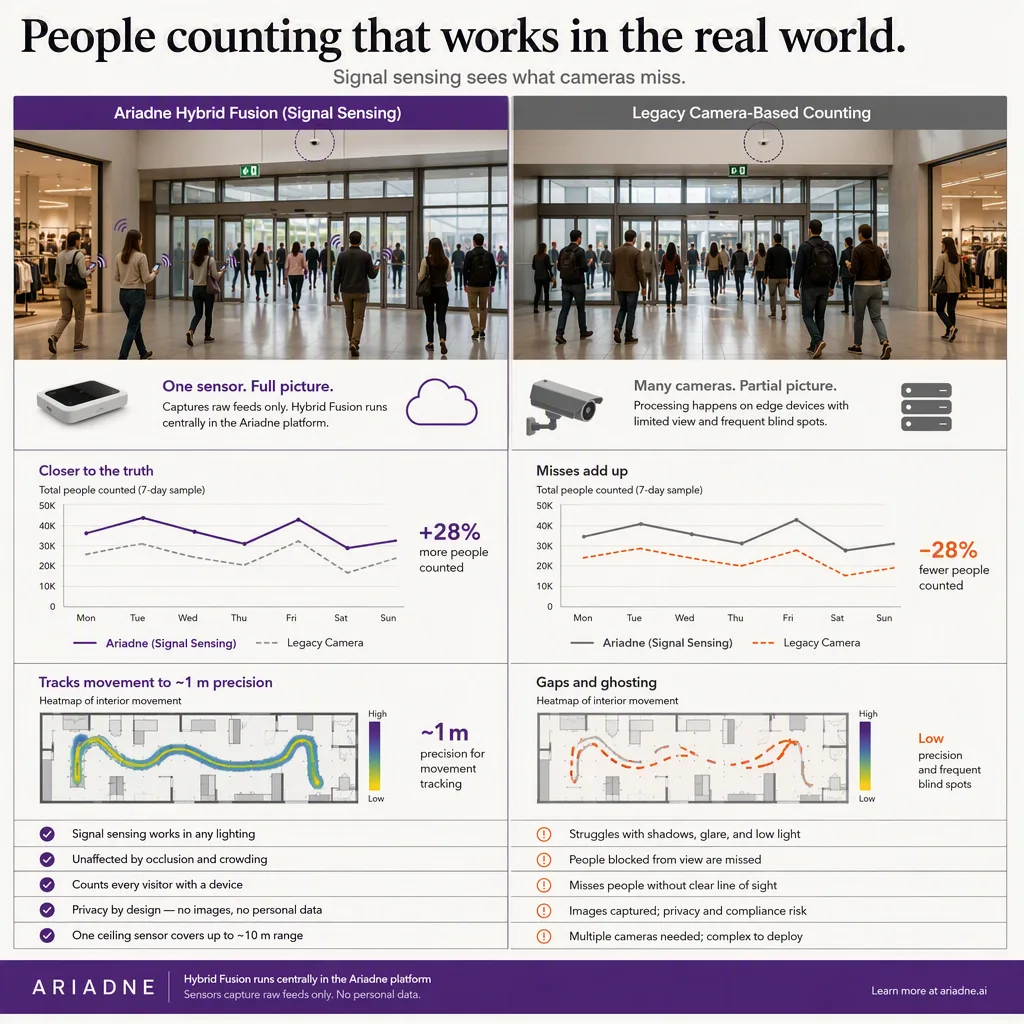
Does privacy-friendly people counting mean lower accuracy?
No, for entrance counting and zone measurement, which is what the overwhelming majority of deployments need. What resolves two people walking abreast into two counts is depth: a three-dimensional silhouette separates where a flat image or a light beam merges. Depth sensing captures that geometry without capturing appearance, so the property that produces accuracy is not the property that creates privacy exposure. Where identity genuinely adds capability is a narrow set of use cases (re-identifying a specific individual across a site, or tying a visit to a known customer record), and those are different products with different legal footprints, not more accurate counters.
What identity actually buys, honestly
Two things, and they are worth naming plainly rather than dismissing. Cross-site re-identification: recognizing that the visitor at store A is the visitor who was at store B, which supports certain marketing measurements. And per-person history: attaching a visit sequence to a known individual, which supports personalization. Both are real capabilities. Neither improves the count at the door, and both import consent, retention, and data-subject-rights obligations that camera-free counting simply does not have. The measurement-versus-surveillance distinction is drawn in full in counting vs surveillance and the biometric line in biometric vs non-biometric counting.
Where the real accuracy variation lives
If not privacy, then what does move accuracy? The answers are unglamorous and well documented: sensor class and whether it resolves depth, mounting height and coverage relative to door width, crowding and group arrivals, occlusion and tailgating, staff movements in the count, lighting for image-based systems, and calibration drift over time. Not one of those is a privacy property. The catalogue is in people counting accuracy factors, with the specifics in occlusion and tailgating, group entry counting, staff exclusion, and calibration. A buyer who fixes those has fixed accuracy; a buyer who adds cameras has added obligations.
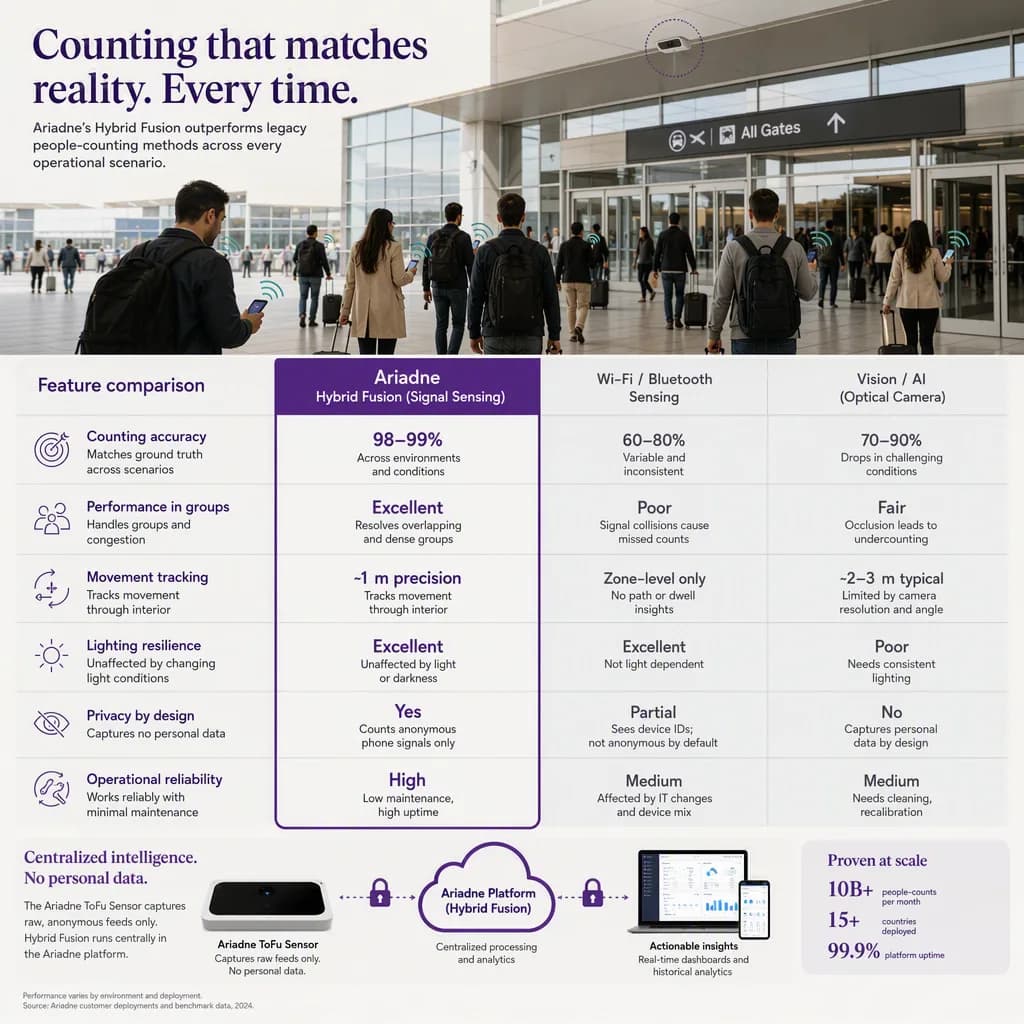
How Ariadne measures, and why it is not a compromise
Ariadne measures this with Hybrid Fusion, its patented camera-free method. Time-of-Flight depth sensing counts every visitor at the entrances, capturing geometry rather than images, while patented phone signal sensing follows movement through the interior, detecting the signals a phone emits even in airplane mode, and tracks that movement to about one-metre precision. The sensor streams both feeds to Ariadne, where Hybrid Fusion combines them into one trajectory per visit and computes counts, dwell, and paths. The streams carry no identifier: no MAC address, no device ID, no biometric data, and no camera is involved. Identifiers are stored only when a visitor explicitly opts in, which keeps the method GDPR-friendly and outside biometric territory.
Two properties of that method matter for this argument. The count at the door comes from depth geometry, which is the physical property that separates individuals, so accuracy does not depend on appearance capture. And the interior journey comes from a second, independent stream, which means the two can cross-validate each other, a structural accuracy advantage rather than a concession; the mechanism is described in sensor fusion for people counting.
The buyer's test for the claim
When a vendor asserts the trade-off, ask one question: which specific accuracy failure does identity capture fix, at a doorway, that depth sensing does not? The honest answers are narrow and rarely relevant to a footfall or occupancy brief. Then settle the accuracy question the only way it can be settled, on your own doors with a documented test: accuracy test methodology, and decide what you actually need first with accuracy requirements by use case.


