
A people counter's accuracy is not a fixed property of the brand. The same sensor can read 99 percent at one door and 88 percent at another, and the difference is rarely the hardware. It is the install and the conditions. These are the eight factors that move the number, sorted into the ones you control at install and the ones that come down to choosing the right sensor.
What affects people counting accuracy?
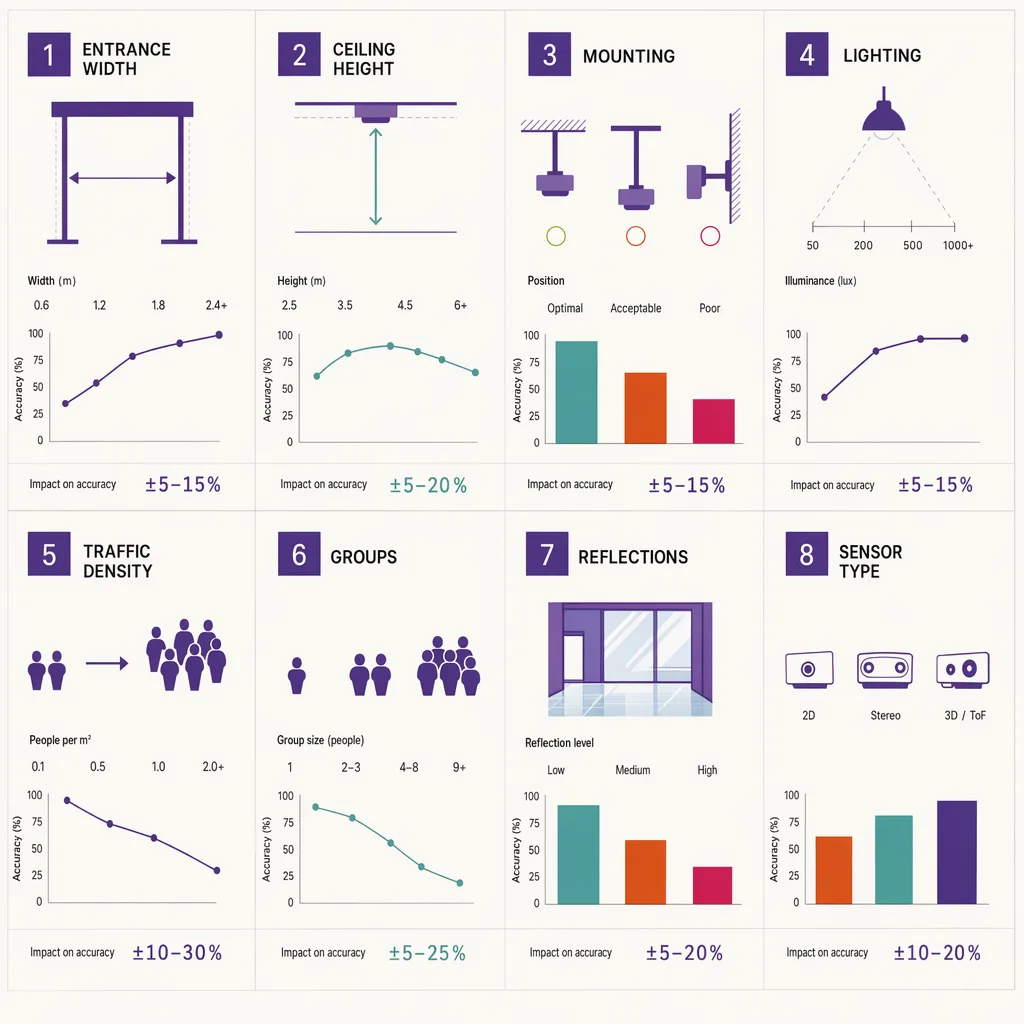
Eight factors move people counter accuracy more than the brand does: entrance width, ceiling height, mounting position, lighting, traffic density, groups, reflective surfaces, and the sensing method itself. The first five are mostly within your control at install. The last three depend on choosing a sensor suited to the site. Getting the install right is usually a bigger accuracy gain than paying more for the sensor.
The eight factors
1. Entrance width
Wide doors let people fan out and pass side by side, which is harder to count than a single-file entrance. Match the sensor's rated coverage to the actual door width, and use multiple units across very wide entrances.
2. Ceiling height
Mounting height sets what the sensor sees and the size of its counting zone. Every sensor has a working range; install outside it and accuracy drops.
3. Mounting position
Directly overhead at the threshold is usually best. Off-angle mounting, or placement where a display or column blocks the view, creates blind spots. See ceiling mount vs door frame placement on placement choices.
4. Lighting
For camera-based counters, inconsistent or low light costs accuracy. Depth methods that provide their own light are far less sensitive, which is a sensor-choice point as much as an install one.
5. Traffic density
Accuracy at light traffic is not accuracy at peak. If your peaks are heavy, test and tune for the peak, not the average.
6. Groups
People arriving together are the top source of undercounting. Whether you can count them apart depends mostly on the sensing method, covered below.
7. Reflective surfaces
Polished floors, glass doors, and mirrors create false motion that inflates counts. Sensor placement and the right method reduce it.
8. Sensing method
The method sets the ceiling. A beam cannot separate a group; a flat camera cannot see in the dark; depth and fusion handle both. No tuning overcomes a limit built into what the sensor captures.
Which factors you control, and which need the right sensor
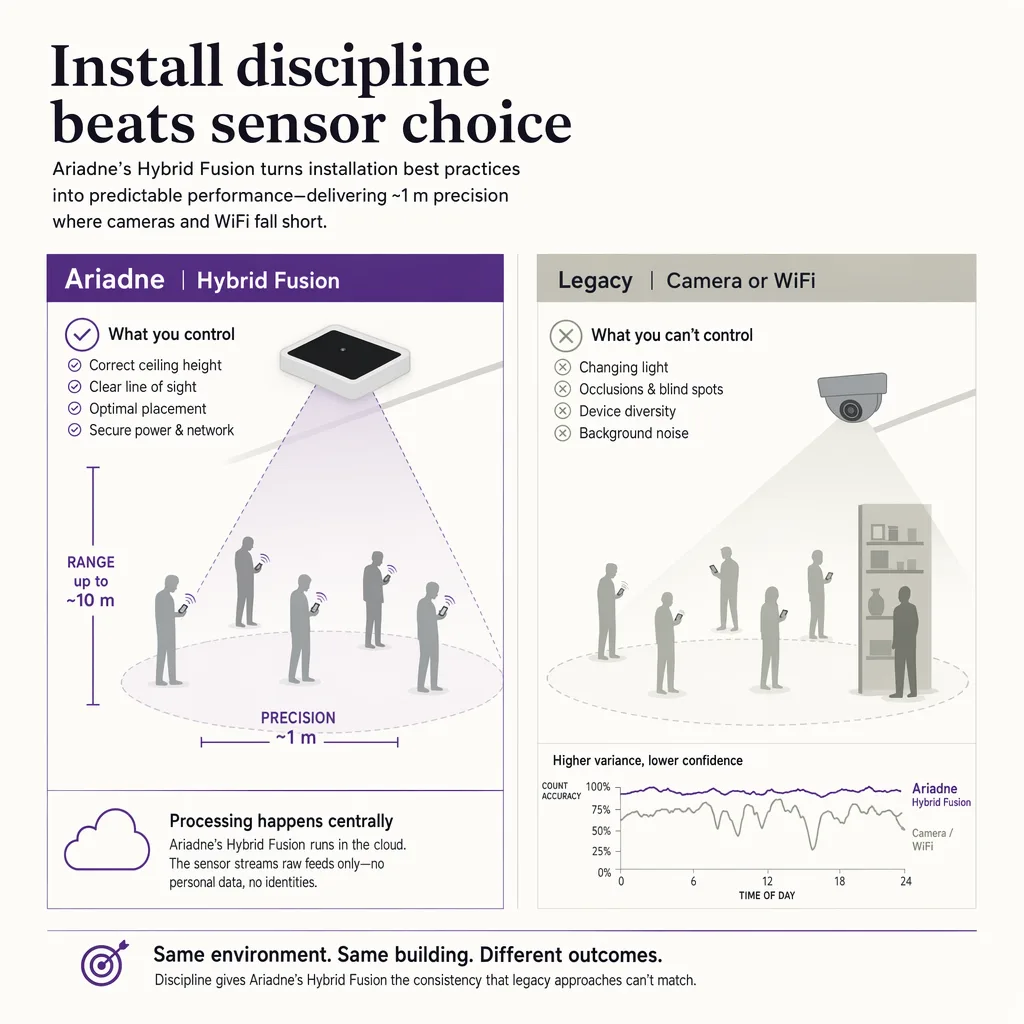
Factors one through five are largely an install discipline: survey the door, mount correctly, account for light and peak traffic. Factors six through eight come down to choosing a method suited to the conditions. A careful install on a well-matched sensor beats an expensive sensor installed badly.
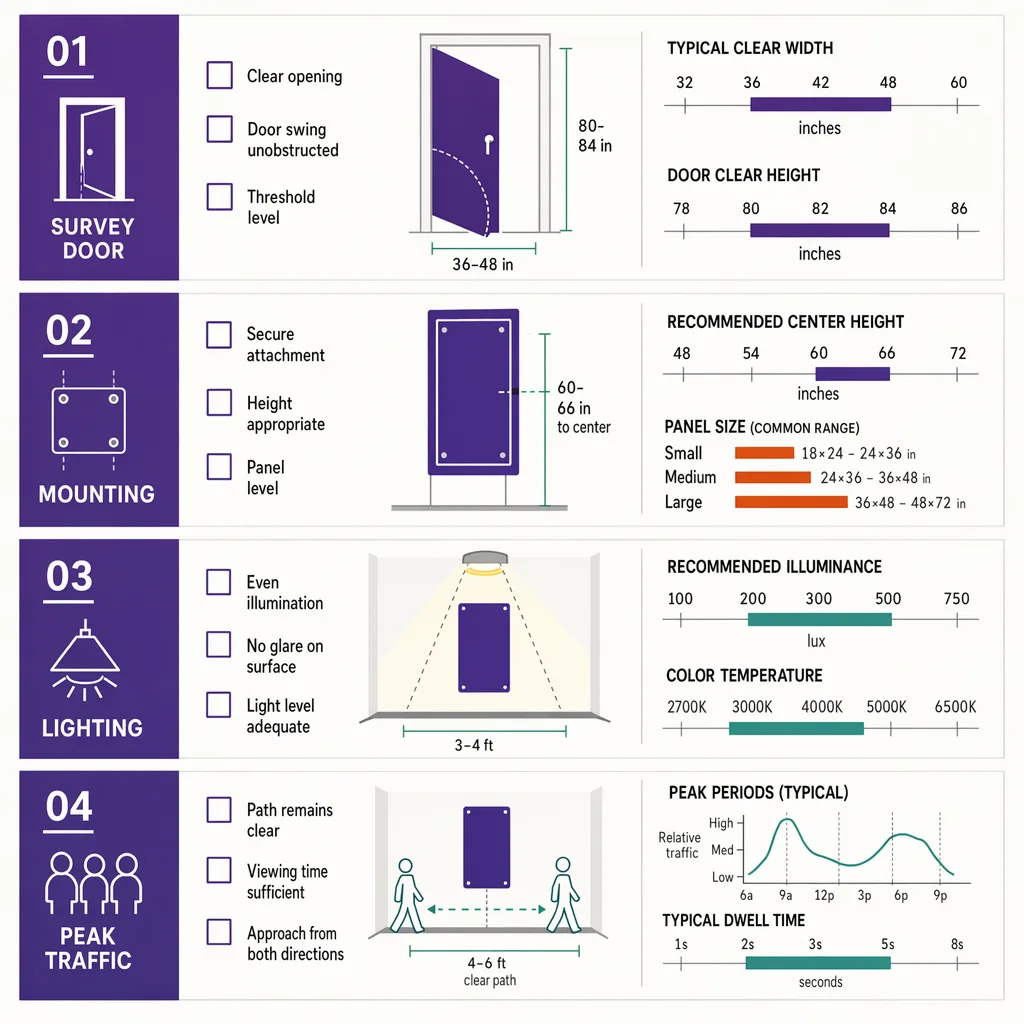
A pre-install checklist
- Measure the door width and ceiling height against the sensor's rated range.
- Confirm an unobstructed overhead sightline at the threshold.
- Note lighting through the full operating day, including after dark.
- Identify reflective surfaces near the door.
- Estimate peak traffic and plan to test at peak.
How Ariadne's fusion reduces several factors at once
Ariadne measures this with Hybrid Fusion, its patented camera-free method. Time-of-Flight depth sensing counts every visitor at the entrances, capturing geometry rather than images, while patented phone signal sensing follows movement through the interior, detecting the signals a phone emits even in airplane mode, and tracks that movement to about one-metre precision. The sensor streams both feeds to Ariadne, where Hybrid Fusion combines them into one trajectory per visit and computes counts, dwell, and paths. The streams carry no identifier: no MAC address, no device ID, no biometric data, and no camera is involved. Identifiers are stored only when a visitor explicitly opts in, which keeps the method GDPR-friendly and outside biometric territory.
Depth handles light and groups, the fusion handles tracking across the interior, which removes several of the eight factors as a single design choice rather than eight separate fixes.
Related reading
- ToF accuracy and range, in practice
- How to spec counting accuracy honestly
- accurate visitor counting, what the claim should mean
- excluding staff from counting data
- how accurate does your counter actually need to be
FAQ
What is the biggest factor in people counter accuracy?
For most sites, separating groups, which depends on the sensing method, and getting the install right at the door.
Does mounting height affect people counter accuracy?
Yes. Every sensor has a working range; mounting outside it reduces accuracy.
Can I improve my people counter's accuracy without replacing it?
Often, yes. Correct mounting, an unobstructed sightline, and accounting for lighting and peak traffic recover a lot of accuracy.
Does the floor surface affect counting?
Reflective floors and glass can create false motion. Placement and the right sensing method reduce the effect.


