
Why do people counters miscount groups?
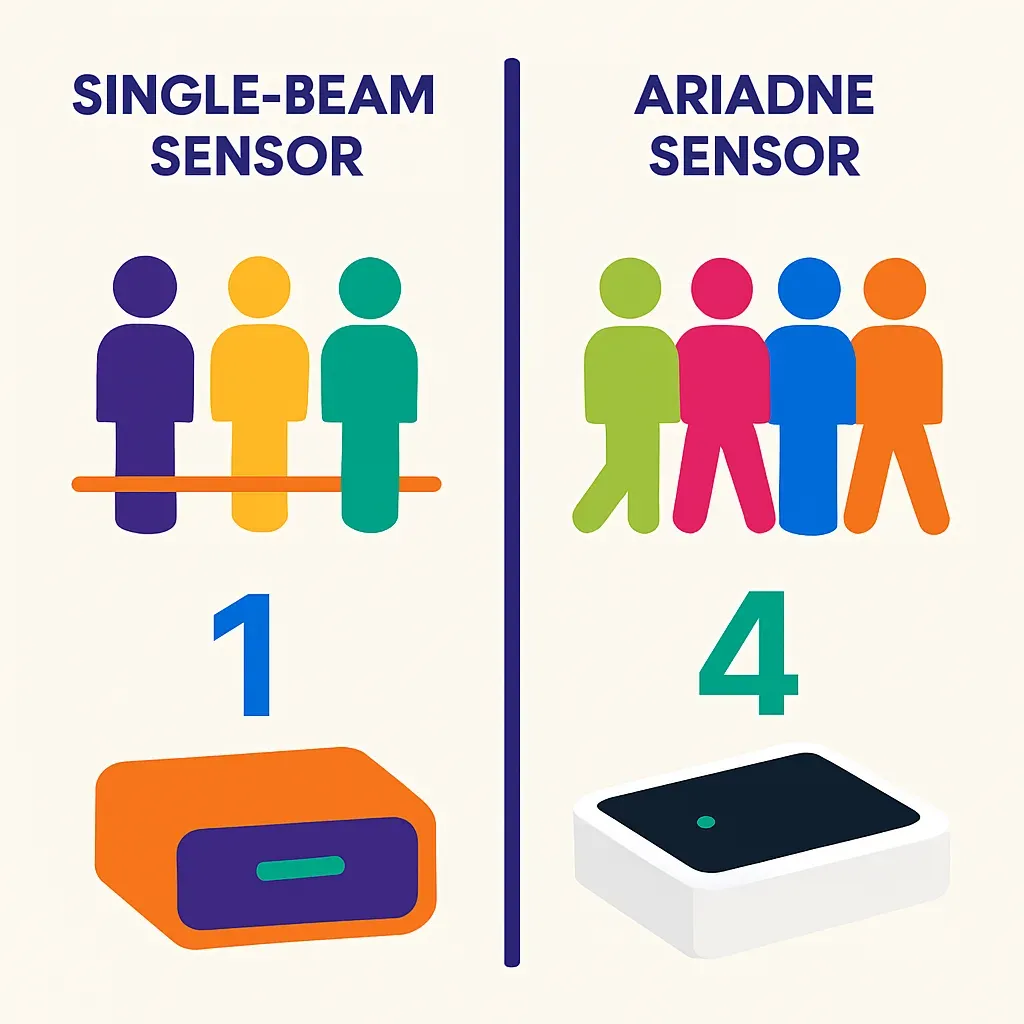
A single-beam door counter triggers once each time the beam is interrupted, so a family of four walking in together collapses into a single count. The fix is to resolve people, not crossings: with hybrid fusion counting, Ariadne's patented signal sensing resolves how many distinct people are present while Time-of-Flight gives a device-independent body count at the entrance, so a family of four registers as four and not one.
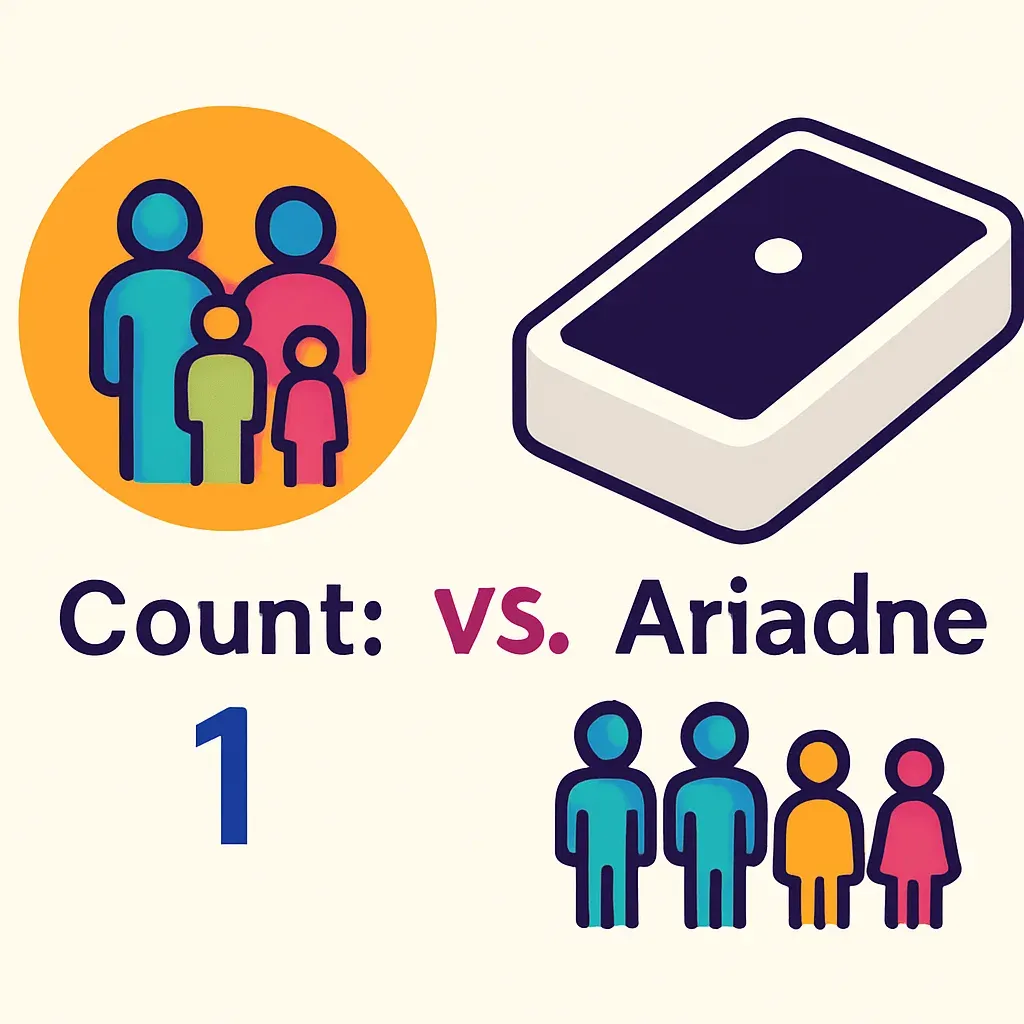
The size of the error depends on how many of your entries arrive as groups. Worked illustration: if a quarter of your entry events are pairs and the rest are solo, a one-count-per-trigger counter records 100 events while 125 people actually walked in, a 20 percent undercount. Family-heavy formats push the gap higher. A miss of that size is enough to flip the sign on a year-over-year conversion comparison, because conversion is sales divided by an undercounted denominator.
How big is the undercount?
The gap scales with your group mix. Three worked illustrations, each assuming a one-count-per-trigger counter that records 100 entry events:
- Mostly solo (10 percent pairs). 90 solo plus 10 pairs is 110 people; counted as 100, a 9 percent undercount.
- Pair-heavy (25 percent pairs). 75 solo plus 25 pairs is 125 people; counted as 100, a 20 percent undercount.
- Family-heavy (20 percent groups averaging 3.5 people). 80 solo plus 20 groups is 150 people; counted as 100, a 33 percent undercount.
The pattern is the problem: the more your visitors arrive together, the larger the miss, and because group mix shifts by day and season the error is not even a stable offset you could correct for. It moves under your feet, which is exactly what a metric is not supposed to do.
The three group patterns that break naive counters
Groups defeat single-trigger counters in three recognisable ways:
- Side-by-side. Two or more people cross the threshold abreast. One beam interruption, one count, several visitors lost.
- Single-file-close. People enter in a tight line with little gap. A counter with a slow reset merges them into one event.
- Child-trailing. A short child or a stroller follows a parent below the sensor's reliable detection height, so it is never counted at all.
How single-beam and pixel-blob counters fail
Two common counter types struggle with all three patterns:
- Single-beam break (one horizontal infrared beam). It only knows the beam was interrupted, not by how many people. Simultaneous or tight entries register as one. The reset window is a trap: speed it up and a single slow shopper double-counts; slow it down and a quick pair merges into one. No setting fixes both, because the beam never knew how many bodies passed in the first place.
- Pixel-blob (2D camera or basic vision). It groups adjacent moving pixels into one 'blob'. When two people overlap from the camera's angle, occlusion fuses them into a single region and the count is one; the closer and more similar they look, the more confidently it reports the wrong number. It also raises the privacy questions that depth and signal sensing avoid entirely.
How Hybrid Fusion resolves groups
Resolving how many distinct people are in a group is the job of Ariadne's patented phone signal sensing. It detects every signal a phone emits, even in airplane mode, and triangulates each to within 30 cm, so several people who arrive together are resolved as separate individuals rather than collapsed into one. Time-of-Flight depth sensing adds a device-independent body count at the entrance, catching anyone without a phone, including a child or a parent with a stroller. Together they see four people where a single-beam or blob counter sees one.
No camera is involved and no images are produced. The streams flow to Ariadne, where Hybrid Fusion combines both into one trajectory per visit; no biometric data or device identifier leaves the sensor, and no MAC address is captured by default.
How to test your counter for group accuracy (a 30-minute on-site protocol)
Any retail ops person can run this without engineering help:
- Pick a busy 30-minute window when group entries are common (after-school, weekend lunch).
- Manually tally every person who enters, counting each member of every group, with a hand clicker or a notes app.
- Read the counter's number for the same window and the same door(s).
- Compute the gap: (manual count minus counter count) divided by manual count. Anything above a few percent on a group-heavy window points to group blindness.
- Repeat on a quiet, mostly-solo window. If the counter is accurate when entries are solo but low when they are grouped, you have confirmed the failure mode, not a calibration drift.
Pair this with a structured counter accuracy verification before you trust any vendor's headline accuracy number, and check the sensor mounting against the Ariadne sensor lineup.
Sector impact: who loses the most to group blindness
The error scales with group-entry mix, which varies by format. Read these as directional, since the exact mix is specific to each store and catchment:
- Fashion and department stores. High pair and family mix, especially at weekends, so group blindness bites hardest here and most distorts conversion.
- Electronics. Frequent couples and parent-child research trips; moderate-to-high exposure.
- Supermarkets. Mixed: solo top-ups plus family shops. Group error concentrates in evenings and weekends.
- Quick-service and convenience. More solo, mission-driven entries, so group error is smaller but not zero at peak social times.
Across formats the pattern holds: the more your visitors arrive together, the more a single-trigger counter understates them, and the more your retail analytics platform needs body-level counting to keep conversion honest.
What to ask a people-counting vendor about group accuracy
Before you trust a counter, put five questions to the vendor. Vague answers are the signal:
- Do you count people or crossings? Ask specifically how a two-abreast, simultaneous entry is counted, not what the brochure accuracy says.
- Show me group accuracy, not overall accuracy. A 98 percent headline can sit on top of a 20 percent miss in group-heavy windows; the average hides it.
- How do you handle a person with no phone, and a person with several devices? You want to hear how a body count and a signal count are reconciled, not a single sensor doing both jobs badly.
- What happens under occlusion? Two people overlapping, a child behind a parent, a stroller, a wheelchair. Ask for the failure behaviour, not just the happy path.
- Will it match my own manual tally? A vendor confident in group accuracy will welcome the 30-minute test above on your busiest door.
Related reading
- excluding staff from counting data
- Entrance counting accuracy: how to choose a visitor counting system
FAQ
How much do naive counters undercount groups?
It depends entirely on your group-entry mix. As a worked illustration, a 25 percent pair mix produces about a 20 percent undercount; family-heavy, weekend-skewed stores see more. The point is that the error is systematic and large enough to distort conversion, not a fixed percentage.
Why does group miscounting matter if footfall is only directional?
Because conversion divides sales by entries. If entries are undercounted by a group-dependent amount that shifts week to week, your conversion rate moves for reasons that have nothing to do with the store, masking real changes.
Do I need cameras to count groups accurately?
No. Ariadne counts with Hybrid Fusion: Time-of-Flight depth sensing plus patented phone signal sensing, never cameras. Time-of-Flight captures geometry rather than images, and signal sensing captures no MAC address by default, so the measurement involves no video, no faces, and no biometric data.
Will a higher mounting position fix group counting?
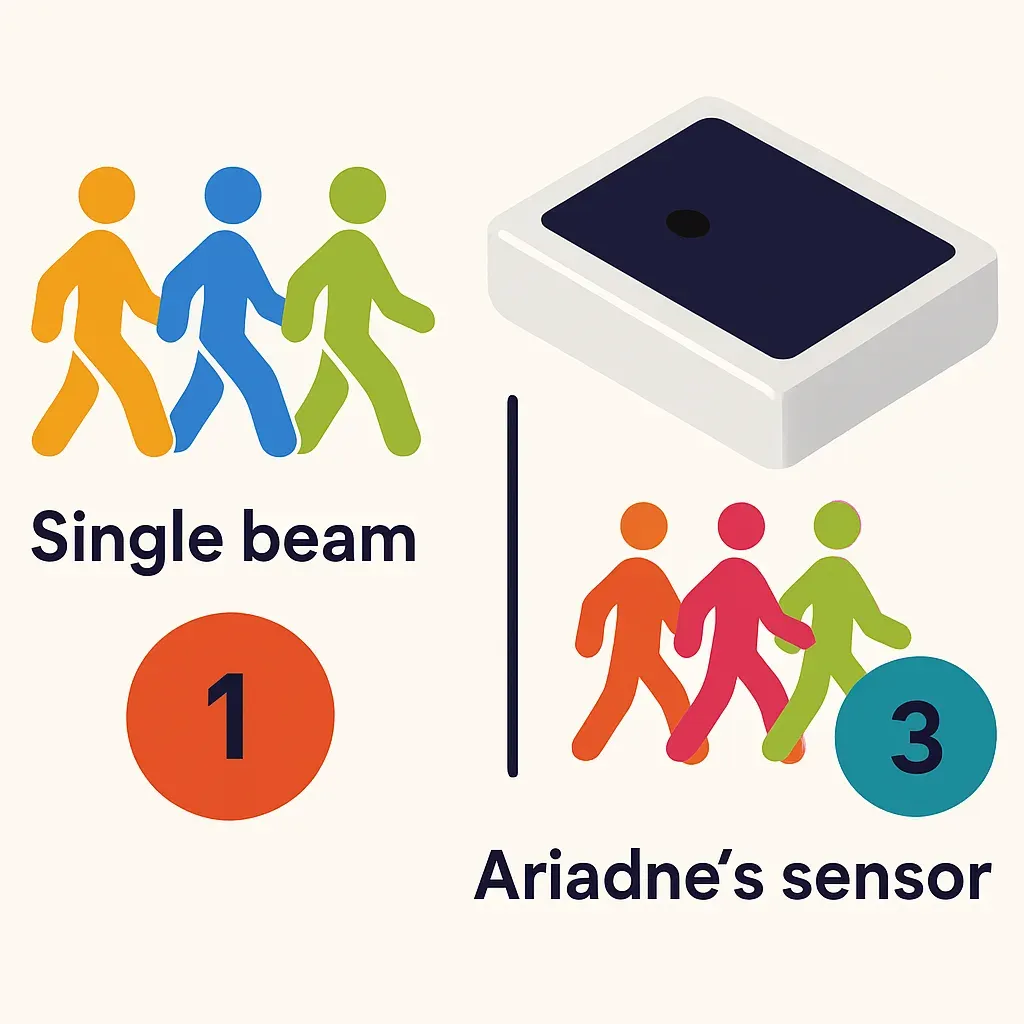
Overhead placement helps Time-of-Flight give a clean device-independent body count, but resolving how many distinct people are in a group is the job of Ariadne's patented signal sensing, which triangulates each phone signal to within 30 cm. A higher-mounted single-beam counter still cannot tell one body from two.


