
Every sensor is partially blind
A door sensor counts entries perfectly and knows nothing about what happens inside. An interior sensing stream reads movement beautifully and cannot swear to an exact door count. A camera sees appearance and inherits every privacy obligation that comes with it. No single sensing modality answers the questions a venue actually asks (how many, where, how long, in what order) on its own. Sensor fusion is the discipline of combining streams so that each covers the others' blind spots.
What is sensor fusion in people counting?
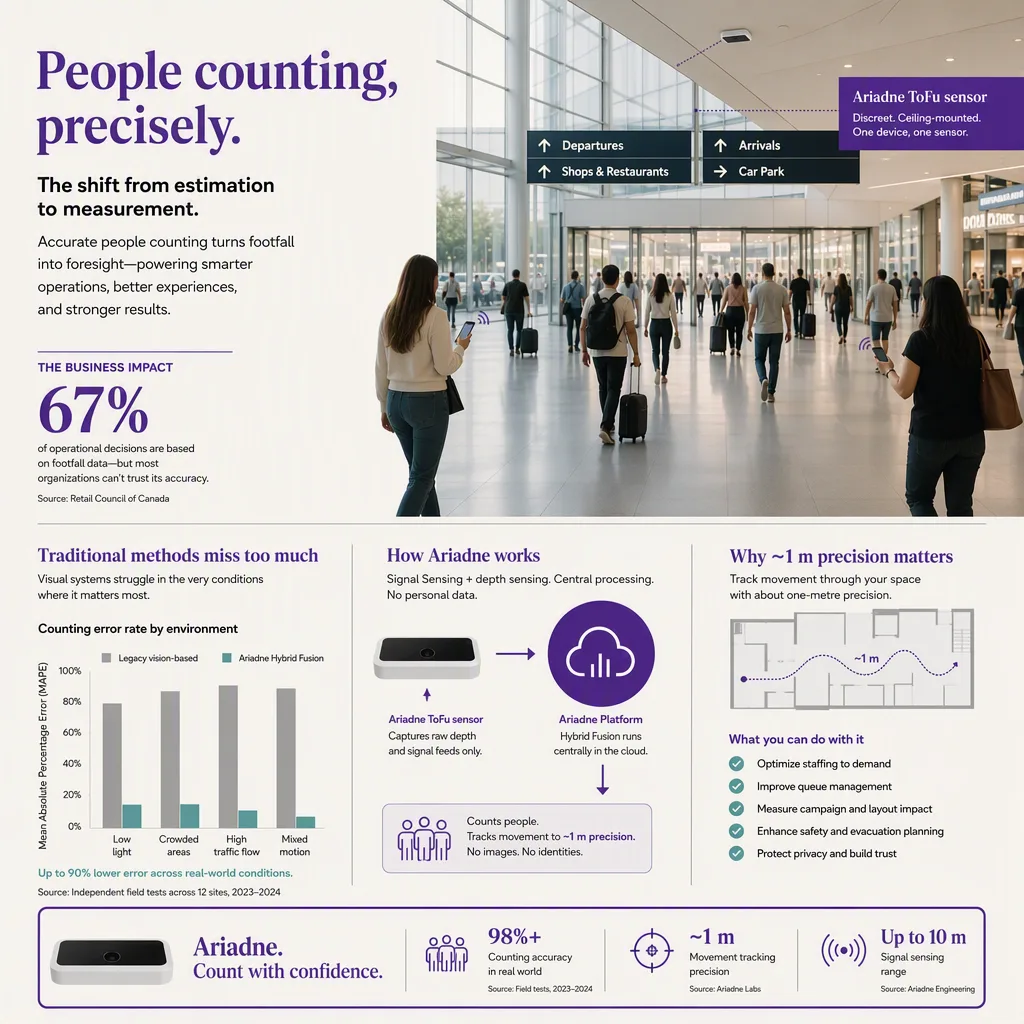
Sensor fusion combines data from two or more sensing modalities into one measurement that is better than either input: typically an exact entrance count from a door sensor fused with interior movement data, producing complete visit journeys. The fusion can run inside each sensor (edge stitching) or centrally in the platform. Done well, it fixes the classic single-sensor failures: double counting across multiple doors, lost continuity between zones, and staff inflating visitor numbers.
What fusion actually fixes
- Multi-door double counting. A visitor who enters door A and exits door B is one visit, not two. Only a fused view that follows the journey knows that.
- Zone continuity. Door counts plus isolated zone sensors give you totals per box. Fusion gives you the path between boxes, which is where layout and merchandising answers live.
- Cross-validation. Two independent streams measuring the same building catch each other's drift. When the door count and the interior stream disagree, the system knows something needs calibration, instead of silently reporting a wrong number.
Edge stitching vs central fusion
Fusing inside each sensor keeps bandwidth low but means each sensor makes final decisions with only its own context: once a track is cut at a zone boundary, no downstream software can reconnect it with certainty. Central fusion streams both raw feeds to the platform, which assembles trajectories with the full building in view. The trade is bandwidth for truth, and for analytics that claim to describe journeys, truth wins. This is the architectural choice behind Ariadne's method:
Ariadne measures this with Hybrid Fusion, its patented camera-free method. Time-of-Flight depth sensing counts every visitor at the entrances, capturing geometry rather than images, while patented phone signal sensing follows movement through the interior, detecting the signals a phone emits even in airplane mode, and tracks that movement to about one-metre precision. The sensor streams both feeds to Ariadne, where Hybrid Fusion combines them into one trajectory per visit and computes counts, dwell, and paths. The streams carry no identifier: no MAC address, no device ID, no biometric data, and no camera is involved. Identifiers are stored only when a visitor explicitly opts in, which keeps the method GDPR-friendly and outside biometric territory.
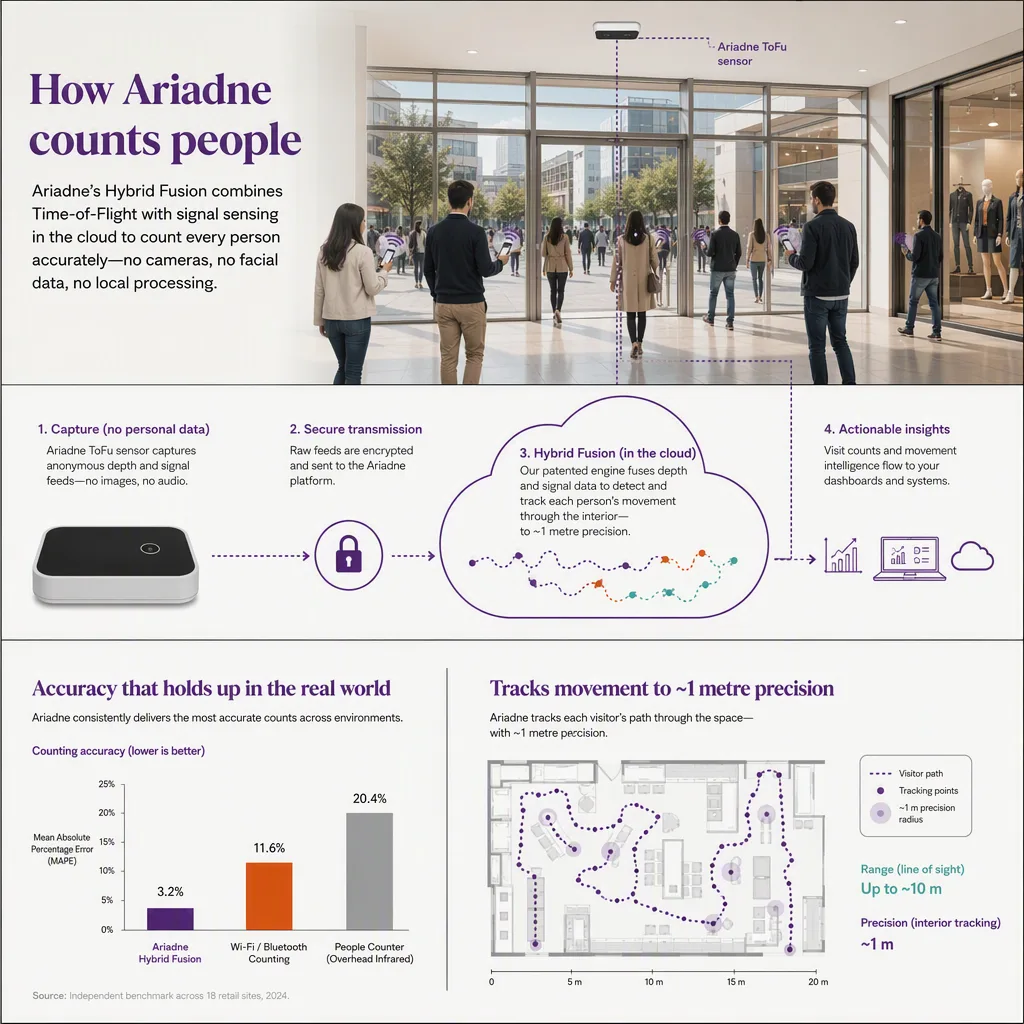
Two properties of that design deserve emphasis. First, the fusion is central: the sensor streams both feeds to the platform, and the trajectory is assembled with full context rather than stitched from edge fragments. Second, the streams carry no identifier to fuse ON: the join is geometric and statistical, not a device ID lookup, which is what keeps the method on the right side of data-protection law by construction rather than by policy. Fusion built on MAC addresses or re-identification solves the continuity problem by creating a bigger one.
Reading a vendor's fusion claim
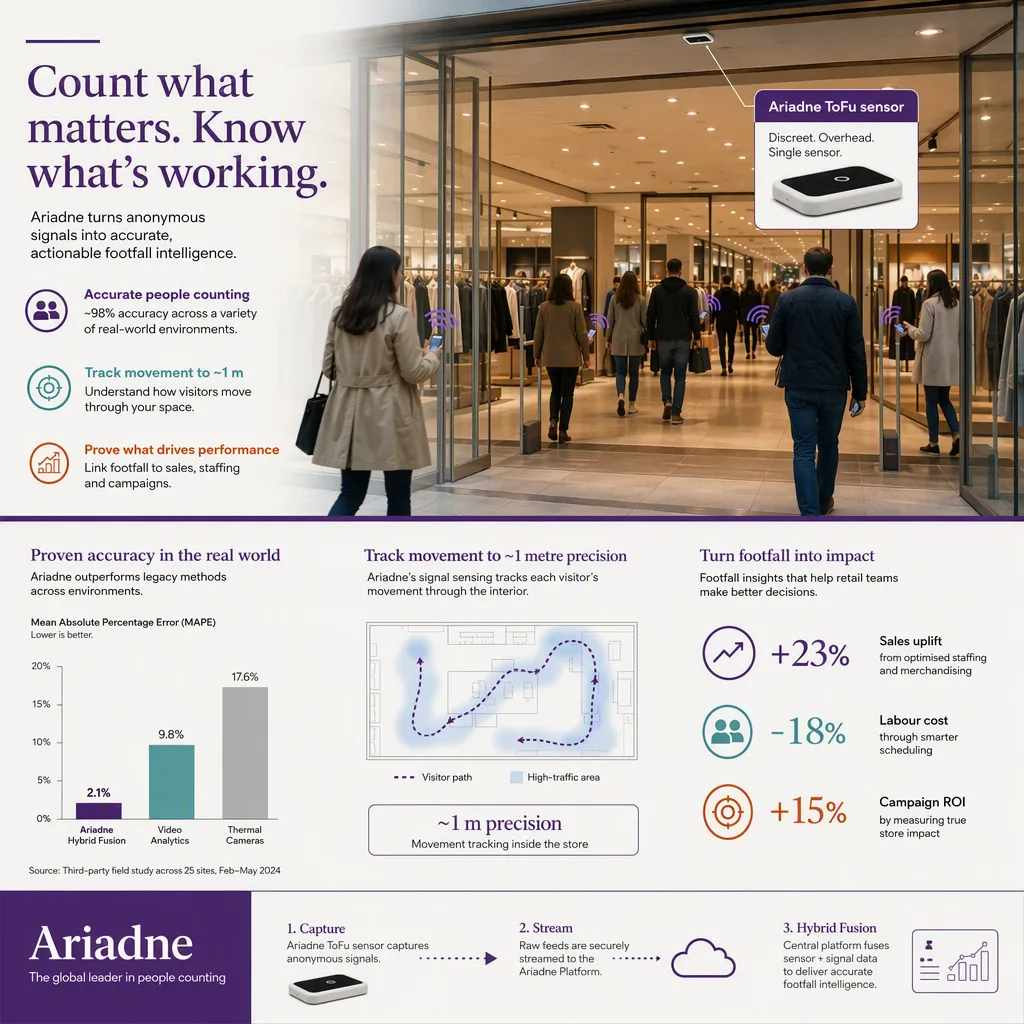
Three questions separate marketing from architecture. Which physical streams exist, and what does each miss alone? Where does the fusion run, edge or central? And what identifier, if any, does the join depend on? The answers tell you whether "fusion" means a real second modality or a dashboard that displays two sensors side by side. For the entrance half of the equation, see the ToF people counter guide and computer vision vs ToF; for how the whole method behaves in a live building, book a demo.


