
If your people counter is wrong, it is almost certainly wrong in the same way: it misses people who arrive together. Occlusion and tailgating are the two failure modes behind most undercounting, and they are the reason a counter that looks accurate in a quiet test falls apart at a busy door. This explains why it happens, what actually fixes it, and how to measure your own miscount rate.
What are occlusion and tailgating in people counting?
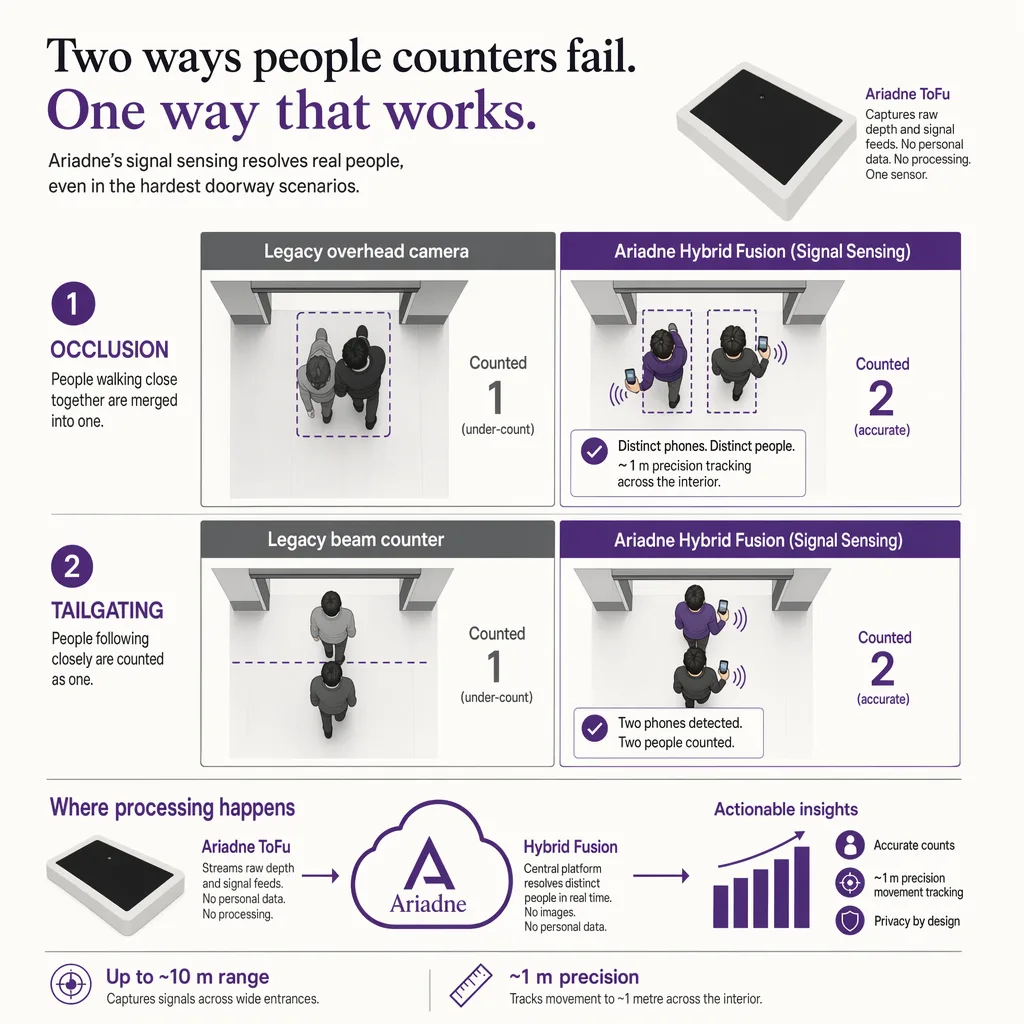
Occlusion is when one person blocks the sensor's view of another, so two or more people register as one. Tailgating is when someone follows closely behind another and the counter treats the pair as a single event. Both produce undercounting, and both get worse as traffic gets busier, which is exactly when accurate counts matter most.
Why a single beam or flat camera miscounts groups
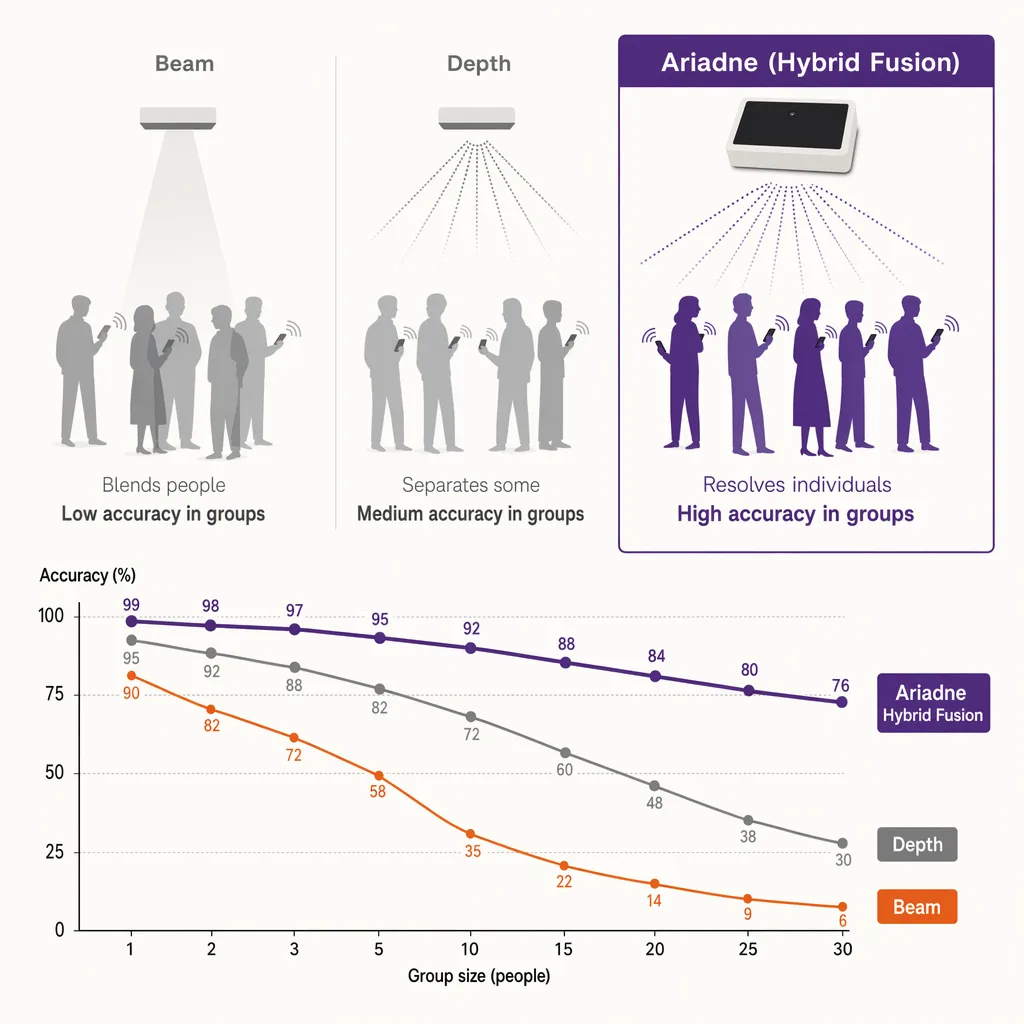
A break-the-beam sensor counts interruptions of a line. Two people abreast break it once. A flat overhead camera sees merged silhouettes when people stand close, and without depth it cannot tell one blob from two. Neither method has the information needed to separate bodies that overlap from the sensor's point of view. You cannot tune your way out of a limitation that is built into what the sensor captures.
How depth and fusion separate people standing close
Depth changes the input. With a depth map, two people produce two distinct volumes even when their outlines merge from above, because each has its own height and shape. Add a second signal that follows movement through the interior, and the system can also resolve cases the door sensor alone would miss.
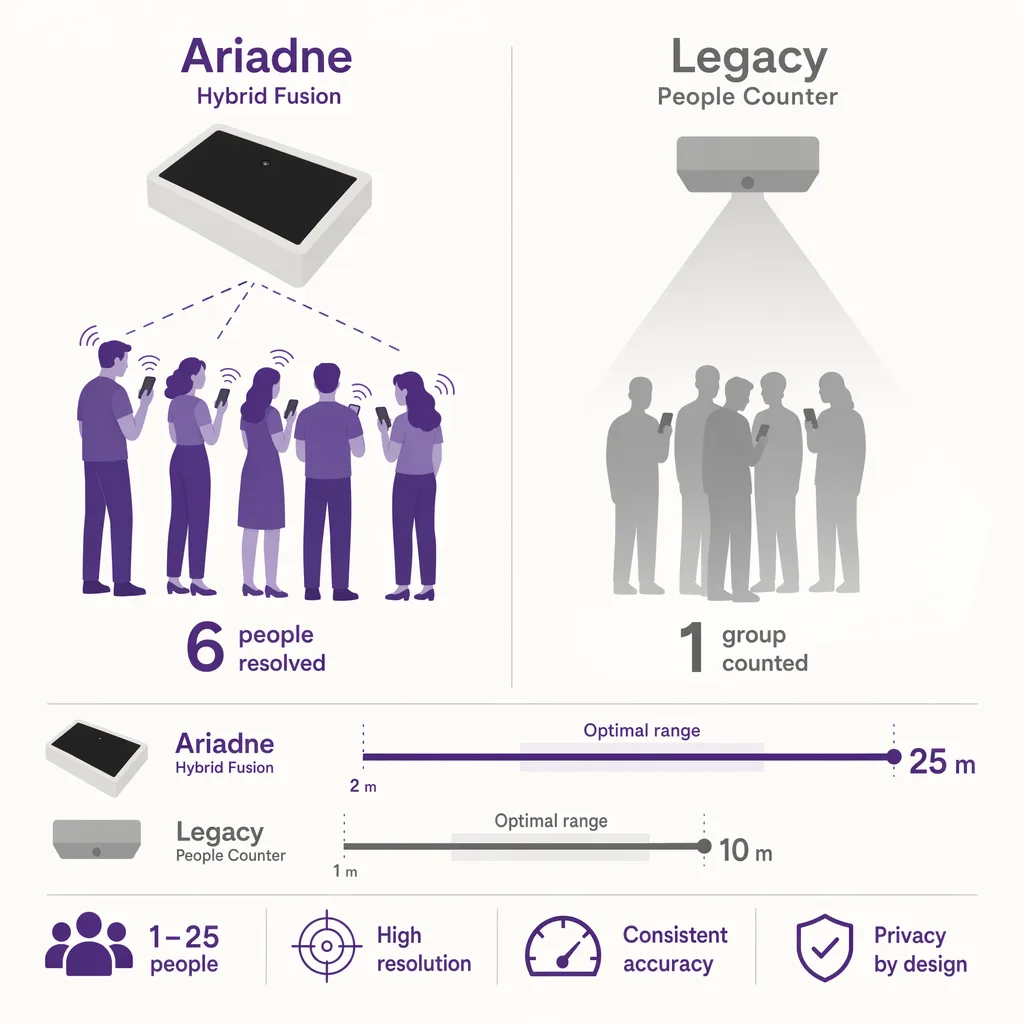
Ariadne measures this with Hybrid Fusion, its patented camera-free method. Time-of-Flight depth sensing counts every visitor at the entrances, capturing geometry rather than images, while patented phone signal sensing follows movement through the interior, detecting the signals a phone emits even in airplane mode, and tracks that movement to about one-metre precision. The sensor streams both feeds to Ariadne, where Hybrid Fusion combines them into one trajectory per visit and computes counts, dwell, and paths. The streams carry no identifier: no MAC address, no device ID, no biometric data, and no camera is involved. Identifiers are stored only when a visitor explicitly opts in, which keeps the method GDPR-friendly and outside biometric territory.
Tailgating at access points vs counting at open doors
Worth separating two things people call "tailgating." At a secured access point, tailgating is a security event: someone slipping through behind an authorised entry. At an open retail or venue door, tailgating is a counting accuracy problem: close-following visitors undercounted. The sensing challenge overlaps, but the goal differs, and a counting system optimised for accurate totals is not the same as an access-control turnstile.
How to measure your miscount rate on groups
Test the failure mode directly:
- At a busy door, manually tally entries for a fixed window, noting how many arrived in groups.
- Pull the counter's number for the same window.
- The gap, concentrated in your group-heavy periods, is your miscount rate.
See the accuracy test methodology for the full protocol.
Related reading
FAQ
Why does my people counter undercount during busy periods?
Groups and tailgating. Simple sensors register close-together people as one, and the effect grows with traffic.
Can a people counter separate people walking together?
Depth-based and fusion systems can, because they measure each person's shape. Beam sensors generally cannot.
Is tailgating a security problem or a counting problem?
Both, depending on context. At a secured door it is a security event; at an open door it is a counting accuracy issue.
---


