
Nobody jumps from rota to forecast
Scheduling advice usually assumes the destination: forecast-led labor allocation, hour by hour, zone by zone. Most retailers are three steps away from that and get told to sprint. A maturity model is more useful than a target, because it names where you actually are, what that stage costs you, and the single next move rather than the ideal end state.
What are the stages of scheduling maturity in retail?
Five. Stage 1, the fixed rota: the same shape every week, changed only for holidays. Stage 2, sales-led: the roster follows last year's POS by day. Stage 3, hourly sales-led: POS by hour rather than by day, which is where most competent retailers sit. Stage 4, demand-led: the roster follows measured visitor traffic, forecast by hour, so it sees demand that never converted. Stage 5, closed-loop: demand-led plus feedback, where allocation accuracy is measured and idle time is actively redeployed.
The five stages, and what each one costs
Stage 1, fixed rota. Cheap to run, expensive to own. Its cost is invisible because there is no counterfactual: peaks are understaffed and troughs overstaffed by the same amount every week, all year. Next step: get an hourly traffic curve for one store, even a single door counter, and compare it with the rota.
Stage 2, sales-led by day. Better, and now the roster inherits POS's blind spot: it plans against people who bought. Days lost to understaffing look like low-demand days. Next step: move to hourly, because daily totals hide the three-hour window where the money is lost.
Stage 3, hourly sales-led. A genuinely competent stage, and the ceiling of what POS can tell you. The residual error is systematic rather than random: every hour where visitors arrived and did not buy is under-weighted forever, which is the self-reinforcing loop described in the software buyer guide. Next step: add measured footfall alongside POS and compare the two forecasts for one month. The gap is usually the business case on its own.
Stage 4, demand-led. The roster plans against measured arrivals, forecast by hour and, in larger formats, by zone, fused with weather and calendar effects. This is the stage where demand-based scheduling becomes real rather than aspirational, and where day-of-week footfall patterns start driving decisions. Next step: close the loop.
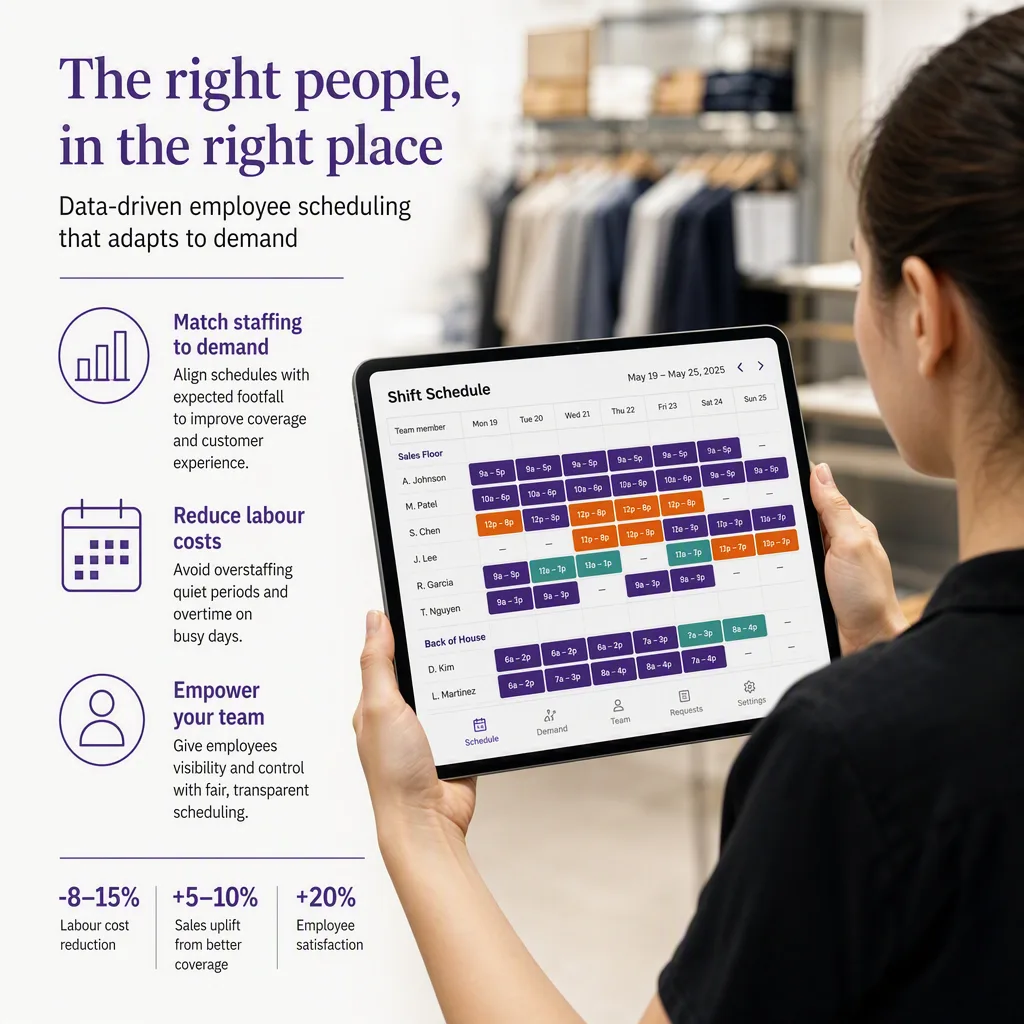
Stage 5, closed-loop. Two additions separate this from stage 4. Allocation feedback: measuring how well scheduled hours actually matched demand, week over week, per labor-to-traffic ratio. And idle redeployment: when the floor is measurably quiet, staff move to restocking, training, or merchandising rather than waiting, which converts an unavoidable cost into output.
How to place yourself honestly
Two questions settle it. What does your roster plan against, and at what granularity? If the answer involves last year's sales by day, you are at stage 2 regardless of how sophisticated the tool is. And can you show, for last week, how your scheduled hours mapped to actual demand by hour? If not, you are below stage 5 whatever the forecast quality, because you have no feedback loop.
Move one stage, not three
The failure pattern in this category is skipping: buying a stage 5 platform while the organization is at stage 2, then reverting to manual overrides within a quarter because managers do not trust an unexplained forecast. Each stage above has exactly one next step, and each is cheap enough to prove in one store. The measurement to support any of them starts with a trustworthy hourly count, which is the subject of accuracy requirements by use case: scheduling sits in the tier that needs per-interval reliability rather than a good daily total. The payback maths for the move is in scheduling ROI from footfall.
Where Ariadne fits
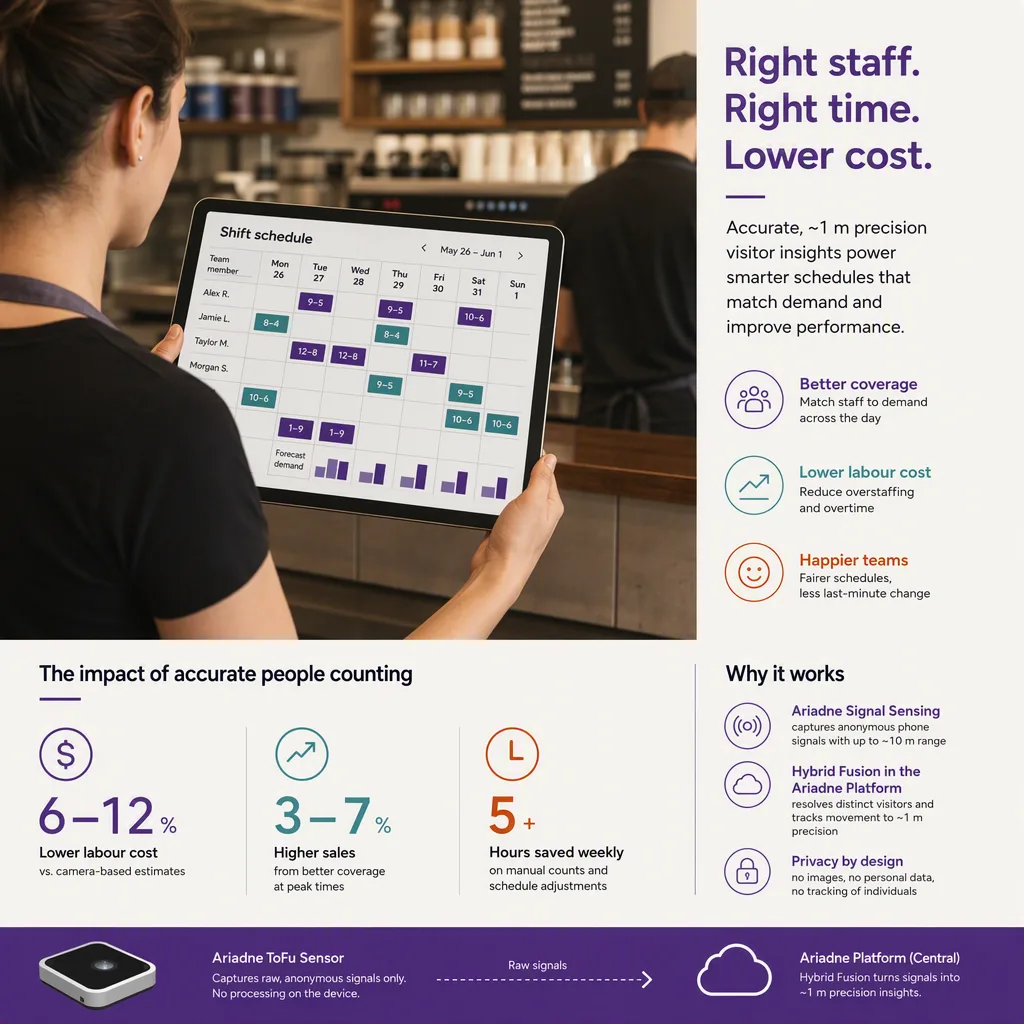
Ariadne is the demand signal for stages 4 and 5, and optionally the scheduler too: Employees Planner builds the roster against forecast footfall by hour and zone, or the same signal exports into the WFM you already run, with allocation reporting for the closed loop. Which of those two routes fits is a stage question rather than a product question, which is the point of this model.


