
When a business installs a people counter, the first question staff ask is rarely about accuracy or price. It is a quieter one: is this thing watching me? The word "counting" and the word "surveillance" sit close together in most people's minds, and a device on the ceiling looks the same whether it is doing one or the other. That confusion is worth clearing up, because the difference between counting a crowd and watching a person is not a matter of degree. It is a difference in what the system is for and what it can actually know.
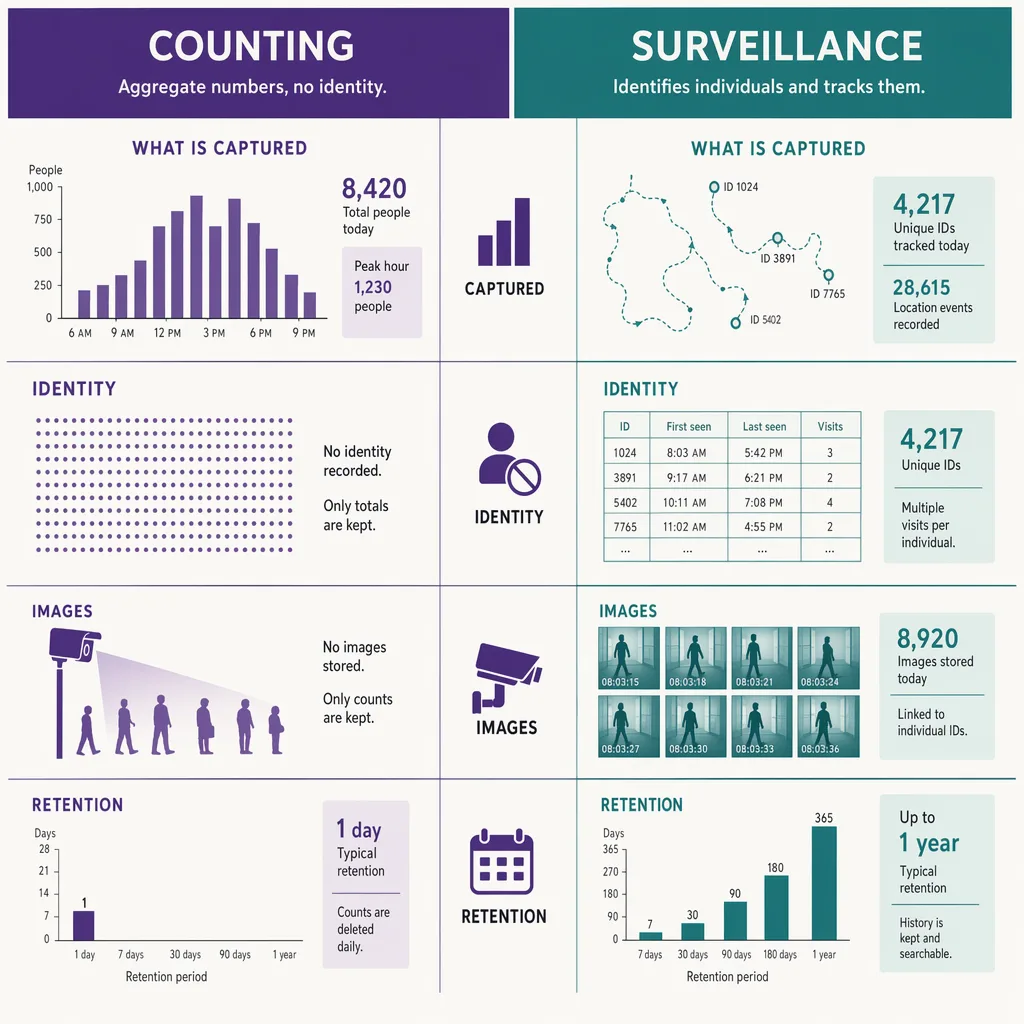
This post draws that line on purpose. It sets out what surveillance means, what people counting measures instead, and the method difference that decides which side a given system falls on. It also gives buyers and managers plain language for the conversation that matters most: reassuring staff, and where relevant a works council, that a footfall counter is not a monitoring tool. This is a conceptual distinction post, not a camera product comparison; for the hardware-swap angle see counting without cameras.
Is people counting the same as surveillance?
No. Surveillance watches identifiable individuals to see who they are and what they do; people counting measures how many people move through a space and how the crowd flows, without identifying anyone. The difference is in both purpose and method. Ariadne counts with Time-of-Flight depth sensing and patented phone signal sensing, capturing geometry and movement rather than faces, and stores no identifier unless a visitor explicitly opts in. Nothing in a footfall report tells you who a specific person was. This distinction is what staff and works councils tend to care about, and it is the right one to draw. This is general information, not legal advice.
What surveillance actually means
Surveillance is defined by its object: the individual. A surveillance system is built to answer questions about a specific person. Who is this? Where did they go? Have they been here before? What did they do while they were here? To answer those questions, the system has to capture something that identifies the person and hold onto it long enough to link one observation to another. A camera feed that a human or an algorithm reviews to recognise faces is surveillance. A system that tracks a named badge or a persistent device identifier across a building is surveillance. So is anything that retains a record tying a movement to a person who could later be picked out.
The three traits that make a system surveillance are identity, linkage, and retention. It captures who someone is, it links separate observations into a picture of that one person, and it keeps that record. Remove any one of the three and the system starts to lose its surveillance character. Remove all three and there is nothing left to watch: you have counts, not identities.
That matters because the concern people have about a ceiling sensor is a surveillance concern. They are not worried that a business knows 400 people came in on Saturday. They are worried that the business, or someone with access to the data, could pick them out of that 400 and follow them. The honest answer to that worry depends entirely on whether the system captures identity, linkage, and retention, or whether it was built so it cannot.
What people counting measures instead
People counting is defined by its object too, and the object is the crowd, not the person. A footfall system answers a different set of questions. How many people entered? How long did they stay? Which paths did the flow take through the space? Where did the crowd cluster and where did it thin out? Every one of those questions is about an aggregate. None of them requires knowing who any single person was.
That is not a softened version of surveillance. It is a different measurement with a different output. A well-designed counting system produces numbers: entries per hour, average dwell, a heatmap of where movement concentrated. Those numbers describe the crowd as a whole. You can run a store, staff a queue, lay out a floor, or judge whether an anchor tenant pulls traffic entirely from aggregates like these, and you never need a single person's identity to do it. The identity data that surveillance depends on is not merely protected in a counting system. In a properly designed one, it is never collected.
The distinction is not just conceptual. It is testable against the data the system actually holds. If you can query the dataset for "everyone who came in more than three times this month" and get names or persistent identifiers back, that is surveillance whatever the vendor calls it. If the most granular thing the dataset can tell you is "the space held 180 people at noon and they stayed 12 minutes on average," that is counting. The line runs through what the data can answer, not through the marketing label on the box.
The method difference that settles it
Purpose sets the intent, but method decides what is actually possible. A system's method determines the questions its data can ever answer, no matter what anyone intends. This is why the method a counting system uses is the real answer to the surveillance worry, and it is where camera-free counting and camera-based systems part company completely.
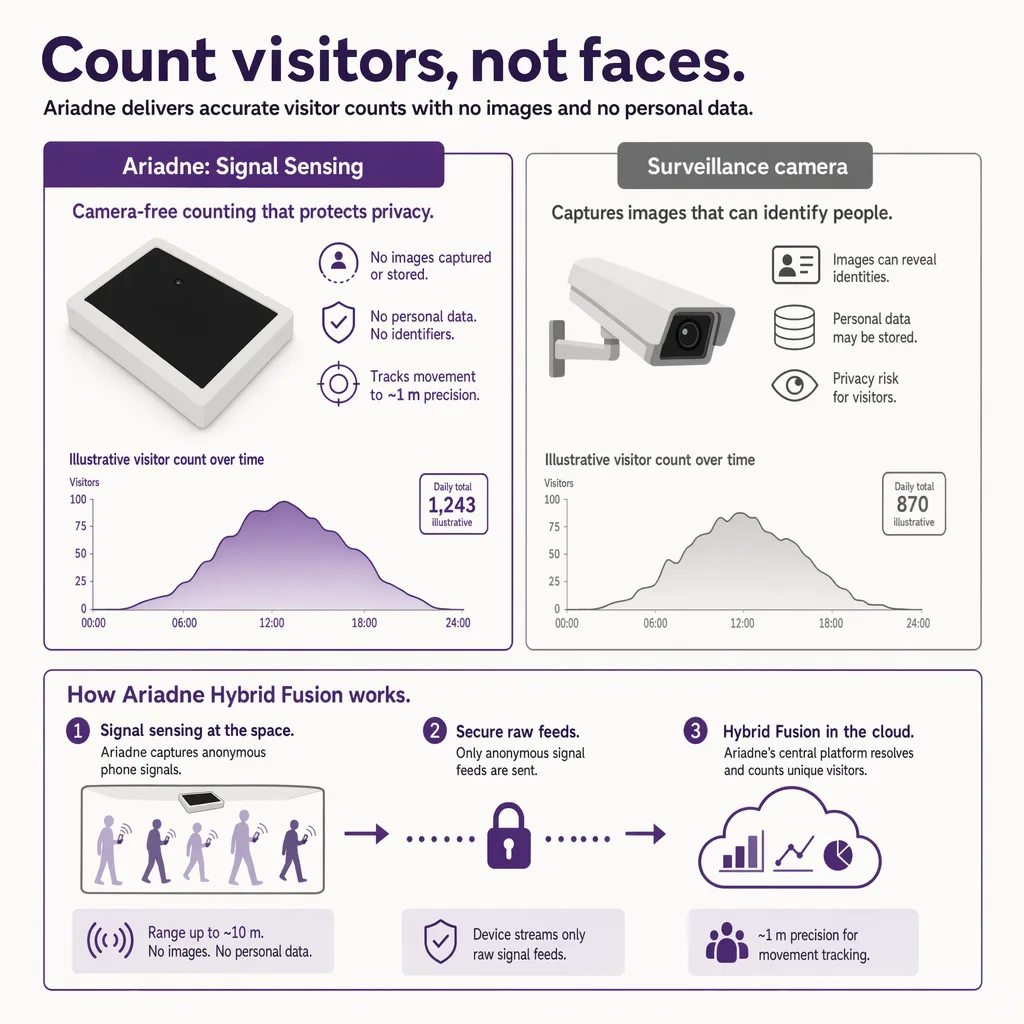
Ariadne measures this with Hybrid Fusion, its patented camera-free method. Time-of-Flight depth sensing counts every visitor at the entrances, capturing geometry rather than images, while patented phone signal sensing follows movement through the interior, detecting the signals a phone emits even in airplane mode, and tracks that movement to about one-metre precision. The sensor streams both feeds to Ariadne, where Hybrid Fusion combines them into one trajectory per visit and computes counts, dwell, and paths. The streams carry no identifier: no MAC address, no device ID, no biometric data, and no camera is involved. Identifiers are stored only when a visitor explicitly opts in, which keeps the method GDPR-friendly and outside biometric territory.
Read that against the three surveillance traits and the result is clean. There is no identity captured, because Time-of-Flight sees geometry not faces and the signal sensing carries no MAC address by default. There is no linkage to a named person, because a trajectory is one anonymous visit, not a profile that accumulates across visits under an identity. And there is no retention of who-did-what, because there is no "who" to retain. The system was not built to strip identity out after the fact; it was built so identity never enters. That is the difference between anonymising surveillance data and never collecting the data in the first place, and it is the point that reassures a careful reader. There is nothing to anonymise, because there is no personal data to begin with. For the sensing-method contrast in more depth, see non-biometric counting.
Counting versus surveillance, side by side
The distinction is easiest to see laid out directly. This table compares what each type of system captures and what it can and cannot know.
| People counting (camera-free) | Surveillance | |
|---|---|---|
| Purpose | Measure crowd volume, dwell, and flow | Observe and identify specific individuals |
| What is captured | Counts, dwell time, path shape (aggregate) | Faces, identities, or persistent identifiers |
| Images or video | None. Time-of-Flight captures geometry, not images | Camera feed of identifiable people |
| Identity of a person | Not captured; no face, no template, no MAC by default | Captured, so a person can be recognised |
| Linkage across visits | None unless a visitor explicitly opts in | Observations linked into a per-person picture |
| Retention | Aggregate numbers, no who-did-what record | Records tying movement to an identity |
| Works-council concern | Low: no employee identity observed | High: capable of monitoring named individuals |
The right-hand column is what people picture when they hear "the ceiling has a sensor." The left-hand column is what a camera-free counting system actually is. Reading the two side by side is usually enough to move a conversation from suspicion to understanding.
What a footfall report can and cannot tell you about one person
The clearest way to explain the difference to a colleague is to show what the data can and cannot do. A camera-free footfall report can tell you that 180 people entered at noon, that the average visit lasted 12 minutes, that the busiest corridor ran along the east wall, and that Saturday afternoons draw twice the traffic of Tuesday mornings. Every one of those is a statement about a crowd.
What the same report cannot tell you is anything about a named individual. It cannot say "that person came back on Tuesday," because there is no identity attached to a visit to match against Tuesday's. It cannot say "employee X spent 40 minutes away from their station," because the system does not know which trajectory is an employee, let alone which employee. It cannot produce a list of repeat visitors by name, or flag one person's movements, or reconstruct where a specific individual went. Those are surveillance questions, and a counting dataset simply has no field that answers them. When someone worries that a counter is watching them, this is the concrete reassurance: the data physically cannot single them out, because the identity that would be needed to do so was never recorded.
How to reassure staff and a works council in plain language
The conversation with staff, and where one exists a works council, goes best when it stays factual rather than reassuring in the abstract. Three plain statements usually do the work. First, what the system measures: crowd counts, dwell, and flow, to run the space better. Second, what it never captures: no faces, no video, no names, no device identifiers by default. Third, where the data lives and how long: aggregate numbers, not a record that can be traced to a person.
It also helps to be direct about the customer-versus-employee point. A footfall system is aimed at understanding customer volume and flow, not at monitoring staff. Because it captures no identity, it has no way to tell an employee's movements from a customer's, which means it cannot function as a performance-monitoring tool even if someone wanted it to. In Germany specifically, a works council has co-determination rights over technical systems capable of monitoring employees, and a camera-free method that captures no identity is a materially weaker candidate for that concern than a camera would be. That is its own subject; for the German-jurisdiction detail see how to brief a works council. None of this replaces the assessment a works council and counsel should carry out for a specific installation; it is the honest starting point for that conversation, not a substitute for it.
For the regulatory framing of why counting a non-identifying crowd is treated differently from biometric processing, see the EU AI Act view of counting, and for how the same principle applies to measuring advertising audiences see measuring audiences without recognising faces. To see the method behind camera-free measurement in full, visit camera-free people counting.
Related reading
FAQ
Is people counting surveillance?
No, when the counting method captures no identity. Surveillance watches identifiable individuals; people counting measures crowd volume, dwell, and flow without knowing who anyone is. A camera-free method like Ariadne's captures geometry and movement rather than faces, and stores no identifier by default, so its data describes the crowd and cannot single out a person.
Can people counters recognise individuals?
A camera-free counter cannot. Ariadne's Time-of-Flight depth sensing captures geometry, not images, and the signal sensing carries no MAC address by default, so there is no face and no persistent identifier to recognise a person by. The data holds counts and paths, not identities. A camera-based system, by contrast, can be built to recognise faces, which is what makes it surveillance rather than counting.
Do people counters record video?
Ariadne's method records no video and uses no camera. Time-of-Flight depth sensing measures the geometry of a space to count movement, which is not a picture of anyone. Some other counting products do use cameras; whether a given system records video is the first thing to check when you want to know if it counts or surveils.
Do I need cameras to count people?
No. Ariadne counts with Hybrid Fusion: Time-of-Flight depth sensing plus patented phone signal sensing, never cameras. Time-of-Flight captures geometry rather than images, and signal sensing captures no MAC address by default, so the measurement involves no video, no faces, and no biometric data.
How do I reassure staff that a people counter is not monitoring them?
State three things plainly: what it measures (crowd counts, dwell, flow), what it never captures (no faces, no video, no names, no device IDs by default), and that it cannot tell an employee's movements from a customer's because it captures no identity. A camera-free method makes each of those statements true by construction, not by policy.
---


