
"Accurate" is the word every visitor counting vendor uses and the one that means the least without context. If you are choosing a system, the question is not whether it is accurate in a brochure, it is whether it stays accurate at your widest door, during your busiest hour, in your actual lighting. This is a practical guide to what drives accuracy in the field and how to choose on evidence rather than adjectives.
What makes a visitor counting system accurate?
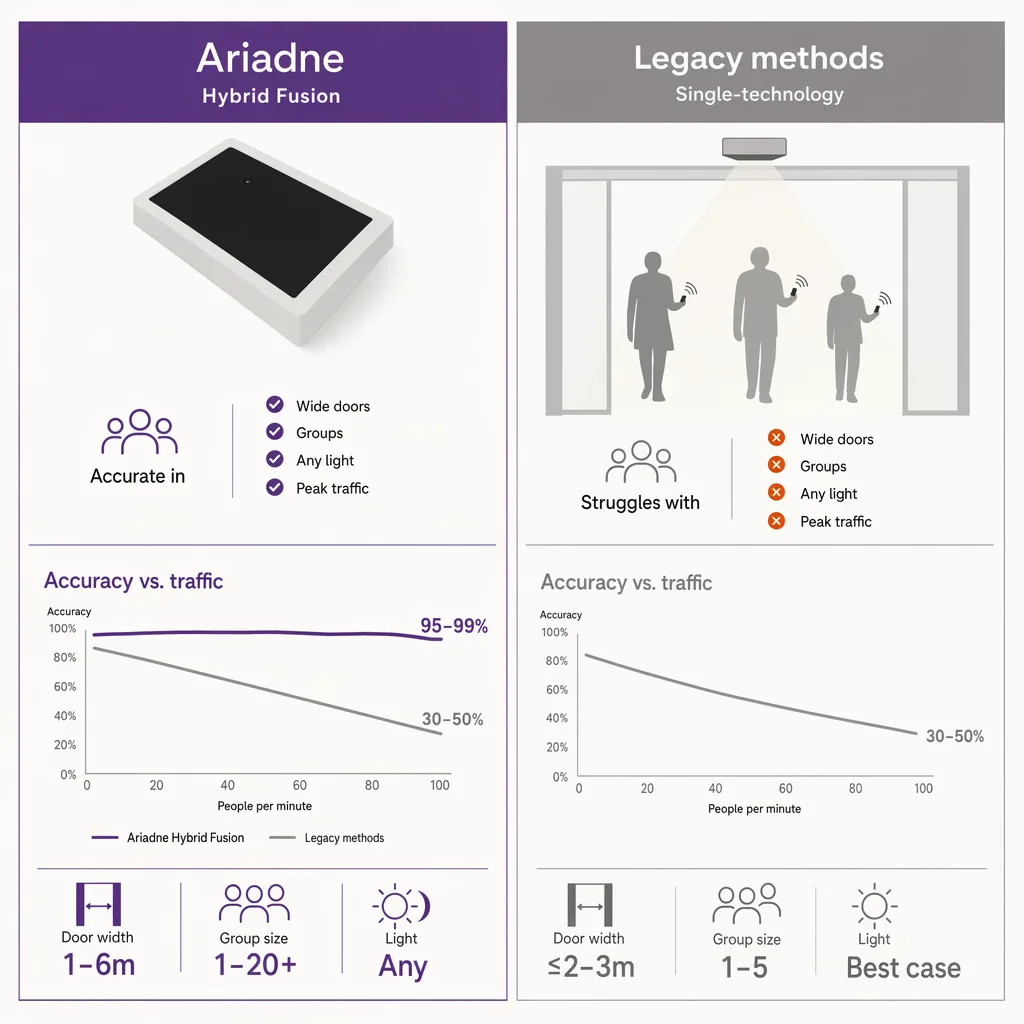
An accurate visitor counting system holds its count where cheap counters fail: at wide entrances, in groups, in changing light, and during peak traffic. Accuracy comes from the sensing method and the processing behind it, not from the marketing number. The most reliable systems use depth or sensor fusion rather than a single beam or flat camera, verify accuracy against a manual ground-truth count on the actual site, and keep that accuracy without capturing anything personal about the visitor.
The five conditions that break a cheap counter
Before you compare brands, know where counters fail, because that is where the price difference shows up:
- Wide entrances where visitors spread out instead of filing through.
- Groups entering together, the top cause of undercounting.
- Low light at opening, closing, and in interior corridors.
- Peak density when the count matters most and simple sensors degrade most.
- Reflective surfaces, glass doors, and polished floors that create false motion.
A system that handles these is worth more than one that wins on a clean test and loses on your floor.
Entrance counting: where accuracy is won or lost
Most of the error in a visitor count is made in the first two metres of the building. Entrance counting is the job of turning a stream of people through a door into a clean in and out count, and it is where the five conditions above stack up: a wide opening, a family entering shoulder to shoulder, a staff member crossing twenty times an hour, and the same door used in both directions.
Four things separate a system that counts an entrance well from one that only counts a doorway:
- Coverage of the full opening width, so a visitor at the far side of a wide entrance is counted rather than missed. Ceiling-mounted depth sensors cover a wider opening than a door-frame beam; the trade-offs are in ceiling-mount vs door-frame people counters.
- Group separation, so two people entering together register as two. This is the single biggest source of undercounting; see group entry counting.
- Bidirectional counting, so an entrance that also serves as an exit produces separate in and out totals rather than a doubled door count.
- Staff exclusion, so employees crossing the entrance repeatedly do not inflate the visitor figure. Ask the vendor how this is done and whether the method needs any personal data.
Entry counting on its own is a door metric. It becomes a visitor metric once the entrance count is reconciled with what happens inside, which is why a comparison of counting methods should be read against your entrances, not against a clean test lane.
Sensing methods, ranked for accuracy and for privacy
A short, honest ranking for visitor counting specifically:
- Beam / break-the-line sensors. Cheapest, least accurate, cannot separate groups. Fine for a rough door count, poor for anything you will make decisions on.
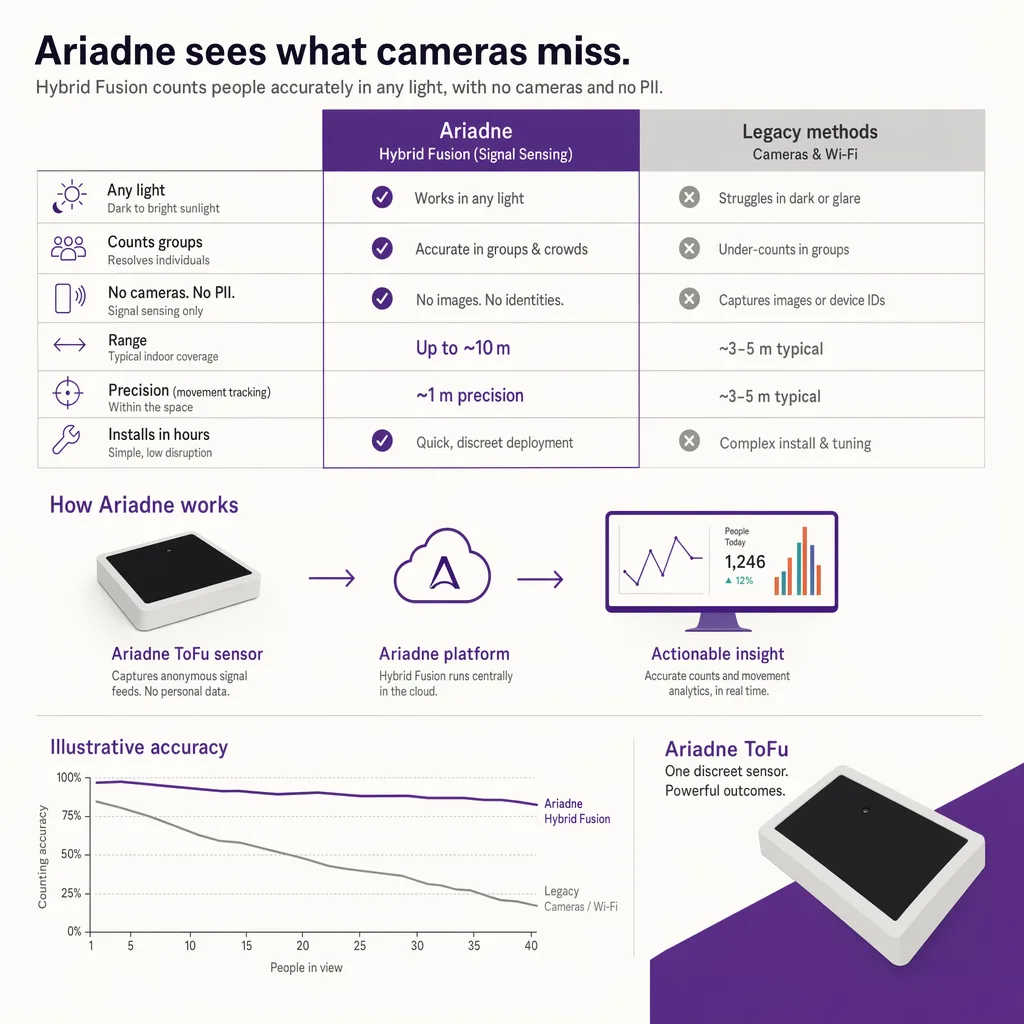
- 2D cameras. Better, but light-dependent and image-capturing, which adds compliance work.
- 3D depth (stereo or ToF). Strong on groups and light. Stereo still captures images; ToF captures geometry only.
- Sensor fusion. Depth at the door plus a second signal across the interior. Highest accuracy on the hard cases and, when done without cameras, the cleanest privacy posture.
How Ariadne keeps accuracy without capturing personal data
Ariadne measures this with Hybrid Fusion, its patented camera-free method. Time-of-Flight depth sensing counts every visitor at the entrances, capturing geometry rather than images, while patented phone signal sensing follows movement through the interior, detecting the signals a phone emits even in airplane mode, and tracks that movement to about one-metre precision. The sensor streams both feeds to Ariadne, where Hybrid Fusion combines them into one trajectory per visit and computes counts, dwell, and paths. The streams carry no identifier: no MAC address, no device ID, no biometric data, and no camera is involved. Identifiers are stored only when a visitor explicitly opts in, which keeps the method GDPR-friendly and outside biometric territory.
A buyer checklist
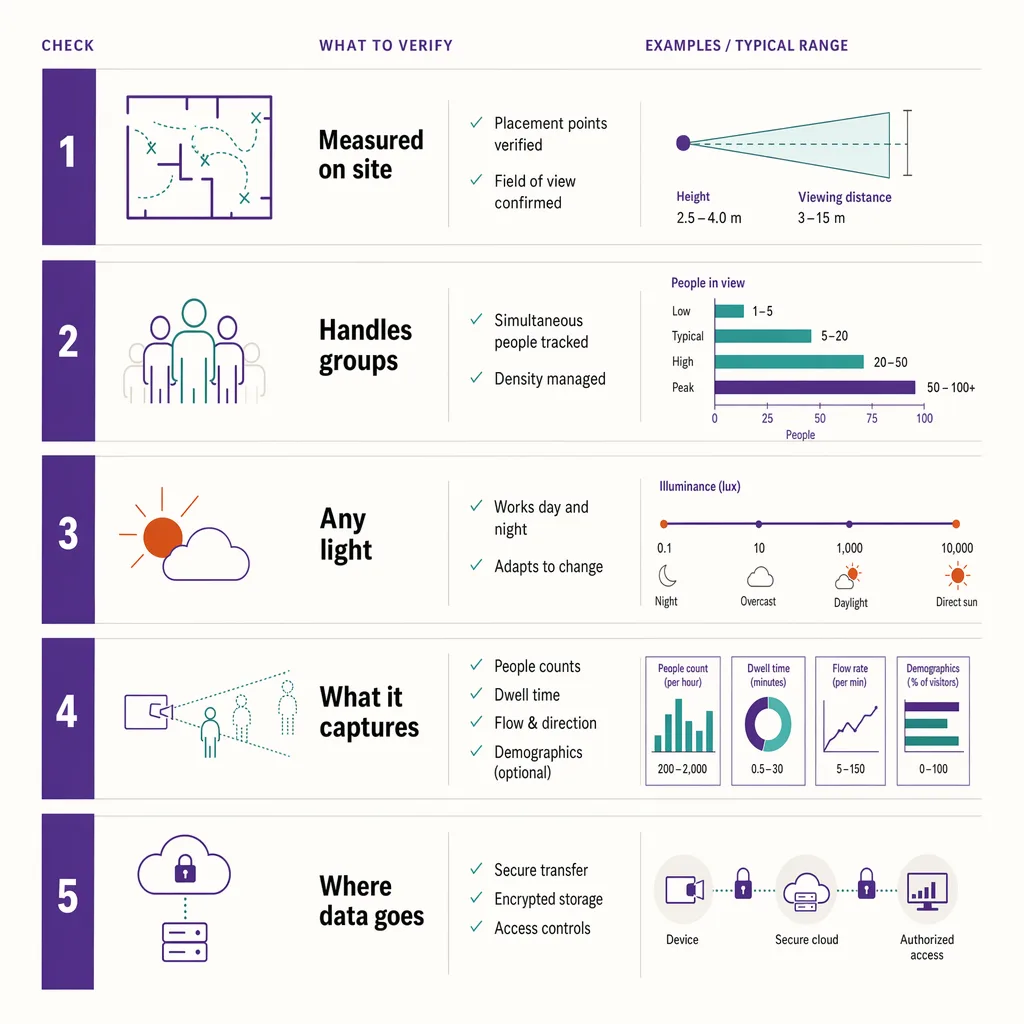
Put these in the evaluation, and the answers in writing:
- Accuracy measured on your site, at peak, against a manual count.
- What the sensor captures: images, depth, or signal.
- Behaviour on groups and at your widest entrance.
- What data leaves the building and where it is stored.
- Whether the system can infer demographics, and whether that can be disabled.
- Install requirements: mounting height, power, and network.
A fuller people counting buyer's guide follows in a later batch.
FAQ
What is the most accurate visitor counting system?
The one that holds accuracy on groups and in your lighting, measured on your site. Method matters more than brand; fusion and depth lead on the hard cases.
How accurate should a visitor counter be?
Vendors typically advertise 95 to 99 percent at a single entrance under stated conditions; verify it yourself at a busy door.
Can a visitor counter be accurate without a camera?
Yes. Depth and signal-based methods reach high accuracy without capturing images.
What is the difference between a visitor counter and a people counter?
The terms are used interchangeably. Both count people entering and moving through a space.
---


