
A transport hub works when nobody notices it working. Passengers walk from the door to the gate, tap through a gateline, clear a checkpoint, and board, without ever standing in a line long enough to remember. The moment that breaks, the moment a security queue folds back on itself or a platform fills past comfort, the whole hub feels it: missed connections, held departures, and safety risk. Passenger flow management is the operational discipline that keeps the hub on the right side of that line.
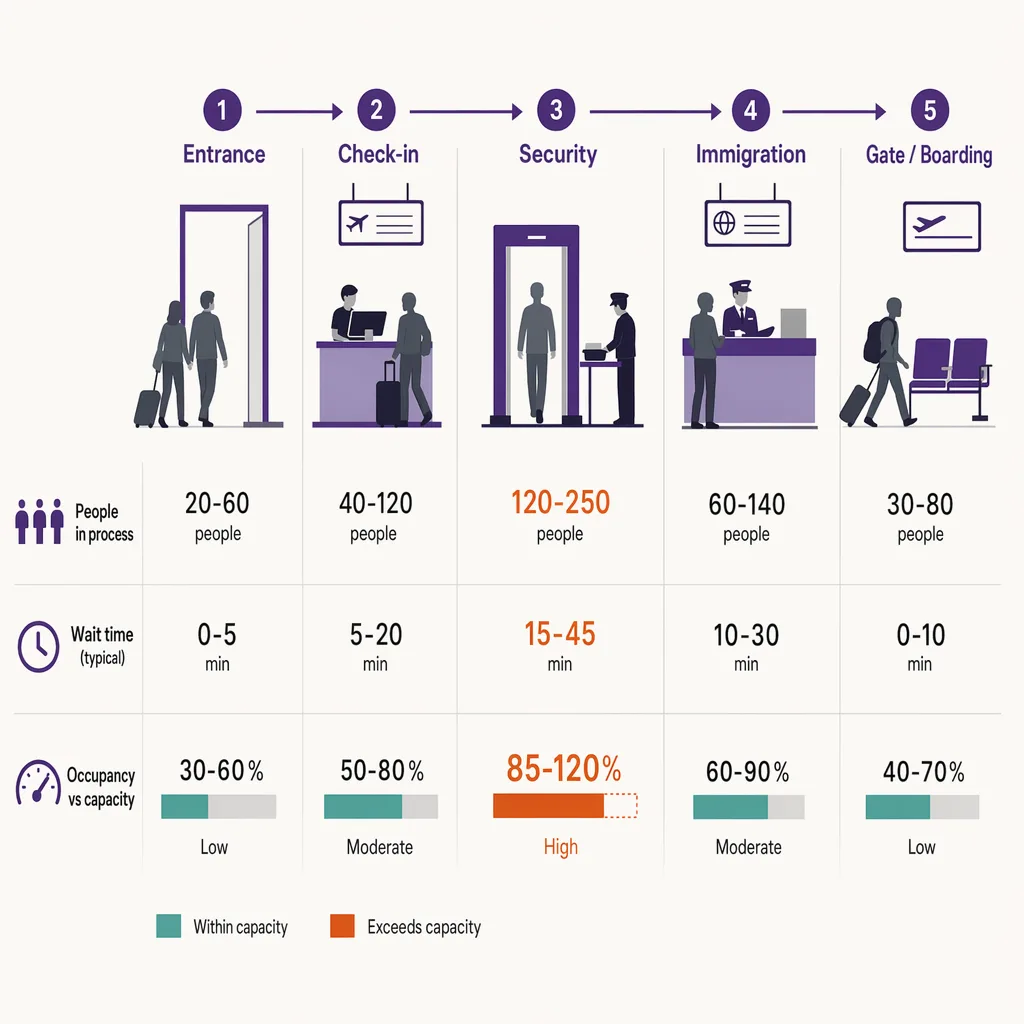
This post is the transport-operations view of flow: what passenger flow management is, where it breaks down across an airport terminal or a rail station, the handful of metrics that actually run a hub, and how a team measures the picture in the first place. It is the pillar for the transport cluster, so it frames the specific problems and routes down to the posts that cover each one in depth, rather than repeating them. It sits under the cross-sector customer flow pillar, which covers the same movement idea in shops, banks, and clinics; this one narrows to transport hubs, where the stakes are throughput and safe capacity rather than conversion.
What is passenger flow management?
Passenger flow management is the practice of moving people through a transport hub, an airport terminal, a rail or metro station, a bus or ferry terminal, without bottlenecks, long waits, or crowding beyond safe capacity. It works from a measured picture of where passengers are, how many, and how long they wait, then acts on it: opening lanes and gates, moving staff, and adjusting wayfinding and announcements before a queue turns into a crush. It is an operations input for the teams running the hub, not a security or identification system. Ariadne supplies the picture camera-free, counting passengers and measuring dwell without capturing any personal data.
The rest of this post takes that apart in the order a hub team meets it: where flow breaks down, the metrics that describe those breakdowns, how the underlying picture is measured, how measurement turns into an operational move, and the line between an operations input and a security function that this kind of data must not cross.
Where passenger flow breaks down: security, immigration, boarding, baggage, interchange
Passengers experience a hub as one journey, but the flow breaks down at a small number of predictable pinch points, each with its own cause and its own owner.
Security screening is the classic one. Throughput at a checkpoint is capped by the number of open lanes and the time each passenger takes at the tray, so a bank of arrivals that outpaces the open lanes builds a queue fast, and the queue is slow to clear even after demand drops. This is the single most measured passenger-flow problem in aviation, and it has its own detailed treatment in airport security queue analytics, which covers how to measure and forecast the security wait specifically. This pillar just places it in the wider journey: security is one pinch point among several, and staffing it well depends on seeing the arrival curve upstream of it.
Immigration behaves similarly on arrival, with the added constraint that lane opening is often outside the operator's control. Boarding is a pinch point at the gate, where a burst of passengers meets a single scanning point at a fixed time. Baggage reclaim is a crowding problem rather than a queue: passengers pool around a belt, and when two wide-body flights land close together the hall fills past comfort. That arrivals-side crowding, and how to read it, is the subject of airport baggage hall flow; route reclaim questions there rather than treating them as a queue.
Interchange is the station equivalent of all of these at once. A metro platform, a concourse, and a set of stairs or escalators form a network of pinch points where a delayed train dumps a surge into a space sized for a steady trickle. Reading footfall through a station, corridor by corridor, is covered in transit station footfall; this pillar frames it as one member of the transport family, sharing the same underlying need for an accurate, timely count of where people are.
The metrics that run a hub: throughput, wait time, dwell, occupancy against capacity
Every one of those breakdowns is described by the same short list of metrics. A hub team that watches these four, at the right points and in close to real time, has the operational picture it needs.
Throughput is the number of passengers passing a point per unit time: through a checkpoint, a gateline, a door. It is the rate the hub is actually processing, and it is what you compare against arriving demand to see whether a queue is forming or clearing.
Wait time is how long a passenger stands in a given queue. It is the metric passengers judge the hub by, and the one most likely to trigger a service-level breach at security or immigration. Wait time is a consequence of throughput falling behind arrivals, so it is best watched alongside the arrival curve, not on its own.
Dwell is how long passengers spend in a zone that is not a queue: a concourse, a lounge, a reclaim hall. High dwell is not always a problem (a passenger relaxing airside is fine), but rising dwell in a space with a capacity limit is an early warning of crowding.
Occupancy against capacity is the count of people in a defined space measured against the safe or comfortable limit for that space. This is the safety-facing metric, the one that matters most on a platform or in a reclaim hall, and the one that should drive a crowd-control response before a space reaches its cap. Setting and planning those caps is the subject of airport terminal capacity planning; route capacity-limit questions there. This pillar's point is narrower: occupancy is a live operational metric, not only a design-stage number, and running a hub means watching it move.
The four work as a set. Throughput and arrivals explain wait time; dwell and occupancy explain crowding. Watch all four at the pinch points above and the breakdowns stop being surprises.
How passenger flow is measured, camera-free
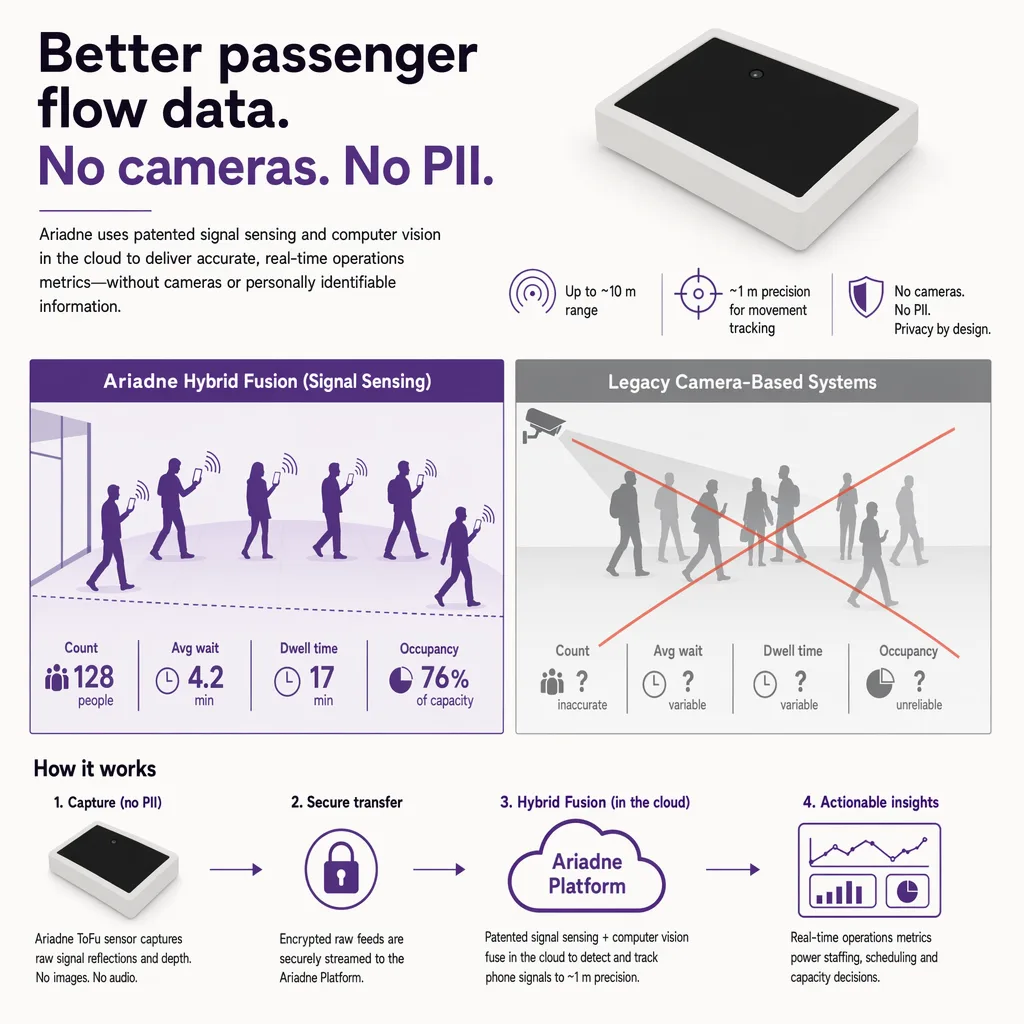
None of those metrics exist until something counts passengers accurately at the points that matter, and holds the count consistently enough to trust as an operational input. In a transport hub that also means measuring without cameras in sensitive zones and without capturing anything that identifies a traveller.
Ariadne measures this with Hybrid Fusion, its patented camera-free method. Time-of-Flight depth sensing counts every visitor at the entrances, capturing geometry rather than images, while patented phone signal sensing follows movement through the interior, detecting the signals a phone emits even in airplane mode, and tracks that movement to about one-metre precision. The sensor streams both feeds to Ariadne, where Hybrid Fusion combines them into one trajectory per visit and computes counts, dwell, and paths. The streams carry no identifier: no MAC address, no device ID, no biometric data, and no camera is involved. Identifiers are stored only when a visitor explicitly opts in, which keeps the method GDPR-friendly and outside biometric territory.
That is the operational summary. The detail of how automatic passenger counting works, the sensor methods compared, and the accuracy to expect belongs to the companion post passenger counting; read that for the measurement mechanics. For the transport-specific counting picture and the real-time angle, airport people counting technology and real-time people counting cover the count as it happens. This pillar assumes the count exists and moves to what a hub does with it.
From measurement to operations: staffing, lane and gate opening, wayfinding, and comms
A measured picture is worth nothing until it changes a decision. Passenger flow management is the loop that turns the four metrics into the handful of levers a hub actually controls.
Staffing is the first lever and the slowest. Because arrivals at a hub follow flight and train schedules, a forecast of the arrival curve lets a team roster security, immigration, and gate staff to the shape of the day rather than a flat average, so lanes are staffed before the surge, not after the queue. Lane and gate opening is the faster version of the same move: throughput at security is set by open lanes, so the response to a rising arrival curve is to open another lane before wait time breaches, and close it again when the curve drops. Occupancy against capacity drives the crowd-control response on the concourse and platform, metering flow into a space approaching its cap.
Wayfinding and communication are the levers that shift demand rather than add supply. Dynamic signage, gate reassignment, and announcements can pull passengers toward an under-used checkpoint or a quieter route, smoothing a peak that staffing alone cannot absorb. All of these depend on the same thing: a count current enough to act on, at the point where the action happens. A dashboard that shows a security wait an hour after it formed is a report; one that shows the arrival curve building against open lanes is an operational tool.
Ariadne feeds that loop through Ariadne Analytics, where the counts, dwell, and occupancy from every measured point in the hub land as live and historical views, so the arrival curve, the queue, and the fill of a space are visible to the team making the call. The camera-free counting that supplies it is the same people counting method used across every sector, applied to the transport pinch points above.
An operations input, not a security system
One framing has to stay clear, because it is what makes this kind of measurement acceptable in a transport hub at all. Passenger flow data is an operations input. It is not a security or identification system, and it should not be sold, deployed, or described as one.
Ariadne does not identify individuals. Hybrid Fusion counts geometry and movement, not faces, and it captures no personal data at all by default: no MAC address, no device ID, no biometric data, and no camera. There is no demographic detection, no age or gender inference, and no attempt to recognise a returning traveller. The system knows that a certain number of people are in a space and how long they have been moving through it; it does not know who they are, and it is built so that it cannot.
That posture is also the regulatory position. Because no biometric data is captured and no demographic profiling takes place, the measurement sits outside the high-risk category the EU AI Act reserves for biometric identification and categorisation, and it stays GDPR-friendly because there is no personal data to protect in the first place. This is a deliberate design choice, not a gap: a hub can measure flow at security, at the border, and on the platform without the measurement itself becoming a surveillance question. It supports the teams running security and safety with a count; it does not perform threat detection, and it makes no claim to a certified security function.
FAQ
What is passenger flow management?
Passenger flow management is moving people through a transport hub (an airport terminal, a rail or metro station, a bus or ferry terminal) without bottlenecks, long waits, or crowding beyond safe capacity. It works from a measured picture of where passengers are, how many, and how long they wait, then acts on it by opening lanes and gates, moving staff, and adjusting wayfinding and announcements. It is an operations input, not a security or identification system.
What metrics matter most for passenger flow?
Four: throughput (passengers past a point per unit time), wait time (how long a passenger queues), dwell (time spent in a non-queue zone), and occupancy against capacity (people in a space versus its safe limit). Throughput and arrivals explain wait time; dwell and occupancy explain crowding. Watching all four at the pinch points is what turns breakdowns into things a team sees coming.
Does passenger flow management use cameras?
No. Ariadne counts with Hybrid Fusion: Time-of-Flight depth sensing plus patented phone signal sensing, never cameras. Time-of-Flight captures geometry rather than images, and signal sensing captures no MAC address by default, so the measurement involves no video, no faces, and no biometric data.
Is this a security system?
No. Passenger flow data is an operations input that supports staffing, queue, and crowd decisions. Ariadne does not identify individuals, run demographic or biometric detection, or perform threat detection, and it makes no claim to a certified security function. Because no biometric data is captured and no profiling takes place, the measurement sits outside the EU AI Act's high-risk biometric category and stays GDPR-friendly, since there is no personal data captured in the first place.
How is passenger flow different from passenger counting?
Passenger counting is the measurement (how the count of boardings, alightings, and people through a point is produced). Passenger flow management is what a hub does with that count: reading the metrics and acting on them to keep people moving. The measurement detail lives in the companion post on passenger counting; this pillar covers the operations.
How does measuring flow reduce queues and crowding?
By making the arrival curve visible before the queue forms. A team that sees arrivals building against the number of open lanes can open another lane or move staff before wait time breaches, and use signage to pull demand toward quieter routes. Occupancy against capacity does the same for crowding, triggering a response before a platform or hall reaches its limit.


