
Almost everything written about airport crowd management sits on the departures side: the security queue, the gate, the airside shops, the curb where passengers are dropped. The arrivals side gets far less attention, and the baggage reclaim hall least of all. Yet it is one of the most reliably congested spaces in any terminal, because it inherits the burstiest flow in the building. A wide-body lands, hundreds of passengers clear immigration in a tight window, and they all arrive at the belts at once.
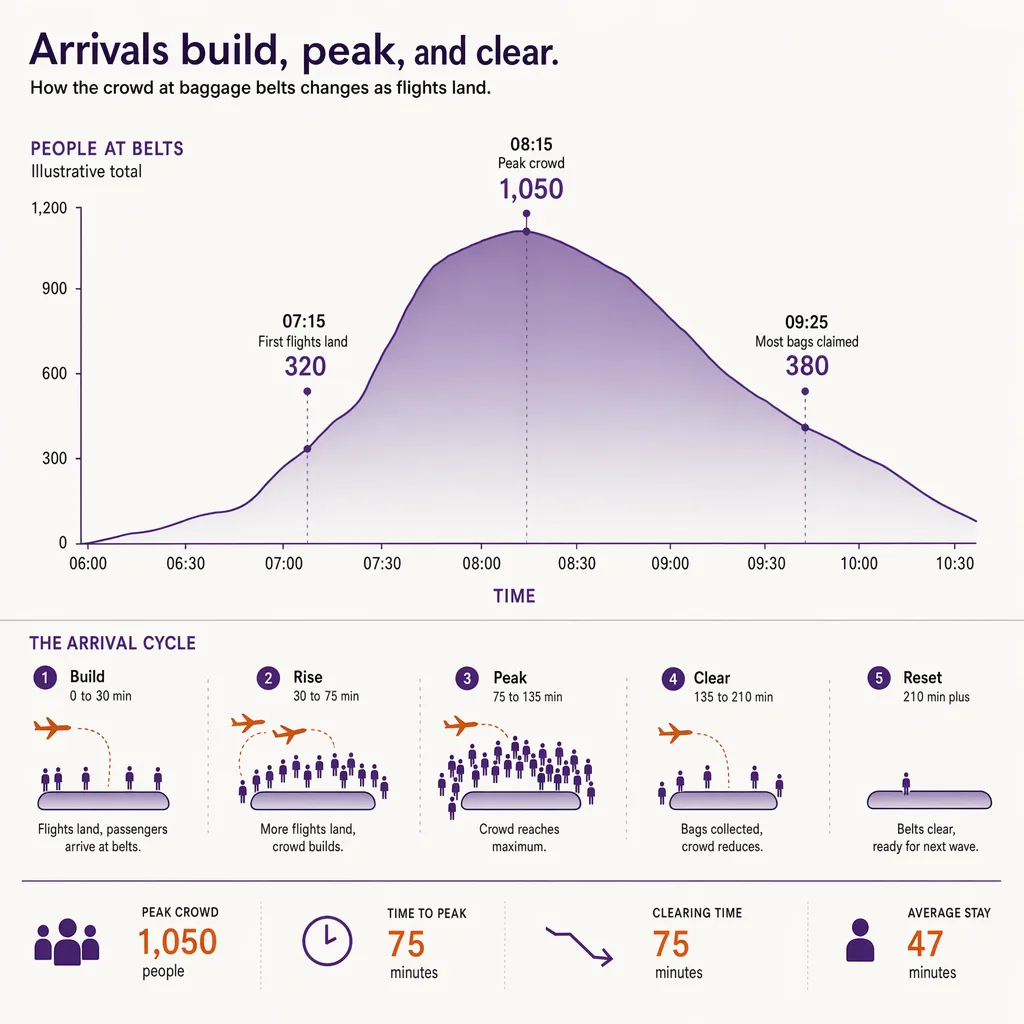
This post covers that arrivals-side flow: how passengers move from immigration into the baggage hall, why the crowding at the belts comes in waves, and how measuring the arrivals flow supports belt allocation and staffing. It is the arrivals counterpart to the departures posts in the airport cluster. It links up to the method pillar, how airports count passengers, and connects downstream to the handoff it feeds.
How do airports manage flow through the baggage reclaim hall?
Arrivals flow is bursty: a wide-body lands and hundreds of passengers move through immigration and into the baggage hall in a short window, then the hall quiets until the next arrival bank. Airports manage it by measuring the arrivals flow into the hall and matching belt allocation and staffing to that curve, so a single belt is not overwhelmed while others sit idle. Measured throughput and crowding at the belts tells the operator whether reclaim is keeping pace with arrivals or backing up, and whether the arrivals-to-curbside handoff is smooth. Counting is an operations input for belt and staffing decisions, not a bag-tracking or security system.
Why arrivals are bursty: the arrival-bank problem on the reclaim side
Departures spread out. Passengers for a single flight drift to the airport over a window of two or three hours, check in at different times, and pass through security whenever they arrive. By the time they reach the gate, the crowd has been smoothed by every process upstream.
Arrivals do the opposite. A flight lands as one event, and the passengers deplane over a few minutes. They move through immigration together, and then they arrive at the baggage hall together. The hall does not see a steady trickle; it sees a wave, then quiet, then another wave when the next flight lands. When several wide-bodies land in the same bank, the waves overlap and the hall fills to a level that no amount of steady-state planning would predict from the daily passenger total.
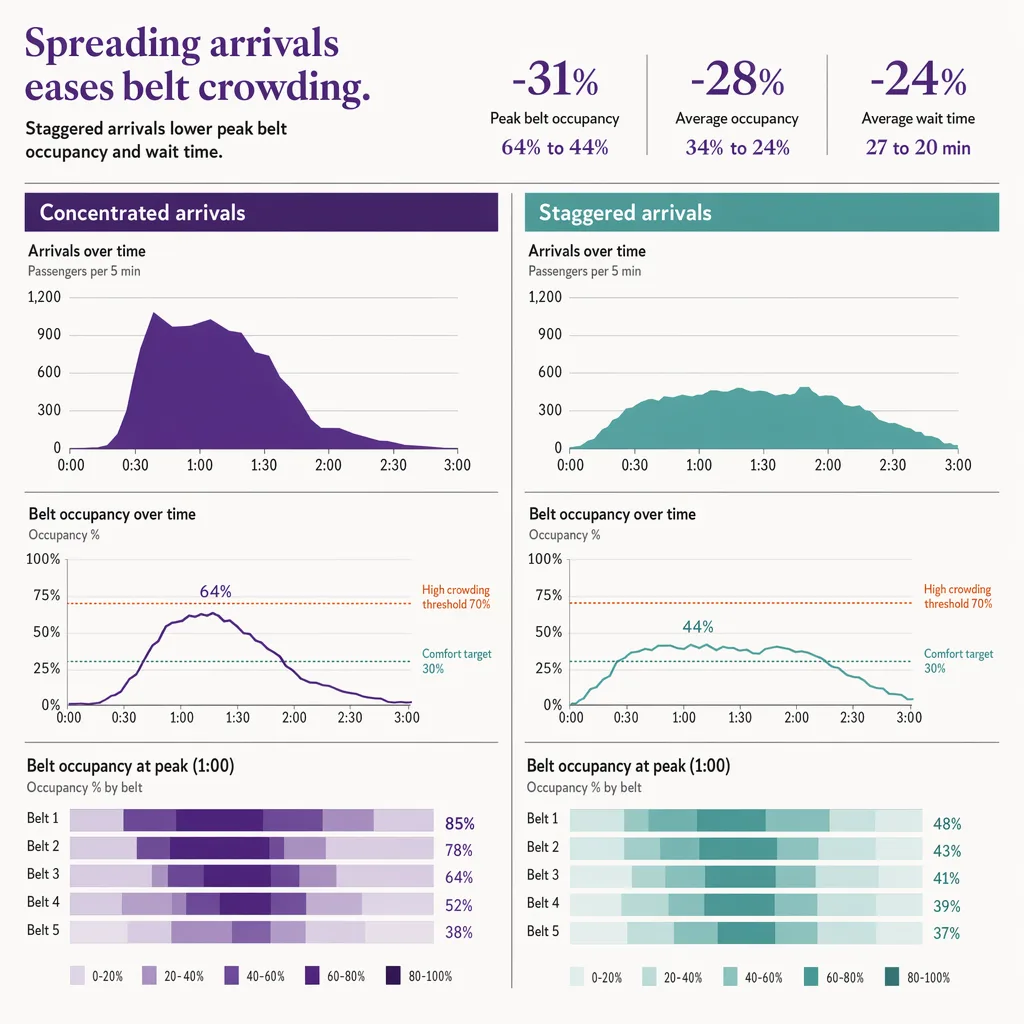
This is why arrivals crowding is a distribution problem, not a volume problem. A hall can handle its total daily arrivals comfortably on average and still overflow for twenty minutes when two long-haul flights land together and their bags hit adjacent belts. The average tells the operator almost nothing; the shape of the arrival curve tells them everything. Planning to the average is the classic mistake, and it is the same trap that catches the departures side, described from the queue angle in predicting passenger surges.
Belt allocation and staffing to the arrivals curve
The two levers an airport has in the baggage hall are which belt each flight's bags go to, and how many staff are working the hall and its surrounding services at any moment. Both should track the arrival curve, not a fixed roster.
Belt allocation is the first lever. When arrival banks are known in advance, allocating flights to belts so that simultaneous arrivals land on separate, well-spaced belts keeps the crowd from concentrating on one point. Put two wide-bodies on adjacent belts in the same window and the space between them becomes a crush, while belts at the far end of the hall sit empty. Spreading the load across the hall is a planning decision that measured flow makes visible: the operator can see where crowding actually builds rather than assuming it distributes evenly.
Staffing is the second lever. The baggage hall and its surrounding services, from the assistance desks to the services that keep the hall clean and clear, all need to be resourced to the peaks, not the average. Rostering flat across the day means the hall is overstaffed during the quiet troughs between banks and understaffed when three flights land together. Matching staff to the arrival curve is the same demand-led principle that governs the rest of the terminal, covered in staffing to demand. The difference on the arrivals side is that the demand curve is even spikier, so the cost of rostering to the average is higher.
Crowding at the belts and the arrivals-to-curbside handoff
The baggage hall is not the end of the arrivals journey; it is the middle of it. Passengers collect bags, clear customs, and then move to the curb for pickup, a taxi, a ride-hail, or public transport. How smoothly the hall clears directly shapes how the next stage behaves.
When the hall backs up, the effect does not stay in the hall. A wave of passengers who were delayed at the belts arrives at the curb later and more bunched than they otherwise would, turning what could have been a manageable trickle of pickups into a concentrated surge. The curb inherits the shape the hall gives it. Measuring the flow through the hall, and the rate at which passengers exit toward the curb, lets an operator see the handoff as one connected flow rather than two separate problems. The curbside side of that handoff, where pickup congestion builds, is covered in curbside pickup congestion.
Reading the two zones together matters because a fix in one can create a problem in the other. Speeding up the hall is good for passengers, but if it dumps a larger wave onto a curb that was already tight, the congestion simply moves rather than clearing. Flow measurement across both spaces is what lets the operator see the whole arrivals chain and plan the handoff, not just the belt.
What flow measurement supports, and what it does not
It is worth being precise about the role counting plays here, because the baggage hall is a place where it would be easy to overclaim. Flow measurement in the reclaim hall supports operational decisions: how to allocate belts to arrival banks, how to staff the hall and its services to the peaks, and how to manage the handoff to the curb. It answers questions about how many people are in the hall, how fast they are arriving and leaving, and where crowding is building.
It does not track individual bags, and it does not identify passengers. It is not a bag-reconciliation system, a customs or immigration process, or any part of security. Those are separate systems with their own purposes and their own regulatory standing. Ariadne footfall and flow data is an operations input that sits alongside them, telling the terminal operations team how the space is filling and clearing so they can staff and allocate to the real curve. Keeping that boundary clear is not a caveat; it is the honest description of what the data is for.
How Ariadne measures arrivals flow
Measuring flow in a baggage hall means counting passengers as they enter from immigration, tracking how the crowd builds and clears around the belts, and measuring the rate at which they exit toward customs and the curb. As on the departures side, it has to be done in a way that suits a sensitive, high-scrutiny environment, which rules out camera-based counting from the start.
Ariadne measures this with Hybrid Fusion, its patented camera-free method. Time-of-Flight depth sensing counts every visitor at the entrances, capturing geometry rather than images, while patented phone signal sensing follows movement through the interior, detecting the signals a phone emits even in airplane mode, and tracks that movement to about one-metre precision. The sensor streams both feeds to Ariadne, where Hybrid Fusion combines them into one trajectory per visit and computes counts, dwell, and paths. The streams carry no identifier: no MAC address, no device ID, no biometric data, and no camera is involved. Identifiers are stored only when a visitor explicitly opts in, which keeps the method GDPR-friendly and outside biometric territory.
In the baggage hall, that means Time-of-Flight counting at the hall entries captures the arrival waves as they hit, and flow measurement across the interior shows where crowding concentrates around the belts and how fast the hall clears toward the exit. The operator gets the shape of the arrival curve, not just a daily total, which is exactly what belt allocation and staffing decisions need. Glasgow Airport is a live Ariadne customer; for the underlying method see how airports count passengers, and for the wider deployment picture, airport analytics.
Related reading
FAQ
Why is baggage reclaim so often crowded?
Because arrivals are bursty. Departures spread passengers out over hours, but a flight lands as a single event and hundreds of passengers reach the belts within minutes of each other. When several wide-bodies land in the same bank, the waves overlap and the hall overflows for a short window, even if its daily average would suggest plenty of capacity.
How do airports reduce crowding in the baggage hall?
By matching belt allocation and staffing to the arrival curve rather than a fixed roster. Allocating simultaneous arrivals to separate, well-spaced belts keeps the crowd from concentrating on one point, and staffing the hall and its services to the peaks rather than the average keeps it resourced when several flights land together.
Do I need cameras to measure baggage hall flow?
No. Ariadne counts with Hybrid Fusion: Time-of-Flight depth sensing plus patented phone signal sensing, never cameras. Time-of-Flight captures geometry rather than images, and signal sensing captures no MAC address by default, so the measurement involves no video, no faces, and no biometric data.
Does counting in the baggage hall track individual bags or passengers?
No. Flow measurement counts how many people are in the hall and how fast they arrive and leave. It does not track individual bags, identify passengers, or form part of any bag-reconciliation, customs, or security process. It is an operations input for belt and staffing decisions that sits alongside those separate systems.
How does baggage hall flow affect the curbside pickup?
The curb inherits the shape the hall gives it. When the hall backs up, the delayed passengers reach the curb later and more bunched, turning a manageable flow of pickups into a concentrated surge. Measuring flow across both zones lets an operator plan the handoff as one connected chain rather than two separate problems.


