
Every transport network runs on one number it cannot afford to guess: how many people actually moved. How many boarded the 07:40 bus, how many passed through the north gateline before the delay, how many walked into the terminal in the hour a flight bank landed. Get that count right and scheduling, capacity planning, and revenue reporting all have a floor to stand on. Get it wrong, and every decision built on top inherits the error.
This post is the methods explainer for how that count gets taken automatically. It is not a buyer's guide to a specific product, and it is not about counting with cameras (that comparison lives in its own post, linked below). It answers the educational question underneath the whole category: what automatic passenger counting is, where it happens, how the sensor methods differ, what accuracy to expect, and how to think about choosing. For the operations side, how a hub acts on the count once it has it, its companion is passenger flow management.
What is automatic passenger counting (APC)?
Automatic passenger counting, usually shortened to APC, is the automated measurement of how many passengers board, alight, or pass a point in a transport system, without a person tallying by hand. It runs on buses and trains to count boardings and alightings per stop, and in stations and airports to count people through entrances, gatelines, and security. The count feeds scheduling, capacity planning, and revenue or subsidy reporting. Methods range from infrared beams and treadle mats to video, depth sensing, and phone-signal sensing. Ariadne counts passengers with Hybrid Fusion, camera-free and with no personal data captured.
The rest of this post takes that definition apart in the order most people need it: where the counting physically happens, how the competing methods work and where each breaks down, how Ariadne counts, what accuracy is realistic, and how to narrow the choice.
Where passengers get counted: buses, trains, stations, and airports
APC is not one setting. The same word covers four quite different jobs, and the right method depends heavily on which job you are doing.
On buses, the count is per-door and per-stop: how many board and alight at each stop along a route. Sensors sit above the doors, the count is tied to the door-open event and the vehicle's position, and the output is a boarding and alighting profile for every trip. That profile drives scheduling, load balancing, and the ridership figures that justify a route.
On trains and metro, counting happens both at car doors and at station entrances or gatelines. Car-level counts show how load distributes along a train so operators can nudge passengers toward emptier cars; gateline counts show how many people entered the station and when. Both feed into service planning and crowding management.
In stations and airports, the count moves off the vehicle entirely and onto the building. Here APC means counting people through entrances, transfer corridors, security lanes, and boarding areas, so operators can see where a crowd is building before it becomes a queue. This is the same measurement problem as counting people into any large venue, and the transport-specific version is covered in transit station footfall and, for air travel, in airport people counting technology.
The through-line is that a bus door and an airport concourse ask very different things of a sensor. A method that is ideal on a vehicle can be a poor fit for a wide station entrance, which is why the methods comparison below matters more than any single accuracy claim.
The counting methods compared: infrared beam, treadle, video, depth, and phone signal
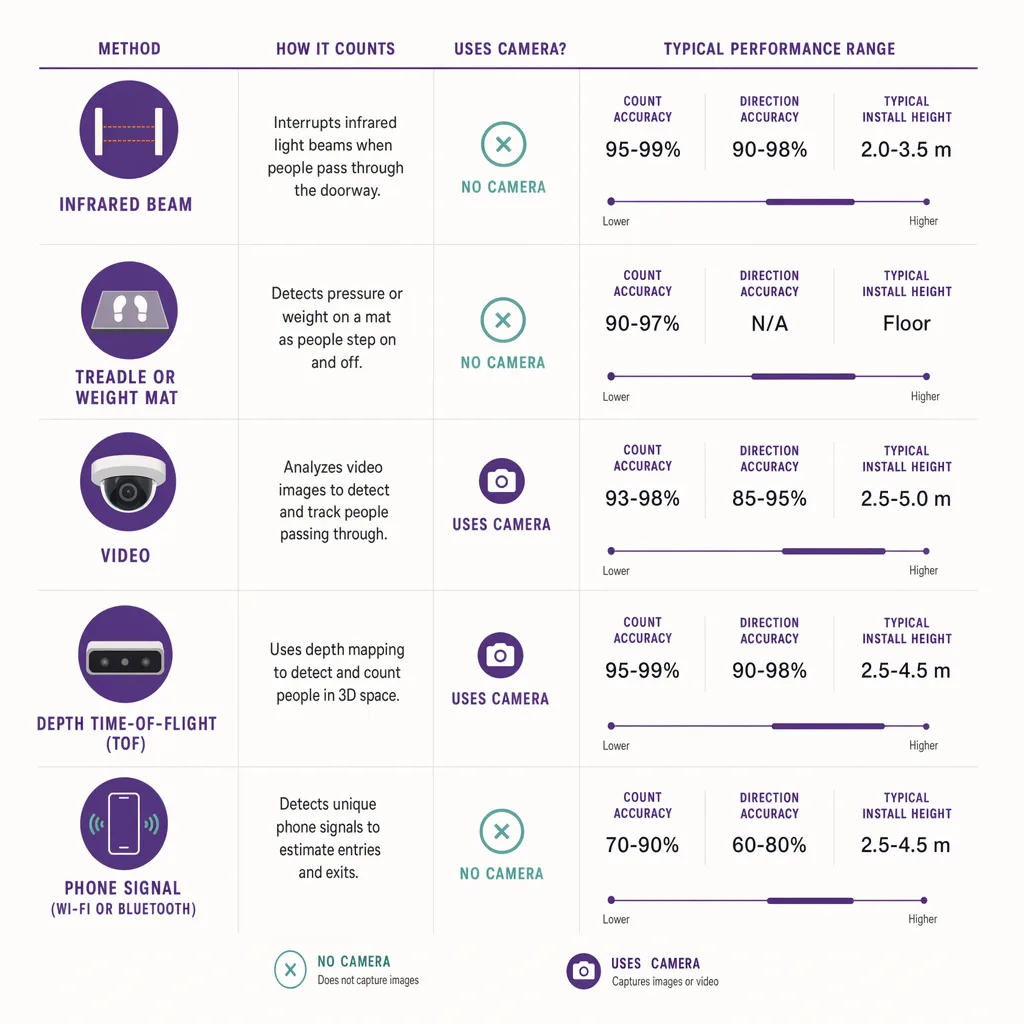
Five families of method dominate passenger counting today. Each was designed around a different constraint, so each has a job it does well and a job it does badly.
| Method | How it works | Strengths | Limits | PII/camera |
|---|---|---|---|---|
| Infrared beam | A beam across a doorway counts each break of the beam | Cheap, simple, easy to retrofit | Miss-counts side-by-side and tailgating passengers; direction is hard | No camera, no PII |
| Treadle / weight mat | A pressure mat or step senses footfalls at a door | Works in the dark; unaffected by light | Wears mechanically; struggles with luggage, prams, and crowds | No camera, no PII |
| Video | A camera plus software detects and counts people in frame | High accuracy; can read direction and paths | Captures images; needs light and privacy review; camera-free detail here | Camera; PII risk |
| Depth (Time-of-Flight) | An overhead sensor measures distance to build a 3D shape, not an image | Accurate; splits groups; no image captured; works in any light | Fixed mounting; per-lane coverage | No camera, no PII |
| Phone signal | Sensors detect the signals phones emit to follow movement | Follows movement across a space, not just a line | Coverage depends on carried devices; needs central processing | No camera; no PII by default |
Two things fall out of the table. First, the older mechanical methods (beam and mat) are cheap and camera-free but lose accuracy exactly where transport needs it most: crowds, groups, and people carrying luggage. Second, the accurate methods split into two camps on privacy. Video reads direction and paths well but captures images, which triggers a privacy review and does not suit every location. Depth sensing and phone-signal sensing reach comparable accuracy without capturing an image, which is why they anchor a camera-free approach. For the full camera-versus-camera-free argument, including why an image-based method carries obligations a geometry-based one does not, read the alternative to people-counting cameras.
How Ariadne counts passengers, camera-free
Ariadne sits in the camera-free camp, and it does not pick one sensor. It combines two.
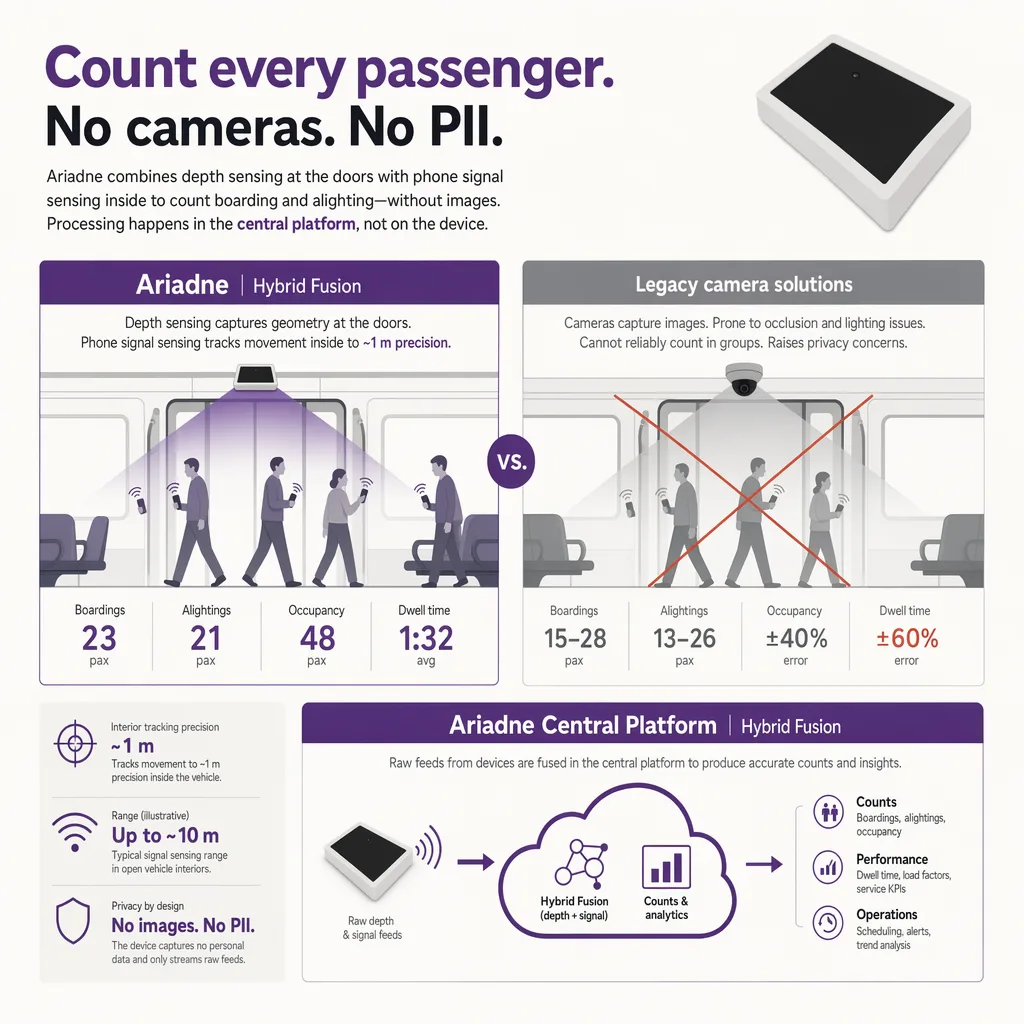
Ariadne measures this with Hybrid Fusion, its patented camera-free method. Time-of-Flight depth sensing counts every visitor at the entrances, capturing geometry rather than images, while patented phone signal sensing follows movement through the interior, detecting the signals a phone emits even in airplane mode, and tracks that movement to about one-metre precision. The sensor streams both feeds to Ariadne, where Hybrid Fusion combines them into one trajectory per visit and computes counts, dwell, and paths. The streams carry no identifier: no MAC address, no device ID, no biometric data, and no camera is involved. Identifiers are stored only when a visitor explicitly opts in, which keeps the method GDPR-friendly and outside biometric territory.
For passenger counting specifically, the pairing matters. Depth sensing gives an accurate line count at entrances and gatelines, splitting groups and handling luggage where a beam or mat would slip. Phone-signal sensing adds what a single counting line cannot see: how that same passenger moves through the interior, which route they take, and how long they dwell at each stage. The result is not just a number at a door but a picture of how the count moves through the space, delivered to Ariadne Analytics without an image ever being recorded.
What accuracy and data to expect
Accuracy is where passenger-counting conversations get vague, so it helps to be concrete about what the number means and what shape it takes.
A modern depth or fused system typically reports line-crossing accuracy in the high-90s percent under normal conditions, with the figure dropping in dense crowds where people overlap. Treat any single headline percentage with suspicion: accuracy depends on mounting height, lane width, crowd density, and whether the vendor counts under real conditions or a clean test. The honest question to ask is not "what is your accuracy" but "what is your accuracy at peak density on a lane my width," because that is where a count either holds or falls apart.
The data itself comes in a few standard shapes. On vehicles, the primary output is boardings and alightings per door per stop, timestamped and tied to location, so it can be joined to the schedule. In buildings, the output is counts per entrance or zone over time, plus, with a method that follows movement, dwell and path. The count feeds three downstream uses: scheduling and load balancing, capacity planning against a safe limit, and revenue or subsidy reporting where the passenger figure has money attached to it. Because the raw feed needs to be joined to timetables, gate events, or point-of-sale, integration is as important as the sensor: a counter that cannot export cleanly to the systems that consume the number is only half a system. For the value of the count arriving live rather than in a next-day batch, see real-time people counting.
Choosing a passenger counting system
Method comparisons are useful, but a purchase decision comes down to matching the method to the job and the constraints around it. A few questions do most of the narrowing.
Start with where you are counting. A bus door, a station gateline, and a wide airport entrance are different problems, and a method that suits one may not suit another. Then ask about density: if the location sees crowds, groups, and luggage, the mechanical methods will underperform and you are choosing among video, depth, and fused approaches. Next, the privacy constraint: if the location cannot host a camera, or you would rather not run a privacy review for every install, a camera-free method is not a preference but a requirement. Finally, integration: confirm the count can export to the scheduling, capacity, and reporting systems that will actually consume it, because a stranded feed has no value.
Where a system fits into a wider analytics stack matters too. A counter that also reads movement and dwell tells you more than a turnstile-style tally, and increasingly these systems apply on-board intelligence to hold accuracy in crowds, which is the subject of AI-enabled people counters. And if the count is one input into a broader effort to keep a hub moving, the operations frame in passenger flow management shows how the number gets used once it exists.
This post is deliberately about the how, not the which. When you are ready to compare an actual system for a site, with counting, movement, and dwell in one camera-free platform, the place to go is Ariadne's people counting solution, which is where buy-intent questions belong.
FAQ
Does passenger counting need a camera?
No. Ariadne counts with Hybrid Fusion: Time-of-Flight depth sensing plus patented phone signal sensing, never cameras. Time-of-Flight captures geometry rather than images, and signal sensing captures no MAC address by default, so the measurement involves no video, no faces, and no biometric data.
What is APC?
APC stands for automatic passenger counting: the automated measurement of how many passengers board, alight, or pass a point in a transport system, without a person tallying by hand. It runs on buses and trains per stop and in stations and airports per entrance, gateline, or security lane.
What methods are used for passenger counting?
Five main families: infrared beams, treadle or weight mats, video, depth (Time-of-Flight) sensing, and phone-signal sensing. Beams and mats are cheap but lose accuracy in crowds and with luggage; video is accurate but captures images; depth and phone-signal sensing reach high accuracy without an image.
How accurate is automatic passenger counting?
A modern depth or fused system typically reports line-crossing accuracy in the high-90s percent under normal conditions, dropping in dense crowds where people overlap. Accuracy depends on mounting, lane width, and crowd density, so the useful question is accuracy at peak density on a lane of your width, not a single headline figure.
Can passenger counting work on buses and trains as well as in stations?
Yes. On vehicles it counts boardings and alightings per door per stop, tied to the door event and location. In stations and airports it counts people through entrances, gatelines, and security lanes over time. The right sensor differs between a vehicle door and a wide building entrance.


