
Every business that serves people in person runs on a flow it usually cannot see. Customers arrive in a shape that changes hour by hour, spread themselves across the space, wait for service, and leave. Most operators plan against a proxy for that flow, last year's sales, a manager's memory of a busy Saturday, a headcount that has not moved in years, rather than against the flow itself. The gap between the proxy and the real movement is where the over-staffed mornings, the lunchtime queues, and the abandoned service counters come from.
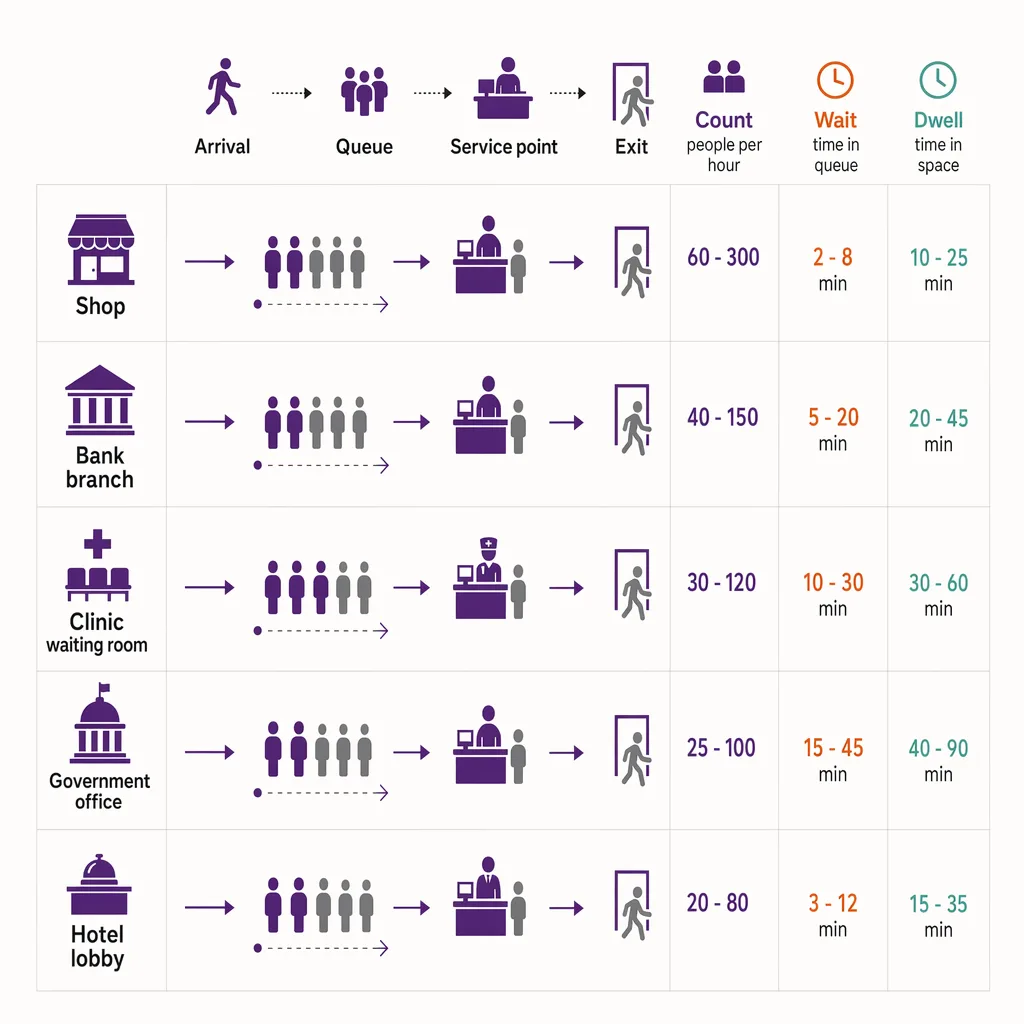
Customer flow is the thing itself: the movement of people through a space where they are served, from arrival to departure. This post is the cross-sector explainer. It defines the term, separates it from the neighbouring words it gets confused with, explains why it matters for queues and staffing and layout, shows how to measure it without cameras, and walks through how to manage against it. Where the pattern is specific to one sector, retail store layout, museum circulation, airport queues, it points to the post that owns that ground rather than re-covering it here.
What is customer flow?
Customer flow is the movement of customers through a space where they are served, from the moment they arrive to the moment they leave: how many come in, where they go, how long they wait, and how they queue. It applies anywhere people are served in person, a shop, a bank branch, a clinic waiting room, a government office, a hotel lobby, so the term is broader than retail footfall. Measuring it well means counting arrivals accurately by time, then following how that demand moves and waits inside the space. Ariadne measures customer flow camera-free, counting every arrival at the entrance and following movement inside without capturing any personal data.
The rest of this post takes that definition apart. First the vocabulary, because "customer flow" sits inside a cluster of near-synonyms that mean different things in practice. Then why it matters, how to measure it, how to manage it, and how the picture changes as you move from a shop to a station.
Customer flow, footfall, and shopper flow: the terms kept straight
The words in this area overlap enough that a planning conversation can go in circles. Four of them are worth pinning down.
Footfall is the count of arrivals, the number of people who enter, usually by time. It is one input into customer flow, the volume at the door, but it says nothing about where people went or how long they waited once inside. A store can have flat footfall and a serious flow problem if everyone arrives in the same twenty minutes and the queue never clears.
Customer flow is the whole movement: arrivals plus what happens after them. It includes footfall, but adds the paths people take, where they cluster, how long they dwell, and how queues form and drain. Footfall is the first frame of the film; customer flow is the film.
Shopper flow is customer flow narrowed to retail: how people move through a store, past fixtures and displays, along the aisles, to the till. It is the same idea applied to a specific job, selling product off a shop floor, and it carries its own vocabulary around store-layout patterns. If retail store movement is what you are after, that is a distinct topic with its own patterns, covered in shopper flow and, for the layout mechanics, in data-driven layout optimization in retail stores. This pillar deliberately does not re-cover store-layout design.
Visitor flow and passenger flow are the same concept moved into other sectors again: visitor flow for attractions and venues (museums, galleries, campuses), passenger flow for transport hubs (airports, stations, terminals). Each has its own constraints, so each has its own guide: visitor flow for venue interiors and passenger flow management for transport operations.
The short version: footfall counts arrivals, customer flow is the movement those arrivals turn into, and shopper, visitor, and passenger flow are that movement inside retail, venues, and transport respectively.
Why customer flow matters: queues, staffing, layout, and conversion
Customer flow is not an analytics luxury. It sits underneath four operational decisions that every service business makes, and getting the flow picture wrong distorts all four.
Queues and wait time. A queue is customer flow going wrong in real time: arrivals outrunning the rate the space can serve them. Waiting is the single most reliable predictor of a poor service experience, and in many settings, a bank branch, a clinic, a government counter, it is the whole experience. Managing the queue means seeing the arrival curve early enough to add service capacity before the line forms, not after a customer has already given up and left.
Staffing. Labor is usually the largest controllable cost in a service operation, and it is almost always scheduled against the wrong signal. Rostering to last year's sales staffs the checkout, not the door, because sales record the moment of payment, which comes after browsing, waiting, and deciding. Rostering to counted arrivals staffs the actual demand, hour by hour, so cover lands when customers do and thins out when the space is quiet.
Layout and space. Where customers cluster and where they never reach is a flow question, and it decides how a space should be arranged. In retail this is the province of store-layout work; in a bank or a clinic it governs where you put the self-service kiosk, the greeter, or the waiting area. The common thread is that layout should be designed against measured movement, not assumption.
Conversion and outcome. In retail, the ratio of visitors to buyers is a direct read on whether the flow is being served well; under-staff a busy hour and the conversion cost is invisible, because the lost sale simply walks out. The link between the traffic that arrived and the money it produced is worked through in footfall to revenue correlation. In non-retail settings the equivalent outcome is a served customer, a completed appointment, or a processed application, but the logic is identical: flow that is measured can be matched with capacity, and flow that is guessed at cannot.
How customer flow is measured, camera-free
Every use above depends on one thing: a count of arrivals that is accurate at the hour and consistent enough to trust as an operational input, plus a read on how that demand moves and waits inside the space. A number that drifts a few percent a day, double-counts groups, or misses people arriving in a cluster produces a plan that is confidently wrong, which is worse than no plan because people schedule and staff around it.
Ariadne measures this with Hybrid Fusion, its patented camera-free method. Time-of-Flight depth sensing counts every visitor at the entrances, capturing geometry rather than images, while patented phone signal sensing follows movement through the interior, detecting the signals a phone emits even in airplane mode, and tracks that movement to about one-metre precision. The sensor streams both feeds to Ariadne, where Hybrid Fusion combines them into one trajectory per visit and computes counts, dwell, and paths. The streams carry no identifier: no MAC address, no device ID, no biometric data, and no camera is involved. Identifiers are stored only when a visitor explicitly opts in, which keeps the method GDPR-friendly and outside biometric territory.
Two properties of that measurement matter for customer flow specifically. Because the count is taken at the entrance and does not depend on a transaction, it captures everyone who arrived, including the browsers, the returners, and the people who left unserved that a sales-based view never sees. And because it is camera-free with no personal data captured, a bank, a clinic, or a government office can measure flow in sensitive settings without a privacy review hanging over the project, which is exactly where cameras are hardest to justify. When the count updates live, the same signal drives in-the-moment decisions, opening a counter, moving a greeter, which is the subject of real-time people counting.
Customer flow management: reading the curve and acting on it
Measuring flow is the input; managing it is the point. Customer flow management is the practice of reading the arrival-and-wait curve and acting on it before a problem sets in. It runs as a short loop.
Read the curve. Look at arrivals by hour and by day of week over a long enough window that the pattern is stable. What you want is the shape within the day, the lunch surge, the school-run dip, the end-of-day rush, not a single daily total. That shape is remarkably repeatable once you can see it, and it is largely invisible to memory.
Forecast the near term. Project the next few days from that history, adjusting for known drivers like paydays, weather, and local events. A short horizon that updates as the day develops beats a static plan locked in a week ahead.
Match capacity to the forecast. Convert expected arrivals into the service capacity needed to hold wait times inside target: how many counters open, how many staff on the floor, when the second till or the extra kiosk comes online. In a queue-driven setting this is where a target service rate does the work, expected arrivals divided by how many one server can handle per hour gives the number of servers each hour needs.
Act in real time on the gap. Forecasts are never exact, so the live count is the safety net. When arrivals run ahead of plan, open a lane, pull a greeter to triage, or push an announcement before the queue turns into a crush. When they run behind, release cover to other work.
The value is in running this as a continuous loop rather than a one-off study. Re-measure, re-forecast on a short horizon, and the operation keeps tracking demand as the flow pattern shifts across seasons, after a refit, or when a neighbouring business opens or closes.
How customer flow differs by sector: retail, services, venues, transport
The definition is constant across sectors, but the constraints and the vocabulary change, which is why the deeper how-to belongs in a sector-specific guide.
Retail. In a shop, customer flow is about the path from the door to the fixtures to the till, and the layout that shapes it. The measure that matters most is conversion, whether the flow turned into a purchase, and the money link between the two runs through footfall to revenue correlation. For the in-store movement patterns and the store-layout mechanics, the owning guide is shopper flow. This pillar points down to it rather than repeating the retail-specific patterns.
Services (banking, healthcare, government, hospitality). Here the defining feature is the queue for a service counter or an appointment, and the outcome is a served customer rather than a sale. Wait time is the primary metric, and privacy is often the tightest constraint, which is why a camera-free count is a good fit for a branch, a clinic waiting room, or a public office. The management job is staffing service capacity to the arrival curve so wait times stay inside target.
Venues and attractions. In a museum, gallery, or attraction, customer flow becomes visitor flow: circulation past exhibits, dwell at zones, chokepoints between rooms, and staying inside a safe capacity. Timed entry and one-way routes are the levers, and the owning guide is visitor flow.
Transport. In an airport terminal, a rail or metro station, or a bus and ferry hub, customer flow becomes passenger flow, and the stakes shift to surges, safe capacity, and moving people through security, boarding, and interchange without a crush. It is an operations input for the teams running the hub, and the owning guide is passenger flow management, with the counting side covered in passenger counting.
Across all four, the underlying method is the same: count arrivals accurately, follow how that demand moves and waits, and act on the curve. The platform that turns those counts into the curves, forecasts, and alerts an operator works from is Ariadne Analytics, and the measurement behind it is camera-free people counting.
FAQ
What is customer flow in simple terms?
Customer flow is how people move through a space where they are served, from arrival to departure: how many come in, where they go, how long they wait, and how they queue. It applies to any in-person service setting, a shop, a bank, a clinic, a government office, a hotel, so it is broader than retail footfall, which only counts arrivals.
What is the difference between customer flow and footfall?
Footfall is the count of arrivals, the number of people who enter, by time. Customer flow is the whole movement those arrivals turn into: the paths people take, where they cluster, how long they dwell, and how queues form and clear. Footfall is one input into customer flow, not the same thing.
Do you need cameras to measure customer flow?
No. Ariadne counts with Hybrid Fusion: Time-of-Flight depth sensing plus patented phone signal sensing, never cameras. Time-of-Flight captures geometry rather than images, and signal sensing captures no MAC address by default, so the measurement involves no video, no faces, and no biometric data. That makes it usable in sensitive settings like bank branches and clinics where cameras are hard to justify.
How do you manage customer flow?
Read the arrival-and-wait curve from a measured count, forecast the near term against known drivers like paydays and weather, match service capacity to that forecast, and act in real time when arrivals run ahead of plan by opening a counter or moving staff. It works as a continuous loop, not a one-off study.
Is customer flow the same as shopper flow?
Not quite. Customer flow is the cross-sector umbrella term for any served space. Shopper flow is customer flow narrowed to retail, how people move through a store past fixtures to the till, with its own store-layout patterns. For retail specifically, see the shopper flow guide; for venues and transport, see visitor flow and passenger flow management.
How does measuring customer flow help staffing?
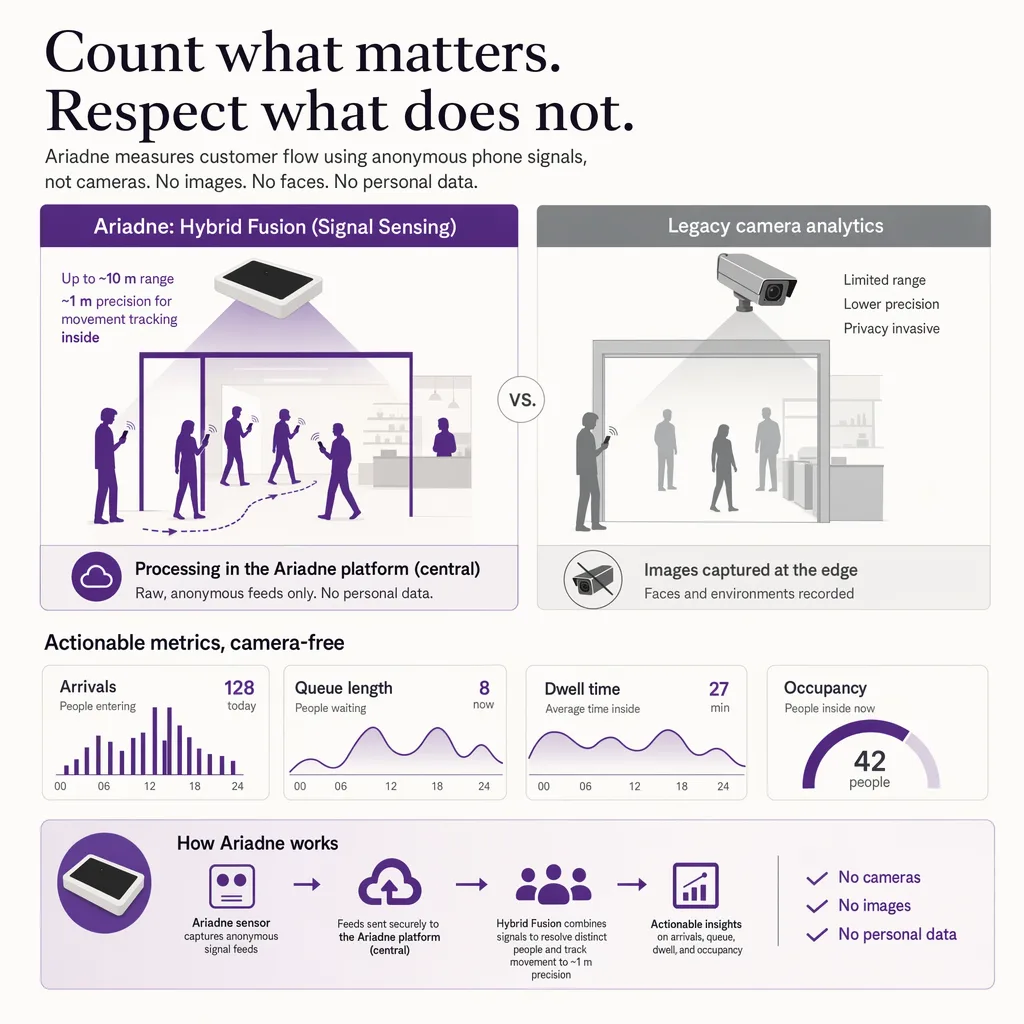
Staffing to counted arrivals lands cover when customers actually show up, hour by hour, rather than staffing to sales, which record the moment of payment and come later than the demand that created the work. A count taken at the entrance also captures browsers, returners, and people who left unserved that a sales-based view never sees.


