
Every airport operations team knows the security checkpoint is where a good morning turns bad. A departure bank puts its passengers on the concourse in a tight window, the queue at the lanes builds faster than anyone opens capacity, and within minutes a manageable wait becomes a complaint, a missed connection, and a photo on social media. Security queue analytics is the practice of seeing that surge coming early enough to staff for it, rather than reacting once the line is already out the door.
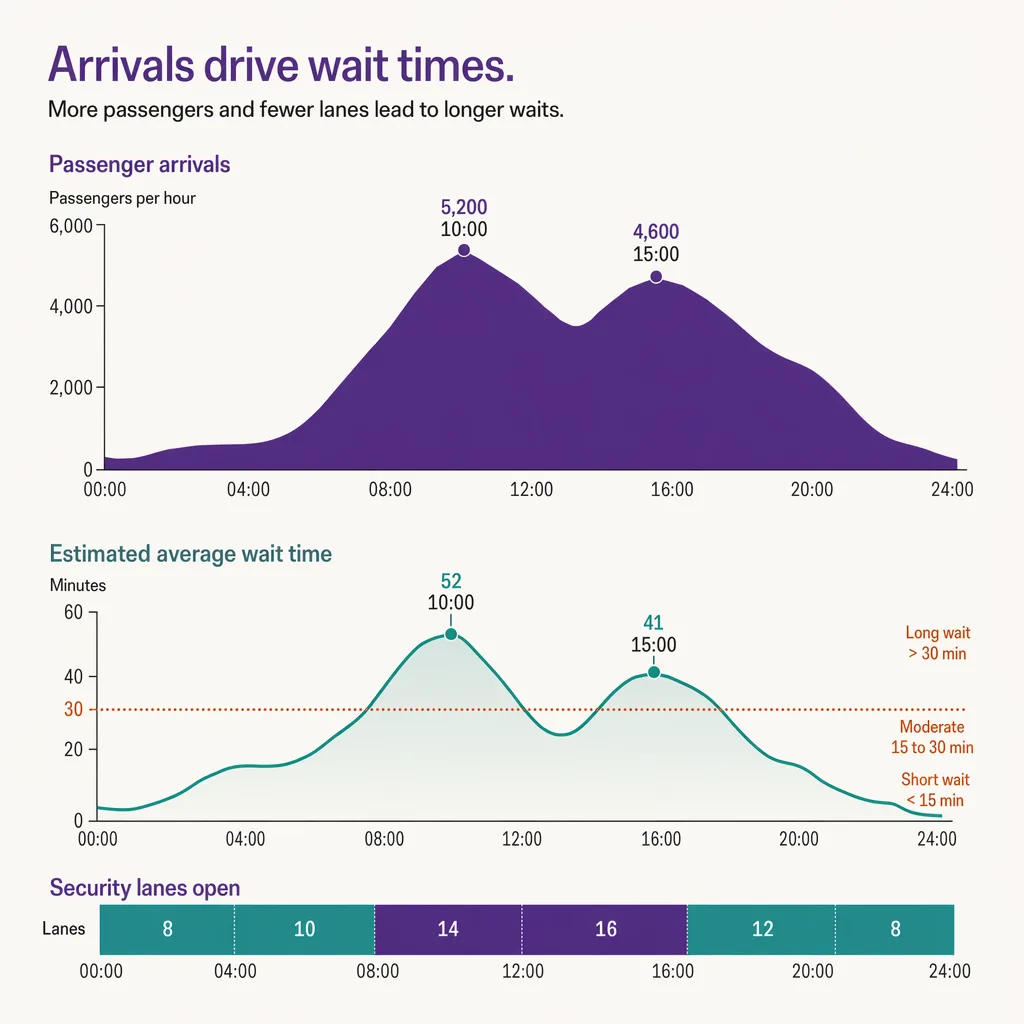
This is a narrower problem than "how airports count people," and it is a different problem from general checkpoint wait forecasting. The parent concept, airport queue prediction, covers predicting wait across the terminal. This post stays on the security lane itself: the gap between queue length and real wait, how upstream flow gives you a forecast lead time, and how to staff lanes to a service level instead of guessing. One point sits under all of it, and it is worth stating before anything else. Counting informs staffing and lane decisions. It does not screen passengers, detect threats, or replace any part of the security process.
How do airports predict and manage security checkpoint wait times?
Airports predict security wait by measuring the flow of passengers arriving upstream, at the curb, at check-in, and at the terminal entry, then modelling how that arrival curve will hit the security lanes given the number of lanes open and each lane's throughput. Wait time is not the same as queue length: a long queue with every lane open clears faster than a short queue with lanes closed. A measurement-led approach forecasts the arrival surge with enough lead time to open lanes before the queue forms, then confirms the actual wait against the target. Counting informs staffing and lane decisions. It does not screen passengers or replace the security process itself.
The rest of this post takes those pieces in order, starting with the distinction that trips up most dashboards: the difference between how long the line looks and how long a passenger actually waits.
Queue length vs actual wait time: why the two diverge and which one to staff to
A queue is a physical thing you can see. Wait time is what the passenger experiences, and the two move independently. A queue of two hundred people with every lane open and staffed at full throughput can clear in a few minutes. A queue of eighty people with half the lanes closed can take three times as long. If your only measure is how far the line stretches back, you will staff to the wrong signal, adding capacity when the queue looks alarming but is already clearing, and missing the short queue that is quietly stalling because processing has slowed.
Wait time is the number that belongs on the service target, because it is the number the passenger and the airline care about. Queue length is useful as an input, but only alongside how fast the queue is moving. The practical measure is throughput: passengers processed per lane per minute, multiplied by lanes open. Pair that with the count of passengers arriving into the queue, and you can compute the wait an arriving passenger faces right now, and project the wait a passenger arriving in twenty minutes will face if nothing changes.
That projection is the whole game. A checkpoint that only reports its current state is always one step behind the surge. A checkpoint that reports where the wait is heading, given the arrival curve already measured upstream, can act before the queue forms rather than after it has already spilled past the stanchions.
Upstream flow as the leading indicator: curbside to check-in to security lead time
The security queue does not appear from nowhere. Passengers arrive at the curb or the car park, move through check-in and bag drop, and reach the lanes some minutes later. That travel time is a gift: it is the lead time you get for free if you are measuring the flow upstream. A spike in arrivals at the terminal entrance is a spike at security a predictable interval later. Measure the first, and you can forecast the second before the queue at the lanes has started to build.
This is why the security checkpoint should never be measured in isolation. The curbside congestion building at the drop-off zone is the same passenger wave that will hit security shortly after, and the entry counts at the terminal doors are the earliest reliable signal of what the lanes are about to face. An airport that measures the arrival curve across those upstream points, rather than watching only the security queue, converts a reactive scramble into a planned response. The pillar on how airports count passengers explains the underlying measurement; the security-specific value is the lead time that upstream measurement buys.
The lead time varies by terminal layout, and that variation is itself worth measuring. A large terminal with a long walk from the door to the lanes gives more warning than a compact one where passengers reach security almost immediately. Knowing your own arrival-to-security interval, from real counts rather than assumption, is what turns an upstream spike into an actionable forecast with a specific number of minutes attached.
Staffing lanes to a wait-time service level
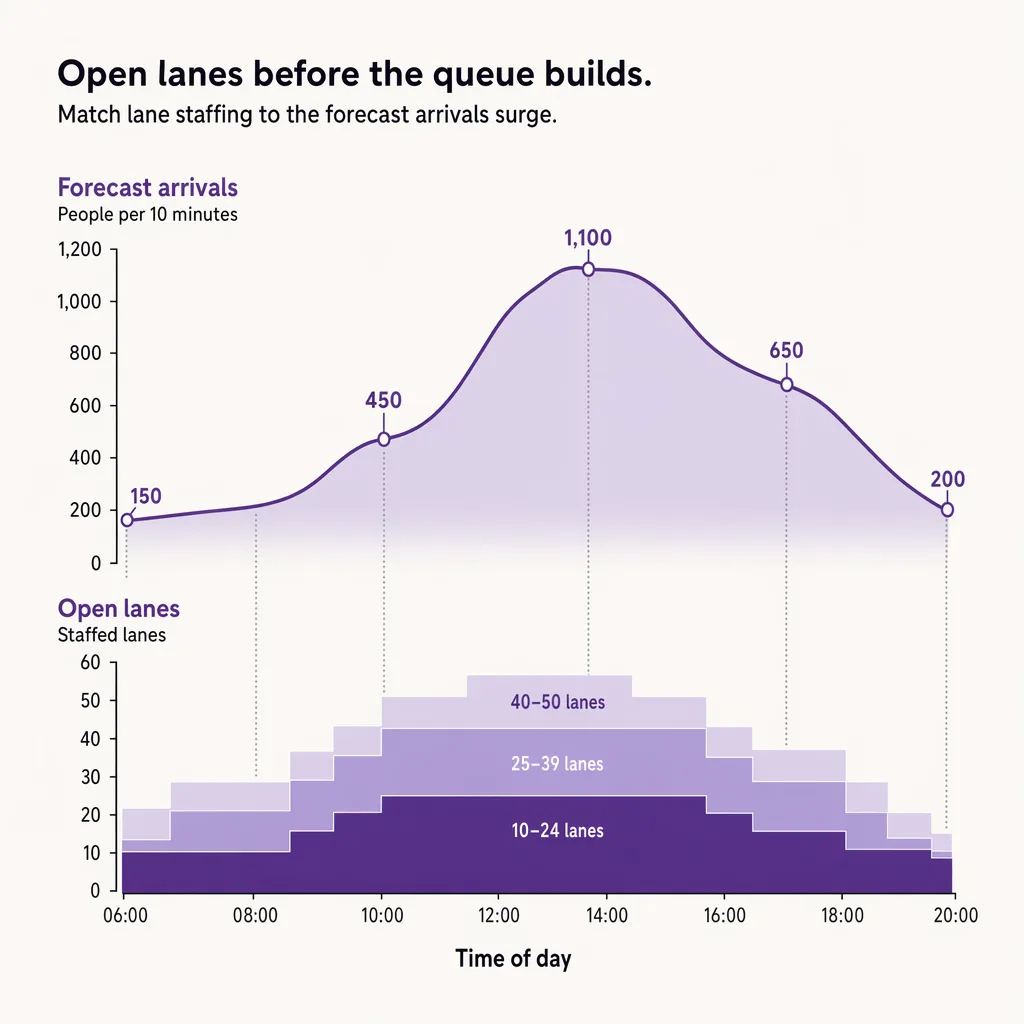
Once you can forecast the wait, the operating question becomes concrete: how many lanes need to be open, and when, to hold wait under the target. Each open lane processes a known number of passengers per minute. The forecast arrival curve tells you how many passengers are coming and when. The service level tells you the wait you refuse to exceed. Put those together and lane opening stops being a judgment call and becomes a schedule you can plan against.
The cost of getting it wrong runs both ways. Open too few lanes and the queue overruns the target, generating complaints and missed flights. Open too many and you are paying staff to stand at empty lanes during a lull. Staffing to a wait-time service level, driven by a measured arrival forecast, is how an airport holds the line on passenger experience without carrying idle labour all day. The same demand-driven logic that airports apply to staffing to demand elsewhere in the terminal applies at the checkpoint, with the added constraint that lane capacity is chunky: you open a whole lane or you do not, so the forecast needs enough lead time to have staff in position before the surge arrives, not as it peaks.
There is a planning layer above the day-of response, too. Weeks of measured arrival curves show the recurring shape of demand: the early-morning business bank, the mid-morning leisure wave, the recurring soft periods. That pattern is what a lane-opening roster is built from, so the day-of forecast is correcting a plan that is already close, not improvising from scratch.
What counting can and cannot do at a security checkpoint
This is the line that must stay bright. Footfall and flow measurement at a security checkpoint counts people and times the wait. It tells operations how many passengers are arriving, how fast the lanes are clearing, and where the wait is heading. That is an operations input, and a valuable one.
It is not a security or screening system. It does not identify individuals, detect prohibited items, assess threat, or make any decision inside the screening process. Those functions belong to the security equipment and the officers who operate it, under the relevant aviation-security authority. Nothing in a people-counting deployment substitutes for or interferes with them. Framed correctly, the analytics sit alongside the security process, helping the airport staff and manage the queue that forms in front of it, and stopping firmly at the point where screening begins.
Keeping that distinction explicit matters for procurement and for trust. An airport buying queue analytics is buying an operations and planning tool, not a security certification, and any vendor blurring that line should be treated with caution.
How Ariadne measures flow into the checkpoint
The forecast is only as good as the counts underneath it, and at an airport the measurement method has to clear a privacy bar as high as anywhere in the built environment. Ariadne measures the arrival flow into a checkpoint without cameras and without capturing personal data.
Ariadne measures this with Hybrid Fusion, its patented camera-free method. Time-of-Flight depth sensing counts every visitor at the entrances, capturing geometry rather than images, while patented phone signal sensing follows movement through the interior, detecting the signals a phone emits even in airplane mode, and tracks that movement to about one-metre precision. The sensor streams both feeds to Ariadne, where Hybrid Fusion combines them into one trajectory per visit and computes counts, dwell, and paths. The streams carry no identifier: no MAC address, no device ID, no biometric data, and no camera is involved. Identifiers are stored only when a visitor explicitly opts in, which keeps the method GDPR-friendly and outside biometric territory.
For a security checkpoint, that produces the two numbers the forecast runs on: the arrival flow into the queue, measured at the terminal entry and the approach, and the throughput and wait at the lanes themselves. Because the fusion happens centrally in the Ariadne platform rather than on the unit, the whole flow across the upstream zones and the checkpoint is stitched into one consistent picture, which is what makes the arrival-to-security lead time measurable rather than guessed. For the terminal-wide view this fits into, see airport analytics, and for the underlying counting method, measuring passenger flow.
Related reading
FAQ
Is queue length the same as security wait time?
No. Queue length is how far the line stretches; wait time is how long a passenger actually stands in it. A long queue with every lane open and processing quickly can clear faster than a short queue with lanes closed. Staff to measured wait time, using queue length and throughput together as inputs.
How far ahead can an airport forecast a security surge?
As far ahead as the travel time between the upstream measurement point and the lanes. A spike in arrivals at the terminal entrance reaches security a predictable interval later, so measuring flow at the curb, check-in, and entry gives a lead time of minutes to open lanes before the queue forms. The exact interval depends on the terminal layout and is best measured from real counts.
Does people counting screen passengers or detect threats?
No. Counting is an operations input for staffing and lane decisions. It counts arrivals and times the wait. It does not identify individuals, detect prohibited items, or make any decision inside the screening process. Those functions belong to the security equipment and officers under the relevant aviation-security authority.
Do you need cameras to measure flow into a security checkpoint?
No. Ariadne counts with Hybrid Fusion: Time-of-Flight depth sensing plus patented phone signal sensing, never cameras. Time-of-Flight captures geometry rather than images, and signal sensing captures no MAC address by default, so the measurement involves no video, no faces, and no biometric data.
How does measuring wait help staff the lanes?
Each open lane processes a known number of passengers per minute, and the measured arrival curve tells you how many passengers are coming and when. Combined with a wait-time target, that lets an airport schedule lane openings to hold wait under the target without carrying idle staff at empty lanes during quiet periods.
---


