
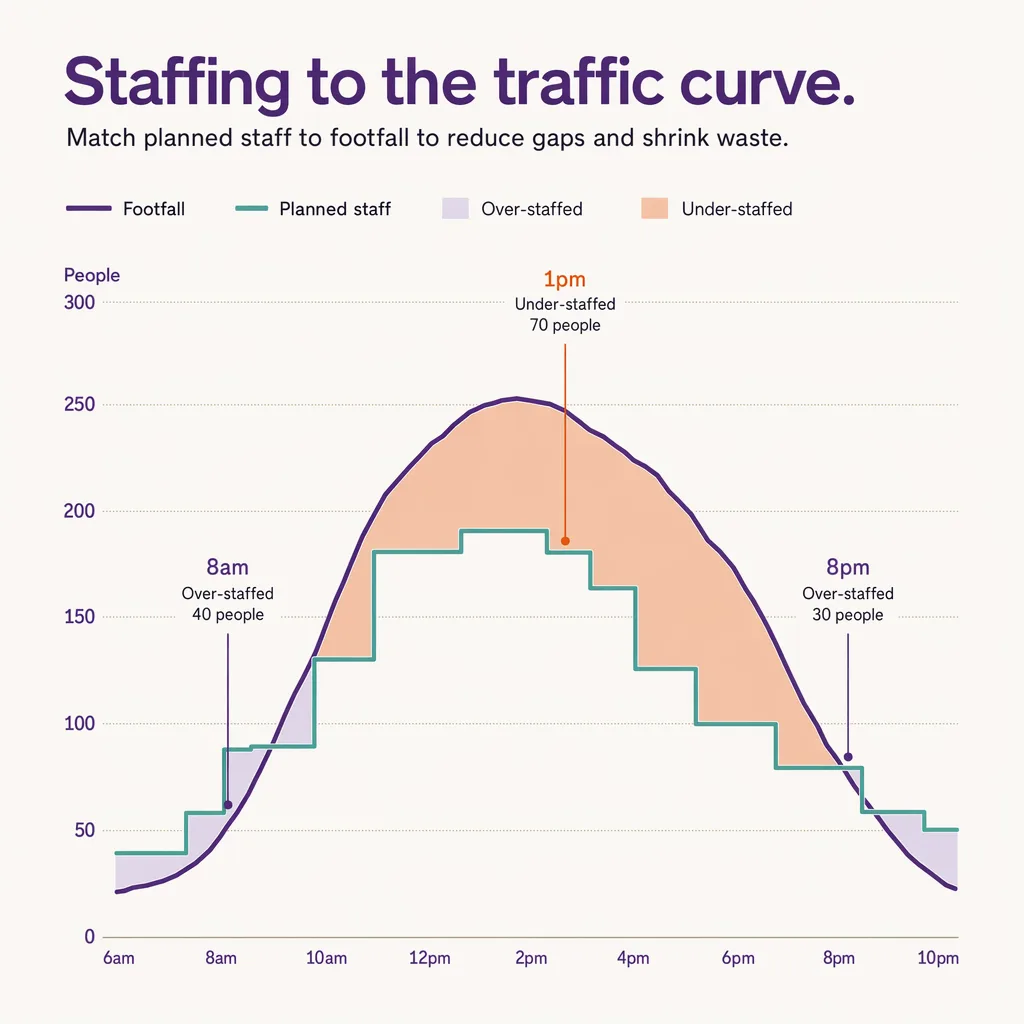
Most retail rosters are built on the wrong number. A manager opens the scheduling tool, looks at last year's sales for the same week, adds a bit for a promotion, and spreads staff across the day in a shape that has barely changed in years. It feels reasonable, and it is almost always slightly wrong, because sales are what happened after people arrived, not a record of when they arrived. The gap between the two is where over-staffed mornings and under-staffed lunch peaks come from.
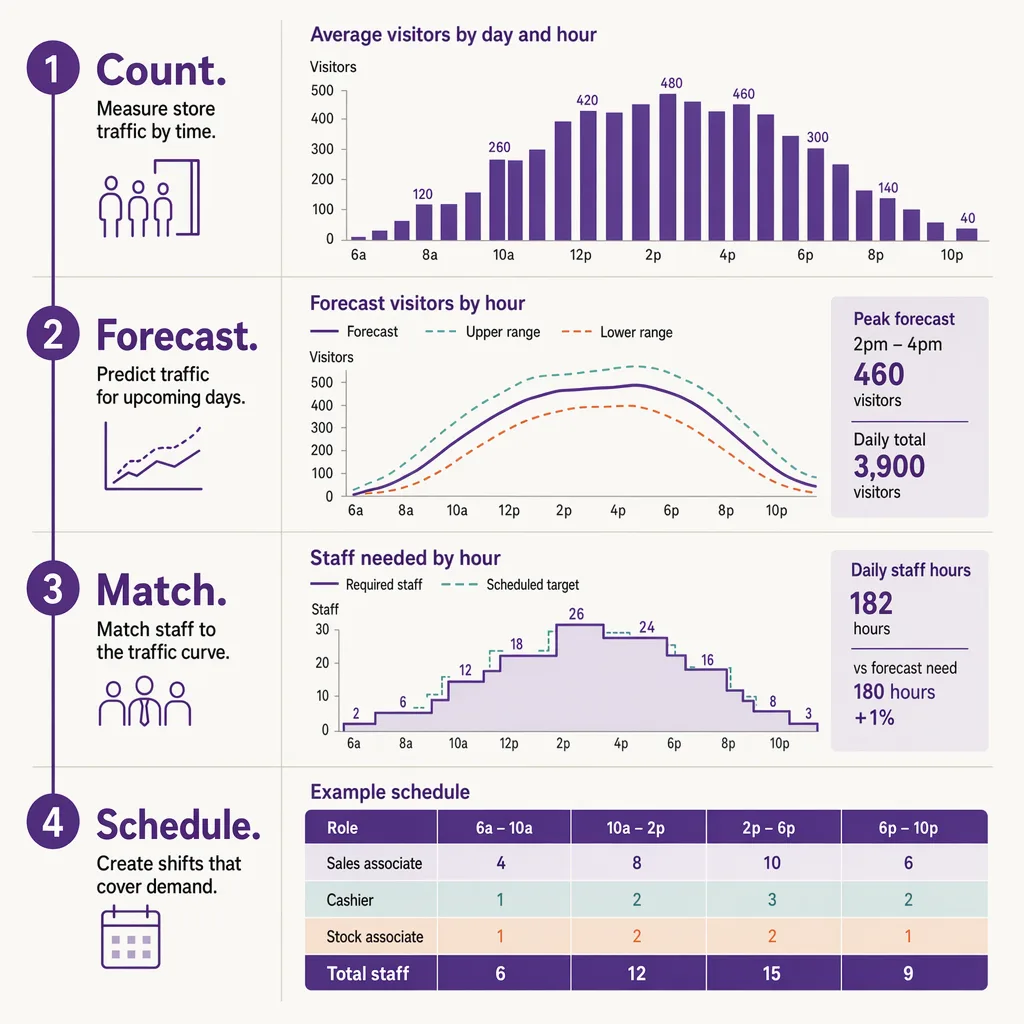
Footfall-based staff scheduling closes that gap by rostering to the traffic itself. This post is the mechanics-first how-to: how to turn a measured count of who walks in, hour by hour, into a roster that lands staff when shoppers do. It sits underneath the broader practice of demand-based scheduling; if you want the wide view of scheduling staff to demand, start with scheduling staff to demand. This one narrows to footfall as the specific demand signal and walks the count-to-roster path step by step.
How does footfall-based staff scheduling work?
Footfall-based staff scheduling builds the roster from measured store traffic instead of last year's sales or a manager's habit. You count how many people actually enter, by hour and by day, then forecast the next few days from that history and layer in known drivers like weather and paydays. The forecast sets how many staff each hour needs, so hours land when shoppers do and thin out when the store is quiet. Ariadne supplies the traffic signal camera-free, counting every visitor at the entrance without capturing any personal data, so the roster reacts to real demand rather than a guess.
The rest of this post takes that four-part idea apart: why sales and gut feel drift away from demand, what kind of traffic signal you need before any of it works, the exact steps from a raw count to a published roster, and the extra inputs that make the forecast sharper.
Why hours drift away from demand when you schedule on sales or gut feel
Scheduling on last year's sales bakes in two errors at once. The first is timing. Sales record the moment of the transaction, which for most retail is clustered around the till after a shopper has browsed, tried, and decided. The people who create the workload, the ones who need a fitting room opened, a question answered, or a queue managed, arrived earlier and in a different shape than the sales curve shows. Staff a shop to the sales curve and you are staffing to the checkout, not to the door.
The second error is survivorship. Sales only count the visits that converted. A quiet-looking sales hour might have been quiet because too few staff were on the floor to convert the people who did come in, which then justifies keeping that hour thin next year. The roster and the sales report agree with each other, and both are wrong, because neither can see the traffic that walked out unserved. A count of entries breaks that loop by measuring demand independently of whether it converted.
Gut feel has its own failure mode. A manager remembers the dramatic days, the pre-holiday crush and the dead Tuesday, and smooths everything in between into an average that matches neither. The lunch surge, the school-run dip, the payday-weekend lift: these are real, repeatable, and largely invisible to memory, but they show up plainly in an hourly count. Footfall scheduling replaces the remembered shape of the week with the measured one.
The traffic signal you need first: hourly, accurate, camera-free counts
None of this works on a rough number. To roster to traffic you need counts that are accurate at the hour, consistent day to day so the history is comparable, and clean enough to trust as an operational input rather than a rough gauge. A count that drifts a few percent each day, or that double-counts groups and misses tailgaters, produces a forecast that is confidently wrong, which is worse than no forecast because people plan around it.
Ariadne measures this with Hybrid Fusion, its patented camera-free method. Time-of-Flight depth sensing counts every visitor at the entrances, capturing geometry rather than images, while patented phone signal sensing follows movement through the interior, detecting the signals a phone emits even in airplane mode, and tracks that movement to about one-metre precision. The sensor streams both feeds to Ariadne, where Hybrid Fusion combines them into one trajectory per visit and computes counts, dwell, and paths. The streams carry no identifier: no MAC address, no device ID, no biometric data, and no camera is involved. Identifiers are stored only when a visitor explicitly opts in, which keeps the method GDPR-friendly and outside biometric territory.
Two properties of that signal matter for scheduling specifically. Because the count is device-independent and taken at the entrance, it captures everyone who walked in, including the browsers and returners a transaction-based view never sees. And because it is camera-free with no personal data captured, a retailer can measure every hour of every day without a privacy review hanging over the roster. For the wider picture of how the counting works, see camera-free people counting.
From count to roster in four steps: measure, forecast, translate to hours, publish
With a trustworthy count in hand, footfall scheduling runs as four repeatable steps.
- Measure. Collect entries by hour and by day of week for a long enough window that the pattern is stable, several weeks at minimum. The output you want is an hourly demand curve for each day, not a single daily total, because the whole point is to see the shape within the day.
- Forecast. Project the next few days from that history. A short horizon is more accurate than a long one, which is why a rolling short-horizon traffic forecast that updates as the day develops beats a static template locked in a week ahead. The forecast is a curve of expected arrivals per hour.
- Translate to hours. Convert expected arrivals into required staff. This is where a target staff-to-customer ratio does the work: decide how many visitors one staff member can serve well in a given hour and department, then divide the forecast by that ratio to get headcount per hour. The ratio is the bridge between a traffic number and a people number.
- Publish. Turn the hourly headcount into shifts that respect availability, contracted hours, and local rules, then publish far enough ahead that staff can plan. The forecast tells you the shape; the shift builder fits real people to it.
The value comes from doing all four as a loop, not once. Re-measure continuously, re-forecast on a short horizon, and the roster keeps tracking demand as the store's traffic pattern shifts across seasons and after a refit or a new neighbour opens.
What sharpens the forecast: day-of-week shape, weather, local events
A pure history-based forecast is a good start, but a few known drivers explain most of the variance around it, and adding them turns a decent forecast into a reliable one.
Day-of-week shape is the largest and most stable driver. Saturday is not a busier version of Tuesday; it is a different curve, often with a later, flatter peak. Forecasting each weekday from its own history rather than from a blended average is the single biggest accuracy gain available, and it is why the day-of-week traffic shape deserves its own line in the model. The lunch-hour traffic surge is a related within-day pattern that many stores under-staff precisely because the sales from those visits land later in the afternoon.
Weather is the next lever, especially for stores with any exposure to passing footfall or destination trips. A wet Saturday and a bright one produce materially different curves, and folding a forecast of weather impact on footfall into the model catches swings that history alone treats as noise. Local events, paydays, school terms, and holidays round it out: each is a known, dated driver that shifts the curve in a repeatable direction, so encoding them as calendar features keeps the forecast from being surprised by the predictable.
Where footfall scheduling meets compliance and swaps
A roster built to traffic still has to be a legal, workable roster. Two operational realities sit alongside the forecast and should be designed in from the start rather than bolted on.
The first is scheduling law. Fair-workweek and predictive-scheduling rules in a growing number of jurisdictions govern how much notice staff must get, penalise last-minute changes, and constrain clopening and short-rest shifts. A demand-driven roster that reacts too aggressively to a fresh forecast can collide with those rules, so the publishing step has to respect the notice window even when the traffic signal wants to move faster. The trade-offs are covered in predictive scheduling laws.
The second is what happens after publication. Demand moves, people call in sick, and the neat forecast meets a messy day. A functioning shift-swap automation process lets staff cover gaps without a manager rebuilding the roster by hand, which is what keeps footfall-aligned staffing from becoming a burden on the people running the floor. Traffic-driven demand-based scheduling is the input; a humane, compliant shift process is what turns it into hours people actually work.
Taken together, the practice is simple to state and demanding to run well: measure real arrivals, forecast them honestly, convert them to hours through a ratio you can defend, and publish within the rules. Do that on a clean, camera-free count and the roster stops being a memory of last year and starts being a response to this week.
Related reading
FAQ
Do I need cameras for footfall-based staff scheduling?
No. Ariadne counts with Hybrid Fusion: Time-of-Flight depth sensing plus patented phone signal sensing, never cameras. Time-of-Flight captures geometry rather than images, and signal sensing captures no MAC address by default, so the measurement involves no video, no faces, and no biometric data.
Why schedule to footfall instead of sales?
Sales record when people paid, which is later and differently shaped than when they arrived and created the workload. Sales also only count visits that converted, so they hide demand that walked out unserved. A count of entries measures demand directly, including browsers and returners a sales view misses.
How far ahead can you forecast store traffic accurately?
A short horizon that updates through the day is more accurate than a static template set a week out. Most stores publish shifts ahead to meet notice rules, then refine coverage against a rolling short-horizon forecast as the day develops.
How does footfall become a number of staff?
Through a target staff-to-customer ratio. Decide how many visitors one team member can serve well per hour in a department, then divide the forecast arrivals by that ratio to get required headcount for each hour.
Is footfall-based scheduling compatible with predictive-scheduling laws?
Yes, if the publishing step respects the required notice window. The traffic signal can suggest fast changes, but the roster still has to honour advance-notice and premium-pay rules, so demand-driven coverage is planned within those constraints rather than overriding them.
---


