
What predictive scheduling laws are
Predictive scheduling laws (also called fair workweek or secure scheduling laws) are local and state rules that require employers to give workers their schedules in advance, pay a premium when shifts change late, and respect a minimum rest period between shifts. They sit on top of federal wage and hour law in the United States and on top of working-time rules in the European Union. They exist because hourly workers, especially in retail, hospitality, and food service, were being scheduled on a few days' notice with shifts that shifted by the hour, which made childcare, second jobs, and household planning effectively impossible.
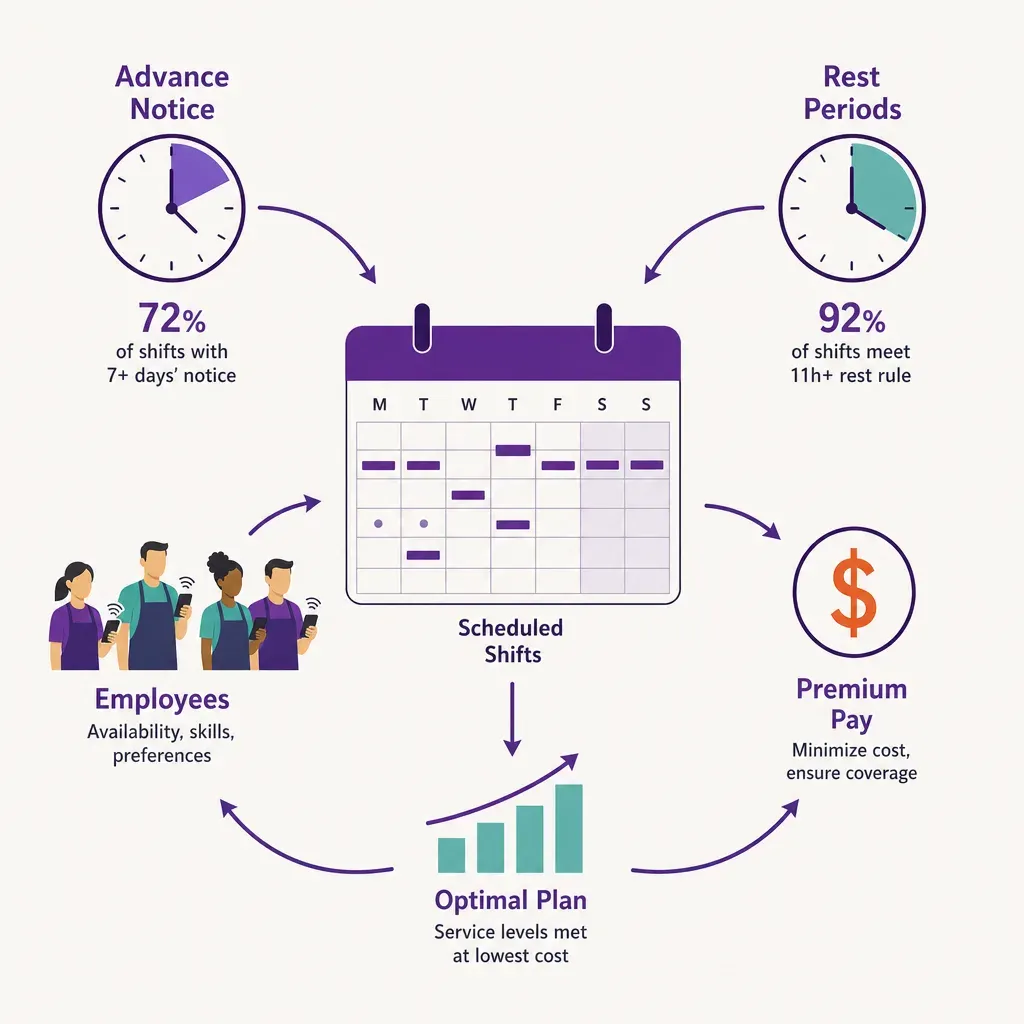
If you run stores and schedule shift workers against a demand forecast, these laws shape how that forecast is allowed to land in a roster. This post is an operator's guide to the pattern, not a legal opinion. The text below describes how the laws are commonly structured and how forecast-led scheduling fits inside them. It is informational only. Treat it as a primer for the conversation with employment counsel, not as a substitute for one. For the underlying scheduling pattern that hooks into a counting platform, the hub is employee scheduling, and the upstream demand signal is people counting.
This is not legal advice. The summaries below describe the publicly known shape of these laws as written; specifics, thresholds, and exemptions change, and only an employment lawyer in the relevant jurisdiction can tell you what applies to your business.
Why the 14-day shift window keeps showing up
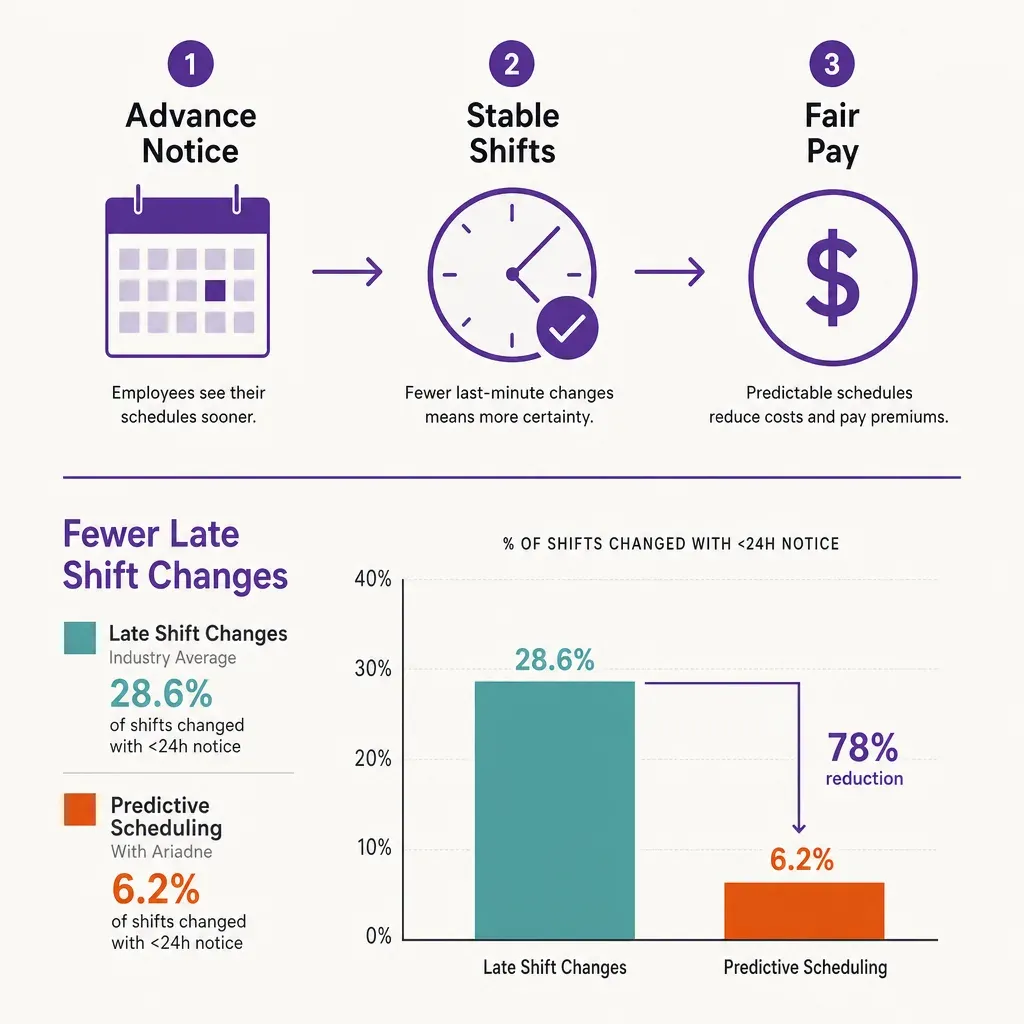
Across most of the US predictive-scheduling ordinances, the headline requirement is the same: post the schedule a fixed number of days before the work week begins, and pay a premium if it changes after that. The most common figure is fourteen days. Some jurisdictions started at seven and moved to fourteen. A few sit at ten. The reason fourteen days became the default is operational: a two-week horizon is long enough for a worker to arrange childcare and a second job, and short enough that a retailer's demand forecast still carries useful signal.
Fourteen days is also the natural cadence of a retail roster cycle. Most workforce management platforms publish on a one-week or two-week horizon and refine inside the day. A two-week posting window means the forecast that produces the published roster has to be stable on a two-week horizon, with any change inside that window carrying a financial cost. That cost is what aligns the scheduler's interests with the worker's.
The financial cost is usually called predictability pay, or schedule-change pay. It is paid in addition to wages and tracks how much notice the worker received for the change. A typical pattern, again as written rather than as universal:
- Cancelling or shortening a shift inside the posted window: pay a percentage of the lost hours, often half or all of the originally scheduled wage for the cancelled hours.
- Adding hours or moving a shift inside the posted window: pay a flat premium, often equivalent to one hour at the worker's rate, on top of the worked hours.
- Calling a worker in or sending them home early on the day: pay a minimum call-in or a minimum shift length even if fewer hours are actually worked.
Worker-initiated changes (swaps, voluntary pickups, time-off requests) typically do not trigger the premium. The premium attaches to employer-initiated changes inside the protected window. Distinguishing one from the other in software is a recurring source of compliance bugs.
Where these laws are in force
The US patchwork is the awkward part. There is no federal predictive-scheduling law. Coverage is a city and state mosaic, and a national retailer with stores in multiple jurisdictions has to comply with the strictest applicable rule on a store-by-store basis. The publicly known set, as of writing:
- Seattle, Washington. Secure Scheduling Ordinance, in force since 2017. Retail and food service with 500+ employees globally. Fourteen days advance notice, predictability pay for employer-initiated changes, minimum rest between shifts, right to request a preferred schedule.
- New York City, New York. Fair Workweek Law, in force since 2017. Retail and fast food, with separate provisions for each. Fourteen days advance notice, predictability pay, restrictions on on-call shifts in retail, restrictions on clopening shifts in fast food.
- Oregon (statewide). The first US state to adopt a statewide rule, in force since 2018. Retail, hospitality, and food service with 500+ employees worldwide. Fourteen days advance notice, predictability pay, ten-hour rest period between shifts.
- Philadelphia, Pennsylvania. Fair Workweek Ordinance, in force since 2020. Retail, hospitality, and food service with 250+ employees and 30+ locations worldwide. Fourteen days advance notice, predictability pay, right to rest of nine hours between shifts.
- Chicago, Illinois. Fair Workweek Ordinance, in force since 2020. Broader sector coverage than the coastal ordinances, including healthcare and warehouse work, with employer-size thresholds that vary by sector. Schedules posted fourteen days in advance, predictability pay, ten-hour rest period.
- Emeryville, San Francisco, Berkeley, and Los Angeles, California. Local ordinances, structurally similar to the others, with thresholds and sector scope that vary by city.
Other jurisdictions have proposed or piloted similar rules and may follow. The structural shape is consistent enough that a retailer building a compliant scheduling pattern once can usually extend it to a new jurisdiction by changing thresholds rather than rebuilding the workflow.
The EU side: working-time and predictability
The European Union does not have a directly equivalent predictive-scheduling regime, but the same problem is addressed through two instruments that EU and EEA retailers schedule against.
The Working Time Directive (2003/88/EC) sets the floor: a minimum daily rest of eleven consecutive hours per 24-hour period, a minimum weekly rest of 24 hours plus the daily rest, a maximum average working week of 48 hours including overtime over a reference period, and minimum paid annual leave. Member states transpose this into national law, sometimes with sector-specific variations. For a retail scheduler, the directive is the boundary inside which any roster has to sit, and the rest periods are non-negotiable in a way that US predictability pay is not (you cannot buy your way out of a rest violation; you can buy your way out of a late notice).
The Directive on Transparent and Predictable Working Conditions (2019/1152) is the closer parallel. It requires that workers in unpredictable work patterns be told at the start of employment which hours and days they may be required to work, that any work outside those reference hours requires reasonable advance notice, and that the worker has the right to refuse without penalty if the notice is too short. Member states have transposed this into national law on different timelines and with different specifics. Germany, France, the Netherlands, and Ireland each implement it differently. Some apply stricter notice and on-call rules to retail and hospitality than the directive itself requires.
Practically, a EU-based retailer building a forecast-led scheduling pattern is working against three things at once: national working-time rules that set the rest-and-hours floor, national transposition of the predictability directive that constrains how late a shift can be called, and collective bargaining agreements (Tarifvertrag in Germany, accords de branche in France) that often go further than either. None of this rules out demand-led scheduling. It does mean the forecast horizon and the publish cadence have to match the strictest applicable rule in each country.
Where forecast-led scheduling fits and where it clashes
Forecast-led scheduling is the practice of sizing shifts against expected demand rather than against last year's calendar. A people counting platform produces a forward-looking visitor forecast per hour per store and, where useful, per zone. A workforce management platform consumes that forecast and proposes a roster. With predictive-scheduling laws on top, the question is when the forecast can change the roster and when it cannot.
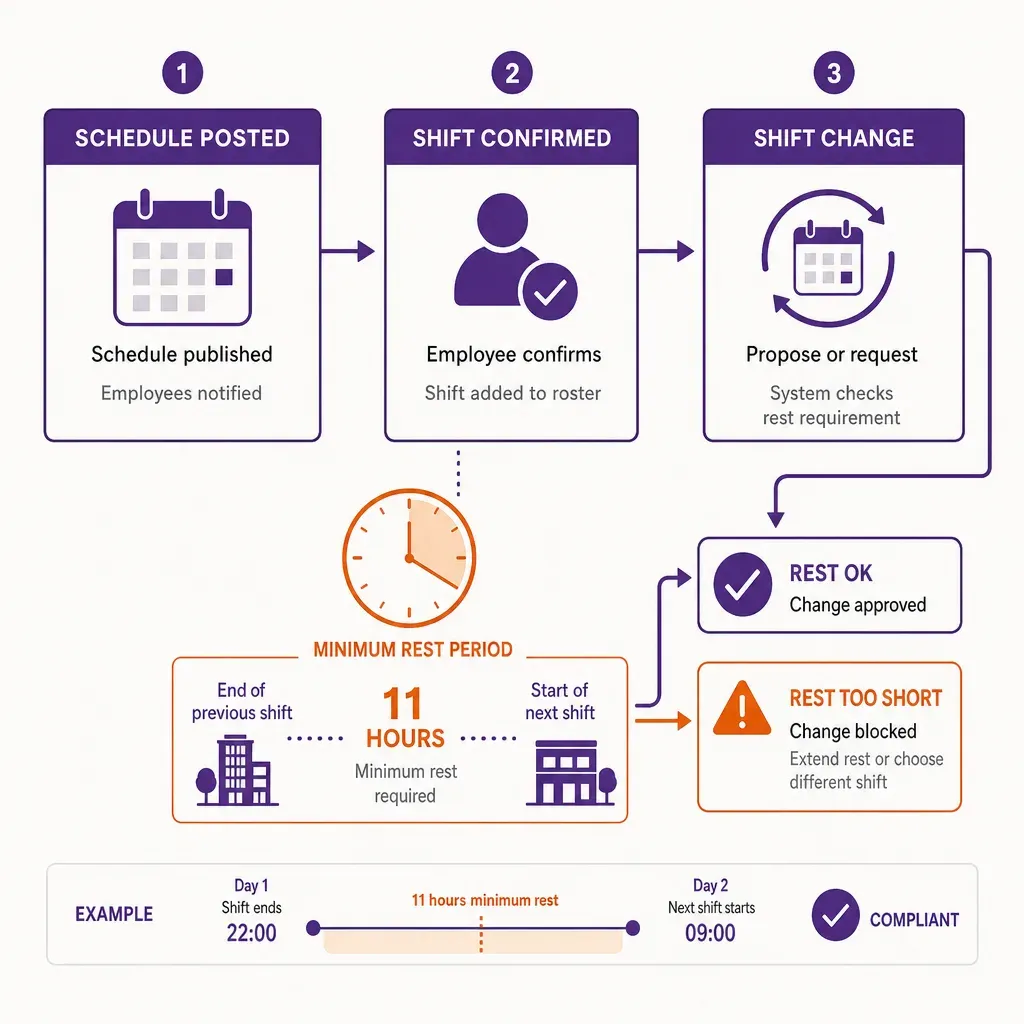
It fits cleanly in three places. First, in the medium-horizon publish. A forecast that is stable two weeks out produces a roster that survives the posting window without late changes, which is the whole point. The better the forecast, the fewer predictability premiums get paid. Second, in voluntary fill. If demand for next Saturday looks higher than the published roster covers, the scheduler can offer additional shifts to workers who opt in, with no premium attached because the change is worker-initiated. A good system makes that offer visible to the eligible pool and lets workers accept inside their existing availability. Third, in shift swaps. A worker who wants to move a shift can post it to a pool, and any worker who picks it up is making a voluntary change. Predictability pay does not attach, but the swap still has to respect working-time rules (rest periods, weekly hours).
It clashes in two places, and these are the ones to design around. First, employer-initiated cuts after the posting window. If the forecast revises down on Wednesday for the following Saturday, the cheapest thing the system can do is leave the roster alone and accept higher labor cost than the demand justifies. Cancelling shifts buys the predictability premium and frequently costs more than the labor saved. The right response is usually to expose the over-coverage to managers as a metric, not to issue automatic cancellations. Second, on-the-day calls. Sending a worker home an hour into a shift because the morning was quieter than expected almost always triggers a call-in minimum. A system that knows this will not propose those cuts in the first place.
What the scheduling system needs to know
Compliance with predictive-scheduling laws is mostly a software problem with a human override. The scheduling system needs four pieces of state to behave correctly inside the laws.
- Jurisdiction per store. A flag that says which ordinance applies to which store. A retailer with stores in Seattle, Portland, and Boise is in three different regimes (Seattle Secure Scheduling, Oregon statewide, no state-level rule).
- Posting timestamp per shift. The moment a roster is posted to the worker is the start of the protected window. Every later change is measured from this timestamp.
- Change origin per change. Each shift modification carries a tag: employer-initiated, worker-initiated swap, voluntary pickup. Predictability premiums attach only to the first; getting this tag wrong is the most common audit finding.
- Rest gap per worker. The system has to know the previous and next shift for the same worker and refuse a schedule that violates the rest rule for that jurisdiction. This is a hard constraint, not a premium-buyable one.
On top of that, the system needs an audit trail. Every change carries who proposed it, who approved it, what the worker received as notice, and which premium (if any) was paid. The audit trail is what an enforcement agency or a private claim relies on, and it is the thing most legacy systems do worst.
Operator checklist for forecast-led scheduling under these laws
If you are wiring a counting platform to a WFM and you operate in one or more predictive-scheduling jurisdictions, walk through this list before you publish a roster the new way.
- Identify the jurisdictions. Map each store to the strictest applicable rule. Maintain this map; new jurisdictions arrive.
- Match the forecast horizon to the posting window. If the law requires fourteen days notice, the medium-horizon forecast has to be stable fourteen days out. A two-week stable forecast that drives a published roster is the design goal.
- Tag every change at the source. Employer-initiated, worker-initiated swap, voluntary pickup. The WFM has to capture this in the change record, not infer it later.
- Distinguish hard limits from price limits. Rest periods are hard. Late changes are priced. The system should refuse to propose a schedule that violates rest, and surface the cost of any late change the operator wants to make.
- Keep the audit trail. Posting timestamps, notice given, premiums paid, retained for at least the local statute of limitations on wage claims (often three or four years in the US; varies in the EU).
- Confirm everything with counsel. The thresholds and exemptions in these laws shift, and the safe path is a sign-off from employment counsel on the implementation, not a single read of an ordinance summary.
How Ariadne fits in
Ariadne sits on the demand side of the integration. The people counting platform produces the visitor forecast and the intraday actuals; the scheduling layer (Ariadne's own Employees Planner, or a third-party WFM consuming the same series) turns those numbers into a roster. The demand series and the rules are separable: the laws constrain the WFM, the counting platform produces the input that lets the WFM publish a stable roster on a two-week horizon. A better forecast is what reduces the predictability-premium bill, because fewer late changes are needed to bring labor back in line with reality.
Ariadne measures this with Hybrid Fusion, its patented camera-free method. Time-of-Flight depth sensing counts every visitor at the entrances, capturing geometry rather than images, while patented phone signal sensing follows movement through the interior, detecting the signals a phone emits even in airplane mode. The sensor streams both feeds to Ariadne, where Hybrid Fusion combines them into one trajectory per visit and computes counts, dwell, and paths. The streams carry no identifier: no MAC address, no device ID, no biometric data, and no camera is involved. Identifiers are stored only when a visitor explicitly opts in, which keeps the method GDPR-friendly and outside biometric territory.
Two integrity points matter on the procurement side. First, the measurement is camera-free and identifier-free, so the demand signal feeding the WFM is a count, not a stream of recognised people. That keeps the upstream input outside the scope of biometric or special-category data regardless of where the stores are. Second, the count is independent of point-of-sale conversion: a busy non-converting hour is visible in the forecast, where a transactions-only forecast would miss it and under-cover. Data handling is set out in the privacy policy, and the retail context is retail stores.
Related reading
FAQ
Does the counting system use cameras?
No. Ariadne counts with Hybrid Fusion: Time-of-Flight depth sensing plus patented phone signal sensing, never cameras. Time-of-Flight captures geometry rather than images, and signal sensing captures no MAC address by default, so the measurement involves no video, no faces, and no biometric data.
Is this article legal advice?
No. It is an operator's primer on how predictive-scheduling laws are commonly structured and how forecast-led scheduling fits inside them. Specifics, thresholds, and exemptions vary by jurisdiction and change over time, and only an employment lawyer in the relevant jurisdiction can advise on what applies to a specific business. Treat the summaries above as a starting point for that conversation.
Do predictive-scheduling laws ban demand-led scheduling?
No. The laws constrain when an employer can change a shift after it has been posted to a worker, and they price late changes that the employer initiates. A demand-led roster that publishes a stable schedule on the required notice and uses voluntary fill and swaps to handle later movement is fully compatible with these rules, and is usually cheaper than a roster that absorbs predictability premiums every week.
What about the EU side?
The Working Time Directive (2003/88/EC) sets minimum daily and weekly rest periods that a roster cannot violate. The Directive on Transparent and Predictable Working Conditions (2019/1152) requires reasonable advance notice for work outside agreed reference hours and a right to refuse short-notice work without penalty. Member states transpose both into national law on different timelines and with different specifics, and collective bargaining agreements often go further. A EU retailer schedules against the strictest applicable rule in each country.


