
Weather is the noise floor of footfall
Most retail teams know weather moves walk-ins. Fewer can say by how much, in which direction, on which day, for which format. The result is that weather quietly absorbs blame for soft weeks and quietly takes credit for strong ones, and the operating decisions that should respond to it (staffing the door, opening overflow checkouts, scheduling deliveries) keep running on instinct.
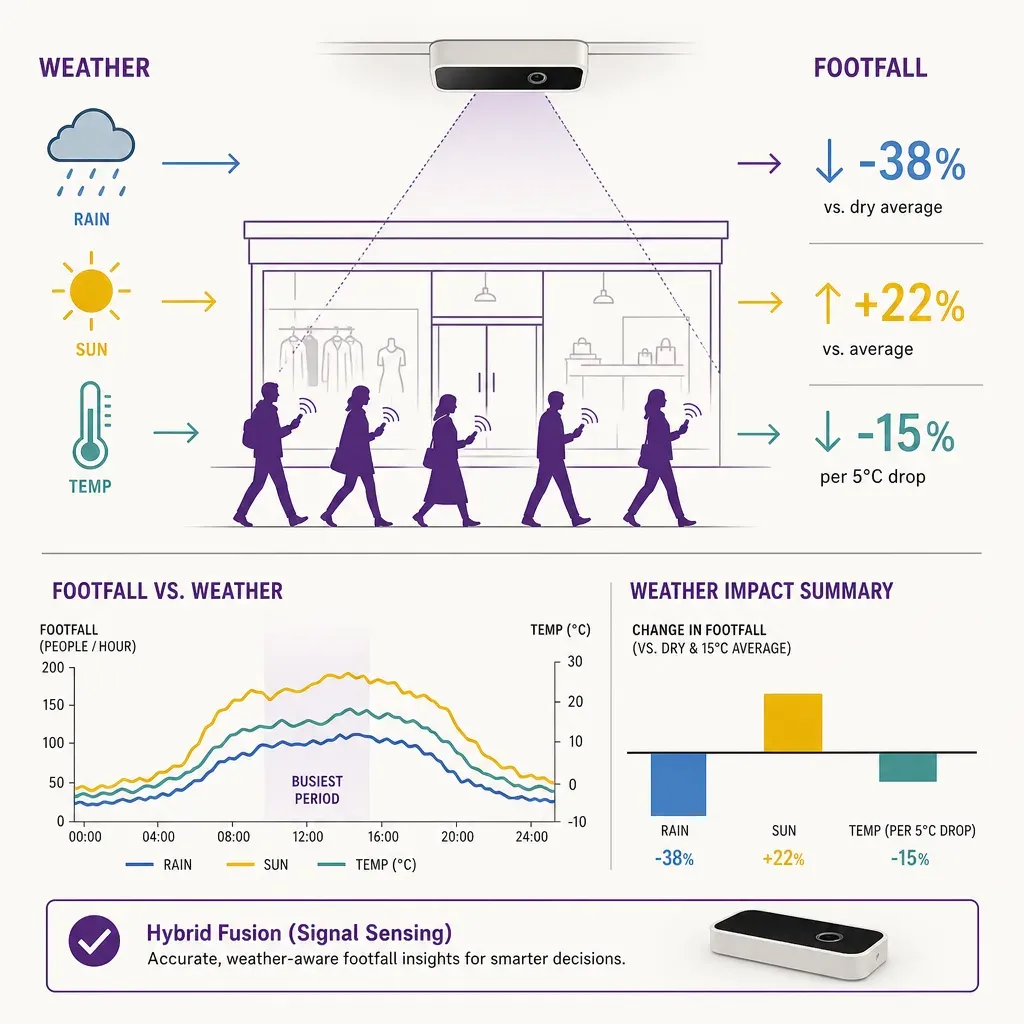
The weather signal in retail store footfall is real, asymmetric, and format-specific. A wet hour does not subtract the same number of visits from a high-street store and from a covered mall. A 30 degree afternoon means one thing for a grocery near a residential cluster and the opposite for an open-air outlet centre two hours away. This post sets out the patterns that most retailers see in practice, the ones they tend to misread, and a methodology for pulling the weather signal cleanly out of a daily count.
The numbers in this piece are illustrative ranges drawn from publicly discussed industry rules of thumb. They are not Ariadne-measured results, they are not study results, and any single store's response curve will differ. Treat them as the shape of the effect, not its size at your address.
The rain-window asymmetry
Rain has the largest single-day weather effect on store visits, and the part most people get wrong is that the effect is not symmetric.
Sustained heavy rain through a peak hour is what dampens visits. A non-trip-essential errand becomes tomorrow's errand, planned outings collapse, and the cars that would have driven to the high street stay in the driveway. For an open-air format, a wet two-hour window across the lunch peak can pull the day down by a meaningful share, often in a range that retailers describe in low double-digit percentages depending on how heavy and how sustained the rain is.
Brief showers do something different, and the difference matters. A passing shower over a busy footstreet often does not delete those visits, it shelters them. Shoppers already in the catchment duck into the nearest entrance, dwell longer than they planned, and only re-emerge when the rain stops. A covered mall in the same conditions can see a small bump in entries while the high street empties. The same weather event is moving visits between formats, not deleting them from the market.
The practical implication is that hourly footfall reacts to rain duration and intensity, not to rain as a binary. A daily "it rained" flag throws away most of the signal. A useful weather covariate captures rain by hour, separates light from heavy, and keeps a separate variable for whether the rain crossed a meal peak.
Temperature thresholds, and why they shift
Temperature moves footfall in two directions and across at least three thresholds, all of which depend on the time of year and the local norm. A 22 degree afternoon in March pulls people out of their houses. The same 22 degrees in late August is a relief from a heatwave and pulls them out too. A 22 degree morning in November is unseasonable and does something else again. The same Celsius reading is not the same signal.
The pattern that retailers tend to see in their own data, once they control for day-of-week and holidays, looks roughly like this:
- A comfortable band. Temperatures that feel pleasant relative to the local season lift discretionary visits across most formats. The band is wide and the lift is modest, often in single-digit percentages, and it is the cleanest part of the signal.
- A cold floor. Below a region-specific cold threshold, outdoor and high-street formats lose visits and covered formats hold up or gain. The drop on an exposed retail park can be larger than the drop in a covered mall on the same day.
- A hot ceiling. Above a region-specific heat threshold, the pattern reverses for some categories. Climate-controlled malls gain. Open-air retail, parks-adjacent destinations, and stores without strong shading can lose visits in the afternoon while gaining them in early morning and late evening. Grocery shifts to shorter, more frequent trips.
The thresholds themselves are not fixed numbers. They shift with the local climate norm and with the time of year. A 28 degree afternoon in a cool maritime climate is a heat event. The same 28 degrees in a hot inland climate in July is a normal Tuesday. Any temperature model that uses absolute degrees without a seasonal baseline will fit one part of the year well and the rest of it poorly.
The cleanest control variable in practice is a departure from the seasonal local mean for that calendar week, not the raw temperature. Most retail planning teams arrive at that conclusion the second time they look at their data.
Format sensitivity: open-air, enclosed, grocery
Weather sensitivity is not a property of weather, it is a property of the store. The same rainstorm or heatwave reads very differently across formats, and a useful weather analysis starts by sorting stores by their format before pooling any data.
Open-air retail (high street, retail parks, lifestyle centres)
Open-air formats are the most weather-sensitive. The walk between the car park and the store, and the stroll between adjacent stores, is exposed. Heavy rain compresses dwell, cold below the local threshold compresses visits, and a sunny pleasant afternoon delivers the cleanest lift. Open-air formats also tend to feel the strongest first-warm-day-of-spring spike, when a turn in the weather pulls a season's worth of suppressed discretionary trips into one afternoon.
Enclosed malls and shopping centres
Covered shopping centres absorb weather. They lose visits in extreme cold less than open formats, lose less in heavy rain, and gain visits in heatwaves and cold snaps. A covered centre is the substitute trip when the weather goes against the high street nearby, so its weather curve is partly a function of what the surrounding open-air competition is doing on the same day. The implication for an operator is that a strong day in a covered centre during bad weather is not necessarily a strong day for the catchment, it can be a redistribution.
Grocery and essentials
Grocery is the least weather-sensitive format in total daily visits and one of the most weather-sensitive in the shape of the day. A wet day shifts the same visits later. A hot day breaks one weekly shop into two short trips, both earlier and later than the usual peak. Total visits move by single-digit percentages while the hourly profile rearranges by a lot more than that. Staffing a grocery store on the daily total misses this. Staffing it on the hourly profile is the only way to catch it.
Holidays, school terms, and the weather they bring with them
One of the harder modelling problems in retail weather analysis is that holidays and weather are not independent variables. A long August weekend often sits inside a heatwave. A Christmas weekend often sits inside cold and possibly snow. School holiday weeks in late October and February run through different weather regimes than the same calendar week the following year. Pulling the weather signal out without controlling for the holiday calendar produces a number that says weather did things that the holiday actually did.
Two patterns recur:
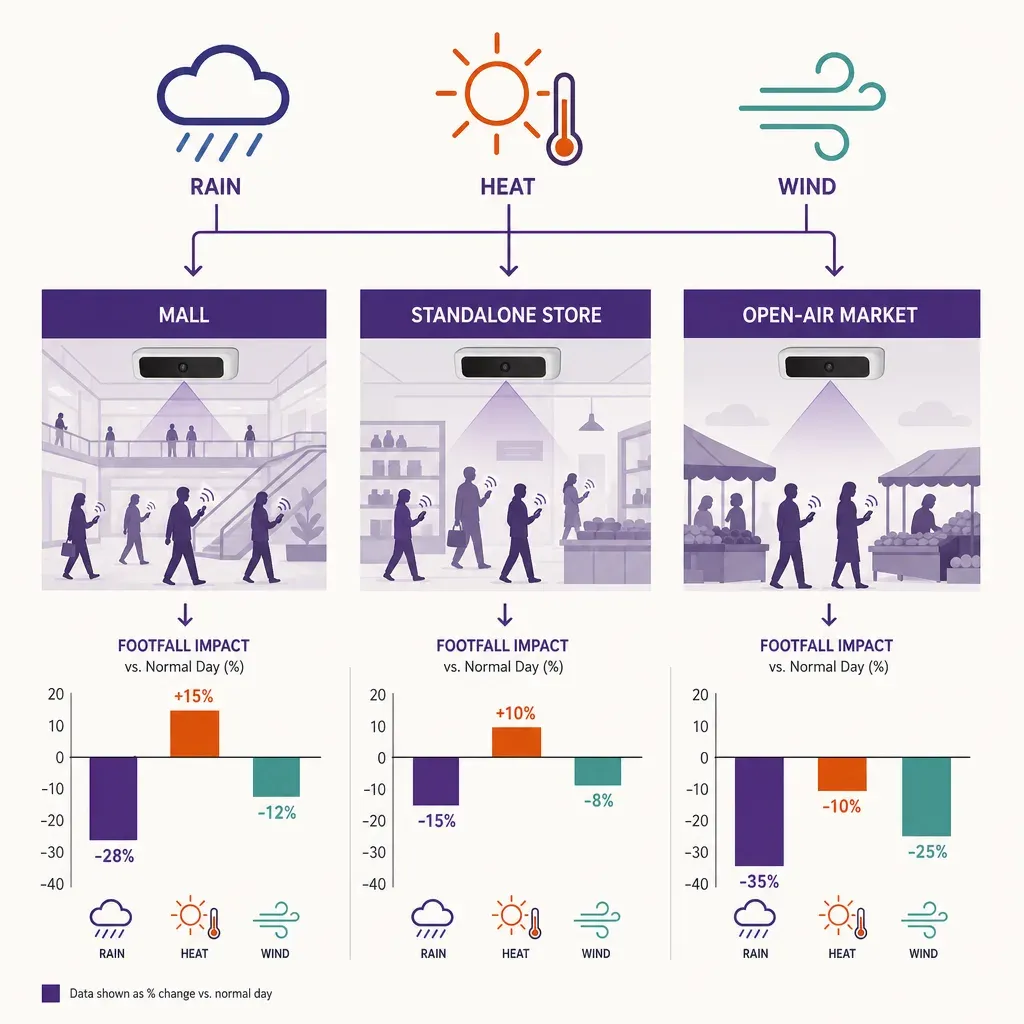
- Weather can amplify a holiday or kill it. A long weekend that lands on a sunny pleasant Saturday delivers a footfall day that is large even by holiday standards. The same long weekend in cold sustained rain underperforms a normal Saturday in the same store. The base rate ("holidays lift visits") is the wrong granularity for any planning that matters.
- Holiday weather is non-stationary year to year. Comparing this year's August bank holiday to last year's August bank holiday only works once you remove what the weather did to each one. Otherwise the year-on-year line is mostly a weather chart wearing a holiday label.
Year-on-year footfall reporting that does not control for weather and for school-term placement tends to overstate operational performance in good-weather years and understate it in bad ones. The fix is to put weather and a holiday calendar into the same regression and read the residual, which is what is left after both are accounted for.
Pulling the weather signal out of a daily count
Most of the value in weather-aware footfall analysis is methodological. The principles are simple, the application is where mistakes happen.
Match the time grain to the effect
Daily totals hide most of what weather does. Rain effects sit inside two-hour windows. Heat effects rearrange the hourly profile. The minimum useful join is hourly footfall to hourly weather, with separate variables for precipitation rate, temperature departure from seasonal mean, wind, and humidity in the formats where it matters.
Always pair with a day-of-week control
Some weather patterns are correlated with the calendar in subtle ways: weekends in spring and autumn skew sunnier than weekdays in a given week because of how synoptic systems move. A model that does not include day-of-week will assign part of the weekend lift to whatever the weather happened to do on Saturday, and the weather coefficient will be inflated. Day-of-week first, then weather.
Use departures from local seasonal norm, not absolute values
A temperature variable expressed as degrees above or below the local seasonal average for the calendar week is far more informative than raw degrees. The same logic applies to rain (rain compared to the local wet-week base rate) and to daylight (departure from same-week-prior-year, after controlling for calendar).
Hold out the holidays
Fit the weather model on non-holiday weeks first. Then add holiday dummies and look at how the weather coefficients change. If they change a lot, you had holiday leakage in the original fit. If they hold steady, you have a clean weather signal you can use for planning.
Report the residual, not the prediction
The point of a weather model in retail is not to predict footfall. It is to remove weather from the year-on-year comparison so the operational story underneath becomes visible. Report the weather-adjusted line and the residual against it. That is the number a regional manager can act on.
Where the count comes from
All of the above assumes the footfall data being modelled is itself clean. A weather analysis built on a noisy daily count produces a noisy answer. Two properties matter here:
- Hourly granularity at minimum. Without it, the rain-window and the temperature-shift effects in the same day average out into a daily total that looks much smaller than the real effect.
- Group counted as a group. Bad weather changes group composition. Families shelter together, solo shoppers come back later in the day. A counter that splits a group into separate counts will misread the weather effect as a visit change when it is actually a group-size change.
Ariadne measures this with Hybrid Fusion, its patented camera-free method. Time-of-Flight depth sensing counts every visitor at the entrances, capturing geometry rather than images, while patented phone signal sensing follows movement through the interior, detecting the signals a phone emits even in airplane mode. The sensor streams both feeds to Ariadne, where Hybrid Fusion combines them into one trajectory per visit and computes counts, dwell, and paths. The streams carry no identifier: no MAC address, no device ID, no biometric data, and no camera is involved. Identifiers are stored only when a visitor explicitly opts in, which keeps the method GDPR-friendly and outside biometric territory.
For weather-aware reporting, Ariadne contributes the part of the stack that has to be right first: hourly entries and exits at the door, group sizing from the patented signal sensing inside, and live occupancy, all without capture-rate or conversion-rate distortions from miscounted groups. The weather covariates and the day-of-week and holiday controls sit on top of that count in whatever analytics environment a retailer already runs. The sensor lineup is documented at the Ariadne hardware page, and the data handling is set out in the privacy policy.
FAQ
How much does weather affect retail footfall?
The effect varies by format, by season, and by time of day. The patterns retailers typically describe are: an open-air format can lose visits in the low double-digit percentages on a sustained wet peak hour and gain a similar amount on the first warm pleasant day of spring, while a covered mall in the same conditions often moves in single digits and sometimes in the opposite direction. Treat any single number as directional, not as a target. The size of the effect at your address is whatever your own hourly data, controlled for day-of-week and holidays, tells you it is.
Do brief showers reduce footfall the same way as sustained rain?
No, and treating them the same is a common modelling mistake. Sustained heavy rain through a peak hour dampens visits and pushes some of them to the next day. A brief shower over a busy area often shelters those visits inside the nearest store or covered centre rather than deleting them, so an hourly count can show the high street emptying while a covered mall a few hundred metres away ticks up.
What temperature is best for retail footfall?
There is no single best temperature. The pattern that holds across most formats is that a comfortable band relative to the local seasonal norm lifts discretionary visits, while temperatures meaningfully below the local cold threshold suppress open-air formats and temperatures meaningfully above the local heat threshold redistribute visits toward covered formats and shift the hourly profile earlier and later. Use departures from the seasonal local mean as the variable, not absolute degrees.
Do you need cameras to measure weather-driven footfall changes?
No. Ariadne counts with Hybrid Fusion: Time-of-Flight depth sensing plus patented phone signal sensing, never cameras. Time-of-Flight captures geometry rather than images, and signal sensing captures no MAC address by default, so the measurement involves no video, no faces, and no biometric data.
Can year-on-year reporting be adjusted for weather?
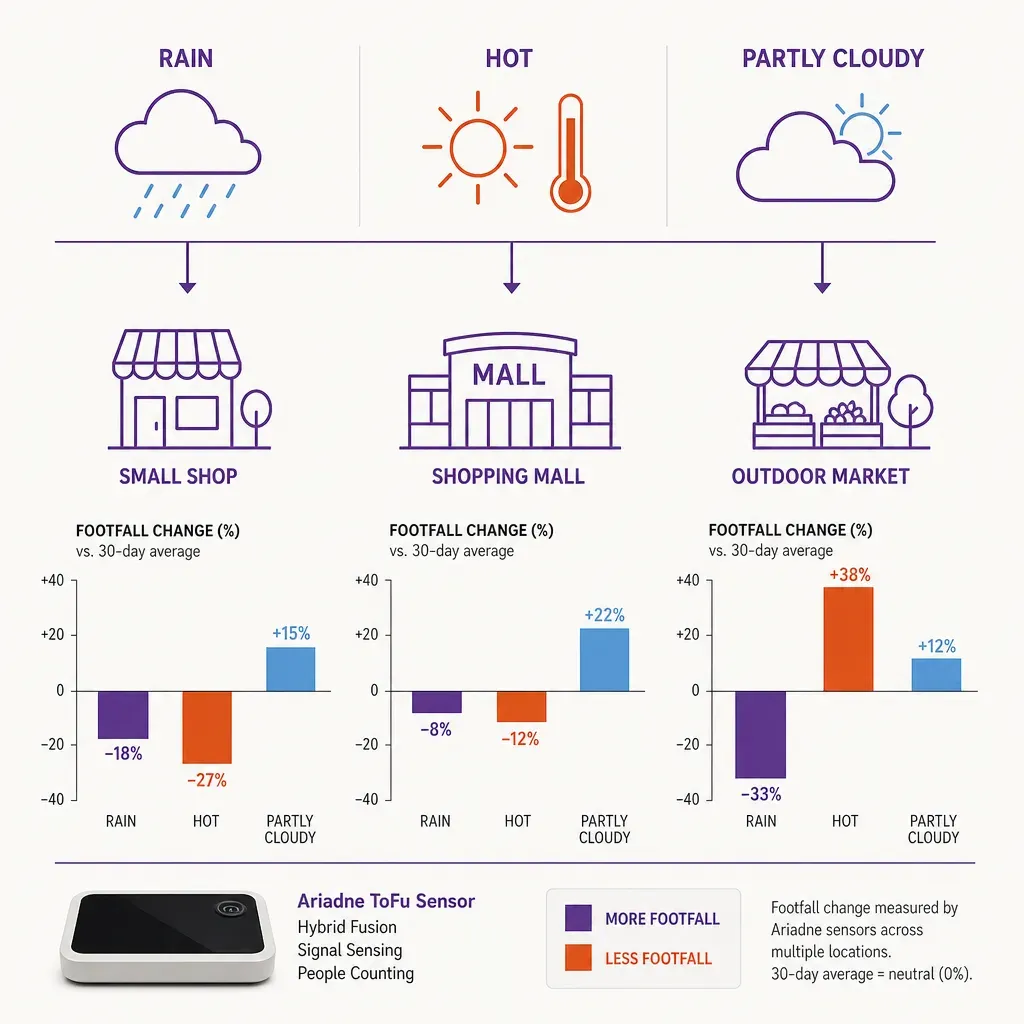
Yes, and for any retailer running discretionary categories it should be. Fit a model that includes hourly precipitation, temperature departure from local seasonal mean, day-of-week, and holiday placement on a multi-year footfall history, then report the residual. The residual is the part of year-on-year that the operating team actually moved. The unadjusted line is mostly a weather chart.


