
The metric most stores schedule against, and never measure
Almost every store manager knows the rough number of associates they want on the floor at noon on a Saturday. Fewer can tell you what the staff-to-customer ratio actually was last Saturday at noon, because that requires a clean count of customers in the store, broken down the same way the labor schedule is broken down. The schedule is built by half-hour slot. The customer count, in most stores, is a daily total at best. The two never line up, so the ratio that decides whether the floor was over-staffed, under-staffed, or roughly right ends up being a feeling rather than a figure.
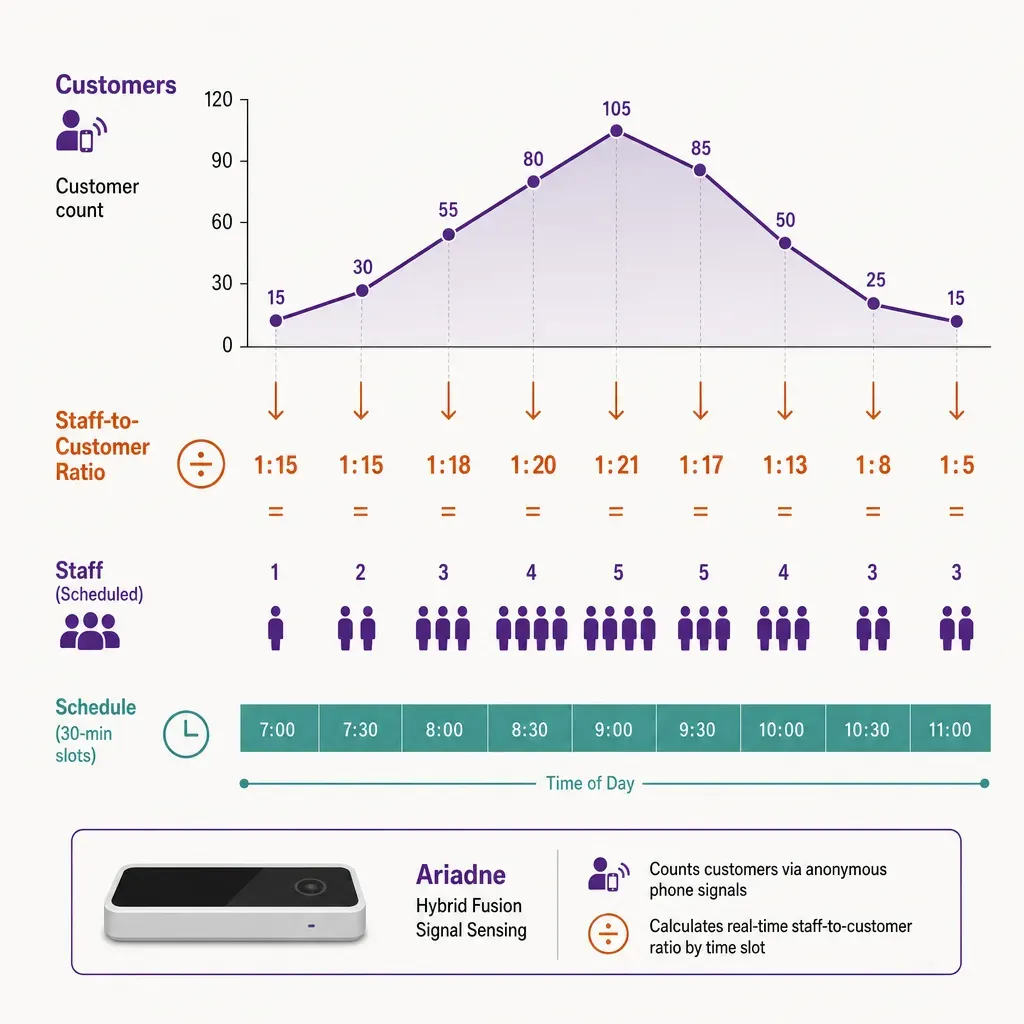
That gap costs both ways. A floor that runs lean during a peak loses the assists that close the basket. A floor that runs heavy during a lull pays for labor that nobody wanted, and worse, can feel pushy to a thin crowd of browsers. The interesting part of the staff-to-customer ratio is that it is not monotonic. More staff is not always better, and fewer is not always cheaper. The curve is an inverted U: conversion and basket climb as you add staff up to a point, plateau, and then drop. The point where they drop is the point most retailers cannot see, because they cannot read the ratio in something close to real time.
This post walks through where the inverted U sits, what moves it for a given store, and how live occupancy plus dwell let a manager schedule dynamically by the hour instead of fixing a shift in advance. It links to the labor side at employee scheduling and to the counting side at people counting.
Defining the ratio cleanly
Staff-to-customer ratio is the number of customer-facing associates on the floor divided by the number of customers in the store, computed over a short, comparable time slice. For an operational decision, the slice that matters is 15 or 30 minutes, not a daily total.
- Numerator. Associates physically on the sales floor and assigned to customer interaction. Stock-room hours, fitting-room only roles, and till-only cashiers are usually split out, because they do not contribute to the assist on the floor.
- Denominator. Live occupancy of the sales floor over the same slice. Not entrance count for the day, and not transactions: the number of customers actually present, averaged over the period.
- Time slice. 15 or 30 minutes. The schedule changes at those intervals, and so does the traffic curve. A daily ratio of 1:30 hides a 1:5 lunch peak and a 1:55 mid-afternoon lull, and both of those are the decisions that matter.
The denominator is where most stores stop. Occupancy by 15-minute slice requires a count that resets on exit, not just an entrance counter, which is why the metric stays a guess in stores that only know how many people walked in for the day. The wider methodology behind continuous occupancy belongs to the same family as retail capture rate and sales per visitor: all of them need a real headcount, broken down at the resolution that decisions are made on.
The inverted U, in plain words
Plot conversion rate or units per transaction against staff-to-customer ratio for a given store-format and you tend to see the same shape. As staff per customer increases from very lean, the curve rises: queues clear, fitting-room turnaround goes up, an associate is free to greet, to assist, to up-sell, and to handle the question that decides the sale. The curve keeps climbing for a while and then flattens. After the flat patch, it starts to drop. The drop is not subtle when you see it on a chart, and it has two main mechanisms.
Why more staff stops helping
The first mechanism is that an associate cannot assist a customer who is not there. Once every customer in the store has someone within helping distance, adding another associate cannot move conversion, because the marginal customer is already being served as well as they can be. This is the plateau, and it shows up as a flat top on the chart.
Why more staff actively hurts
The second mechanism is harder. Past the plateau, more associates per customer makes the floor feel watched. A shopper who is browsing slowly and weighing a purchase reads three idle associates and one customer as pressure, and the dwell time that was going to lead to a basket gets shortened. The associates themselves, sensing the lull, often start a too-soon, too-frequent greet cycle that compounds the effect. The result is lower conversion at higher staff cost, which is the operationally worst quadrant a manager can be in.
The exact location of the peak varies by store. A discount apparel store, where customers expect to self-serve, peaks at a leaner ratio than a beauty store where consultation is the format. A jeweller or a high-touch consumer-electronics store peaks much closer to one-to-one. The shape of the curve is the same across formats; what shifts is the position of the peak and the steepness of the drop after it.
What moves the peak for a given store
Four variables move the location of the optimum for a particular store. Three of them are about the customer, one is about the product. None of them is directly observable from a labor schedule, which is why the schedule alone is not enough to set the ratio well.
Average dwell
A store where customers stay 18 minutes on average needs more staff per customer than a store where they stay 4 minutes, because the assist window is longer and the chance of a question is higher. Dwell is also the variable that flips the sign of the curve after the peak: long-dwell customers are exactly the ones who feel watched on an over-staffed floor.
Basket complexity
Baskets that require sizing, configuration, or comparison need a higher ratio than baskets that are a single item picked off a shelf. The same store may need a different ratio on a launch weekend, when the assortment is unfamiliar, than on a steady-state weekday.
Group composition
A store that runs heavy in family groups is functionally less crowded than the raw count suggests, because each group makes one purchase decision among several people. Conversely, a steady stream of singles uses the staff more intensively per person on the floor. Group sizing is a separate metric from headcount and is read from the same sensing layer.
Format and self-serve depth are the fourth variable, slower to change but worth naming. Stores that lean on signage, fixtures, and well-laid-out self-serve peak at a leaner ratio than stores that build the journey around the associate. The practical implication of all four variables is that the peak ratio for any given store should be discovered empirically. Pick a comparable set of weeks, plot conversion against the ratio at the 30-minute slice, find the inflection, and treat the result as the operating target rather than carrying over a rule of thumb from a head-office spreadsheet.
Why a fixed shift cannot hit the target
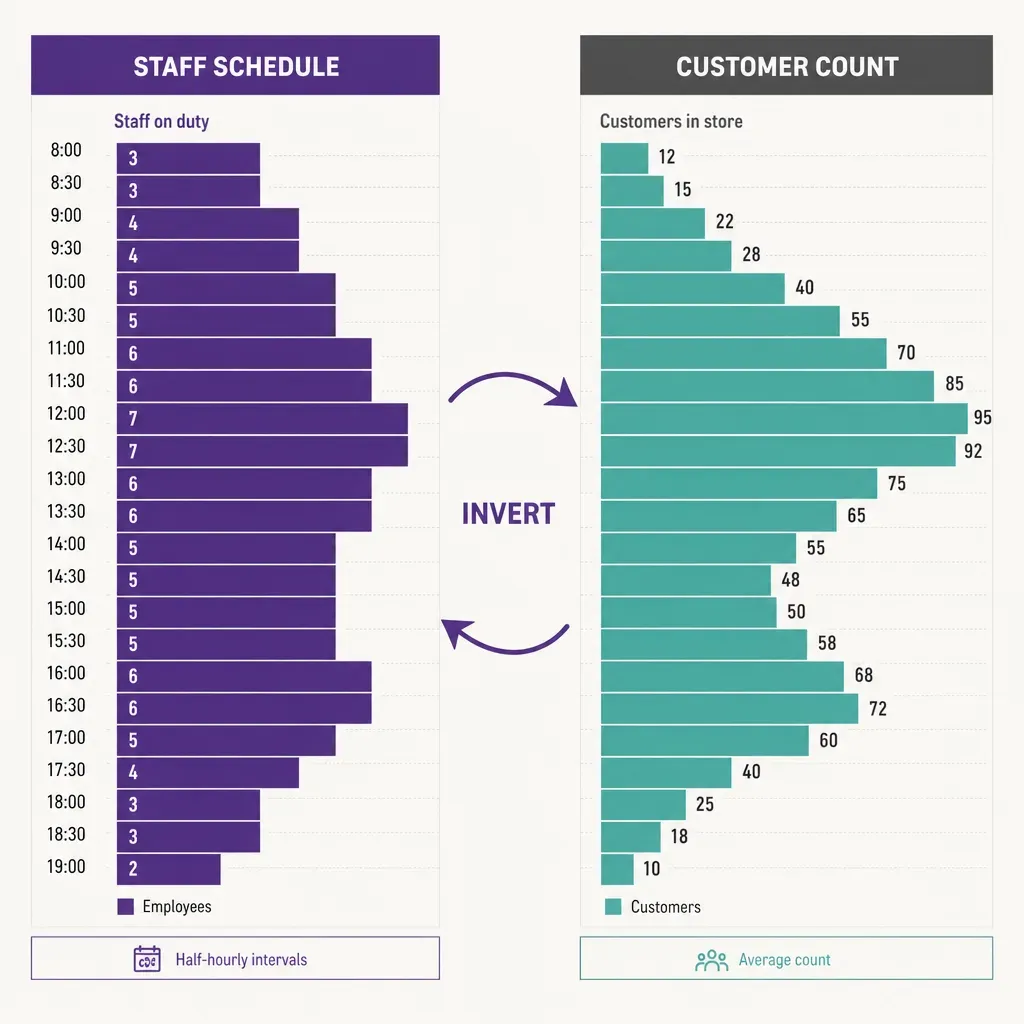
Even a store that knows its peak ratio can miss it badly with a fixed shift schedule, because customer arrivals are not uniform. A typical weekday in a mall apparel store might show a lunchtime spike, a mid-afternoon trough, an after-school bump, and an early-evening peak before close. The schedule, set a week ahead and built around fixed four-hour or eight-hour blocks, smooths across that curve. Two associates from 10 to 14 and two from 14 to 18 looks fine on paper. It produces a 1:5 ratio at noon, a 1:45 ratio at 15:30, and a 1:15 ratio at 17:00, none of which is the peak.
The fix is not adding people, it is making the labor curve track the traffic curve. That requires three things in combination: a live picture of occupancy at the 15 or 30-minute resolution, some flexibility in the schedule (a small pool of on-call hours, movable part-time tails, or simple call-in and release-early authority within a shift), and forecasts that look two to four weeks ahead so the shift template itself can be revised when the forecast diverges from what the template was built on.
What a dynamic ratio looks like in practice
An illustrative store, to make the mechanic concrete: a mid-sized apparel store with 14 associate-hours scheduled across a Saturday, peak target ratio around 1:12, average store occupancy moving between 8 and 90 over the day. With a static schedule of 2 associates from 10 to 14 and 2 from 14 to 19, the store would hit the target ratio for about 35 percent of the trading day. With a live picture and a flexible last hour at each end of the shifts, the same 14 associate-hours land near the target for around 70 percent of the day, with the gains concentrated on the lunchtime and early-evening peaks where the marginal sale is biggest. The headline change is not staffing up, it is staffing onto the right slot. Numbers above are illustrative, not measured at any Ariadne customer.
How Ariadne fits
Ariadne provides the sensing layer and the dashboard the schedule reads off. The hardware is a small number of sensors per store, not a camera array, and the data the platform produces is built for the people who actually write the schedule.
Ariadne measures this with Hybrid Fusion, its patented camera-free method. Time-of-Flight depth sensing counts every visitor at the entrances, capturing geometry rather than images, while patented phone signal sensing follows movement through the interior, detecting the signals a phone emits even in airplane mode. The sensor streams both feeds to Ariadne, where Hybrid Fusion combines them into one trajectory per visit and computes counts, dwell, and paths. The streams carry no identifier: no MAC address, no device ID, no biometric data, and no camera is involved. Identifiers are stored only when a visitor explicitly opts in, which keeps the method GDPR-friendly and outside biometric territory.
For staffing decisions, the practical outputs are continuous live occupancy at the 15-minute slice, average dwell over any chosen window, and group sizing that gives the labor planner a fair reading of the floor. The schedule is driven off forecasts produced from the same data, and the live figure is what the duty manager uses to call a release or a hold during the day. None of this changes what an associate does on the floor, only when they are on it. The sensor hardware sits in the Ariadne sensor lineup, data handling is set out in the privacy policy, and broader retail context lives at Ariadne for retail stores.
A buyer checklist for retail labor planning
If you are evaluating a system to drive dynamic staff-to-customer ratio, these are the questions to put to any vendor in writing before a trial.
- Does it give live occupancy, not just entry counts? A counter that fires only on entry will let you build a traffic curve, but not a ratio. You want a system that nets entries and exits to a continuous floor figure.
- What is the time resolution? 15 or 30 minutes is the slice the schedule is written on. Hourly is usable, daily is not. Confirm the resolution before you sign.
- Can it report dwell and group sizing? Both shift where the peak of the inverted U sits for a given store. A counting layer that produces only headcounts will give you a labor curve, but not the curve you actually need.
- Does it work without cameras? For most retailers, a sensor that reads geometry and radio signals rather than images is the simpler answer to give the data protection officer, the works council, and the customer-experience team.
- Will the figures plug into the existing scheduling tool and the conversion loop? A dashboard that nobody opens is wasted. Ask about exports and alerts for whoever writes the rota, and ask how the system supports plotting conversion against the ratio so the peak can be re-found as assortment, format, or season changes.
Related reading
FAQ
What is a good staff-to-customer ratio for retail?
There is no single number that applies across formats. Discount apparel can peak around 1:25 to 1:35 customers per associate. Mid-market apparel and grocery often peak in the 1:10 to 1:15 band. Beauty, jewellery, and consultative consumer electronics can peak as tight as 1:3 to 1:6. The honest answer is to discover the peak empirically for your store, by plotting conversion against the ratio at a 30-minute slice over a few comparable weeks. The bands above are general industry ranges and not Ariadne-measured figures.
Can more staff really hurt conversion?
Yes, past the peak of the inverted U. A floor with associates idle relative to customer count starts a too-frequent greet cycle, shortens browsing dwell, and reads as pressure to a customer who is weighing a purchase. The effect is most visible in formats where the basket depends on a longer browsing window, such as apparel and home goods. In high-consultation formats the peak is closer to one-to-one and the risk is smaller, but it still exists at the extreme.
How does dwell time affect the right ratio?
Dwell sets the size of the assist window. A 4-minute average dwell gives an associate very little time to engage; a 20-minute dwell gives plenty. Stores with longer dwell tend to peak at a more generous ratio, both because the assist workload is higher and because the conversion gain from a well-placed associate is larger. Dwell also marks the customer most exposed to the negative side of the curve: long browsers are the ones who feel watched, so dwell pulls in both directions and has to be read alongside the ratio rather than separately.
Does the system use cameras?
No. Ariadne counts with Hybrid Fusion: Time-of-Flight depth sensing plus patented phone signal sensing, never cameras. Time-of-Flight captures geometry rather than images, and signal sensing captures no MAC address by default, so the measurement involves no video, no faces, and no biometric data.
Where does this connect to conversion reporting?
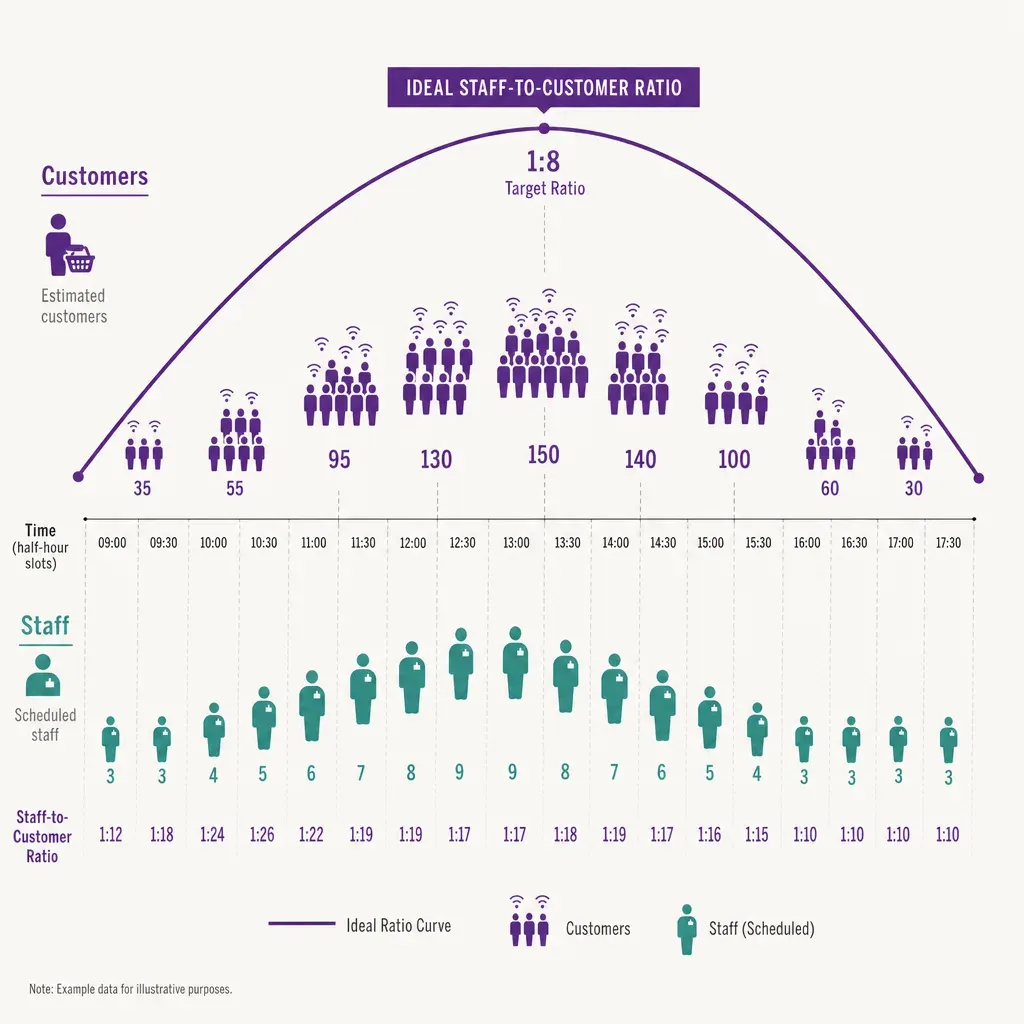
Conversion rate is the headline measure of how the labor and the floor are interacting. Read the staff-to-customer ratio as one of the variables that moves conversion up or down, and use the standard retail conversion rate formula to close the loop. A store that has solved the ratio without moving conversion has either the wrong peak or another variable in play; a store whose conversion lifts as the ratio gets sharper is reading the inverted U correctly.


