
Why a 4 hour traffic forecast is the one most retailers are missing
Most retail rosters are built on two forecasts. There is a medium-horizon view used for the published rota, usually two to four weeks ahead, and there is a same-day reality check that happens informally when a manager looks at the floor at 11:00 and decides whether to send someone home. Between those two sits a quieter, more useful horizon: the next four hours. A four-hour traffic forecast is a rolling view of how many visitors the store is about to see in the window between now and roughly the end of the trading shift, refreshed as each hour reports in. It is short enough to be steerable, and long enough that a manager can still do something about it.
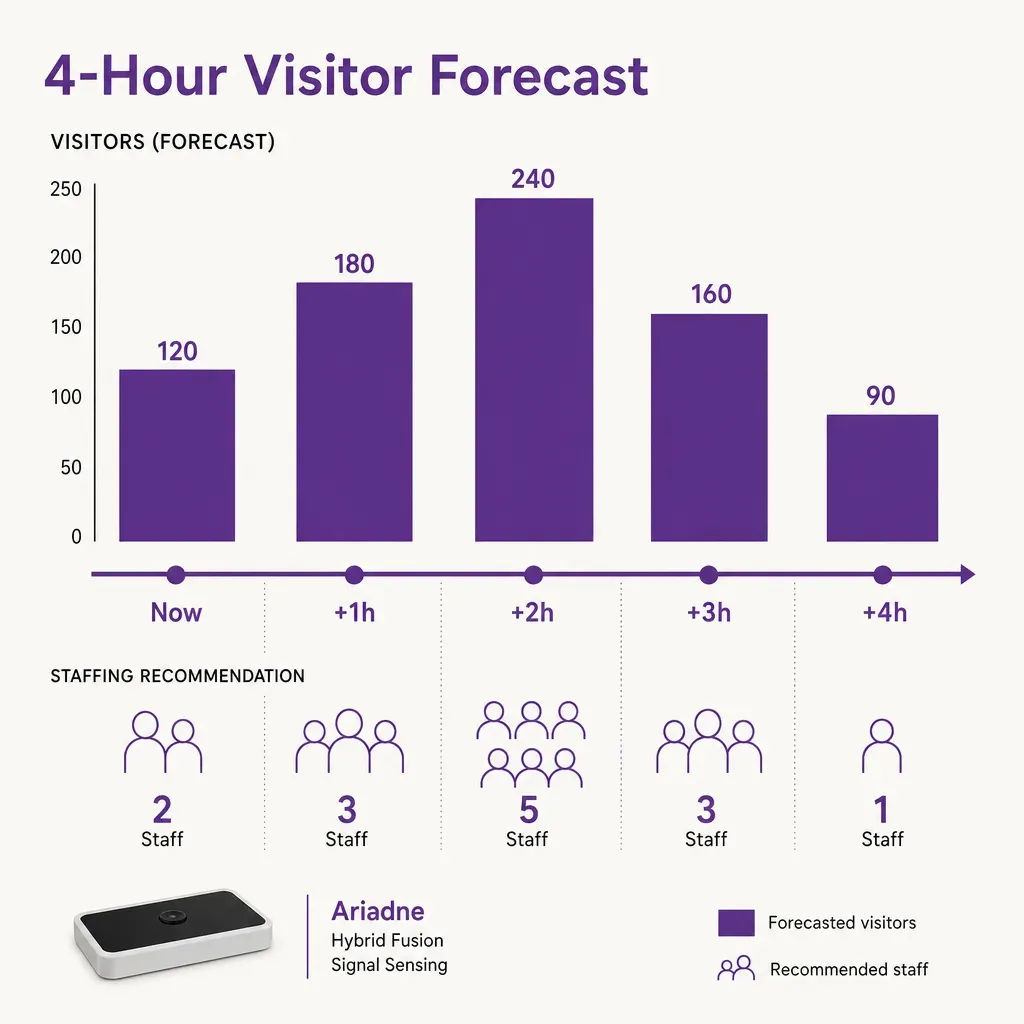
Stores that schedule against a four-hour forecast take fewer hits from forecast misses than stores that rely on the published rota alone. The reason is not exotic. The medium-horizon model is good at base patterns and bad at today. A four-hour forecast keeps the rota honest by giving the day a chance to correct. Employee scheduling built on a fixed daypart curve from last year cannot do this. Today is not last year. The shape is similar; the level often is not.
This post sets out what a four-hour traffic forecast does, why it beats last year's daypart curve in practice, how the intraday correction loop is structured, the rules for when to act on a deviation and when to ignore it as noise, and what a good forecast looks like in the hands of a store manager rather than a data team.
What a four-hour traffic forecast actually is
A four-hour traffic forecast is a forward-looking estimate of visitor count for the next four hours, broken down into hourly or fifteen-minute slots, refreshed on a fixed cadence using the day's measured traffic so far. It has three parts:
- A baseline. Built from history, the baseline is what the model expects on this day, in this store, in this hour, given seasonality, day of week, public holidays, and recurring local events. The baseline is the closest thing the system has to last year's daypart curve, but it is not consumed directly; it is the floor under the live forecast.
- A nowcast. The nowcast is the day's measured footfall so far. It compares the count from each hour of trading already completed against what the baseline expected for that same hour, and computes a deviation in percent. A nowcast saying "plus twelve percent against baseline at the half-day mark" is the start of a useful conversation.
- A short-horizon correction. The forecast for the next four hours is the baseline for those hours adjusted by the nowcast deviation, with rules around how confident the correction should be and how it decays as the window extends. The result is one number per upcoming hour, with a confidence band around it.
That is the architecture, and it is simple enough that most retailers could run a workable version on a single spreadsheet refreshed every hour. The differences between systems live in the rules: how aggressive the correction is, how the confidence band is built, and how the model handles structural shifts versus noise.
Why today's footfall beats last year's daypart curve
The default in most retail planning is to roster against a daypart curve learned from a historical period of the same shape: this Saturday looks like last Saturday, this Tuesday in March looks like the same Tuesday in March last year. That is a reasonable starting point and a wrong place to stop. Three structural effects push today off last year's curve almost every trading day.
- Trend drift. A store's underlying traffic level moves over a year. Catchment changes, neighbouring openings, transport changes, the spending climate, all push the level up or down without changing the shape of the day. Last year's curve at last year's level is a poor estimator of today's hours.
- Local events the model has not seen. A nearby concert, a new transport route, a school holiday that fell on a different week, a planned street closure: these are normal life and they move traffic by double-digit percentages in the affected hours. The medium-horizon model gets them only if they are encoded as features, which most are not.
- Same-day weather and trading shocks. Heat waves, rain windows, public-transport disruption, a viral social-media moment for an anchor tenant, all show up first in the early hours of the day and never make it into the historical baseline. Today's nowcast sees them within the first hour or two; last year's curve never does.
The role of the four-hour forecast is to let those effects show up in the roster before the peak, not after. A manager who finds out at 18:00 that the day ran fifteen percent under expectation has nothing to do about it. The same information at 11:00 is a usable signal, and that is exactly the window a four-hour forecast covers.
The intraday correction loop
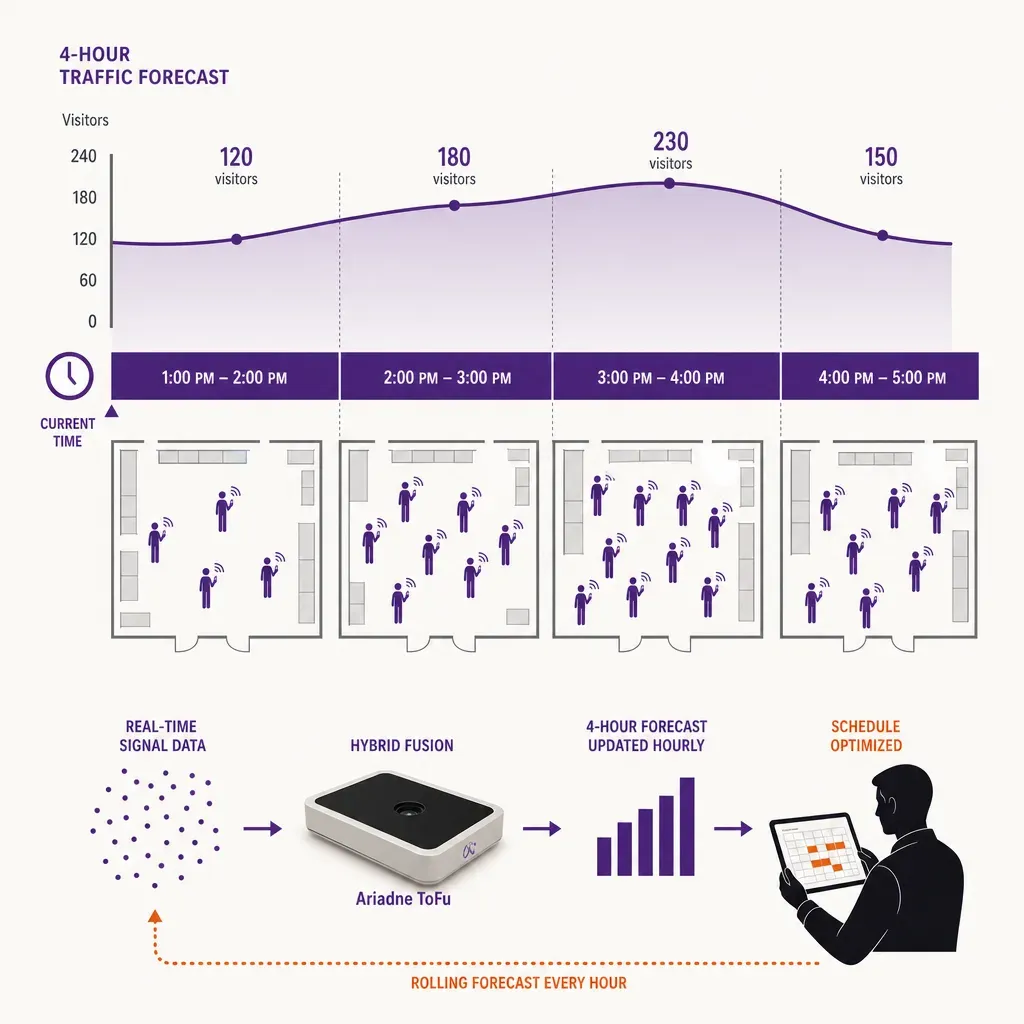
Treat the day as a series of correction points rather than a single planning event. A workable loop has five steps, repeated on a fixed cadence (hourly works for most retail formats; fifteen-minute slots for high-traffic flagships).
- Measure the just-completed hour. Pull the actual count for the hour that has just ended. This is the only ground truth in the loop.
- Compare to baseline. Compute the deviation of measured traffic against the baseline expectation for that same hour. The result is a single percent, signed.
- Update the nowcast. Combine the new hour with the day-so-far to produce a rolling day deviation. Recent hours weigh more than morning hours by the close of trading.
- Project forward. Apply the rolling deviation to the baseline for each of the next four hours, with a decay factor that reduces the correction as the horizon extends.
- Decide. Compare the corrected forecast against the rostered coverage for those hours. If the gap crosses a threshold, the manager has a defined action; if it does not, the gap is treated as noise and the roster runs as published.
The cadence matters. A daily refresh is too coarse, and a continuous live feed creates more noise than signal. Hourly is the sweet spot for most retail formats: long enough for a deviation to be real, short enough that a manager can act inside the trading day.
When to act on a deviation and when to ignore it
Not every gap between forecast and actual is a problem worth solving. A four-hour forecast is only useful if it comes with rules that separate a signal from a coincidence. Three thresholds, taken together, tend to work.
- A size threshold. Below a defined percentage deviation, the roster runs as published. Illustrative ranges only, but most retailers find five to seven percent is too small to chase and ten to fifteen percent is where intervention starts paying back. Below the threshold, the gap is treated as variance inside the model's expected range.
- A persistence threshold. A single hour off baseline is rarely worth chasing on its own; two consecutive hours moving in the same direction is. The persistence rule keeps the loop from over-reacting to one noisy hour.
- A horizon threshold. Deviations in the first hour of the forecast window are higher confidence than deviations in the fourth. The acceptable size threshold widens as the horizon extends, which is just the model's own confidence band expressed as a decision rule.
These thresholds should be set per format and per store, not centrally. A specialty fashion store with low base traffic and high per-visitor value behaves differently from a high-volume health-and-beauty shop. The rule is the same: define the thresholds in advance, write them down, and only intervene when a deviation crosses them. The discipline is what keeps the system credible to the operations team.
It is also worth defining what "intervene" means in the same document, so a manager is not improvising under time pressure. The usual menu is: pull an off-roster associate in, send someone home early, shift a break, move someone from the stockroom to the floor, or accept the gap and reset coverage for the next hour. Each of those has a different cost and a different lead time, and the threshold rules should map to one of them.
What a good four-hour forecast looks like operationally
A four-hour forecast that works on the day, not just on the dashboard, has a few common properties. They are worth listing because they are also what to look for when evaluating any system that claims to do this.
- Refreshes on a fixed cadence. Hourly is the default. The cadence is part of the contract with the operations team: the forecast updates at minute fifty-five of each hour and the manager looks at it at minute zero of the next one. Predictable refresh beats slightly fresher data on an unpredictable cadence.
- Shows the band, not just the line. A point forecast on its own invites false confidence. A high-low band keeps the conversation honest about what the system can and cannot say.
- Surfaces the deviation, not the count. Managers do not need to read an absolute number; they need to know how far today is running off plan. The headline metric is the rolling deviation against baseline, with the projected count as the detail underneath.
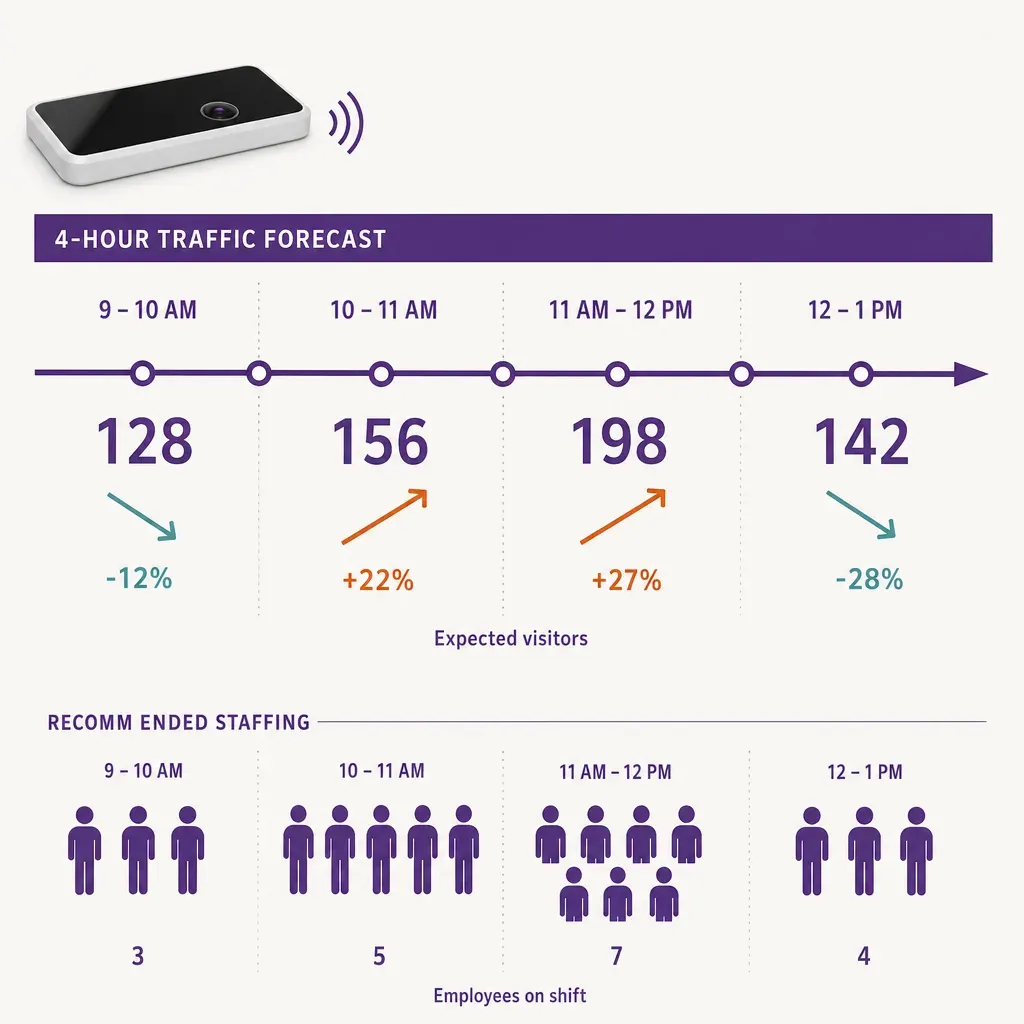
- Maps directly to coverage. The forecast must be expressed in the same units the roster speaks. If the rota plans in hourly coverage, the forecast shows projected visitors per hour against rostered associates for the same hour. Translation steps lose people.
- Logs every decision. When a manager acts on a deviation, the system records the action and the outcome. The feedback closes the loop: the model learns which interventions worked and the thresholds improve over time.
- Lives where the manager already works. A separate dashboard nobody opens during peak is worse than no system at all. The forecast belongs in the rota tool, the back-office screen, or the mobile app the store team already uses.
A four-hour forecast is also the place where rota fragility shows up earliest. If the same store is consistently above baseline on Friday afternoons and the rota is consistently understaffed for those hours, the four-hour loop is the symptom and the medium-horizon model is the cause. Over a few weeks, that pattern feeds back into the published roster so the loop has less work to do.
How Ariadne fits
A four-hour traffic forecast is only as honest as its inputs. The hour-by-hour count of visitors entering the store is the one piece of data the loop cannot fake, and it is the piece most retailers measure imperfectly. People counting at the entrance is the upstream measurement that makes the rest of the chain credible.
Ariadne measures this with Hybrid Fusion, its patented camera-free method. Time-of-Flight depth sensing counts every visitor at the entrances, capturing geometry rather than images, while patented phone signal sensing follows movement through the interior, detecting the signals a phone emits even in airplane mode. The sensor streams both feeds to Ariadne, where Hybrid Fusion combines them into one trajectory per visit and computes counts, dwell, and paths. The streams carry no identifier: no MAC address, no device ID, no biometric data, and no camera is involved. Identifiers are stored only when a visitor explicitly opts in, which keeps the method GDPR-friendly and outside biometric territory.
Two properties of that measurement matter for the four-hour loop. The first is that the count is independent of conversion: a busy hour with low conversion still reports as a busy hour, which is exactly the population the loop is trying to staff against. A count built from transactions, by contrast, underweights the hours where understaffing was the problem in the first place, which is the wrong feedback for a scheduling system. The second is that the count carries no personal data. No images, no faces, no MAC address by default, no device identifier. One ToF sensor at the entry handles the count itself; group sizing, where it matters inside the store, comes from the patented phone signal sensing. The scheduler is fed an integer per hour, not a recognised person, which keeps the same measurement on the right side of GDPR and of any works-council conversation. Hardware specifications and data handling sit in the privacy policy, and the wider context is in the retail industry overview.
Most workforce management platforms can ingest an external hourly time series. The pattern is the same one that powers the published roster: footfall per hour from Ariadne goes into the scheduler, and the scheduler combines it with transactions, tasks, and operational rules. The difference is the cadence. Where the medium-horizon model gets refreshed once a fortnight, the four-hour forecast gets refreshed every hour, and the upstream count is what makes that refresh worth running.
Related reading
FAQ
How is a 4 hour traffic forecast different from a daily forecast?
A daily forecast gives a single total for the trading day, useful for the published roster but not for the day itself. A four-hour forecast is a rolling view of the next four hours, refreshed on the hour, built from the day's measured traffic so far. It is the layer that lets the roster correct inside the day, while the daily forecast is the layer the roster is built from in the first place.
Why four hours, not two or eight?
Two hours is too short for most coverage decisions to play out: by the time an off-roster associate is in the store, the window is almost over. Eight hours is long enough for the correction to drift, because the structural reasons a day moves off baseline (weather, local events, transport disruption) often do not persist for a full shift. Four hours sits at the point where the manager still has time to act and the correction is still tight to today's conditions.
Does the system use cameras?
No. Ariadne counts with Hybrid Fusion: Time-of-Flight depth sensing plus patented phone signal sensing, never cameras. Time-of-Flight captures geometry rather than images, and signal sensing captures no MAC address by default, so the measurement involves no video, no faces, and no biometric data.
What happens to the forecast when there is no historical baseline yet?
A new store, a refurbished store, or a store in a substantially changed catchment has a baseline that is either missing or known to be wrong. The loop still works, with two adjustments: the baseline is built from a comparable store rather than the store's own history, and the size threshold for intervention is widened to reflect the lower confidence. Over the first few weeks of trading, the store's own data takes over from the proxy baseline and the thresholds tighten back to normal.


