
The 11am-to-2pm problem
For a wide band of retail formats, the working day is not a smooth curve. It has a hill in the middle. From roughly 11am to 2pm a quick-service restaurant, a cafe, a high-street grocery, or a drug store can see two, three, sometimes four times the visitor volume it handles in the surrounding hours. The hill is short, it is sharp on both sides, and it is the part of the day where a store either lands its service standards or quietly loses them. A queue at 12:30 that ran nine minutes long is not recovered by faster service at 3pm; the customer who left without buying is already gone.
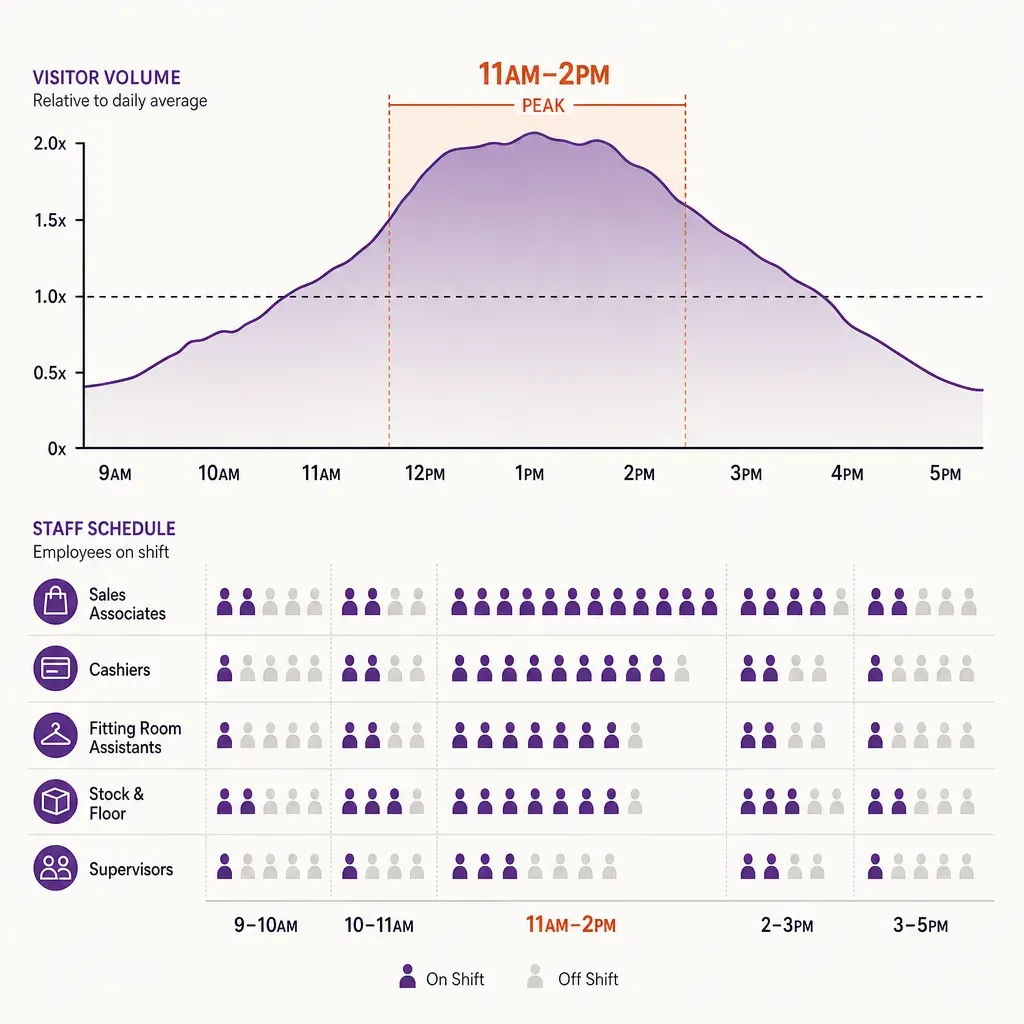
Most operations teams understand the shape of this curve intuitively. The harder question is what to do about it. Staffing for the peak means paying people to stand around at 10am and at 3pm. Staffing for the average means losing the peak. The compromise most schedules end up with is a single mid-shift bump that adds an hour or two of cover and hopes it lands in the right place. The cost of getting that wrong is paid in queue length, transaction abandonment, and the slow erosion of repeat visits.
This piece is about the operational pattern of the lunch peak across four formats that feel it most acutely, and about using people counting and live capture-rate as an early-warning signal so that the schedule responds to what the day is actually doing, not what last quarter's average says it should.
How the peak shows up across formats
The lunch peak is not one curve. It is four related ones, each with its own shape, its own bottleneck, and its own staffing answer.
Quick-service restaurants
QSR runs the sharpest version of the curve. Traffic builds from around 11:30, peaks somewhere between 12:15 and 12:45 depending on the surrounding workplace mix, and falls off through 1:30. Service time per order is short, so the constraint is throughput at the counter and at the kitchen line, not floor space. The visible failure mode is queue length: when the line reaches the door, walk-ins reverse out, and that bounce is invisible in transaction data unless someone is counting visitors at the entrance separately from transactions at the till.
Cafes
Cafe traffic has two related humps, a morning peak around 8 to 9am and a lighter lunch wave that usually lands later than QSR, closer to 12:30 to 1:30, mixing takeaway with sit-down. The bottleneck is different on each side: the morning is barista throughput, the lunch wave is often seat availability. A cafe at 80 percent of its seat capacity has effectively reached its ceiling, because the next visitor through the door cannot find a table and leaves.
Grocery
A high-street grocery or convenience format sees a lunch bump that overlaps with the lunch-break workforce, picking up sandwiches, salads, and meal deals. The shape is broader than QSR, often running from 11:30 to 2:30, with the curve depending heavily on the surrounding worker density. The bottleneck shifts during the peak: at the start it is shelf access in the chilled aisle, at the height it is checkout, and toward the tail it is replenishment as the fastest-moving lines start to clear.
Drug stores
Drug or pharmacy formats inherit the lunch wave because they sit on the same routes the lunch-break workforce already walks. The shape is broader and flatter than QSR. The bottleneck is usually the prescription counter and any single point where a licensed pharmacist has to be present. A queue at the prescription window is harder to clear than a queue at a self-service till, because adding staff to the rest of the floor does not help.
Across all four, the operations problem looks similar in outline. The peak is short. The cost of under-staffing it is concentrated in a 90-minute window. The cost of over-staffing the hours either side of it shows up across the rest of the day, every day, and it adds up fast.
Why staffing the peak by yesterday's average gets it wrong
Most retail schedules are built from historical transaction data, smoothed across a week or a month, and converted into staff-hours by a rough labour standard. That works tolerably well for the back end of the curve, where averages are stable. It works badly for the lunch peak, for three reasons.
- Averages hide the spread. If the 12:30 peak averages 180 visitors across a month, that figure can cover days running 140 and days running 240. A schedule sized for 180 is over-staffed on the low days and lets service collapse on the high ones. The standard deviation around the peak is usually larger than the standard deviation around the average, which is the opposite of what a flat schedule assumes.
- Transactions miss the bounce. If a visitor walks in, sees the queue, and walks out without buying, they do not appear in transaction data. They are part of the demand the schedule needs to serve, but they are missing from the data the schedule is built on. The schedule keeps thinking the peak is the size of the transactions it converted, when in reality the peak is the size of the visitors who arrived, and the gap between those two figures is the size of the problem.
- Weekly patterns drift. Lunch peaks move with the surrounding workplace mix, school terms, weather, and local events. A schedule fixed in August will be off by October, and the way it is off is rarely uniform: one day shifts earlier, another runs longer, a third develops a second sub-peak after the main one. A static schedule cannot follow that movement.
The result is a familiar pattern in the data. A store hits its peak, the queue grows, transaction count flatlines because the till is at throughput capacity, walk-outs spike, and the schedule does not respond because nothing in the schedule's input data tells it that demand is higher than it expected.
Capture-rate as the early-warning signal
The most useful single signal for managing the lunch peak in flight is not transaction count, queue length, or visitor count on its own. It is the ratio between visitors entering the store and visitors completing a transaction, measured live. Capture rate is the canonical name for it. It answers, in one number, whether the store is keeping up with its arrivals.
In a normal hour, capture rate is broadly stable. The same share of arrivals buys something, give or take a small range. In the run-up to a peak, capture rate starts to decline before the queue is visibly bad. Visitors arrive, see the early signs of congestion, look at the line, and a small share of them reverses out. Five minutes later, more arrive, more leave, and the curve steepens. The fall in capture rate leads the fall in service quality by 10 to 20 minutes, depending on the format.
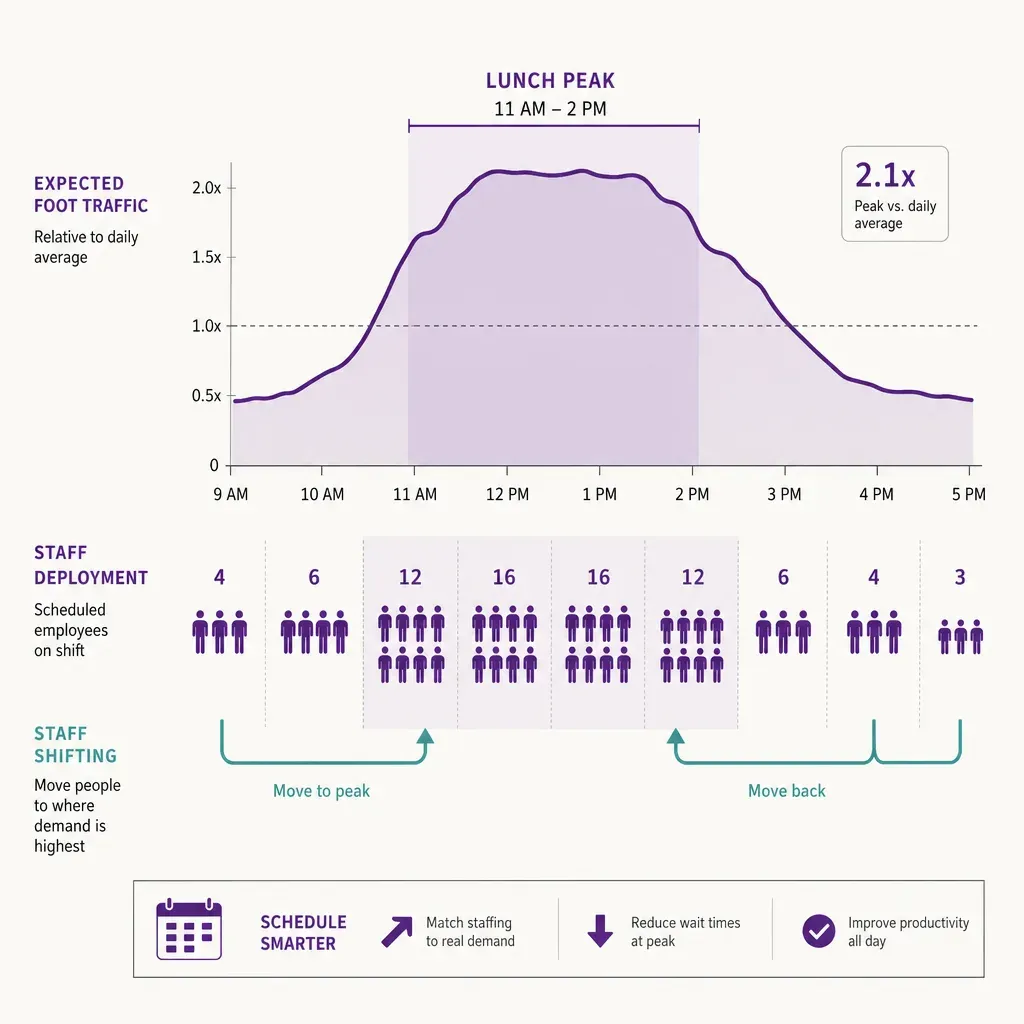
That lead time is the operational asset. A schedule that watches capture rate live can call in extra hands, open a second till, or move a floor staffer to the counter before the peak fully arrives, rather than after the queue has already cost the store an hour of conversion. An illustrative shape: in a QSR seeing 600 visitors over a lunch peak, a capture rate that slips from 78 percent to 64 percent during the run-up represents roughly 84 lost transactions in 90 minutes, and a schedule that catches the slip at the first 5-point drop has a different morning than one that catches it after the queue has reached the door. The numbers here are illustrative; the direction is what every operator who has watched the live signal reports.
What a peak-aware schedule looks like
Working from the live signal changes the structure of the schedule, not just its size. Three habits show up consistently in stores that have moved off a flat mid-shift.
- A staggered call-in, not a single bump. Instead of one extra body landing at 11am and leaving at 2pm, the schedule lays out two or three shorter overlaps that bracket the predicted peak: someone in at 11:15 to 1:15, another in at 11:45 to 2:00, a closer at 12:15 to 1:45. The overlaps are smaller and they match the actual shape of the curve better than a single block.
- A live-trigger rule, not just a forecast. On top of the predicted schedule, the team has an agreed action that fires when capture rate drops by a set amount, say five points, for ten minutes during the peak window. The action might be moving a floor staffer to a till, opening a second counter, or calling a stand-by hour off the call-in list. The trigger is written down so the store does not need a manager to spot the slip and decide what to do under pressure.
- A learning loop on the post-peak data. After the peak passes, the store keeps the visitor curve, the transaction curve, and the capture-rate curve together for next week's roster. Over a few cycles the schedule learns where the peak is moving and where the recurring trigger points sit. The schedule stops being a fixed template and becomes a forecast plus a set of live rules.
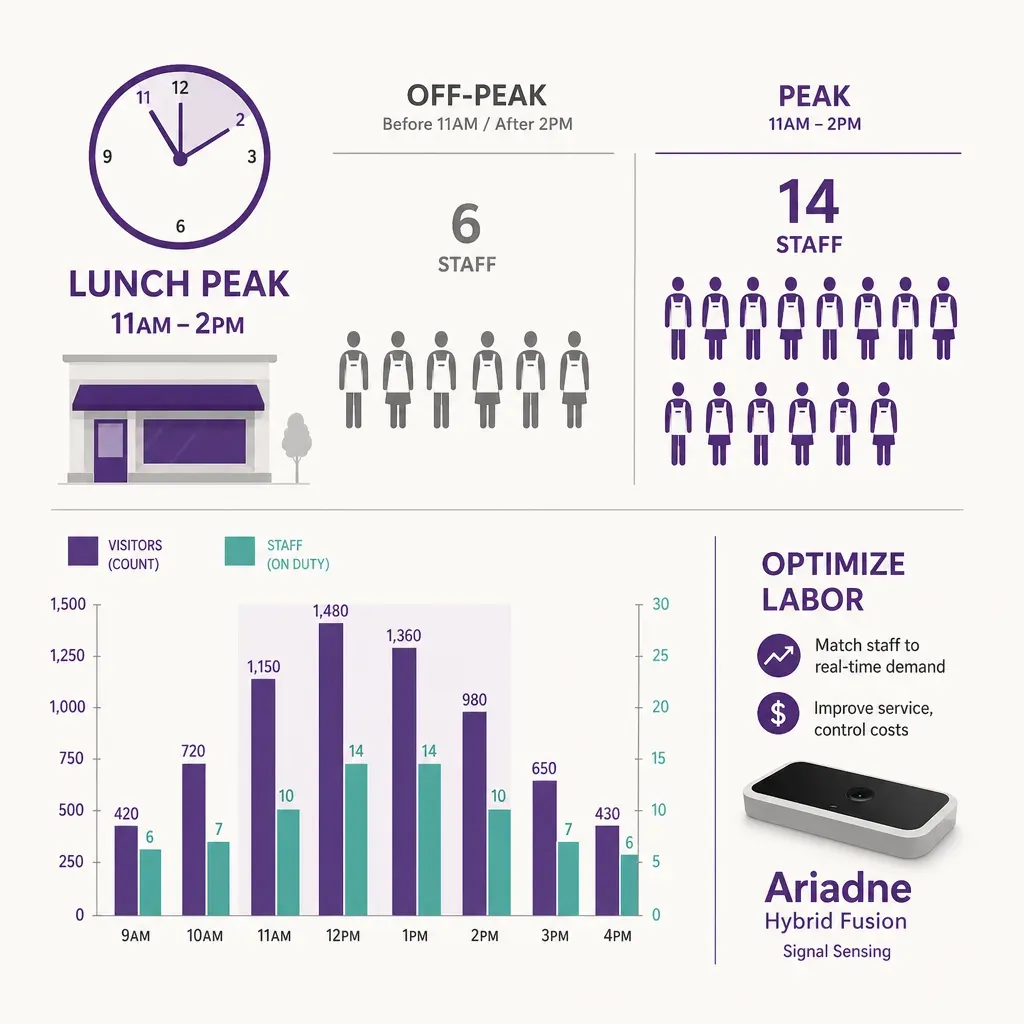
The economics of this are not subtle. Hours over-scheduled outside the peak are paid every day, in every quiet shift, and they accumulate into a meaningful share of the monthly labour bill. Hours under-scheduled inside the peak cost in lost transactions, but only on the days the peak is high, so they do not show up in the average. Moving labour out of the surrounding hours and into a tighter, signal-driven peak almost always reads as a net reduction in scheduled hours plus a lift in peak conversion. That is the win the format is looking for.
How Ariadne fits
The signal a peak-aware schedule needs is straightforward: an accurate count of visitors entering the store, broken into short intervals through the day, joined to transaction or queue data so the live capture rate can be read against a familiar baseline. The two parts that have historically been hard are getting the entry count right, especially when families and small groups arrive together, and getting it without standing up a camera system the store does not want at the front of the floor.
Ariadne measures this with Hybrid Fusion, its patented camera-free method. Time-of-Flight depth sensing counts every visitor at the entrances, capturing geometry rather than images, while patented phone signal sensing follows movement through the interior, detecting the signals a phone emits even in airplane mode. The sensor streams both feeds to Ariadne, where Hybrid Fusion combines them into one trajectory per visit and computes counts, dwell, and paths. The streams carry no identifier: no MAC address, no device ID, no biometric data, and no camera is involved. Identifiers are stored only when a visitor explicitly opts in, which keeps the method GDPR-friendly and outside biometric territory.
In a QSR, cafe, grocery, or drug-store context, this lands in three useful ways. First, group sizing is handled by the patented signal sensing, so a family of four arriving together counts as four visitors and not as one threshold crossing, which is the place most cheap counters fail and the place capture rate is most sensitive. Second, no camera is involved, so the front of the store does not need a video device on the door at exactly the time customers are most aware of how a queue feels. Third, the entry count is exportable in short intervals into the same dashboard the manager is already watching, so the capture-rate read against the transaction stream is something a duty manager can use during a peak rather than after it. Sensor hardware sits in the Ariadne sensor lineup, scheduling tooling lives at employee scheduling, and the data handling is set out in the privacy policy.
The same data feeds the wider questions a small-format store asks, including capture rate by hour, dwell at the counter, and the way visitor flow moves around a busy retail store day. The lunch peak is one window of that, but it is the window where getting the schedule right has the biggest single effect on the daily P&L.
FAQ
What hours count as the lunch peak in retail?
Roughly 11am to 2pm, with the centre and the shape varying by format. QSR tends to peak between 12:15 and 12:45 with a sharp curve. Cafes run a later, broader lunch wave from about 12:30 to 1:30. Grocery and drug-store formats see a flatter band from 11:30 to 2:30 that overlaps with the lunch-break workforce in the surrounding area. The local workplace mix and the day of the week move the centre by 15 to 30 minutes either way.
How is lunch-hour capture rate different from regular capture rate?
Mechanically it is the same calculation, visitors divided by transactions, but the value of measuring it changes. Outside the peak, capture rate is stable enough that the daily figure is what matters. Inside the peak, capture rate is the leading indicator of a service failure, because it falls before the queue reaches the door and before transaction count flatlines. Reading it in short intervals during the peak is what makes it useful for live scheduling decisions.
Can people counting separate a family arriving together from individual visitors?
Yes. The Time-of-Flight sensor at the door counts every visitor crossing the threshold, and Ariadne's patented signal sensing handles group sizing centrally, so a family of four counts as four arrivals rather than as one. This matters most during a lunch peak in formats where small groups are a meaningful share of the traffic and a per-threshold counter would systematically understate demand.
Does this system use cameras at the entrance?
No. Ariadne counts with Hybrid Fusion: Time-of-Flight depth sensing plus patented phone signal sensing, never cameras. Time-of-Flight captures geometry rather than images, and signal sensing captures no MAC address by default, so the measurement involves no video, no faces, and no biometric data.


