
Why day of week is the wrong question to assume
Most retailers carry a mental picture of their week. Saturday is the peak, Sunday is quieter, Monday is dead, Friday builds, the middle of the week is flat. That picture gets baked into staff schedules, delivery windows, cleaning rotas, and promotional calendars, and once it is set it tends to stay set for years. The problem is that the picture is wrong often enough to be expensive, and the places it is wrong are not random. There are a handful of specific day-of-week patterns retailers consistently misread, and they show up as understaffed peaks, overstaffed troughs, and promotions running on the wrong days.
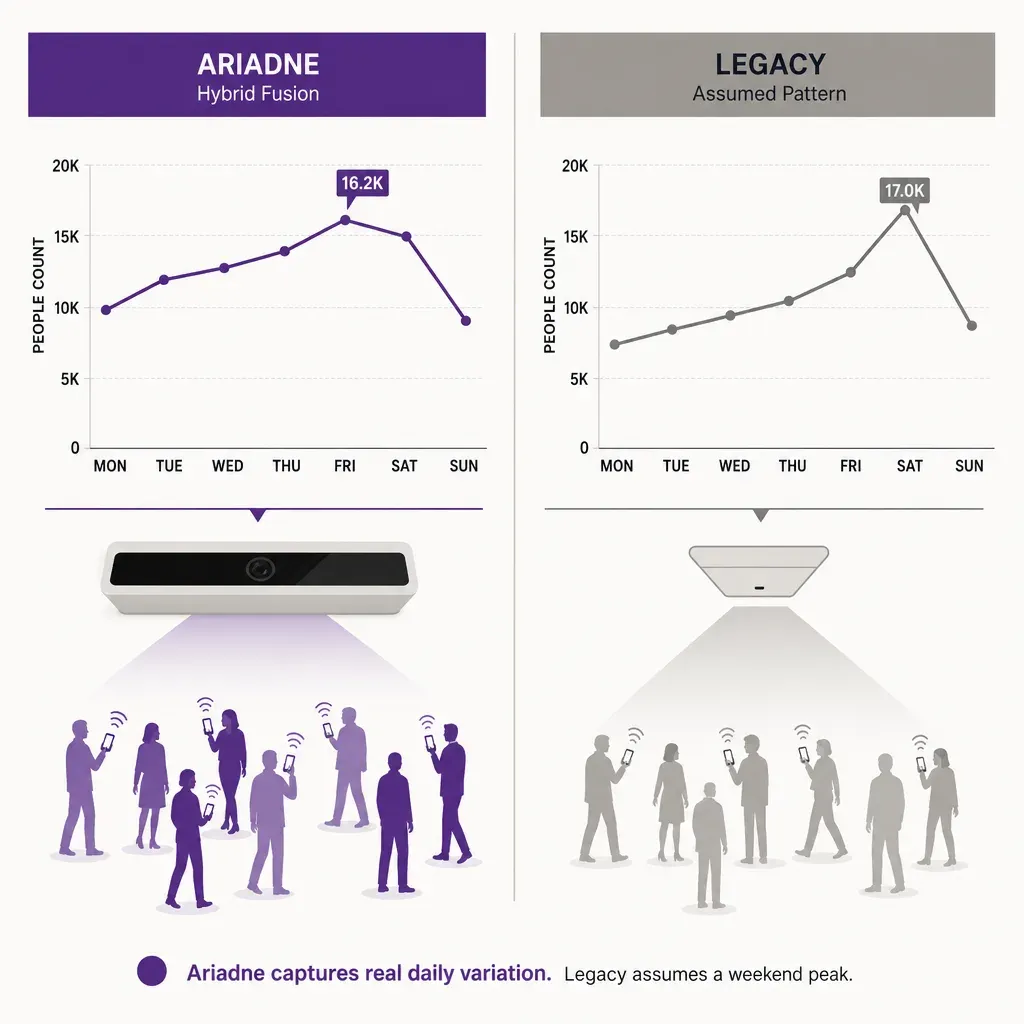
The fix is not to swap one folk model for another. It is to read the actual curve a specific store produces, week after week, and let that curve decide how the week is staffed, stocked, and promoted. That requires continuous people counting data and a methodology that controls for the things that make raw daily numbers misleading. This is a methodology piece, not a study. The numbers in it are illustrative of patterns the industry has reported widely, not measurements from Ariadne or any single retailer.
The five misreads that keep showing up
Across formats and catchments, the same handful of mistakes recur. None of them is exotic. Each one is the result of using an averaged or assumed curve where a measured one would have told a different story.
Misread 1: Saturday is always the busiest day
In a lot of high-street and mall retail, Saturday is the busiest day. In a lot of others, it is not. Stores in residential catchments, near places of worship, or in markets where Sunday is the main family shopping day can see Sunday match or overtake Saturday by a meaningful margin. A retailer who treats Saturday as the default peak in those locations will reliably understaff Sunday, run out of stock on Sunday afternoons, and book deliveries for the wrong end of the weekend.
The honest answer for any individual store is: measure it. As a general industry pattern, expect a weekend that is 1.4 to 1.8 times an average weekday in visitors, with the Saturday-to-Sunday split anywhere from 60-40 to 45-55 depending on catchment. Those are illustrative ranges, not measured figures, and they exist to make the point that the split itself is not stable across locations.
Misread 2: Thursday is a quiet midweek day
Thursday is the day most retailers underestimate. In categories where customers do a pre-weekend shop, grocery, drug, beauty, casual fashion, Thursday afternoon and evening tend to run substantially busier than Tuesday or Wednesday, and in some catchments approaches a weekday-Friday level. The schedule that treats Thursday as a midweek tail leaves the floor undermanned during a real demand window, and the cost shows up as queues, lower conversion, and a service-quality dip exactly where the next weekend's revenue is being seeded.
If a store's daily curve is read only as a Monday-to-Friday average plus a weekend peak, this pattern is invisible. The pattern only becomes obvious when each weekday is plotted on its own, week over week, with hour-of-day detail.
Misread 3: Friday and Saturday are the same shape
Friday and Saturday often produce similar total visitor counts, which encourages retailers to schedule them the same way. The hourly shape is rarely the same. Friday traffic tends to weight later in the day, with a strong post-work and post-school surge from 4pm to 8pm and a longer evening tail. Saturday is more evenly spread, with a stronger morning, a long midday plateau, and an earlier wind-down. Two days that share a daily total but not a daily shape need different staffing, not the same one applied twice.
Misread 4: Monday is always the slowest day
Monday is the slowest day in many retailers and the second-slowest in many others, with Tuesday or Wednesday taking the bottom slot. The slowest day depends on what surrounds it: when local payroll lands, whether nearby offices and schools are in session, whether the store sits near a transit hub that runs on a different rhythm. A retailer who closes early on Monday by reflex sometimes turns out to be closing early on the wrong day.
Misread 5: The same curve applies all year
The day-of-week curve is not a fixed object. It deforms by season. The weekend share of the week tends to grow in summer and around holidays and to shrink during heavy promotional weeks where weekday traffic lifts disproportionately. A staffing plan built on the annual average understaffs the winter weekend and overstaffs the August weekday. The plan that works is the one that reads the curve a recent rolling window has produced, not the one that reads the annual average.
Why raw daily counts mislead
Even with continuous counting in place, the raw daily total can lead a retailer in the wrong direction. Four things distort the picture often enough to be worth handling explicitly.
- Trading hours that vary by day. A store that opens an hour later on Sunday than on Saturday will look quieter on Sunday for reasons that have nothing to do with demand. Daily totals need to be normalised to the trading window, or read at a per-trading-hour rate, before any day-to-day comparison is fair.
- Group sizing. A count of crossings at the door is not the same as a count of shopping decisions. Two people walking in together usually make one decision. On family-shopping days, average group size rises, which means the same number of doorway crossings represents fewer real shopping parties. Without group sizing in the data, weekends can look more different from weekdays than they actually are at the level of decisions made.
- Staff and contractor traffic. Mid-morning deliveries, cleaning rounds, and shift changes register at the door if the counting setup includes back-of-house movement. Stores that fail to filter staff traffic see false peaks at opening and at delivery times that are not customer signal.
- Weather and events. A wet Saturday and a sunny one can produce daily totals that differ by 20 to 30 percent in some catchments. Reading a single recent week without weather context is reading noise. The day-of-week curve should be built from several weeks of data, not from yesterday's number compared with last Saturday's.
A methodology for reading the curve honestly
Producing a day-of-week curve a store can act on is not difficult, but it does take a small amount of discipline that one-off snapshots skip. The steps below describe how an analyst inside a retail operations team can build a curve from continuous counting data without overreaching the data they have.
- Use a rolling window of at least 8 to 12 weeks. Long enough to average out weather and one-off events, short enough that the trading environment has not changed underneath the data. For seasonal categories, a year-on-year window is also worth building.
- Normalise to trading hours. Express each day as a visitor count per trading hour, not just a daily total. This makes Sundays and bank holidays comparable to full-trading weekdays.
- Hold out abnormal days. Days with weather alerts, transit disruption, local events, or store closures sit in a separate bucket. They are useful for the elasticity analysis later, but they should not enter the baseline day-of-week curve.
- Group days, do not average them. Plot each weekday as its own line, with the median and an interquartile range across the window, not just a single point. The spread shows which days are stable and which are volatile, which matters for staffing.
- Layer hour-of-day. A daily total can hide the difference between a Friday that peaks at 7pm and a Saturday that peaks at noon. Plot hour-of-day curves for each weekday side by side; staffing is built from hour-of-day, not from daily totals.
- Validate against POS. Where transactional data is available, conversion (transactions per visitor) and basket size should be plotted by day of week alongside footfall. A day that draws fewer visitors but converts better may be more profitable than a louder one, and the staffing decision needs to reflect that.
What a healthy day-of-week curve looks like
There is no single correct shape. The shape that is right for a given store is the one its catchment, format, and product mix produce, measured cleanly. The signs that a curve has been read well, rather than assumed, are practical:
- The staffing plan changes when the curve changes, rather than being set annually and left alone.
- Each weekday is treated separately for staffing and stocking, not collapsed into a Monday-to-Friday average.
- The hour-of-day pattern for each weekday is mapped, so that staff arrivals match the build of traffic, not the opening of the doors.
- The weekend split is verified rather than assumed, with Sunday treated as an independent day rather than a tail of Saturday.
- Promotions are aligned to days where incremental traffic, not just total traffic, is realistic to win.
Staffing the curve instead of the average
The first place the day-of-week curve pays back is the staff schedule. A schedule built on a measured curve looks different from one built on the assumed week in three concrete ways.
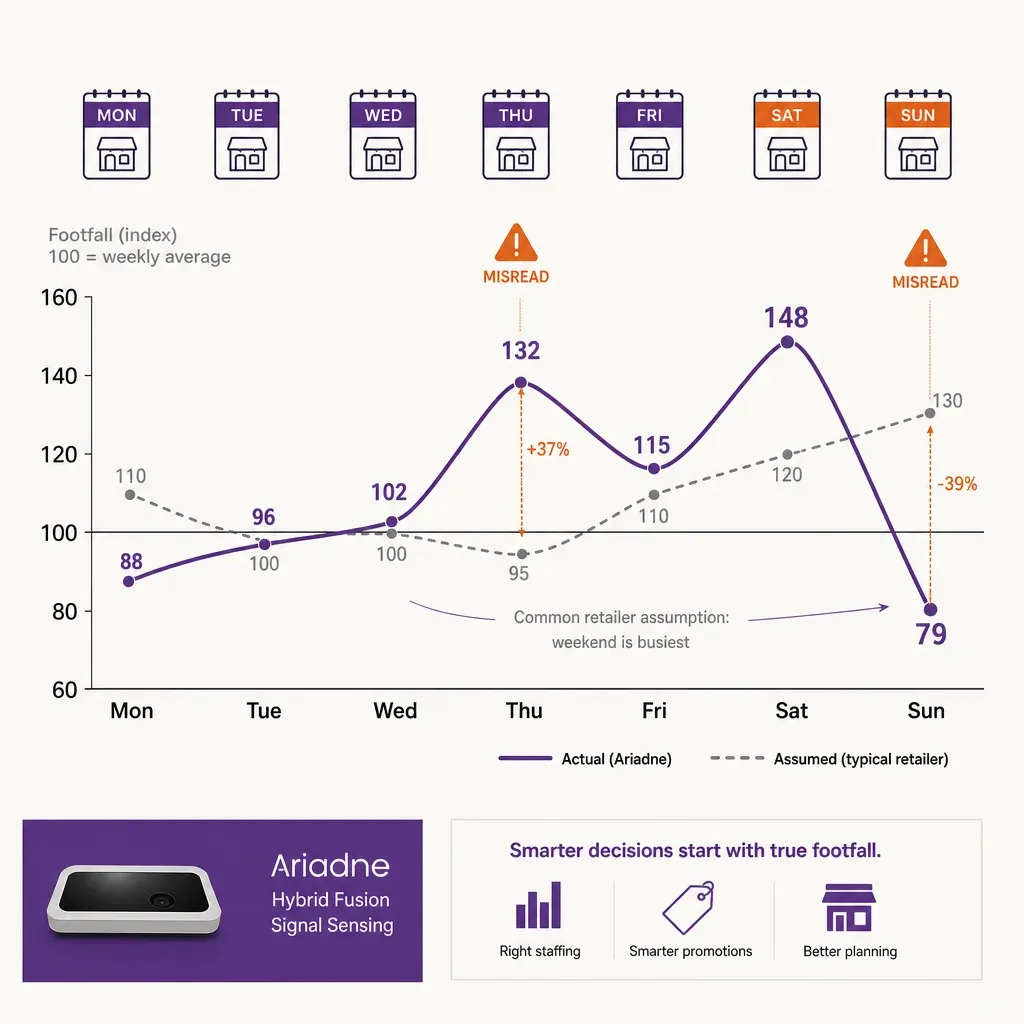
First, the Thursday late shift gets reinforced. The pre-weekend afternoon and evening, which the assumed week treats as midweek, is recognised as one of the higher-conversion windows of the week. Service quality on Thursday afternoon directly influences how the following weekend lands.
Second, Sunday is staffed as a peak in catchments where the data says it is one. The reflex to treat Saturday as the only weekend peak loses sales when Sunday afternoons are running near Saturday levels with thinner cover.
Third, the slowest weekday gets resolved on evidence rather than reflex. Where the curve shows Tuesday as the true low, Monday hours stop being trimmed by habit. Where Monday genuinely is the low, the trim is sized to actual demand rather than to a generic figure pulled from elsewhere.
The mechanics of moving from a measured curve into a schedule are covered in more detail in the wider work on retail employee scheduling. The day-of-week reading is the input; the schedule is the output that has to be re-run as the curve drifts.
Measuring the curve without cameras
Reading day-of-week footfall well needs three properties from the underlying counting system: continuous coverage across opening hours, accurate group sizing, and a way to read each store as its own object rather than as part of an aggregate. The measurement also needs to sit comfortably under GDPR, because day-of-week analysis is the kind of work that runs every week across a whole chain. Anything that introduces a camera or a personal identifier into that loop multiplies the compliance overhead unnecessarily.
Ariadne measures this with Hybrid Fusion, its patented camera-free method. Time-of-Flight depth sensing counts every visitor at the entrances, capturing geometry rather than images, while patented phone signal sensing follows movement through the interior, detecting the signals a phone emits even in airplane mode. The sensor streams both feeds to Ariadne, where Hybrid Fusion combines them into one trajectory per visit and computes counts, dwell, and paths. The streams carry no identifier: no MAC address, no device ID, no biometric data, and no camera is involved. Identifiers are stored only when a visitor explicitly opts in, which keeps the method GDPR-friendly and outside biometric territory.
For day-of-week analysis specifically, the practical setup is straightforward. A ToF sensor over each entry counts every crossing, including children, and resolves group size so the daily figure reflects shopping parties as well as raw individuals. Inside the store, signal sensing measures how long visitors dwell across zones, which lets a retailer see whether a quiet day in raw counts is also a quiet day in engagement, or whether a smaller crowd is converting better. The streams carry no MAC address by default, no device ID, no faces, and no video, so the analysis can run every week without re-opening the data protection conversation. Sensor hardware is documented in the Ariadne sensor lineup, and the data handling sits in the privacy policy.
The same data feeds the wider questions a retailer asks of a retail store: conversion by day and hour, capture rate, the response to a window change, the effect of weather on midweek volume. The day-of-week curve is one cut of that data, but it is the cut that decides how the week gets staffed, and that is where most of the operational money in retail analytics is.
Related reading
FAQ
Is Saturday always the busiest day in retail?
Not reliably. In many high-street and mall stores Saturday is the peak, but in residential catchments and markets where Sunday is the main family shopping day, Sunday can match or overtake it. The honest answer for any single store is to measure several weeks of trading-hour-normalised counts and read the curve directly, rather than carrying over an assumption from a different format.
Why is Thursday often underestimated?
Thursday afternoon and evening is when a lot of pre-weekend shopping happens in grocery, drug, beauty, and casual fashion. Schedules built around a Monday-to-Friday average treat it as a midweek tail and understaff it. Plotting each weekday on its own, with hour-of-day detail, makes the Thursday lift visible and lets the staff schedule respond to it.
How long a window of data should a day-of-week curve use?
A rolling 8 to 12 week window is usually long enough to average out weather and one-off events while staying short enough to reflect the current trading environment. For seasonal categories, a year-on-year window built from the same weeks of the previous year is also worth carrying alongside the rolling one.
Does the system use cameras to read day-of-week patterns?
No. Ariadne counts with Hybrid Fusion: Time-of-Flight depth sensing plus patented phone signal sensing, never cameras. Time-of-Flight captures geometry rather than images, and signal sensing captures no MAC address by default, so the measurement involves no video, no faces, and no biometric data.


