
Every retail roster carries two kinds of waste at once, and they hide from each other. In the quiet mid-morning stretch you have staff standing around with nothing to serve, which is pure cost. Two hours later the queue backs up, the fitting room goes unmanned, and shoppers who came to buy leave without buying, which is lost revenue that never shows up as a line item. Both problems come from the same root: the roster was built from something other than the traffic that actually walked in.
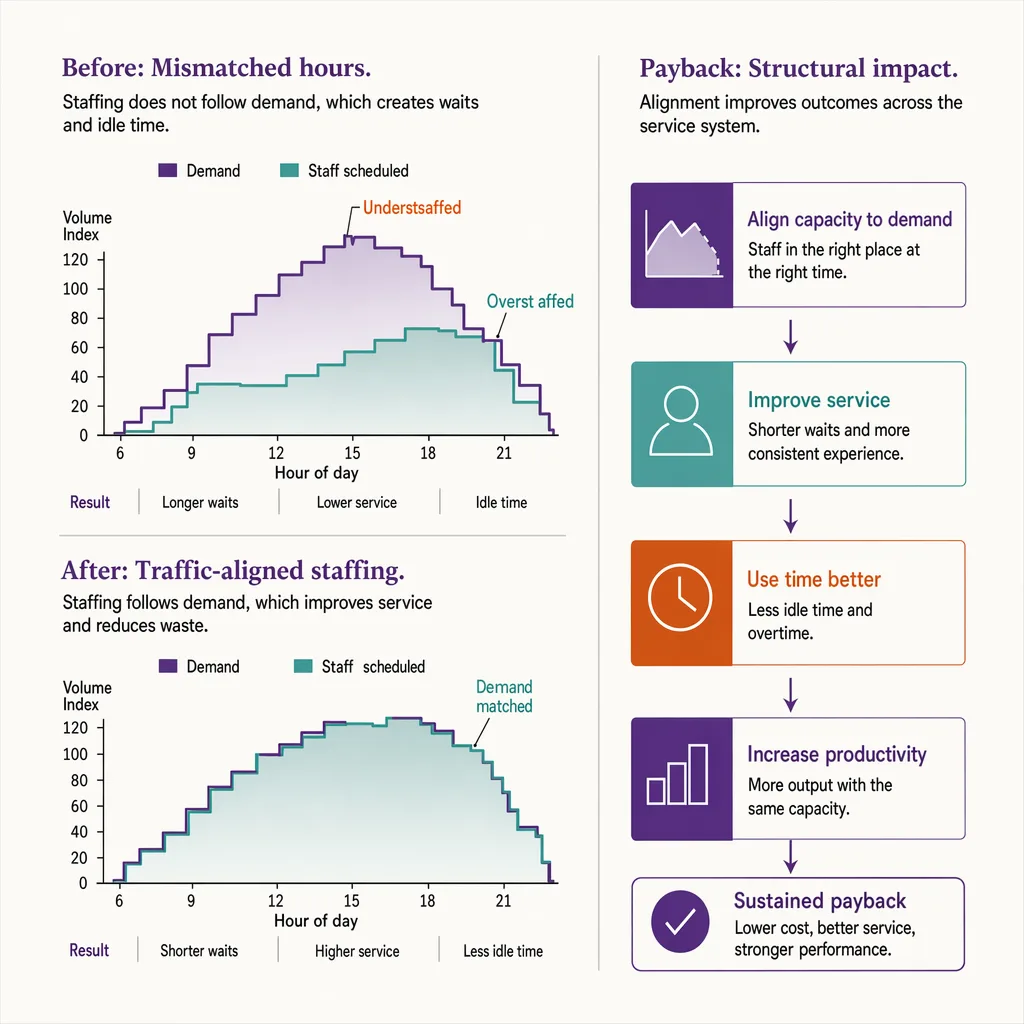
Footfall-based scheduling fixes the root, and the return comes from closing both gaps. This post is the dedicated business case: the two levers that produce the payback, how to build a defensible before-and-after comparison, and a worked sample model you can adapt to your own numbers. It sits beside demand-based scheduling, which explains the practice, and labor cost benchmarks, which gives the cost context. Neither owns the ROI math, and that is what this post is for.
What is the ROI of scheduling staff to footfall?
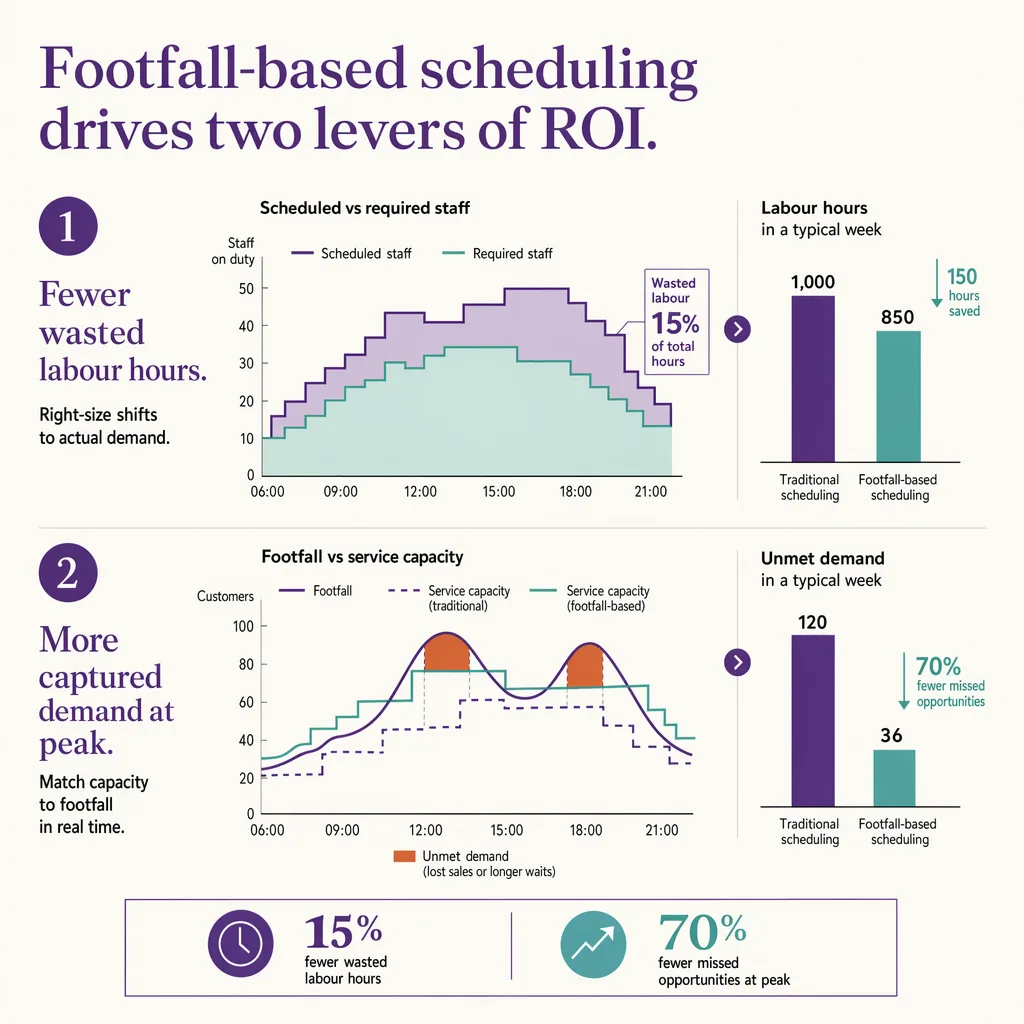
The ROI of footfall-based scheduling comes from two sides of the same roster: cutting labor hours parked in quiet periods, and adding cover in peaks where understaffing costs sales through longer queues and missed conversions. You quantify it by comparing labor cost as a percentage of sales, and conversion at peak, before and after you align hours to measured traffic. The gain is not a single headline number. It depends on how far your current roster drifts from demand, so a store already close to its traffic curve has less to recover than one running a flat schedule against a spiky day. Ariadne supplies the traffic input camera-free, so the business case rests on real hourly counts rather than an estimate.
The two levers: trimmed over-staffing and recovered peak conversion
The first lever is the easy one to see and the easy one to over-claim: trimming hours you did not need. A store that opens with a full floor team at 09:00 because that is what the schedule template says, when the door count does not build until 11:00, is paying wages against an empty aisle. Shift the start times to match the traffic build and those hours come straight off the labor bill without touching service, because there were no shoppers to serve in the first place. This lever is real, but it is bounded. You can only cut hours the traffic did not justify, and once the roster tracks the quiet periods honestly, the well runs dry.
The second lever is the one most stores leave on the table, and it is usually the larger of the two. When a peak is understaffed, the cost is not idle wages, it is sales that walk out the door. Queues lengthen, browsers who wanted help cannot find it, and conversion rate at the busiest hour of the day sags precisely when the most people are in the building to convert. Moving hours you saved from the trough into the peak does not just add cover, it recovers spend that was leaking. Because the peak carries a disproportionate share of daily traffic, a small lift in peak conversion applied to the busiest hours can outweigh the pure hour savings from the trough. The two levers work best together: the trough funds the peak, and the peak pays back more than it costs.
Both levers only become measurable once you can express them in the same currency as the traffic. Sales per visitor converts a recovered conversion point into money, and that is the figure a finance team will actually recognise.
Building the before/after case: labor cost, conversion at peak, hours against traffic
A credible ROI case is a before-and-after, not a projection pulled from thin air. You need three measurements captured the same way in both periods, so the comparison is honest rather than flattering.
The first is labor cost as a percentage of sales, taken hourly rather than daily. A daily average hides the exact problem you are trying to fix, because it nets an over-staffed morning against an under-staffed afternoon and reports a number that looks fine. Break it down by hour and the drift shows up: cost percentage spikes in the quiet stretches where wages run against thin sales, and it can also spike in the peak if understaffing suppressed the sales that should have absorbed those wages. Use the labor cost benchmark work to frame what a healthy percentage looks like for your format.
The second is conversion at peak, isolated to the busiest one or two hours. This is where the recovered-revenue lever lives, so it deserves its own number rather than being folded into a whole-day conversion figure.
The third is the overlay that ties the other two to reality: scheduled staff hours plotted against measured footfall, hour by hour. This is the picture that makes the case self-evident. Where the staffing line sits above the traffic line you are over-covered, and where it sits below you are under-covered. The gap between the two lines, summed across the day, is the drift you are being paid to remove. Pair the overlay with the footfall to revenue correlation so the conversation moves from headcount to money, which is the only unit that closes a business case.
A worked, illustrative model you can adapt
The table below is a sample, not a customer result. The numbers are illustrative and chosen to show the mechanics of the two levers, so replace them with your own counts and rates before you present anything. A single store, one representative trading day.
| Line | Before (flat roster) | After (footfall-aligned) |
|---|---|---|
| Opening block staff hours (quiet 09:00 to 11:00) | 18 | 10 |
| Peak block staff hours (busy 12:00 to 15:00) | 24 | 30 |
| Total daily staff hours | 96 | 94 |
| Peak-hour conversion rate | 18% | 21% |
| Peak-hour visitors | 900 | 900 |
| Peak-hour transactions | 162 | 189 |
| Sample sales per transaction | 40 | 40 |
In this illustrative model the total hours barely move, dropping from 96 to 94, because the point is redistribution rather than blunt cutting. Eight hours come out of the over-covered opening block, and six of them go back into the peak where they earn their keep. The visible payback is in the peak conversion line: lifting from 18% to 21% on the same 900 visitors turns 162 transactions into 189, and at a sample 40 per transaction that is 27 extra transactions worth roughly 1,080 in recovered daily sales, against a net reduction in labor hours. Run that pattern across a trading week and the recovered conversion, not the small hour saving, is what carries the return.
Two honest caveats keep the model trustworthy. First, the peak conversion lift is the assumption doing the heavy lifting, so it must come from your own before-and-after measurement, not from a hoped-for number. Second, sales per transaction and visitor volume vary by store and day, so a single day proves the mechanism, not the annual figure. Build the model on a representative period, and state plainly that it is a template rather than a guarantee.
What the model needs to be trustworthy: accurate counts, not estimates or camera-based guesses
The entire case above collapses if the traffic input is a guess. If your visitor numbers are modelled from sales, or extrapolated from a sample hour, or pulled from a sensor that miscounts groups and prams, then the hours-against-traffic overlay is drawing conclusions from noise. The peak you are staffing to might be an artefact, and the trough you are cutting might have been real demand the sensor missed. Accurate, hour-by-hour counts are not a nice-to-have here, they are the foundation the whole ROI rests on.
Ariadne measures this with Hybrid Fusion, its patented camera-free method. Time-of-Flight depth sensing counts every visitor at the entrances, capturing geometry rather than images, while patented phone signal sensing follows movement through the interior, detecting the signals a phone emits even in airplane mode, and tracks that movement to about one-metre precision. The sensor streams both feeds to Ariadne, where Hybrid Fusion combines them into one trajectory per visit and computes counts, dwell, and paths. The streams carry no identifier: no MAC address, no device ID, no biometric data, and no camera is involved. Identifiers are stored only when a visitor explicitly opts in, which keeps the method GDPR-friendly and outside biometric territory.
Because the count is device-independent and captured at the door, the before-and-after periods are measured the same way with the same instrument, which is what makes the comparison defensible rather than an argument about methodology. For the counting side of the picture, see camera-free people counting.
Beyond the store: the same signal drives airport and cleaning rosters
The store case is the clearest one, but the mechanism is not retail-specific. Any operation that staffs against a variable flow of people has the same two levers and the same payback logic. An airport terminal rosters cleaning and service staff against passenger flow that swings hard with the flight schedule, and the cost of getting it wrong is the same shape: idle hours in the lulls, unmet demand in the surges. The playbook for traffic-driven airport rosters applies the identical count-to-hours logic to restroom servicing and terminal coverage, where a dirty facility during a peak arrivals bank is the equivalent of an unmanned till.
Wherever the flow of people is measured accurately and hours are aligned to it, the business case is built the same way: trim the trough, fund the peak, prove the change with a before-and-after on real counts. That is the whole idea behind demand-based scheduling, and footfall is simply the most honest demand signal a physical location has.
Related reading
FAQ
What is the ROI of footfall-based scheduling?
It comes from two levers: cutting labor hours that sat in quiet periods, and recovering sales lost when peaks were understaffed. You quantify it by comparing hourly labor cost as a percentage of sales, and conversion at peak, before and after you align hours to measured traffic. There is no universal figure, because the size of the gain depends on how far your current roster drifts from actual demand.
Which lever pays back more, cutting hours or recovering conversion?
Usually the recovered peak conversion, because the peak carries a disproportionate share of daily traffic. A small conversion lift applied to the busiest hours can outweigh the wage savings from trimming an over-covered trough. The trough saving is real but bounded; you can only cut hours the traffic never justified.
Do I need cameras to measure the traffic for this?
No. Ariadne counts with Hybrid Fusion: Time-of-Flight depth sensing plus patented phone signal sensing, never cameras. Time-of-Flight captures geometry rather than images, and signal sensing captures no MAC address by default, so the measurement involves no video, no faces, and no biometric data.
How long does it take to prove a footfall scheduling ROI?
Build the before period on a representative trading window, make the roster change, then measure the same metrics over a comparable after period. A single day demonstrates the mechanism; a full week or two gives you a figure stable enough to present, because it averages out day-of-week and weather swings in the traffic.
Is the worked model in this post a real customer result?
No. It is an illustrative sample built to show how the two levers interact. Replace every figure with your own counts, conversion rates, and transaction values before using it, and present it as a template rather than a promised outcome.
---


