
Why this comparison gets asked
Both Density and Ariadne report numbers about people in a building. The two companies show up together on shortlists when a buyer searches for sensor-based occupancy or counting, and a tidy side-by-side seems like the obvious next step. The honest reading is that Density and Ariadne are not really direct competitors. They are adjacent. They were built to answer different questions for different buyers. Once you see that, the comparison becomes useful, because you can stop trying to choose between them on a single feature checklist and start choosing based on what you actually need to measure.
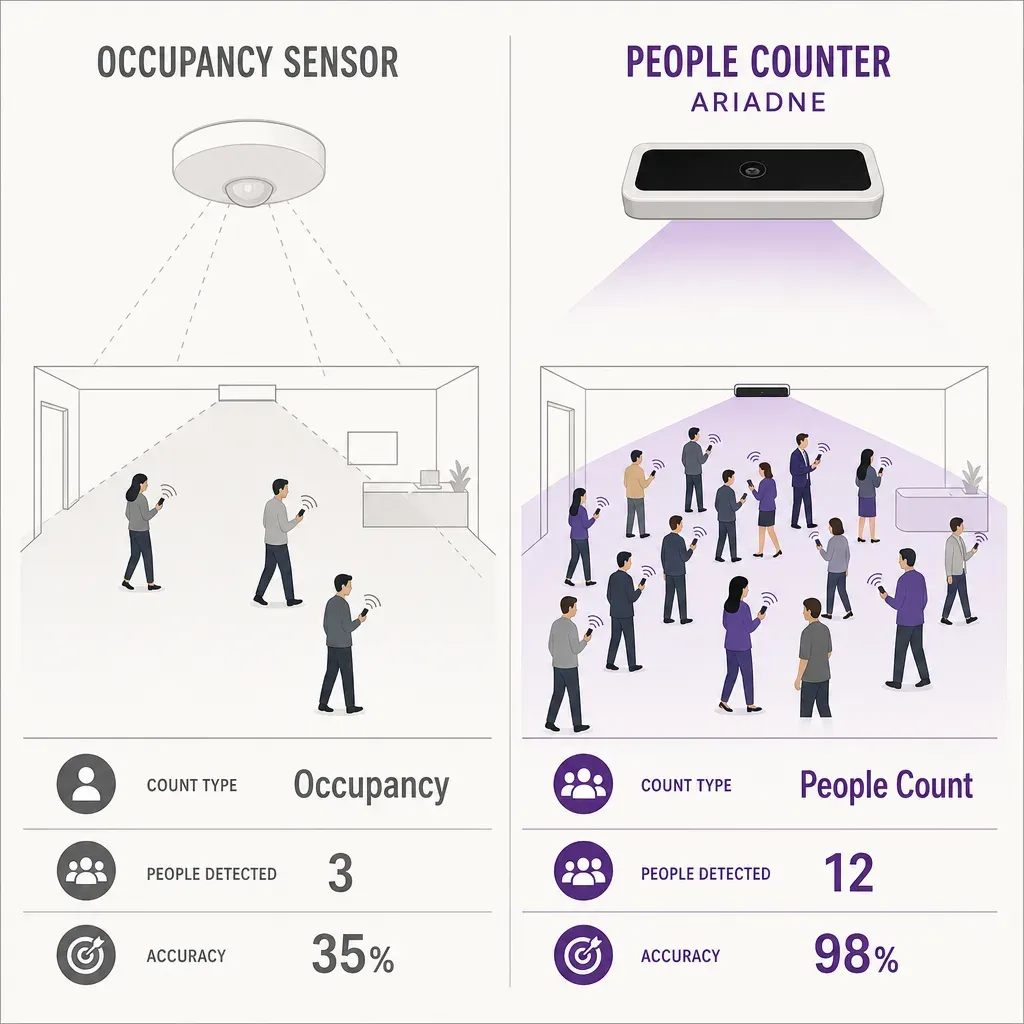
This post draws on Density's own public website (density.io) as accessed on 3 June 2026, and on Ariadne's own product documentation. Where a feature is specific to Density, the source is cited inline so anyone can verify it. There is no synthetic accuracy benchmark and no fabricated customer claim from either side.
The short version
Density is an occupancy-sensing company built around workplace and real-estate use cases. Its flagship sensor, Waffle, is described on density.io as "a new, real-time radar sensor" that "counts 0, 1, 2 or 3+ people" with a "120° FOV + adjustable 18ft range" and "<1 second data latency" (density.io, accessed 2026-06-03). The product narrative is about helping facilities and real-estate teams understand whether meeting rooms, phone booths, desks, and floors are being used.
Ariadne is a people-counting and visitor-flow platform built around retail, shopping centres, airports, and smart cities. It measures with Hybrid Fusion, a patented camera-free method that combines Time-of-Flight depth sensing at entries with phone signal sensing across the interior. The product narrative is about helping merchandising, operations, and city teams understand traffic, dwell, and visit patterns inside a store, a centre, or a public space.
If you are trying to optimise an office portfolio, Density is the obvious shortlist entry. If you are trying to understand visitor behaviour in a shop or a public venue, Ariadne is. The rest of this post is the long version of why.
Different buyers, different questions
The first useful filter is not technology. It is the question the buyer is trying to answer.
Density's buyer: corporate real estate and workplace
Density's published customer logos lean heavily into Fortune 500 employers (its homepage at density.io lists names such as ExxonMobil, Okta, HPE, Stripe, Coca-Cola, BlackRock, and Shopify, accessed 2026-06-03). The questions those buyers tend to ask are workplace questions. How many people are actually in the office on a given day? Which meeting rooms are over-booked and under-used? Which phone booths sit empty? Should we keep this floor or hand it back at lease renewal? Density's Atlas software is designed to surface exactly that: occupancy and visit counts, per room and per floor, with operating-hour controls and downloadable charts (per Atlas product page, density.io, accessed 2026-06-03).
That is the workplace and corporate real estate (CRE) problem. The metric of the year for those teams is utilisation: are the spaces we pay rent on being used, and at what rate.
Ariadne's buyer: retail, centres, airports, cities
Ariadne's buyer is a different operator: a retail brand, a shopping centre, an airport, or a city. The questions are different too. How many visitors entered the store today, and how does that compare with last week? What was the conversion rate from footfall to transactions? Which aisles or zones held attention and which were skipped? On a festival weekend, how many people moved through the high street, and where did they linger? Those questions are about people counting, visitor flow, and dwell, not about whether meeting room 4B was empty between 2 and 3 pm. Ariadne's customer pages and the retail, shopping centre, and smart city sections of the site describe that posture in more detail.
Different sensors, different physics
Once the buyer question is clear, the sensor design follows. The two companies have made genuinely different choices, and the choices are visible from each company's own documentation.
Density: radar at the ceiling
Density's current flagship, Waffle, is described on its product page as "a new, real-time radar sensor" that "counts 0, 1, 2 or 3+ people," with a "120° FOV + adjustable 18ft range," "<1 second data latency," and "powered, no batteries" installation (density.io, accessed 2026-06-03). Density also lists an Open Area sensor and an Entry sensor in its earlier lineup. The product framing is about quick install and broad coverage of meeting rooms, phone booths, desks, and open spaces, with the ceiling radar reading whether the space is occupied and roughly how many people are in it.
Density positions this as anonymous: its homepage describes "anonymous people count for rooms, phone booths and desks" (density.io, accessed 2026-06-03). Radar by physics does not produce images. That matters in an office setting where employees would reasonably push back against ceiling cameras over their desks, and it is a clean answer to give the works council or labour representative who has to sign off on a workplace sensor rollout.
Ariadne: Hybrid Fusion, depth plus signal
Ariadne measures this with Hybrid Fusion, its patented camera-free method. Time-of-Flight depth sensing counts every visitor at the entrances, capturing geometry rather than images, while patented phone signal sensing follows movement through the interior, detecting the signals a phone emits even in airplane mode. The sensor streams both feeds to Ariadne, where Hybrid Fusion combines them into one trajectory per visit and computes counts, dwell, and paths. The streams carry no identifier: no MAC address, no device ID, no biometric data, and no camera is involved. Identifiers are stored only when a visitor explicitly opts in, which keeps the method GDPR-friendly and outside biometric territory.
The Ariadne sensor design is shaped by what a retail, centre, or city operator typically needs to know: how many visitors entered, how long they stayed, where they went inside, whether the same people came back. Time-of-Flight counts every visitor at the door regardless of whether they carry a phone, and phone signal sensing follows movement through the interior to compute dwell and path length. The Ariadne sensor lineup lists the hardware that runs this method.
Why the sensor choices look different
Radar is well suited to a small, contained space such as a meeting room or a phone booth, where the question is roughly "is anyone here, and is it more than three." Time-of-Flight depth sensing is well suited to a doorway, where the question is "exactly how many people just crossed this line." Phone signal sensing is well suited to the interior of a larger venue, where the question is "how long did this individual stay in this zone, and where did they go next." Each method is best at the questions it was chosen for. The reason Density and Ariadne look different at the sensor layer is that they are answering different questions.
What gets measured
The metrics on each platform reflect the buyer they serve. A few examples, sourced from each company's own materials.
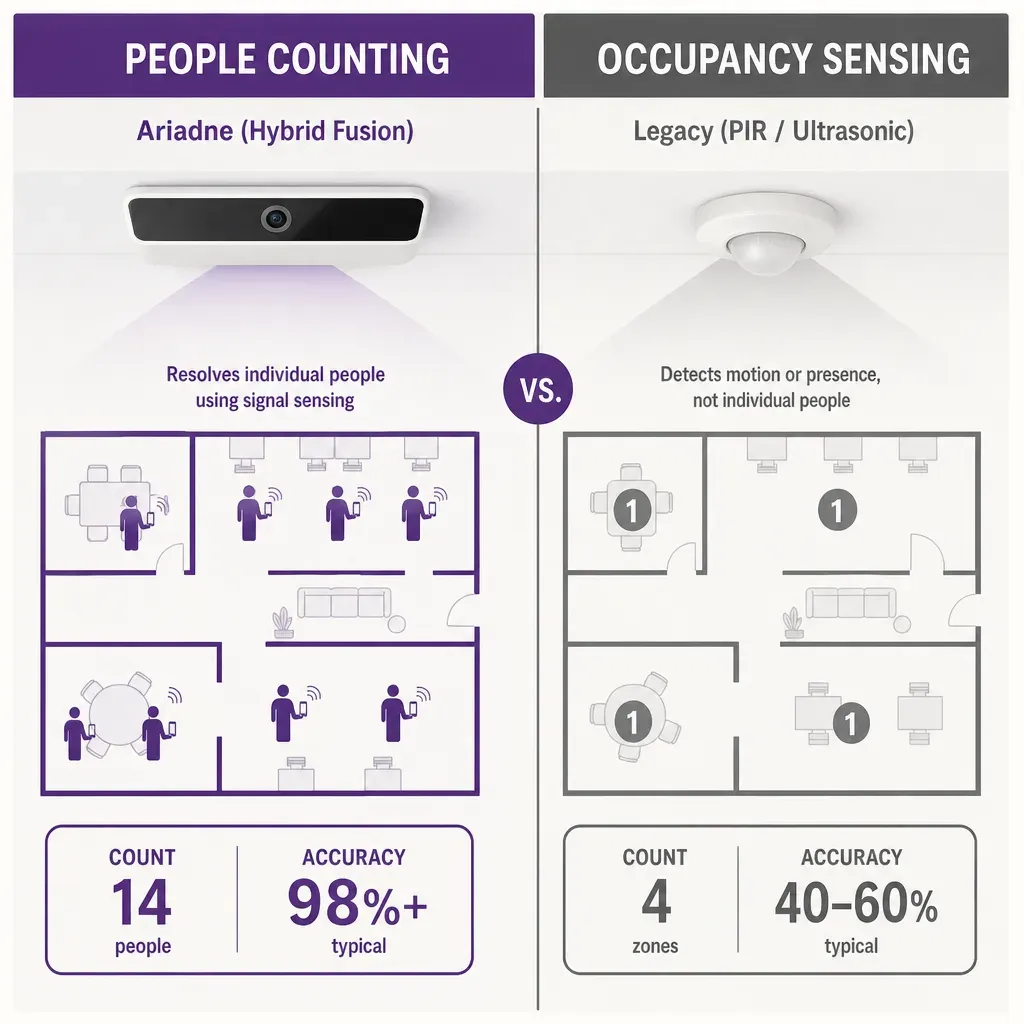
Density: occupancy of defined spaces
Density's Atlas product page describes occupancy and visit metrics at building, floor, and space level, with controls for operating hours and downloadable charts (density.io, accessed 2026-06-03). The natural unit is a space: a meeting room, a phone booth, a desk neighbourhood, a floor. The natural KPI is utilisation rate over time, with peaks, troughs, and trend lines.
Ariadne: footfall, dwell, conversion, journeys
Ariadne reports footfall (entries over time), dwell time (how long visitors stayed by zone), conversion (footfall against transactions, when sales data is connected), and visitor journey or path data across a venue. The natural unit is a visit, not a desk. The natural KPI for retail is conversion rate; for a centre it is footfall and dwell by zone; for a smart-city or airport context it is flow and density of crowds in public space. The people-counting solution page sets out the metrics in detail.
Privacy posture, side by side
Both companies position around privacy, and both make defensible cases. The shape of the case is different in each.
- Density. Radar is non-imaging by physics. Density's homepage frames this as "anonymous people count" (density.io, accessed 2026-06-03). For a workplace deployment in front of a works council or an employee privacy review, that is a clean position: no camera, no image of an employee, no facial recognition, no biometric data.
- Ariadne. Hybrid Fusion is camera-free by design. Time-of-Flight captures geometry rather than images, and phone signal sensing carries no MAC address and no device identifier by default. Identifiers are stored only when a visitor explicitly opts in, for example by logging into guest Wi-Fi, which is a choice the operator can simply decline to offer. There is no PII captured at the sensor in the first place, which is the point that matters when an operator has to defend the system to a data protection officer. Full details are in the privacy policy.
Both stances are honest. They are also targeted at slightly different audiences. Density's audience is an employer asking whether the system can be deployed over its workforce. Ariadne's audience is a retailer, centre operator, or city asking whether the system can be deployed over members of the public under the GDPR.
Where each fits, in plain terms
A short rule of thumb for shortlisting.
Pick Density if
- You are a corporate real estate, workplace, or facilities team, or you are the buyer for one.
- Your unit of analysis is a defined space: meeting room, phone booth, desk neighbourhood, floor.
- Your KPI is utilisation rate against capacity, and your decision is about layout, lease, or shared resource policy.
- Your privacy review is dominated by employee and works council concerns, where "no camera, no image" is the cleanest answer.
- You want plug-and-play deployment with a published sensor and software price list (Density publishes sensor and Atlas pricing on density.io, accessed 2026-06-03).
Pick Ariadne if
- You are a retailer, shopping centre, airport, museum, or city.
- Your unit of analysis is a visit: a person who entered the venue, moved through it, and left.
- Your KPIs include footfall, dwell time by zone, conversion rate against sales, and visitor journeys.
- Your privacy review has to defend the system to a data protection officer for members of the public, and "no PII captured at the sensor" is the position you need.
- You need door counts you can trust regardless of whether visitors carry a phone, and interior journey data on top.
Where they might overlap
Two edge cases blur the line, and they are worth naming honestly.
First, a mixed-use building. An airport terminal has both employee back-of-house space and public concourse. A shopping centre has both tenant retail floors and a back office. In those buildings, an operator could in principle run a workplace-occupancy system for the staff areas and a people-counting system for the public areas. They are not in competition; they are doing different jobs in the same envelope.
Second, an operator who wants "how many people in this room" for a public venue that happens to look like a workplace room. A small library reading room is a workplace-shaped space with public visitors. Either approach can answer the headcount question. The harder question, what those visitors did and how long they stayed, sits closer to the people-counting problem and closer to Ariadne's model.
A neutral evaluation framework
If you are still genuinely uncertain which side of the line your project sits on, these are the questions worth answering before any demo or pilot.
- Who is being counted? Employees in a workspace you control, or members of the public in a venue they visit. The privacy answer differs sharply between the two.
- What is the unit of analysis? A defined space (room, desk neighbourhood) or a visit (enter, move through, leave). A space-first system and a visit-first system are not interchangeable.
- What is the headline KPI? Utilisation against capacity, or footfall and dwell against revenue or flow. The KPI sets the reporting model you need.
- Does the operational team need door-accurate counts? If your operation has to know exactly how many people are in the building right now, a depth sensor at the door is the right answer. A ceiling occupancy sensor inside a room is not designed for that.
- Do you need interior journey data? If you need to know how visitors moved between zones and where they lingered, a presence-per-room sensor will not give you that. A system that follows movement across the interior will.
- Who signs off privacy? Works council and employee representatives versus a data protection officer for public visitors. The acceptable answer is shaped by who is in the room.
- Is the cost model published? Density lists sensor and software prices on density.io. Ariadne pricing is sales-led and project-shaped. Neither model is right or wrong; ask both vendors for a written total cost of ownership for your specific deployment.
FAQ
Are Density and Ariadne direct competitors?
Not really. They are adjacent. Density's centre of gravity is workplace and corporate real estate occupancy. Ariadne's centre of gravity is retail, shopping centre, airport, and smart-city people counting and visitor flow. The two products do show up on the same shortlist when a buyer searches generically for "sensor-based people counting," which is why a side-by-side is useful, but the strongest fit for each is different.
Does Ariadne use radar sensors like Density?
No. Ariadne uses Hybrid Fusion: Time-of-Flight depth sensing at entries combined with patented phone signal sensing across the interior. The two methods are chosen for the visitor-flow problem, not the room-occupancy problem.
Does Density use cameras?
Per density.io (accessed 2026-06-03), Density's Waffle sensor is described as radar, and the company positions its counting as anonymous. Radar by physics does not capture images. Refer to Density's own product documentation for the current specifics.
Does Ariadne use cameras?
No. Ariadne counts with Hybrid Fusion: Time-of-Flight depth sensing plus patented phone signal sensing, never cameras. Time-of-Flight captures geometry rather than images, and signal sensing captures no MAC address by default, so the measurement involves no video, no faces, and no biometric data.
Can Ariadne be used in a workplace?
It can, particularly if the office building doubles as a venue with public visitors or if the operator needs door-accurate entry counts. For pure workplace utilisation analytics inside meeting rooms and at desk neighbourhoods, an occupancy-sensor product such as Density's is purpose-built for that job and worth shortlisting.
Can Density be used in a retail store?
Density's published case material and customer logos centre on workplace deployments rather than retail (density.io, accessed 2026-06-03). For retail door counts, dwell, conversion against sales, and zone-level visitor journey analytics, a people-counting platform such as Ariadne is the closer fit.
Related comparisons
Compare other vendors: Best people counting systems 2026 · V-Count alternative · FootfallCam alternatives · RetailNext vs Ariadne · Placer.ai vs Ariadne


