
About this comparison: written by Ariadne. Claims about Placer.ai are sourced from Placer.ai's public documentation as of 2026-06-10, with links inline so you can check each one. The goal is a fair, buyer-side read, not a takedown.
Why this comparison is not a like-for-like one
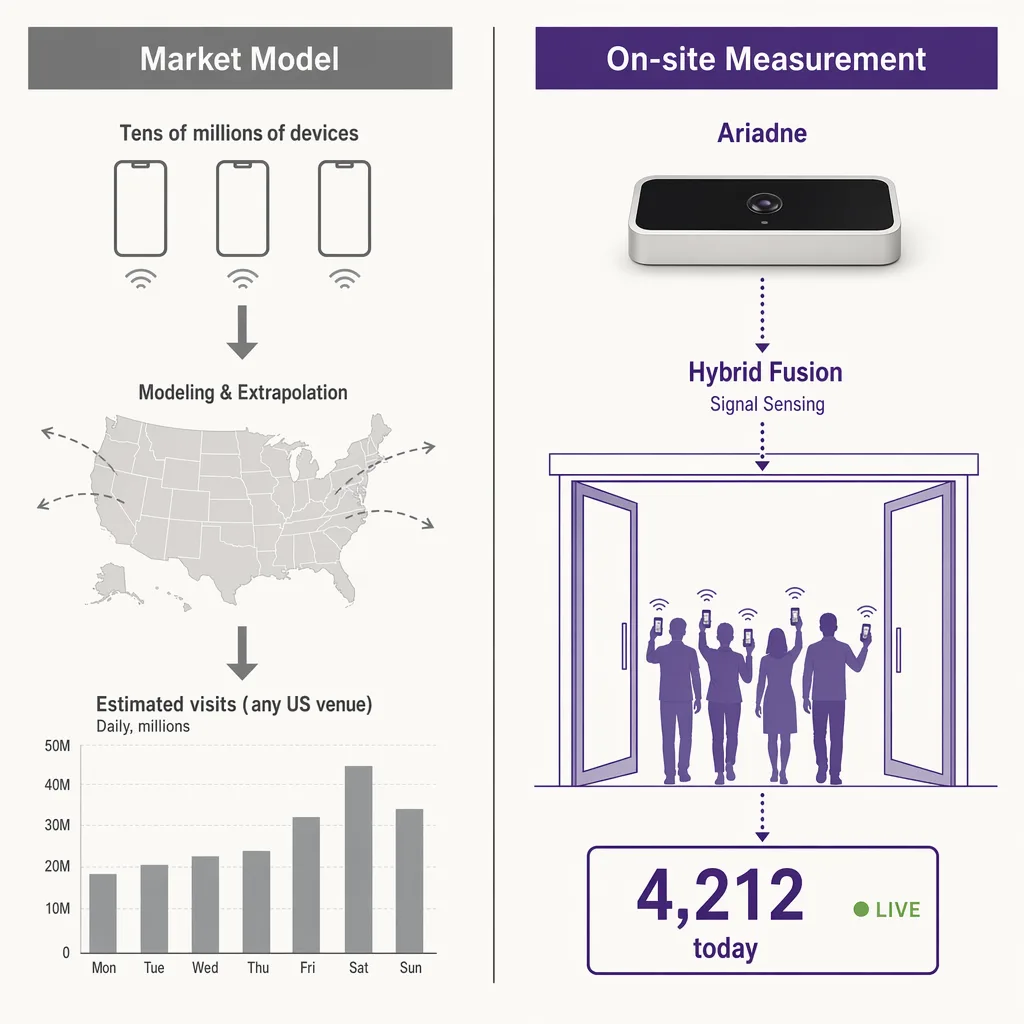
Placer.ai and Ariadne both promise to tell you about foot traffic, so they end up on the same shortlist. They are, in fact, two different categories of tool. Placer.ai is a location-intelligence platform that models foot traffic for almost any place in the United States from a panel of mobile devices, without anyone installing anything. Ariadne is an on-site people counting and indoor analytics platform that measures what actually happens inside one venue using camera-free sensors you install at the doors and in the interior.
The short version: Placer.ai answers where the market is. Ariadne answers what is happening inside your building. One is modeled and market-wide, the other is measured and venue-specific. If you understand that split, the rest of this comparison tells you which job you are actually trying to do, and therefore which tool fits.
Modeled market data vs measured on-site counting, in one paragraph
Placer.ai describes itself as a location intelligence and foot traffic data platform built on a panel of tens of millions of mobile devices that forms a representative sample of the US population, sourced from vetted mobile application providers (placer.ai/resources/our-data, accessed 2026-06-10). It draws a polygon or radius around any point of interest and estimates visits to it, then extrapolates from the panel to the full population using proprietary machine-learning models. Ariadne, by contrast, measures one venue directly. Its hardware combines Time-of-Flight depth sensing at the entrances with patented phone signal sensing in the interior, and there is no camera in the path. Placer.ai gives you a modeled estimate of any place you do not control. Ariadne gives you a measured count of the place you do.
How each one gets its numbers
Placer.ai: a mobile-device panel, extrapolated
Placer.ai does not install sensors. Its data comes from a panel of mobile devices whose location is shared through the apps on them. Per Placer.ai's data documentation (placer.ai/resources/our-data, accessed 2026-06-10), the panel is tens of millions of devices forming a representative sample of the US population, and the platform aggregates and extrapolates that panel with proprietary algorithms and machine learning to estimate visits to any location in the country. A device that spends more than about two minutes inside a drawn point of interest is counted as a visit, and those counts are aggregated into visitation and demographic trends once they clear a privacy threshold.
The practical reading: Placer.ai is a model. It takes a sample of devices, observes where they go, and scales those observations up to a population estimate. That is exactly the right method for the job it is built for, comparing one place against thousands of others you will never put hardware in. It is an estimate, not a turnstile count, and Placer.ai is clear that the panel is US-based.
Ariadne: one camera-free sensor that measures the venue
Ariadne measures this with Hybrid Fusion, its patented camera-free method. Time-of-Flight depth sensing counts every visitor at the entrances, capturing geometry rather than images, while patented phone signal sensing follows movement through the interior, detecting the signals a phone emits even in airplane mode. The sensor streams both feeds to Ariadne, where Hybrid Fusion combines them into one trajectory per visit and computes counts, dwell, and paths. The streams carry no identifier: no MAC address, no device ID, no biometric data, and no camera is involved. Identifiers are stored only when a visitor explicitly opts in, which keeps the method GDPR-friendly and outside biometric territory.
The practical reading: nothing is modeled from a third-party sample. The sensor at your door measures every visitor who walks through it, and the interior sensing follows movement to produce dwell and paths. The number is a measurement of your venue on the day in question, available in real time, not an extrapolation from a panel of phones somewhere else.
This is the architectural difference that drives everything below: coverage, accuracy at a single site, real-time availability, privacy posture, and geography.
Accuracy: estimate vs ground truth
These two tools should not be judged on the same accuracy scale, because they are not measuring the same thing. Placer.ai's strength is relative accuracy at scale: how this mall trends against that mall, how a chain's visitation moved quarter over quarter, how a trade area is shaped. Its published method is panel-based extrapolation (placer.ai/resources/our-data, accessed 2026-06-10), which is well suited to ranking and trend questions and is not designed to be a precise absolute count of one door on one afternoon.
Ariadne's strength is absolute accuracy at a single site. Ariadne publishes a 30 cm accuracy figure for both sensing methods, and the count is generated centrally after the two feeds are fused. If you need to know that 4,212 people entered your store today, not an indexed estimate of how busy it probably was, that is a measurement question, and a panel model is the wrong instrument for it. If you need to know whether your store is busier than the three competitors down the road, that is a market question, and an on-site sensor in your own store cannot answer it.
What each platform actually produces
Placer.ai
Per the Placer.ai analytics and foot traffic pages (placer.ai/products/analytics and placer.ai/guides/foot-traffic-analytics, accessed 2026-06-10), the platform is built around market-level questions:
- Visitation trends. Estimated visits to any US venue over time, including places you do not operate.
- Trade area and catchment. Where a venue's visitors come from, drawn from the panel's home and work geographies.
- Competitive benchmarking. Your estimated visits against competitors and against category and market averages.
- Demographics and audience. Modeled demographic and behavioural profiles of a venue's estimated visitors.
- Cross-visitation and loyalty. Where else a venue's visitors go, and repeat-visit estimates, useful for site selection and tenant mix.
Ariadne
Per the Ariadne product pages, the same camera-free hardware powers:
- People counting. Measured entry counts at every door, group size from phone signal sensing, hourly and daily breakdowns, multi-site rollups.
- Real-time occupancy. Live occupancy per zone with capacity alerts, for fire-code limits and customer-experience limits.
- Heatmaps, dwell, paths. Zone-level dwell, kinetic heatmaps, and shopper journey traces from interior signal sensing.
- Conversion and KPIs. Entry counts joined to point-of-sale data for conversion rate, sales per visitor, and staffing models.
- Indoor navigation and visitor marketing. EaseLink is Ariadne's blue-dot indoor wayfinding and visitor marketing layer on the same sensor base.
The lists barely overlap, which is the point. Placer.ai is built to compare your venue against the wider market it sits in. Ariadne is built to run your venue: who is inside right now, how long they stay, where they go, and whether they convert. A retailer doing serious site selection wants the first. A retailer running the store they already have wants the second.
Real time vs historical
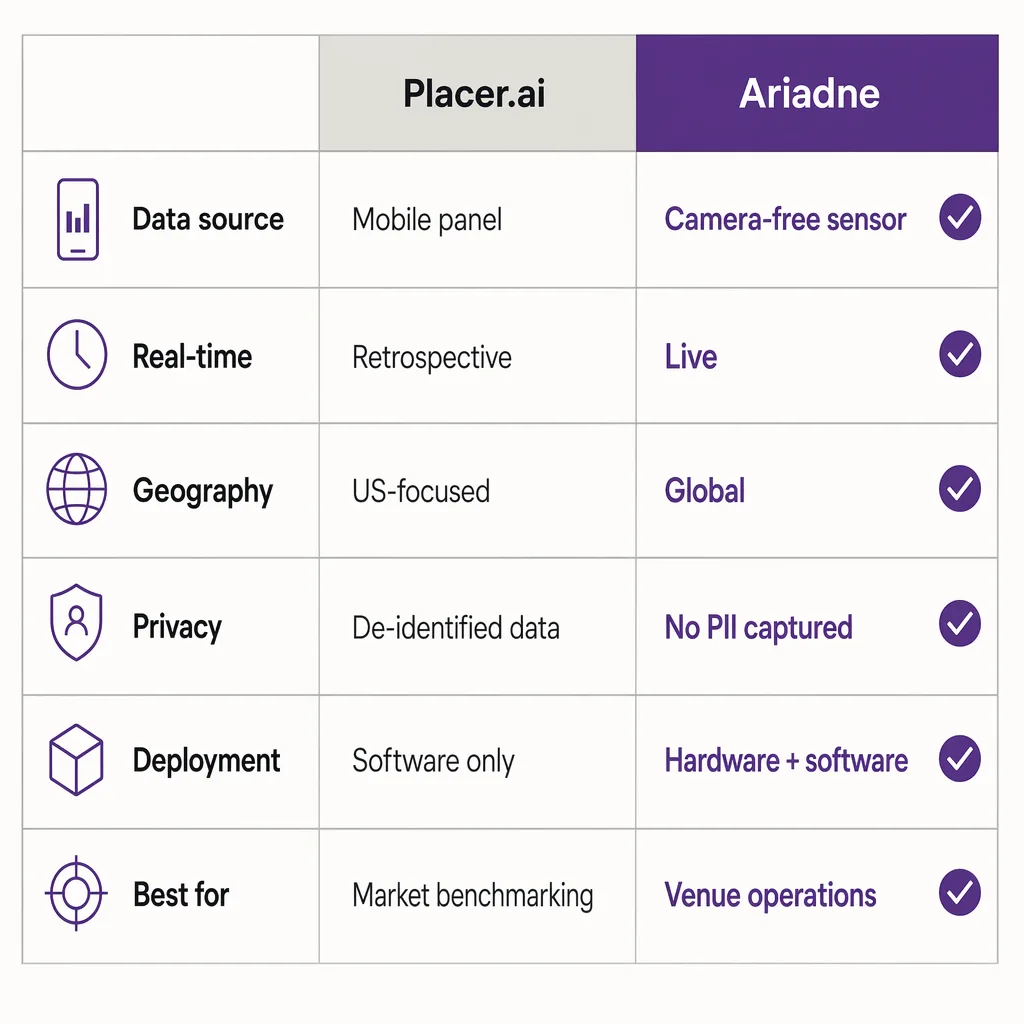
Operational decisions need live data. Queue management, occupancy compliance, dynamic staffing, and same-day response all depend on knowing what is happening now. Ariadne is a live system: occupancy and counts update in real time because the sensor is in the room. Placer.ai's panel model is inherently retrospective, built for trend, trade-area, and benchmarking analysis rather than real-time floor operations. Neither is a flaw. A market-intelligence platform does not need to tell a duty manager that the third floor just hit capacity, and an on-site counter does not need to wait for a national panel to settle. They are tuned for different clocks.
Privacy posture
Placer.ai
Placer.ai's privacy model is de-identification and aggregation of third-party mobile data. Per its data documentation (placer.ai/resources/our-data, accessed 2026-06-10), the panel data Placer.ai works with is stripped of personal identifiers such as names and mobile advertising IDs, and the platform only reports aggregated, statistical information about locations once a panel clears a minimum-device threshold. That is a recognised privacy-by-design approach for location-panel analytics. The underlying input is still mobile-device location data gathered through apps, then de-identified and aggregated upstream of the customer.
Ariadne
Ariadne starts from a different place: there is no personal data to de-identify, because none is captured. Time-of-Flight depth sensing produces geometry, not pictures. Phone signal sensing produces a position, not a MAC address, and captures no device identifier by default. There is no biometric data and no camera anywhere in the system. Identifiers are stored only when a visitor explicitly opts in, for example a guest Wi-Fi login. The distinction matters for a data protection officer: Placer.ai aggregates data that began as personal data and was de-identified upstream, while Ariadne never collects personal data at the sensor in the first place. The Ariadne privacy policy sets out the details, and the how it works page explains the measurement method.
There is a European angle worth stating plainly. Placer.ai's panel is built on the US population, so for a venue outside the United States the market-data coverage thins out, and the third-party mobile-location-panel model itself faces tighter consent and ePrivacy scrutiny in the EU than it does in the US. Ariadne's first-party, no-personal-data-by-default measurement sidesteps that question entirely, which is one reason European retailers, transport hubs, and public venues tend to start there.
Geography and coverage
Placer.ai is US-centric by construction. Its panel represents the US population, and its market, trade-area, and competitive data are strongest in the United States (placer.ai, accessed 2026-06-10). For US retail, commercial real estate, restaurants, and civic analysis, that panel is deep and purpose-built, and Ariadne does not offer an equivalent market-wide view.
Ariadne is geography-agnostic in a different sense: it works anywhere you can install a sensor. Ariadne is European-headquartered (Munich, Germany) and operates across Europe, the Middle East, North America, and Asia in retail, shopping centres, airports, and smart cities. The coverage is wherever the hardware is mounted, not wherever a national device panel happens to be representative. For a non-US venue, that is often the deciding factor, because the on-site measurement does not depend on a US-weighted panel at all.
Deployment and cost model
The two tools cost money in completely different shapes. Placer.ai is software only: a subscription to a data platform with nothing to install, which means fast time to first insight and zero hardware, balanced against the fact that you never get a measured ground-truth count of your own door. Ariadne is hardware plus software: camera-free sensors installed per coverage area, streaming to Ariadne's cloud for central Hybrid Fusion, with SDKs and APIs to connect the data to a warehouse, POS, BI, or workforce-management stack. The hardware lineup is on the Ariadne hardware page, and Ariadne's pricing page explains the tier structure. Placer.ai does not publish public pricing either; both vendors quote through sales. The honest framing is that you are not choosing the cheaper tool, you are choosing the right category for the question, and in many estates the answer is to budget for both.
A buyer-side decision frame
The choice resolves into a handful of questions you can answer in your own terms.
- Do you need a measured count of your own venue, or an estimate of the market? If you need to know exactly how many people entered your store, your airport terminal, or your museum, that is a measurement job and Ariadne is built for it. If you need to know how your venue trends against competitors and markets you do not control, that is Placer.ai's job.
- Do you need real-time data? Occupancy compliance, queue management, and same-day staffing need live numbers, which means an on-site system. Placer.ai's panel model is retrospective by design.
- Is the estate in the United States? Placer.ai's panel is US-built and deep for US market analysis. Outside the US, its market coverage thins and Ariadne's on-site measurement is unaffected because it does not rely on a national panel.
- What does your data protection officer need to see? Both models can be operated lawfully, but the case is cleanest when no personal data was collected. Ariadne captures none at the sensor. Placer.ai de-identifies and aggregates third-party mobile data upstream.
- Is the question site selection or store operations? Site selection, trade-area planning, and tenant mix favour Placer.ai. Running the venue you already have, conversion, dwell, occupancy, staffing, favours Ariadne.
What we would not claim about Placer.ai
A few framings worth avoiding, because they would not be honest:
- Placer.ai is not inaccurate. Its panel-based estimates are purpose-built for market and trend analysis, where they are strong. They are estimates rather than turnstile counts, which is a property of the method, not a defect.
- Placer.ai is not a privacy problem by default. It de-identifies and aggregates panel data upstream and reports only above a device threshold. The honest distinction is upstream de-identification versus no capture at all, not compliant versus non-compliant.
- Placer.ai is not trying to count your single door in real time. That was never its job. Holding it to an on-site counter's standard misreads the category, just as holding Ariadne to a national market-panel standard would.
And the fairness in reverse: Ariadne is the right answer when you need measured, real-time, privacy-clean data about a venue you operate. It is not a substitute for a national market-intelligence panel, and for US-wide site selection or competitive benchmarking, Placer.ai is the purpose-built tool. Many sophisticated retailers run both, Placer.ai to decide where to be, Ariadne to run what they have.
How Ariadne fits
If your real question is what is happening inside the venues you operate, the relevant product surface is the people counting page, with retail use cases on the retail stores industry page, shopping-centre use cases on the shopping centers industry page, and the sensor hardware on the Ariadne hardware page. A short pilot is the fastest way to see measured counts, occupancy, and dwell for your own site next to whatever market data you already buy.
FAQ
Is Ariadne a Placer.ai alternative?
Only for part of what Placer.ai does. Ariadne replaces and improves on the on-site measurement Placer.ai cannot give you: a real, real-time, privacy-clean count of your own venue with dwell, paths, and occupancy. Ariadne does not replace Placer.ai's national market-intelligence panel for benchmarking venues you do not operate. If your goal is to measure your own sites accurately, Ariadne is the better tool. If your goal is US-wide competitive and trade-area analysis, Placer.ai is purpose-built for that and the two can run side by side.
Does Ariadne use cameras or mobile location data?
No. Ariadne counts with Hybrid Fusion: Time-of-Flight depth sensing plus patented phone signal sensing, never cameras. Time-of-Flight captures geometry rather than images, and signal sensing captures no MAC address by default, so the measurement involves no video, no faces, and no biometric data.
How does Placer.ai get its foot traffic numbers?
Per Placer.ai's data documentation (placer.ai/resources/our-data, accessed 2026-06-10), Placer.ai uses a panel of tens of millions of mobile devices, a representative sample of the US population sourced from vetted mobile app providers, then aggregates and extrapolates that panel with machine learning to estimate visits to any US location. It is a modeled estimate from a sample, not a sensor count at the door.
Which one should I buy?
Buy for the job. For measured, real-time, privacy-clean data about venues you operate, especially outside the United States, Ariadne. For US-wide market intelligence, trade-area, and competitive benchmarking across places you do not control, Placer.ai. They are complementary more often than they are rivals, and a serious analytics budget frequently includes both.
Sources
Placer.ai claims in this post are taken from the public Placer.ai website, in particular placer.ai, placer.ai/resources/our-data, placer.ai/products/analytics, and placer.ai/guides/foot-traffic-analytics, all accessed 2026-06-10. Ariadne claims are taken from the Ariadne site (ariadne.inc), in particular /solutions/people-counting/ and /platform/how-it-works/. Placer.ai product details can change; confirm current capabilities with Placer.ai directly before a procurement decision.
Related comparisons
Compare other vendors: Best people counting systems 2026 · V-Count alternative · FootfallCam alternatives · RetailNext vs Ariadne · Density vs Ariadne


