
Why buyers look for a FootfallCam alternative
FootfallCam is one of the most recognised names in retail people counting, with installations across malls, stores, transport hubs, and public buildings. It is also not the only credible option, and the reasons buyers go looking for an alternative are usually concrete: a procurement constraint, a privacy review that turned up new questions, a deployment style that does not match how their site is wired, or a feature set that the current vendor does not cover. This post is for that buyer. It is a vendor-neutral comparison, with every product claim sourced to a public page on the vendor's own site, accessed 2026-06-03. No hit pieces, no invented numbers, no scraping of revenue or customer lists. Where the public page does not say, we say so.
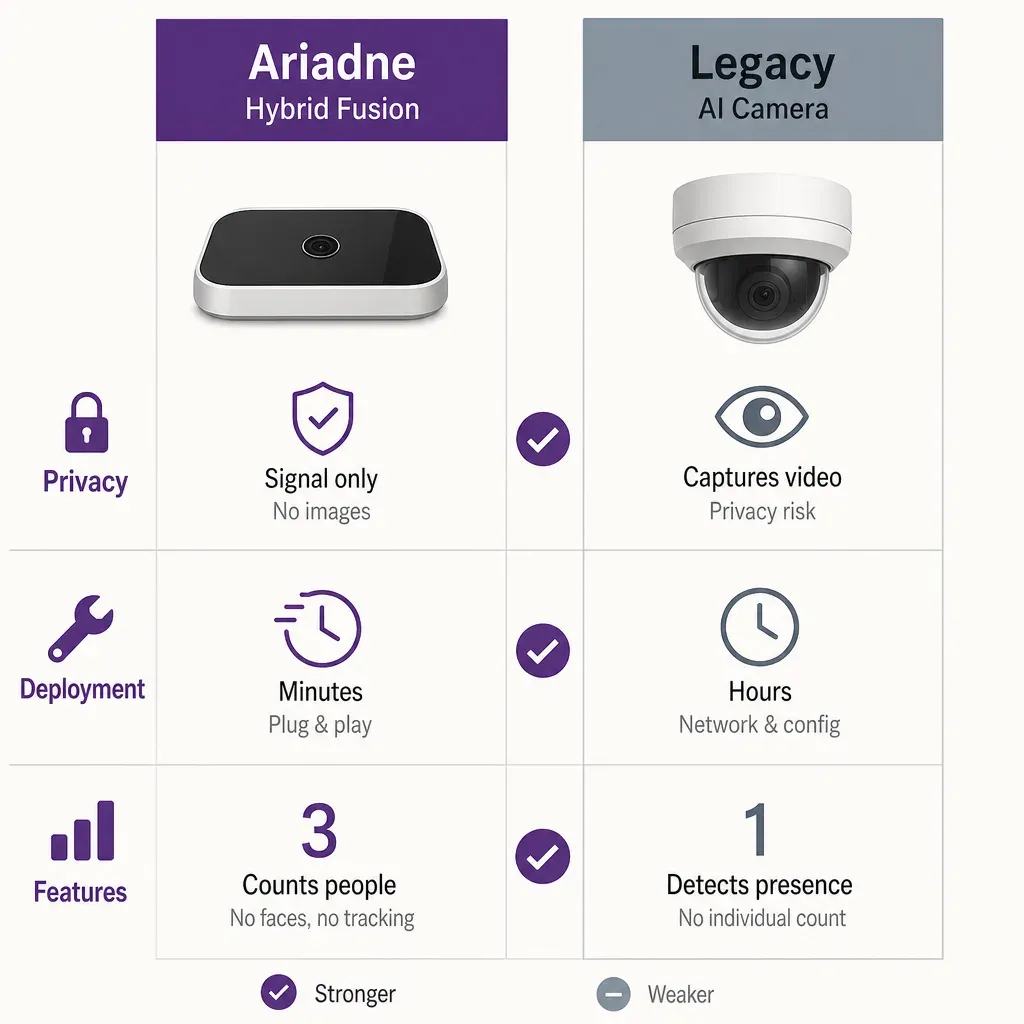
We cover three alternatives that turn up most often in shortlists alongside FootfallCam: V-Count, the broader category of stereo or 3D camera-based counters represented by vendors like Sensormatic ShopperTrak and Hella Aglaia, and Ariadne, which sits in a separate technical category as a camera-free option. The goal is to give you a buying frame, not a winner. You will land on a different system depending on the weight you put on privacy, geography, deployment model, total cost, and the specific KPIs you need.
What FootfallCam actually offers
Start with what is on the FootfallCam website itself, so the comparison has a fair baseline. Per FootfallCam's product pages (footfallcam.com, accessed 2026-06-03), the lineup centres on a People Counter family (Pro2, Extend), an IP Camera family (Pro1 in fisheye, dome, and carpark variants), an AI Box / Smart NVR family (Pro3 and Centroid), and the V9 analytics platform that sits on top. The site references "6 People Counting Technologies" without breaking them down on the homepage, and it does not publish a single headline accuracy percentage on the front page.
On privacy, FootfallCam states that "all processing is performed at the edge, with data masked at source" and that "no personally identifiable information is collected or stored, ensuring consistent compliance with GDPR and data protection standards" (footfallcam.com, accessed 2026-06-03). On scale, the homepage cites more than 2,200 retail installations, 1,200 shopping mall installations, 500 office deployments, and 150 transportation deployments, alongside universities, libraries, airports, supermarkets, museums, and smart cities. On pricing, the public site does not list prices and routes buyers to a sales contact.
Two things follow from that public picture. First, FootfallCam's catalogue is broad: people counters, IP cameras, and AI boxes are all part of the same family, and a buyer can mix them on one site. Second, the underlying sensing in most of the lineup is camera-based image processing. The vendor's stated privacy posture is that processing happens at the device and identifying data is masked before it leaves; the data protection conversation with a strict DPO is still about a system that ingests video and then strips identifiers from it, rather than one that never captures an image to begin with. Whether that distinction matters to you depends on your privacy bar.
Alternative 1: V-Count
Per the V-Count product pages (v-count.com, accessed 2026-06-03), the flagship is the Nano AI sensor, with a Nano Prime variant for wider indoor areas and a Nano Outdoor variant for weather-resistant outdoor counting. The site describes the sensing method as "3D Active Stereo Vision" with infrared projection that lets the sensor count in darkness, and claims "99% accurate retail foot traffic analytics" as the headline accuracy figure. Analytics sit in a SaaS dashboard called BoostBI, with a mobile app.
On privacy, V-Count describes the system as "100% Privacy-Focused, GDPR-Compliant Visitor Counting" and states that the sensor "processes only 3D depth data" so that "no identifiable image is ever recorded", with all processing on the chip before transmission (v-count.com, accessed 2026-06-03). On scale, V-Count cites 600+ clients including 11 Fortune 500 companies across 130+ countries, and says it is "the only company in the world" to combine people counting, gender and age recognition, and staff exclusion in a single sensor.
Two things to weigh as a buyer. First, the 3D depth sensing approach is genuinely closer to non-image data than a 2D camera, and the GDPR posture is stronger than a system that records video and then strips it down. Second, the same single sensor offers gender and age recognition. That is useful for some retailers and a problem for others: under the EU AI Act, inferring sensitive attributes from biometric features is high-risk territory and many DPOs will refuse to enable that feature even if the rest of the sensor passes review. If you are evaluating V-Count, check exactly which features are switched on in the configuration you will deploy.
Alternative 2: stereo and 3D camera counters more broadly
Beyond the two named vendors above, a buyer's shortlist often includes other stereo or 3D camera-based counters: Sensormatic ShopperTrak in retail and mall analytics, Hella Aglaia in transit and people flow, and a long tail of regional integrators. The product pages of these vendors are organised by industry and use case rather than by sensor catalogue, and at the time of writing some of those pages return errors or sit behind login, so we will not source specific feature claims to them here. The category-level point still holds: most established people counting vendors run on overhead 3D cameras with on-device processing, present GDPR compliance through on-device masking of identifying data after capture, and reserve pricing for sales conversations.
If a vendor in this category is on your shortlist, the buying questions are the same ones you would put to FootfallCam. They are in the checklist later in this post. The honest answer for many retail-only deployments is that any one of these is a credible choice; the differences become material when privacy, deployment, or specific KPIs sit at the top of the requirements list.
Alternative 3: Ariadne (camera-free)
Ariadne sits in a different technical category from the three vendors above. It does not use cameras. Per the how it works and people counting pages on ariadne.inc (accessed 2026-06-03), Ariadne's method is called Hybrid Fusion: Time-of-Flight depth sensing at entries and choke points plus patented phone signal sensing in the interior. Both sensing streams share one hardware unit, the sensor streams both feeds to Ariadne, and Hybrid Fusion combines them centrally into one trajectory per visit.
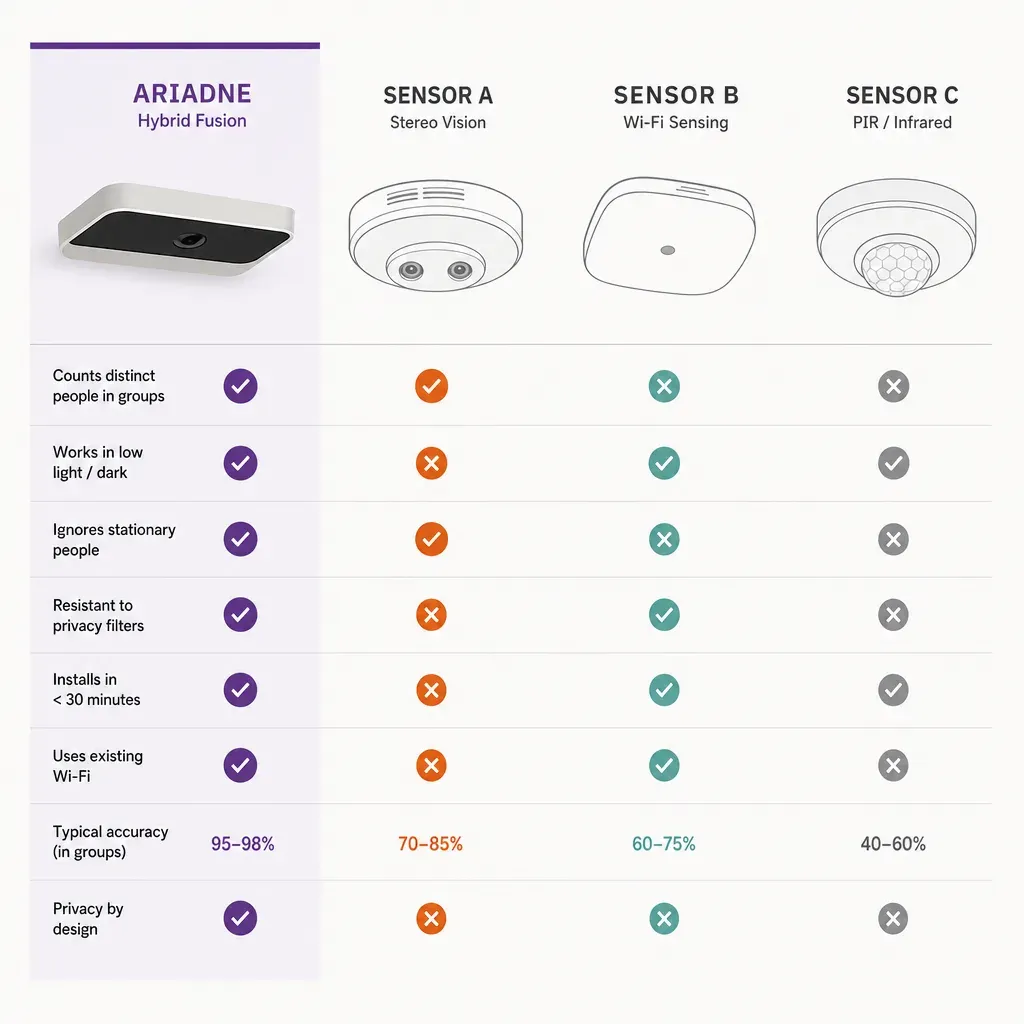
Ariadne measures this with Hybrid Fusion, its patented camera-free method. Time-of-Flight depth sensing counts every visitor at the entrances, capturing geometry rather than images, while patented phone signal sensing follows movement through the interior, detecting the signals a phone emits even in airplane mode. The sensor streams both feeds to Ariadne, where Hybrid Fusion combines them into one trajectory per visit and computes counts, dwell, and paths. The streams carry no identifier: no MAC address, no device ID, no biometric data, and no camera is involved. Identifiers are stored only when a visitor explicitly opts in, which keeps the method GDPR-friendly and outside biometric territory.
Three properties of that design matter when you compare it to FootfallCam or V-Count. First, there is no camera anywhere in the path, so the DPO conversation is not about how a video feed is processed, it is about a sensor that never captures an image. Second, the phone signal sensing layer follows the same visitor through the interior across multiple zones, which gives genuine per-zone occupancy and dwell without a camera in each space. Third, there is no MAC address captured by default and no biometric data; identifiers are stored only when a visitor explicitly opts in, for example by logging into guest Wi-Fi. The sensor lineup is set out at ariadne.inc/hardwares, and the data handling is in the privacy policy.
Ariadne tends to come up on a shortlist when one or more of the following is true: the site is privacy-sensitive (museums, public buildings, government, healthcare); the buyer wants per-zone interior data without a sensor in every space; the procurement team needs a system that can be argued to a strict EU DPO without conditional masking of a video feed; or the existing site already has Wi-Fi infrastructure that can do double duty.
Side-by-side: what the public pages actually say
Here is the same product information laid out against five questions a buyer typically has to answer. Every line is sourced to the public page cited above, accessed 2026-06-03. Where the vendor's public site does not state a value, we say so rather than estimate.
Sensing technology
- FootfallCam: mixed lineup of People Counters, IP Cameras, and AI boxes; site references "6 People Counting Technologies" without breaking them down on the homepage.
- V-Count: 3D Active Stereo Vision with infrared projection.
- Ariadne: Hybrid Fusion (Time-of-Flight depth at entries and patented phone signal sensing in the interior). No cameras.
Accuracy claim on the public site
- FootfallCam: no single headline percentage on the homepage.
- V-Count: "99% accurate retail foot traffic analytics".
- Ariadne: depth sensing at roughly 30 cm spatial accuracy at the entrance, with phone signal sensing triangulated to roughly 30 cm in the interior, as set out on the how-it-works page.
Privacy posture
- FootfallCam: edge processing, "data masked at source", states no PII is collected or stored.
- V-Count: 3D depth only, "no identifiable image is ever recorded", on-chip processing.
- Ariadne: no cameras and no images at any point in the path; no MAC address by default; no biometric data; identifiers stored only when a visitor explicitly opts in. The streams carry no identifier.
Deployment model
- FootfallCam: edge processing on the device plus the V9 analytics platform; no public pricing.
- V-Count: on-chip processing in the Nano AI plus the BoostBI cloud dashboard; no public pricing.
- Ariadne: single sensor per location streaming both feeds to Ariadne for central Hybrid Fusion; SaaS analytics; private quote.
Where the vendor lands well
- FootfallCam: broad retail and mall catalogue, mix-and-match of counter and camera SKUs on one site, large installed base.
- V-Count: retail and mall analytics, stronger privacy posture than a 2D camera approach, single sensor that bundles demographics if the buyer wants them.
- Ariadne: sites where camera-free is a requirement, per-zone interior data without a sensor per zone, strict GDPR review, and customers who want to keep the privacy story honest in front of a board.
How to weight the comparison for your buying decision
Most shortlists do not come down to a single feature. They come down to the order in which the buyer ranks the criteria. Five rankings change the answer.
- Privacy bar first. If the site is privacy-sensitive (museum, public building, healthcare, government, schools, EU corporate offices with a strict DPO), the cleanest answer is a method that captures no image and no identifier in the first place. That is the design property of Ariadne's Hybrid Fusion. 3D camera systems can be argued through a DPO review with extra documentation; a system without a camera in the path is a shorter conversation.
- Bundled demographics first. If you specifically want gender and age recognition baked into the same sensor as the count, V-Count is the only vendor among the four that markets that on the public site. Be aware of the EU AI Act implications and your own ESG posture; some buyers will treat that as a feature, others as a reason to exclude the sensor.
- Catalogue breadth first. If you want to mix conventional CCTV with people counting on one procurement, FootfallCam's lineup of people counters, IP cameras, and AI boxes is the broadest of the four.
Buyer checklist to put to any vendor in writing
Whichever way the shortlist goes, the procurement and IT review is easier when the buyer puts the same questions to every vendor and gets the answer in writing before a trial. These are the questions worth asking.
- Does the system capture any image? Ask whether the sensor stream contains video, stills, or depth maps that could be reconstructed into an image. Get a clear yes or no.
- Does the system capture any identifier? Ask specifically about MAC addresses, device IDs, face vectors, and gait or biometric features. Confirm whether anything identifying is collected by default or only after explicit opt-in.
- Where is the data processed? On the device, in a private cloud, in the vendor's SaaS, or in a customer-owned environment. Each option has different security and contract implications.
- What is the headline accuracy figure, on what test, by whom? Most vendors quote a percentage. The useful question is what test produced it, in what environment, and whether the test report is available.
- Can the system report per zone, not just per door? For sites bigger than a small shop, a single doorway count is not enough. Confirm whether interior zones get entries, live occupancy, and dwell.
- What is the total cost across hardware, install, SaaS, and renewals? Most vendors keep pricing private, which is fine, but the buyer needs a number for the full picture before the procurement signs anything.
- How is the data exported? Confirm CSV, API, or SFTP, the cadence, and whether the export is included or sold as an add-on.
- What is the contract length and the exit clause? Some vendors lock buyers into multi-year SaaS contracts with cancellation penalties; some run rolling annual SaaS.
If you are leaning Ariadne, the next step is short
The Ariadne side of this comparison is documented on the marketing site itself: the method is on the how it works page, the sensor lineup is at ariadne.inc/hardwares, the privacy posture is in the privacy policy, and the people counting solution overview is at ariadne.inc/solutions/people-counting. From there a short call with the team is enough to confirm fit for your sites and to size a trial. If the answer to your buying review is FootfallCam or V-Count instead, that is a defensible choice; the goal of this post is to make sure the answer is grounded in what each vendor actually says about itself, not in a sales pitch.
FAQ
Is Ariadne a direct replacement for FootfallCam?
Functionally yes for the people counting use case: entries, live occupancy, and per-zone dwell are all covered. Technically the two systems are in different categories. FootfallCam runs camera-based image processing with on-device masking of identifying data; Ariadne runs camera-free Hybrid Fusion (Time-of-Flight depth at entries and patented phone signal sensing in the interior). If the buying decision is being driven by a privacy review, the technical difference is the point. If it is being driven by catalogue breadth or an existing fleet of FootfallCam IP cameras, FootfallCam still has the broader product family.
Does Ariadne use cameras anywhere in the path?
No. Ariadne counts with Hybrid Fusion: Time-of-Flight depth sensing plus patented phone signal sensing, never cameras. Time-of-Flight captures geometry rather than images, and signal sensing captures no MAC address by default, so the measurement involves no video, no faces, and no biometric data.
How do these vendors compare on price?
None of the three vendors covered here publishes prices on the public site, so an honest comparison on cost is only possible after each one quotes. The buying questions that move the total cost are the same for all of them: number of zones, contract length, SaaS tier, install scope, and integration cost. Put those parameters in the RFP and ask each vendor to quote against the same scope, rather than comparing list prices that none of them publish.
Is the EU AI Act a problem for any of these vendors?
It depends on which features are switched on. Counting visitors and measuring dwell is not classified as high-risk biometric processing in itself. Inferring gender, age, or emotion from biometric features is. V-Count markets demographics as part of the same sensor; the others do not call out demographics in the same way on the public homepage. If the AI Act is on your radar, ask each vendor in writing which features are switched on by default and which require an explicit configuration, and get the answer before the trial begins.
Related comparisons
Compare other vendors: Best people counting systems 2026 · V-Count alternative · RetailNext vs Ariadne · Density vs Ariadne · Placer.ai vs Ariadne


