
Why this comparison exists
If you are shortlisting a people counting platform for a retail estate, two names come up early: RetailNext, a US-headquartered retail analytics company that has been in the market since 2007, and Ariadne, a European camera-free people counting and indoor analytics vendor. They both report store traffic, occupancy, and behaviour, and they both sell to multi-site retailers. They also make very different bets about sensor type, privacy posture, and where they fit best.
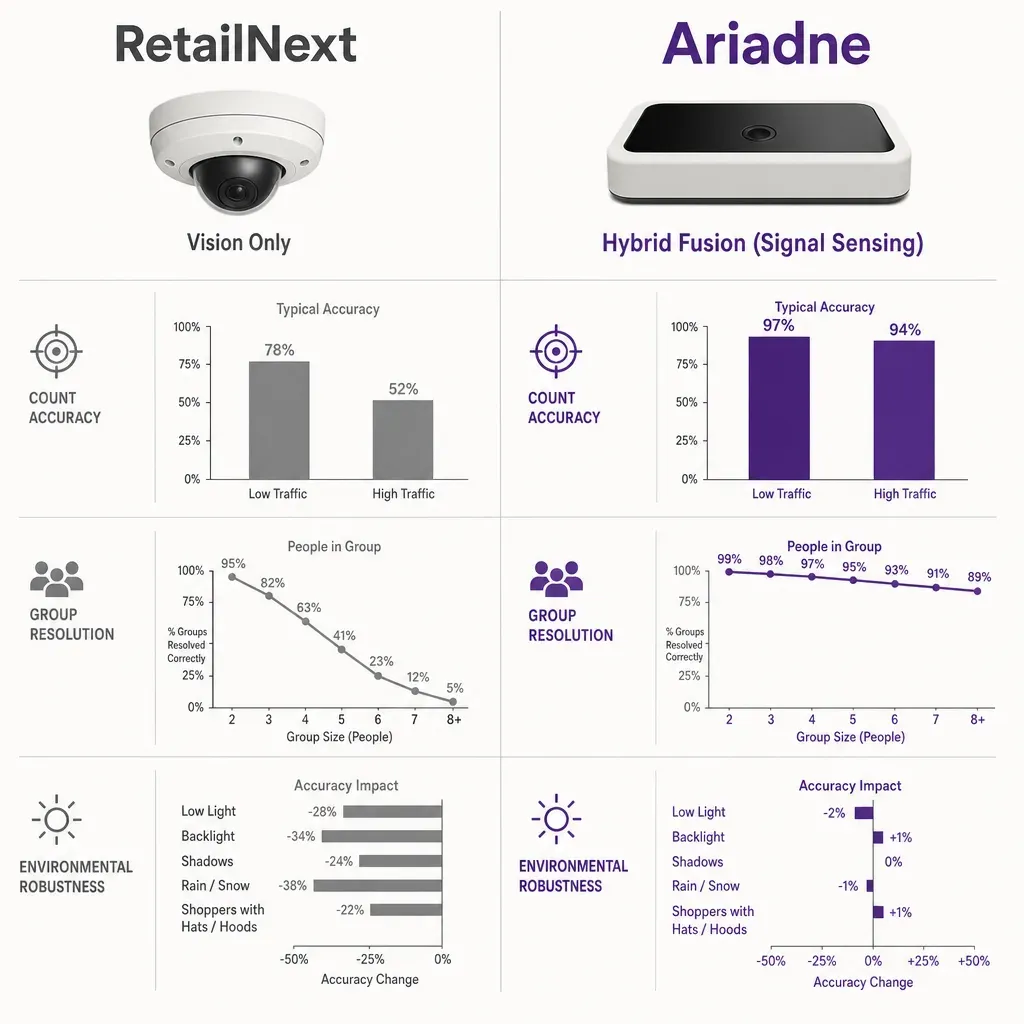
This post is a buyer-side comparison built from each company's public documentation, with every RetailNext claim sourced inline so you can verify it. The point is not to declare a winner. The point is to give a buyer a structured way to read both vendors against a real evaluation: sensor and capture model, accuracy claims, integrations, privacy posture, deployment, geography, and pricing transparency. Where each vendor is strong, where they differ, and where the differences matter for your estate.
Sources: RetailNext claims below are taken from the public RetailNext website (retailnext.net) and the product pages for Aurora, Traffic, Occupancy, Insights, plus pricing and Why RetailNext, all accessed 2026-06-03. Ariadne claims are taken from the Ariadne site (ariadne.inc), in particular /solutions/people-counting/ and /platform/how-it-works/.
Side by side, in one paragraph
RetailNext is a video-led retail analytics platform. Its current sensor, Aurora, is described on its product page as a device that uses a Sony megapixel sensor with 3D imagery and deep learning to detect people, with most analysis happening on the sensor and video that can be blurred or discarded afterwards (per retailnext.net/product/aurora, accessed 2026-06-03). Ariadne is a camera-free people counting platform. Its hardware combines Time-of-Flight depth sensing at entries with patented phone signal sensing in the interior. There is no camera in the path and no image of a visitor is captured at any point. The two systems aim at overlapping problems but choose opposite starting points on how to see a person.
Sensor and capture model
RetailNext: Aurora is a camera-based IoT sensor
Aurora is described on its product page as a "next-generation sensor for physical location analytics" that uses a "Sony megapixel sensor" together with "3D imagery and deep learning" and a "patented algorithm" (retailnext.net/product/aurora, accessed 2026-06-03). The Traffic product page is more direct about how it counts: Aurora is described as an IoT device that "detects people ten times each second" and transmits analytics to the cloud every second (retailnext.net/product/traffic, accessed 2026-06-03). The privacy framing is that "all analysis happens onboard the sensor" and that the video can be "blurred or simply discarded" post-analysis (per the Aurora page).
The practical reading: Aurora is a camera. It uses computer vision and deep learning to extract analytics on-device, and the marketing emphasis is on what the system does with the video after the fact (process it, then blur or discard). That is a defensible position for a vendor whose roadmap depends on demographics and shopper recognition, but it is still a camera in the ceiling.
Ariadne: one camera-free sensor that fuses depth and phone signal
Ariadne measures this with Hybrid Fusion, its patented camera-free method. Time-of-Flight depth sensing counts every visitor at the entrances, capturing geometry rather than images, while patented phone signal sensing follows movement through the interior, detecting the signals a phone emits even in airplane mode. The sensor streams both feeds to Ariadne, where Hybrid Fusion combines them into one trajectory per visit and computes counts, dwell, and paths. The streams carry no identifier: no MAC address, no device ID, no biometric data, and no camera is involved. Identifiers are stored only when a visitor explicitly opts in, which keeps the method GDPR-friendly and outside biometric territory.
The practical reading: there is no camera anywhere in the system. The entries are read with depth geometry; the interior is read with patented phone signal sensing. No image of a visitor is ever formed, so there is nothing to blur or discard later.
This is the single biggest architectural difference between the two vendors and it cascades into everything below: how privacy is justified, what the failure modes look like, which buyers approve the system, and what the rollout looks like on the floor.
Accuracy claims
RetailNext
RetailNext does not publish a specific accuracy percentage on its public product pages. The Traffic page says the company offers "the most accurate analytics data in the market today" and that customers can run a "self-audit" against high-resolution recorded video at no extra cost (retailnext.net/product/traffic, accessed 2026-06-03). The Occupancy page describes Aurora as a "deep-learning device that delivers industry-leading accuracy" (retailnext.net/product/occupancy, accessed 2026-06-03). No specific number is published on either page.
What that means for a buyer: you will need to ask RetailNext directly for the accuracy figure they will commit to in your contract, and ideally for an independent audit method. The self-audit-against-video pitch is genuinely useful for proving accuracy after install, because the system records the video that was used to produce the count.
Ariadne
Ariadne publishes a 30 cm accuracy figure for both sensing methods (Time-of-Flight depth at entries and phone signal sensing in the interior), and the count is generated centrally after the two feeds are fused, rather than purely on the device. That gives a measurable spatial figure rather than a relative claim. The trade-off is that there is no video to replay for a self-audit; the audit method is data-side, comparing counts against benchmarks, manual counts on sample days, or a parallel sensor.
Both vendors will quote accuracy higher than the public number in a tender. The substantive difference is the source. RetailNext can ground its audit in the video the sensor captured; Ariadne grounds it in geometry the sensor never recorded as imagery.
What each platform measures
Both vendors are broader than door counts. The comparison gets sharper when you line up what each one produces.
RetailNext's modules
Per the retailnext.net product navigation (accessed 2026-06-03):
- Traffic. Entry counts, passby traffic, conversion rates, group counts, predictive trends, staffing recommendations.
- Occupancy. Real-time occupancy, historical occupancy trends, occupancy compliance against capacity, cross-reference with sales and labour.
- Insights (Shopper Journey). "Interior traffic and dwells", zone traversal, "kinetic maps" (heatmaps), filtered journey animations, and AI-based demographic segmentation that "anonymously segments your shoppers by gender" (per retailnext.net/product/shopper-journey, accessed 2026-06-03).
- Video Security. Cloud-accessible video surveillance with point-of-sale data overlay, accessible from desktop and mobile (per the home page navigation).
- Visual Merchandising. Tools for evaluating store layout and merchandising decisions.
Ariadne's modules
Per the Ariadne product pages, the same hardware powers:
- People counting. Entry counts at every door, group size from phone signal sensing, hourly and daily breakdowns, multi-site rollups.
- Real-time occupancy. Live occupancy per zone with capacity alerts, suitable for fire-code limits and customer-experience limits.
- Heatmaps, dwell, paths. Zone-level dwell, kinetic heatmaps, and shopper journey traces produced from phone signal sensing in the interior.
- Indoor navigation and visitor marketing. EaseLink is Ariadne's blue-dot indoor wayfinding and visitor marketing layer, sold separately but on the same sensor base.
- Employee scheduling. Forecasted demand fed into shift planning.
Where RetailNext is broader: visual merchandising and integrated video security are products in their own right inside the RetailNext platform. If a retailer wants to consolidate analytics and loss-prevention CCTV onto one stack, that is a real RetailNext advantage. Where Ariadne is broader: indoor navigation, wayfinding, and visitor marketing are first-class products on the same Ariadne hardware, which RetailNext does not advertise.
Privacy posture
RetailNext
RetailNext frames privacy through three claims on the public site. First, that Aurora "anonymously detect[s] people" with deep learning (retailnext.net/product/occupancy, accessed 2026-06-03). Second, that Aurora performs "all analysis on the sensor" and the video can be "blurred or simply discarded" afterwards (retailnext.net/product/aurora, accessed 2026-06-03). Third, that the platform has "fine-grained privacy controls" designed to support GDPR and CCPA compliance, with a separate cloud for China (retailnext.net/why-retailnext, accessed 2026-06-03). The home page lists SOC 2 Type II certification.
The honest reading for a buyer: video-based systems can be operated within GDPR by retailers who have a documented legal basis, run a data protection impact assessment, and either process video locally and discard it, or apply blurring. RetailNext provides the engineering ingredients to make that case. The conversation with a data protection officer is still about a system that captures images of identifiable people in the moments before analysis, even if the images are then discarded.
Ariadne
Ariadne starts from a different position: the system never captures an image of a visitor in the first place. Time-of-Flight depth sensing produces geometry, not pictures. Phone signal sensing produces a position, not a MAC address. There is no biometric data. There is no video to discard or to blur. The cleanest GDPR conversation is one where there was no personal data to begin with. The Ariadne privacy policy sets out the details.
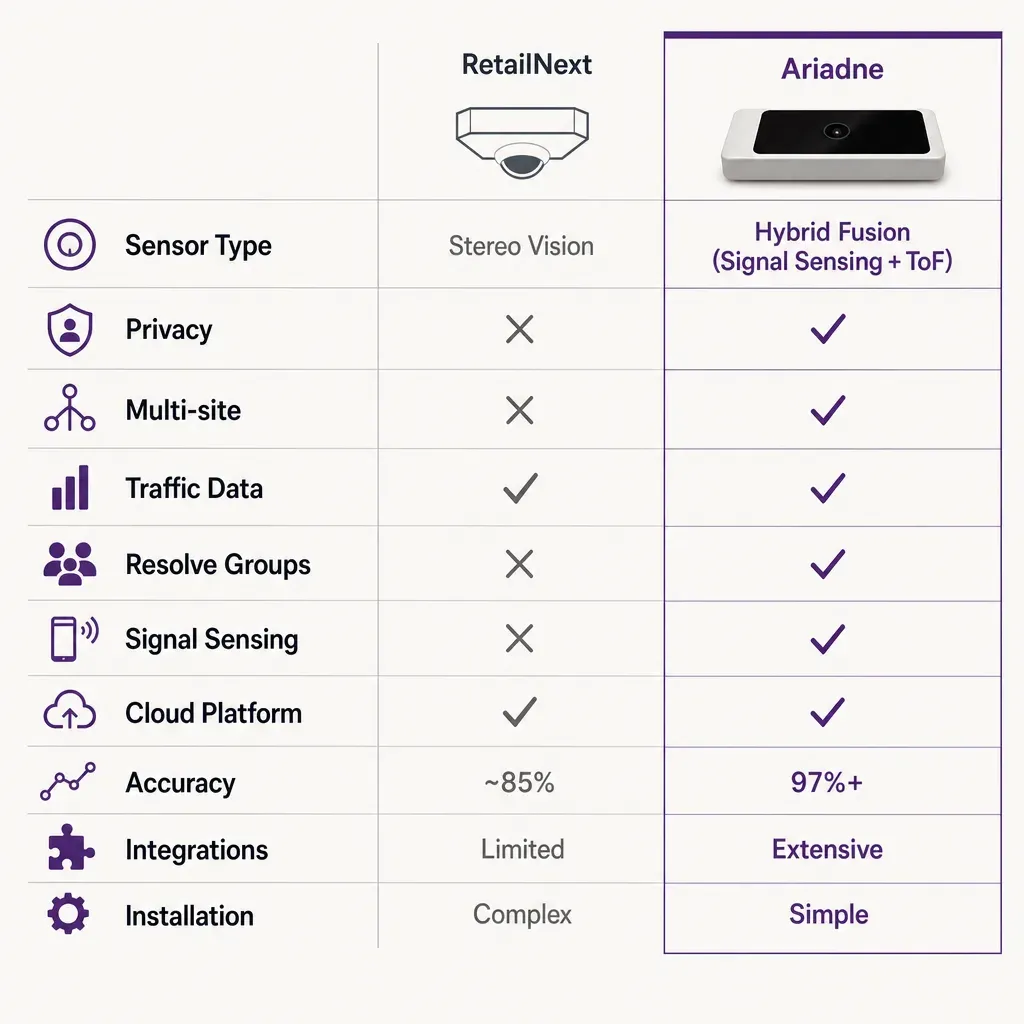
There is one further frame worth surfacing because retail buyers are starting to ask about it. The EU AI Act, which finishes phasing in across 2025 to 2027, treats biometric categorisation and emotion recognition in public-accessible spaces as high-risk or prohibited use cases. Systems that capture imagery in order to infer demographics sit in that direction of travel. Systems that capture no imagery of visitors do not. That is not a hit on RetailNext, whose video-led model long predates the AI Act, but it is something a retailer renewing a five-year contract should think about explicitly.
Deployment model
RetailNext
Aurora is sold as a sensor-as-a-service. The Aurora page emphasises "simple network configuration" with "just one outbound port, no incoming ports", centralised user management with SSO, and an "API included" for embedding data into custom applications (per retailnext.net/product/aurora, accessed 2026-06-03). The platform itself is cloud-based, with deployments across "100+ countries" and dedicated infrastructure for China (retailnext.net/why-retailnext, accessed 2026-06-03). Coverage per sensor is described as "two to three times the coverage of other sensors on the market" (per the Aurora page), which the company frames as reduced hardware and cabling costs at fleet scale.
Ariadne
Ariadne's hardware is one camera-free sensor unit per coverage area, with the sensor streaming both the depth feed and the phone signal feed to Ariadne's cloud for central Hybrid Fusion. SDKs and APIs are available for connecting Ariadne data to a retailer's data warehouse, POS, BI, or workforce management. The hardware lineup is set out on the Ariadne hardware page. The platform architecture is set out on /platform/how-it-works/.
Where each is strong: RetailNext's per-sensor coverage claim is meaningful for large open-plan stores where one wide-angle ceiling unit can replace several. Ariadne's split between Time-of-Flight at entries and signal sensing in the interior gives a cleaner separation between counting accuracy at the door and pathing in the body of the store, which is the right shape for venues that want both numbers to be defensible to a different audience (operations vs marketing).
Integrations and ecosystem
Both vendors expose APIs and SDKs for integrating into the retailer's stack. The differences are about which neighbouring stacks each one slots into easily.
- RetailNext. The Traffic product page emphasises point-of-sale integration for conversion analysis, and the Aurora page advertises an included API for embedding analytics into custom applications. The Insights page advertises API access for custom analysis by data science teams (per retailnext.net product pages, accessed 2026-06-03). RetailNext also runs a Technology Partners program, though specific partner names are not listed on the public navigation.
- Ariadne. Ariadne publishes an integration directory at ariadne.inc/platform/integrations/ for tools like BI platforms, workforce management, and indoor navigation surfaces. The EaseLink indoor positioning layer feeds positioning data into a venue's existing mobile app via SDK. Both video security and POS integrations are available but not packaged as a single product the way RetailNext bundles them.
Geography and target customer
RetailNext describes itself as operating across more than 100 countries with installations in 90, serving more than 560 brands, with a public customer list that names retailers like Macy's, Ulta, Sephora, and Calvin Klein (per retailnext.net and retailnext.net/why-retailnext, accessed 2026-06-03). The centre of gravity is North American mid-market and enterprise retail with a strong international presence and a dedicated cloud for the China market.
Ariadne is European-headquartered (Munich, Germany) and operates in retail, shopping centres, airports, and smart cities across Europe, the Middle East, North America, and Asia. Camera-free architecture is the centre of gravity, and the customer base skews toward European retailers, transport authorities, and cultural institutions for whom the privacy posture is a procurement requirement rather than a nice-to-have.
Buyer reading: a US retailer with a homogeneous mall fleet may find RetailNext's footprint and bundled video security a faster install path. A European retailer, a retailer with a strong privacy mandate from the board, a transport hub, a museum, or a smart-city deployment will find Ariadne's camera-free posture easier to defend and faster to clear with the data protection officer.
Pricing transparency
Neither vendor publishes a price list on the public site. RetailNext routes to a pricing estimator page where the buyer enters store count, entrances, type, region, and current technology to receive a "personalized estimate" (retailnext.net/pricing, accessed 2026-06-03). The Insights page mentions that the product is "priced per sensor per month" without naming the figure. Ariadne publishes a pricing page that explains the tier structure without listing per-sensor monthly prices, and routes detailed quotes through the contact form.
Net: pricing is contact-sales on both sides. If you want a like-for-like number, you will need to put both vendors through the same RFP with the same store list, same entry count, same data export needs, and the same accuracy and uptime commitments. There is no reliable way to compare these vendors on price from public information alone.
A buyer-side decision frame
Pulled together, the comparison resolves into a small number of questions a buyer should answer in their own terms before signing with either vendor.
- Does the system need to capture images of your visitors? If yes, RetailNext's video-led architecture is built for it and the visual merchandising and asset protection modules become a real bundle. If no, or if your data protection officer would prefer no, Ariadne's camera-free architecture is the easier case.
- How important is integrated video security on the same platform? RetailNext's Video Security product sits on the same Aurora sensor as the analytics, which is a genuine consolidation play for retailers who would otherwise run two stacks. Ariadne does not bundle video security.
- How important is indoor navigation and visitor marketing? Ariadne ships EaseLink as a blue-dot indoor wayfinding and visitor marketing product on the same hardware. RetailNext does not advertise an equivalent.
- What does the data protection officer need to see? Both vendors can be cleared for GDPR with the right paperwork, but the case is easier when the system never captured imagery. If your DPO would prefer a no-personal-data-by-default architecture, Ariadne is the cleaner answer.
- Where is the estate? Heavy North American mall presence: RetailNext's footprint and customer list favour it. European retailers, transport hubs, smart cities, museums, or any venue with a strong privacy mandate: Ariadne's posture is easier to defend.
- What accuracy commitment will the vendor sign? Neither vendor publishes a single accuracy figure on the public site. Get it in writing, get the audit method in writing, and run a pilot. RetailNext's recorded-video self-audit is genuinely useful; Ariadne's data-side audit against manual benchmarks works for venues that cannot have video.
What we would not claim about RetailNext
A few framings worth not making, because they would not be honest:
- RetailNext is not a low-grade or hobbyist platform. It is an established retail analytics company with a large customer base, a long operating history, and a credible engineering story. The 560+ brand and 100+ country numbers are RetailNext's own figures, but the customer list it publishes is concrete.
- RetailNext is not violating GDPR by default. Video-based people counting is a routine retail use case. RetailNext exposes privacy controls and on-sensor processing precisely so it can be operated within GDPR with the right documentation. The buyer's question is whether they want to sign that paperwork or sidestep it with a camera-free system.
- RetailNext's accuracy is not poor. The company has not published a public accuracy figure, but absence of a number is not evidence of low accuracy. Buyers should ask for it in writing and run a pilot.
And the same fairness in reverse: Ariadne is the right answer where a camera-free posture earns its keep. It is not automatically the right answer where a retailer already runs CCTV across the estate, wants one platform for analytics and loss prevention, and has a documented GDPR position on video. Buyer fit is buyer fit.
How Ariadne fits
If the comparison points you toward a camera-free architecture, the relevant product surface is on the people counting page, with the broader retail use cases on the retail stores industry page and the sensor hardware on the Ariadne hardware page. A short pilot is the fastest way to compare either vendor against the metrics you actually report: counts, occupancy, dwell, conversion, and the time it takes your data protection officer to sign off.
FAQ
Does Ariadne use cameras?
No. Ariadne counts with Hybrid Fusion: Time-of-Flight depth sensing plus patented phone signal sensing, never cameras. Time-of-Flight captures geometry rather than images, and signal sensing captures no MAC address by default, so the measurement involves no video, no faces, and no biometric data.
Does RetailNext use cameras?
Per RetailNext's public product pages accessed 2026-06-03, the current Aurora sensor uses a Sony megapixel sensor with 3D imagery and deep learning, and the platform's Video Security product is a cloud-based video surveillance offering on the same Aurora hardware. Analysis happens on the sensor and the video can be blurred or discarded afterwards, but the capture itself is video-based. Buyers should confirm the current configuration with RetailNext directly.
Can I run both vendors in pilot at the same site?
Yes, and for high-value estates it is a sensible RFP step. Mount one Aurora and one Ariadne sensor on the same threshold, run them for two to four weeks against a manual count or a shared baseline, and compare entry counts, occupancy, and any per-zone metric you care about. The pilot will tell you more about real fit than any vendor benchmark.
Which vendor is cheaper?
Neither company publishes per-sensor pricing on the public site. RetailNext's pricing page asks for store count and entrances and returns a personalised estimate; Ariadne quotes through the contact form. The like-for-like answer requires both vendors to bid against the same RFP. Total cost of ownership over five years is the figure to compare, not the headline per-sensor monthly number, because the privacy paperwork and the integration work are real costs in both stacks.
What if my retailer needs demographics?
RetailNext's Insights page advertises AI-based demographic segmentation that "anonymously segments your shoppers by gender" (per retailnext.net/product/shopper-journey, accessed 2026-06-03). Ariadne does not infer demographics from its sensors, by design: there is no image to classify. If demographic segmentation is non-negotiable, RetailNext is closer to that requirement out of the box, with the caveat that the EU AI Act is tightening the rules on biometric categorisation in public spaces over 2025 to 2027 and retailers in scope should run that question past their legal team before committing to a five-year contract.
Related comparisons
Compare other vendors: Best people counting systems 2026 · V-Count alternative · FootfallCam alternatives · Density vs Ariadne · Placer.ai vs Ariadne


