
A city festival, a street market, a parade, or a weekend-long cultural programme all share a measurement problem: nobody agrees how many people came, and everyone has a reason to guess high. The organiser wants a big number for the sponsor. The sponsor wants an honest one for the return. The city wants a defensible figure for the grant it funded. Guesswork from stewards and photographs of a full square is what usually fills the gap, and it settles none of those questions. Measuring pedestrian flow across the event puts a real number on turnout and, more usefully, shows where people actually went once they arrived.
This post is about that measurement: counting turnout and movement at outdoor city events after the fact, so organisers and cities can evidence attendance, compare one year to the next, and plan the next one around where the crowd really went. It is deliberately not about live crowd-safety density management, the real-time monitoring of density thresholds and safety response during an event. That is a distinct discipline with its own duty of care, covered in live crowd safety and density management. The counting described here is an evaluation and planning input. It answers how many and where, not whether a given area has become unsafe in the moment, and the two should not be confused.
How do you measure pedestrian flow at a city event?
Event pedestrian flow is measured by counting entries and movement across the whole event footprint over its full run, not just at one gate. Counters at each access point give total attendance and the arrival and departure curve, while counts within the site show which stages, stalls, or streets drew the crowd and how long people stayed. Cities and organisers use this to evidence turnout for sponsors and grant funders, to compare one year against the last, and to plan the next year's layout, staffing, and transport around where people actually went rather than where the plan assumed they would.
The sections below cover the parts that make the measurement trustworthy: counting an open footprint with many entrances instead of one gate, reading the arrival and departure curve, mapping where the crowd moved and dwelled across the site, and turning all of it into evidence a funder and a sponsor will accept.
Counting attendance across an open, multi-entrance footprint
A city event rarely has a single controlled entrance, which is exactly why turnout is so easy to get wrong. A festival spread across a park, a market filling several streets, or a parade route with people joining and leaving along its length has many ways in and out, and a count taken at one of them captures a fraction of the real total. Multiplying that fraction by a guess is how attendance figures end up wildly inflated or, occasionally, badly undersold.
Counting every access point is the honest alternative. A count at each entry line, aggregated across the footprint, gives a total attendance figure grounded in measurement rather than an eyeball estimate of a crowded square. For a defined, fenced site with a set number of gates this is straightforward; for an open street event it means counting at the practical entry lines into the event area and reading the picture across all of them together.
Group arrivals complicate the count, because people come to events in twos, threes, and families rather than one at a time, and a naive line count can miscount a cluster passing together. Handling that correctly, so a group of four registers as four people rather than one blur or one crossing, is a measurement detail that matters for turnout accuracy; counting groups at an entrance covers how that is done. Get the group case wrong and the headline attendance number, the one every sponsor reads first, is wrong with it.
The arrival and departure curve
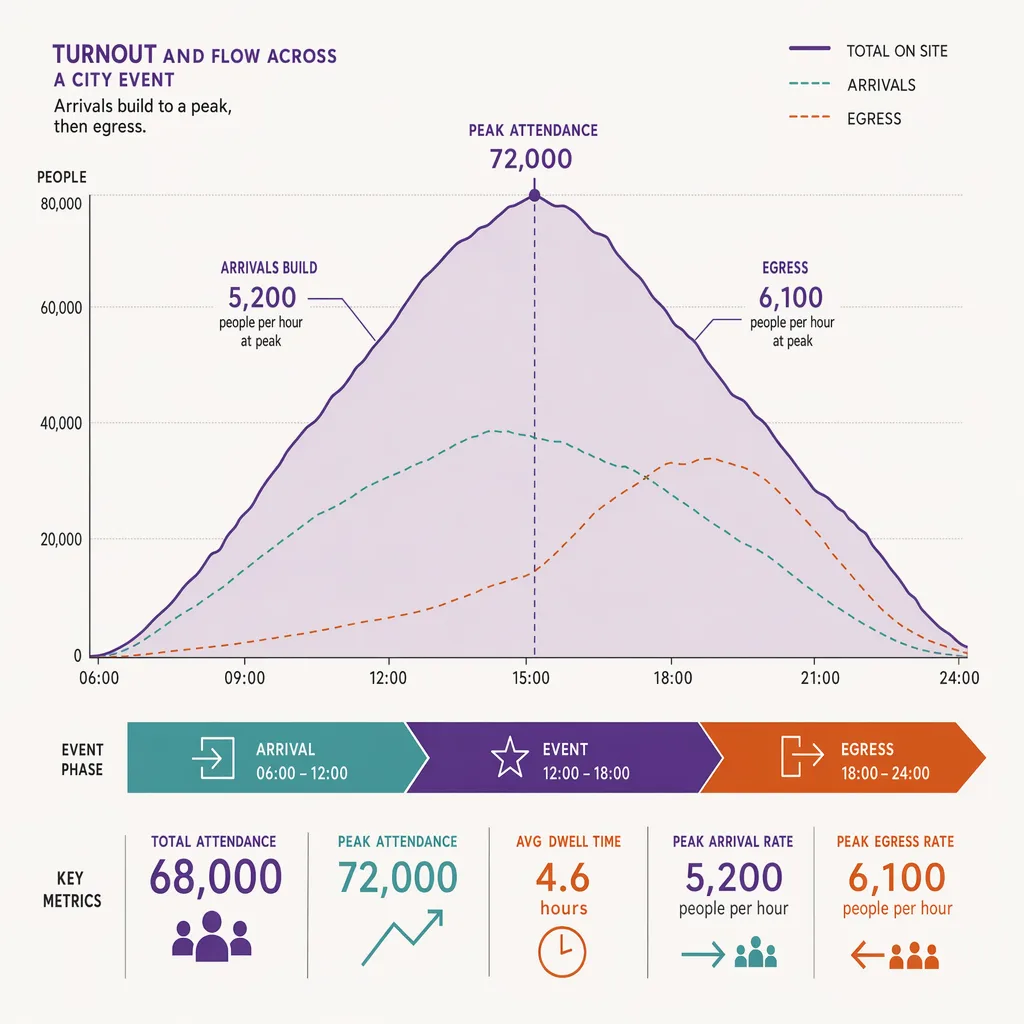
Total attendance is the number everyone asks for, but the shape of arrivals and departures across the event is what actually helps plan the next one. Time-stamped counts at each entrance draw a curve: when the first crowds came, when the site peaked, how long it held near peak, and how quickly it emptied at the end.
That curve answers practical questions a single total cannot. If the peak arrives two hours later than the programme assumed, the opening acts played to a thin crowd and the transport plan and staffing were an hour out of step with reality. If departures spike hard at one moment, the transport network and the streets around the site took a surge that better staggering could ease next time. A parade shows a travelling curve rather than a static one, the crowd building and dispersing along the route over time, and reading that movement is what tells an organiser where along the route the density concentrated and when.
None of this is a live safety judgement; it is a record read after the event to understand what happened and plan the next edition. The arrival curve is planning evidence, and it is often more valuable to the organiser than the headline attendance figure, because it is the part that changes decisions about timing, layout, and transport.
Where the crowd went: movement and dwell across stages, stalls, and streets
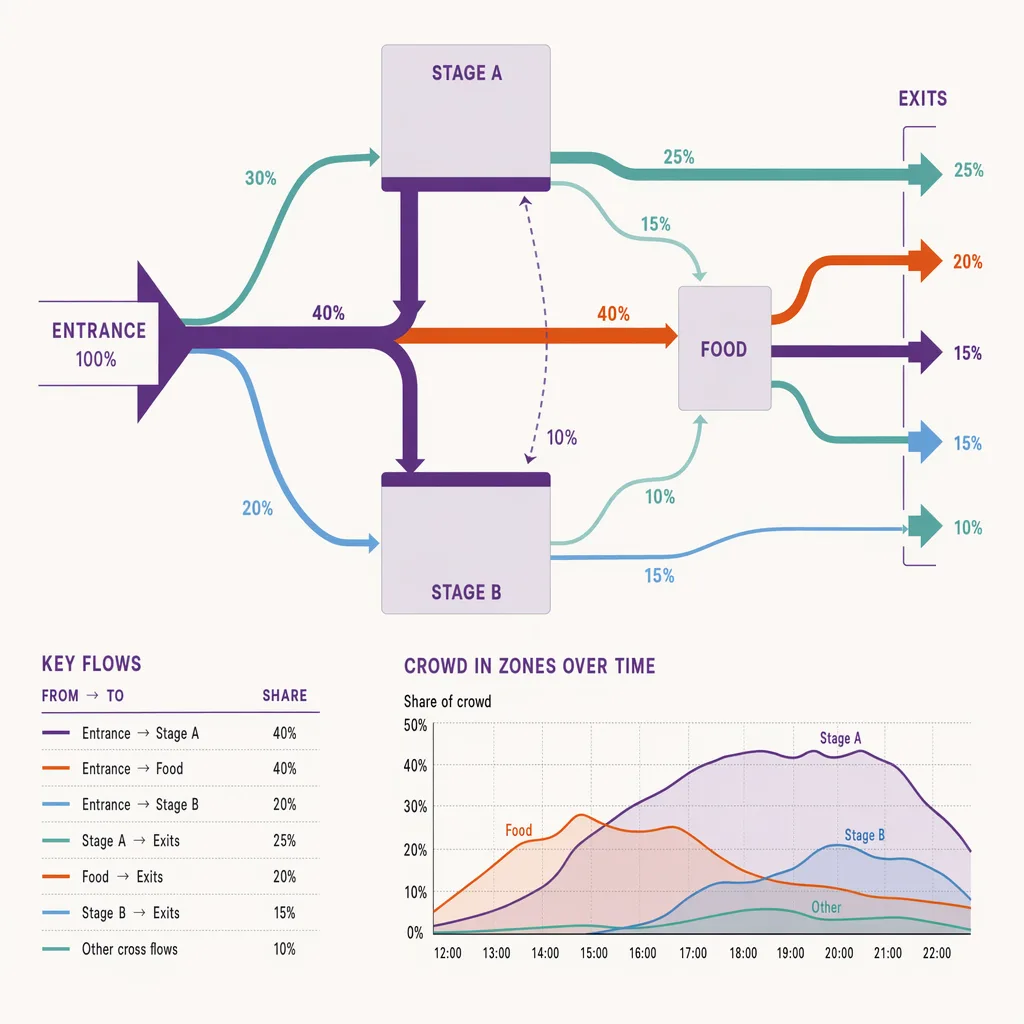
Attendance and the arrival curve describe the event's boundary. What happened inside it is a separate and richer question. Counts placed within the footprint, at the approaches to stages, along market rows, at the junctions between zones, show how the crowd distributed across the site and how long people stayed in each part of it.
This is where an organiser learns which parts of an event worked and which did not. A stage that drew and held a crowd and a corner of the market that people walked straight past are both useful findings, and both are invisible in a single turnout total. Dwell is the telling metric: a zone people entered and left quickly performed differently from one where they lingered, and lingering is usually the sign that a part of the event did its job. Reading movement and dwell across a site this way is the same discipline that underpins city tourism flow analytics, applied to a temporary event rather than a permanent destination.
For a multi-day programme, this internal picture is what lets an organiser move things that did not work and reinforce what did, day to day and year to year. It turns "the festival was busy" into "the east stage drew the crowd on Saturday afternoon and the north market row was consistently underused," which is a finding a programmer can act on.
Evidencing turnout for sponsors and funders, and comparing year on year
The commercial and civic case for all this measurement is straightforward. An event that can show a sponsor a measured attendance figure, an arrival curve, and a map of where the crowd concentrated is in a far stronger position than one offering a steward's estimate. Sponsors increasingly expect evidence of the audience they paid to reach, and a measured number that holds up to scrutiny is worth more than an impressive guess that does not.
The same evidence supports public funding. A city or a grant body that funded an event wants to know it delivered the turnout it was supposed to, and a consistent measurement method lets an organiser compare this year against last on a like-for-like basis instead of arguing from photographs. Year-on-year comparability is the point: measuring the same way each edition means a rise or fall in attendance is a real finding rather than an artefact of how the crowd was estimated that particular year.
Used across a city's programme of events, the same approach lets a council read its whole events calendar on one consistent basis and see which events genuinely drew people to the centre. That municipal view sits within smart-city analytics, and the underlying counting method is the general people counting approach applied to a temporary outdoor site.
Measuring an outdoor event without cameras
An outdoor public event is a setting where camera-based counting is both intrusive and impractical. Attendees at a free public festival have not signed up to be filmed for a headcount, public objection to event surveillance is real, and pointing cameras across a crowded square purely to count it is hard to defend. Events also run into the evening and after dark, when a camera's count degrades exactly as the crowd peaks. Counting the same event without any camera avoids all of that.
Ariadne measures this with Hybrid Fusion, its patented camera-free method. Time-of-Flight depth sensing counts every visitor at the entrances, capturing geometry rather than images, while patented phone signal sensing follows movement through the interior, detecting the signals a phone emits even in airplane mode, and tracks that movement to about one-metre precision. The sensor streams both feeds to Ariadne, where Hybrid Fusion combines them into one trajectory per visit and computes counts, dwell, and paths. The streams carry no identifier: no MAC address, no device ID, no biometric data, and no camera is involved. Identifiers are stored only when a visitor explicitly opts in, which keeps the method GDPR-friendly and outside biometric territory.
Two things about that method fit an event particularly well. Time-of-Flight measures distance rather than light, so it counts an evening market or a night-time parade as accurately as a midday one, a point covered in counting outdoors after dark. And because it captures geometry rather than images, an organiser gets turnout and movement figures without ever holding footage of the attendees, which is the difference between a defensible public-event measurement and one that generates its own objections. To be clear about scope again: this produces the after-the-fact attendance and flow evidence described above. Live safety-critical density management is the separate discipline in the crowd safety and density sibling, and counting for evaluation is not a substitute for it.
Related reading
FAQ
How do you measure pedestrian flow at a city event?
By counting entries at every access point across the whole footprint, not just one gate, and by counting movement within the site. The entrance counts give total attendance and the arrival and departure curve; the internal counts show which stages, stalls, and streets drew the crowd and how long people stayed. It is an evaluation and planning record read after the event.
Do I need cameras to count attendance at an outdoor event?
No. Ariadne counts with Hybrid Fusion: Time-of-Flight depth sensing plus patented phone signal sensing, never cameras. Time-of-Flight captures geometry rather than images, and signal sensing captures no MAC address by default, so the measurement involves no video, no faces, and no biometric data.
Is event pedestrian flow the same as crowd-safety management?
No, and the difference matters. Event pedestrian flow here is after-the-fact measurement of turnout and movement, used for evaluation, sponsor evidence, and planning. Live crowd-safety density management, monitoring density thresholds and safety response in the moment, is a separate discipline with its own duty of care. Counting for evaluation does not replace it.
How do you count turnout when an event has many entrances?
Count at each access line into the event area and read the totals together, rather than measuring one gate and multiplying by a guess. Handling group arrivals correctly, so a family of four counts as four people, is part of keeping the headline attendance figure accurate on an open, multi-entrance site.
Can event counts be compared year on year?
Yes, provided the same measurement method is used each edition. Consistent counting means a rise or fall in attendance is a real finding rather than an artefact of how that year's crowd was estimated, which is what makes the figure useful to sponsors and to the public funders comparing one year to the last.


