
Why event days need their own measurement plan
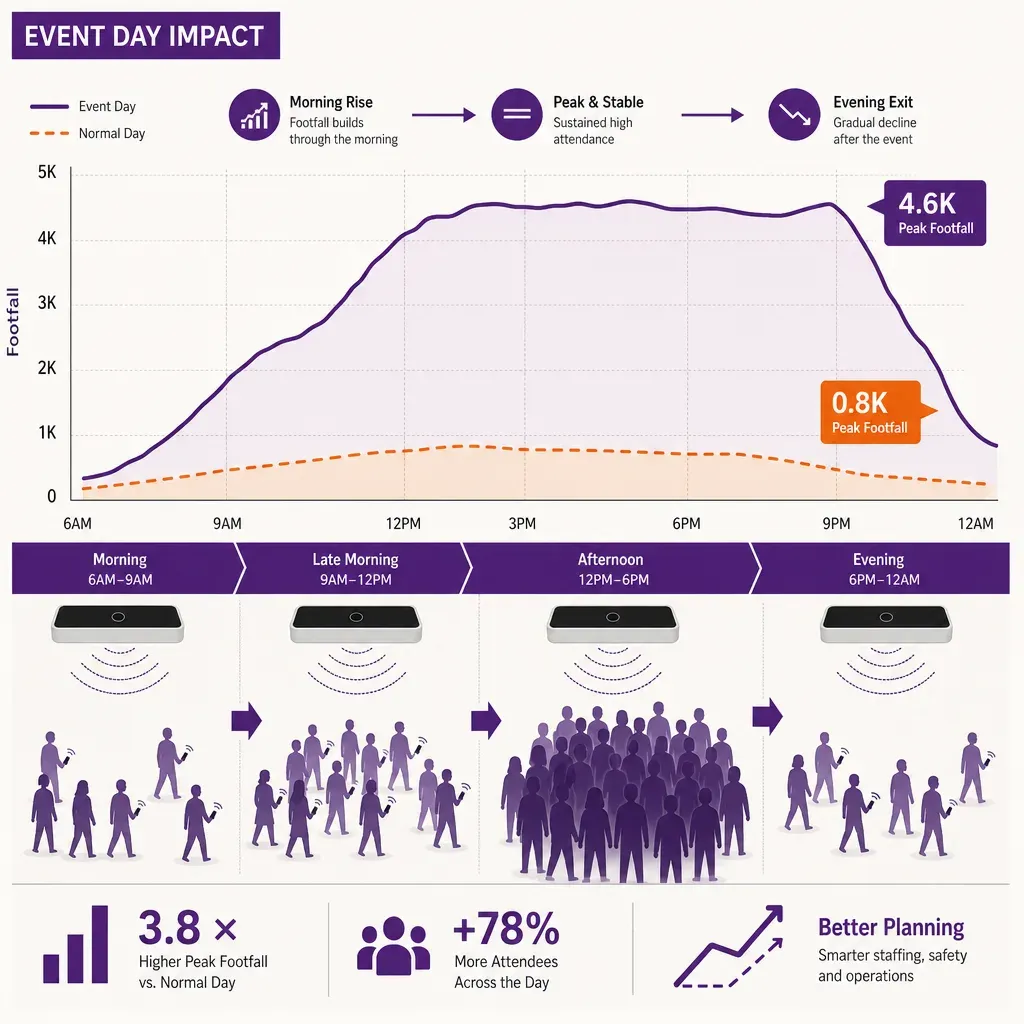
A normal Tuesday in a small European town and the first weekend of a wine festival are not the same operational problem. On a Tuesday, the high street has a known shape: a morning lull, a lunchtime peak, a quieter afternoon, a small evening tail. Staffing, deliveries, waste collection, and parking enforcement all sit comfortably inside that pattern. An event day breaks every line on the chart. Footfall climbs steeply through the morning, holds at a level the town never sees the rest of the year, drifts only slightly through the afternoon, and then climbs again once the music starts. The town that planned for a Tuesday spends the day reacting to a Saturday it has never measured.
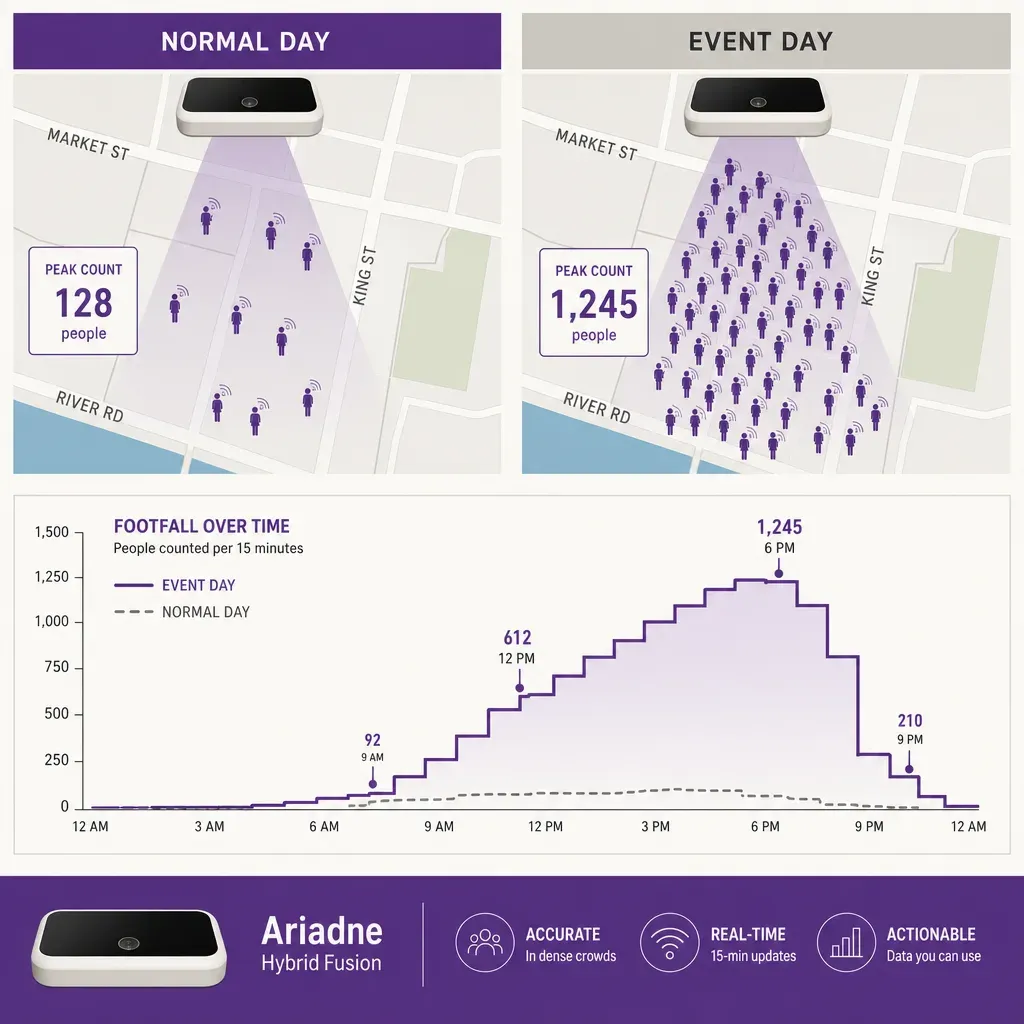
Event crowd management data is the set of numbers a city or a town centre management organisation needs to plan and run that day safely. It is not a single dashboard. It is footfall at the entrances to the event zone, occupancy on the main square, dwell at the stages and stalls, and flow along the streets that connect them, all reported continuously and broken down by hour. With those numbers, an event team can write a staffing plan that matches the curve rather than the calendar, set safety thresholds that trigger an action before crowding becomes an incident, and give retailers and food and beverage operators a clear picture of when their queues will form. Bernkastel-Kues, a wine town on the Moselle that runs one of the region's busiest festivals, is an Ariadne customer using footfall data this way. This post sets out the playbook: what to measure, what to do with it, and how to set the system up so it carries operational weight on the days that matter.
The Bernkastel-Kues setting
Bernkastel-Kues sits on a bend of the Moselle, in the centre of one of Germany's best-known wine regions. The two halves of the town, Bernkastel on the east bank and Kues on the west, are joined by a single bridge. The historic market square, the riverside promenade, and the narrow lanes of the old town carry most of the visitor traffic. For most of the year, that traffic is a steady flow of regional visitors, coach tour groups, and Moselle cycle path traffic. For a few days each year, it changes character entirely. The town's wine festival, the Bernkasteler Weinfest, fills the same streets with crowds that are several multiples of the usual flow, and a string of smaller wine-themed event days and Christmas market weekends does the same on a smaller scale.
The operational picture is therefore made of two states. There is the baseline, which the town wants to understand for tourism planning, retail support, and infrastructure investment. And there is the event state, which has a different staffing plan, a different safety plan, and a different commercial plan. The job of a footfall system is to make both of those states legible at the same time, so the town can run the baseline year as planning data and the event days as live operations.
Bernkastel-Kues partners with Ariadne for the underlying measurement. The customer profile is at ariadne.inc/customers/bernkastel. Specific operational metrics for the town's event days are not published, and this post does not invent them. What follows is the playbook that footfall data of this kind enables, which is the same playbook other small and medium European wine and festival towns can adopt.
What to measure on an event day
An event day pulls four distinct numbers out of a footfall system, and each one drives a different decision.
Footfall at the event-zone entrances
A wine festival or a Christmas market typically has a handful of natural entry points: the bridge, the main pedestrian street, the riverside promenade, the access lane from the car parks. Counting at each of those points gives the inbound rate for the whole event zone over fifteen-minute or hourly windows. That is the number the operations team watches to know whether the day is building faster or slower than last year's curve, and whether the early-morning peak is going to overrun a plan that assumes a lunchtime arrival.
Live occupancy on the main square and at the stages
Inbound counts are not the safety number. Occupancy, the number of people inside a defined zone at a given moment, is. The market square in front of the main stage, the area around a popular wine stall, the stretch of promenade where the band plays at six o'clock, each has a comfortable capacity and a hard limit. Live occupancy lets the operations team see when a zone is filling, hold the next arrivals at a wider point upstream, or open a secondary route before the crowd density becomes a hazard.
Dwell time by zone
Dwell time, the average length of time a visitor stays in a zone, separates a square that people pass through from one where they settle in. That matters for two reasons. Operationally, a high-dwell zone needs more bin emptying, more toilet capacity, and more visible stewarding. Commercially, dwell is the leading indicator that a wine stall, a food vendor, or a craft tent is doing well. A retailer who knows their street will see two hours of high-dwell traffic between noon and two o'clock can prepare for it. A retailer who is told only that the day was busy cannot.
Flow along the connecting streets
Between the entry points and the squares, visitors move along a network of pedestrian streets and lanes. The flow numbers along those connections, how many people pass per hour, in which direction, show the operations team where the natural circulation is working and where a choke point is forming. A lane that is normally a two-way pedestrian street can become a one-way bottleneck during an event peak. Flow data is what tells the team that early, before the bottleneck arrives.
Turning the data into a safety plan
The safety value of an event footfall system is not the dashboard. It is the set of pre-agreed thresholds and the actions tied to them. Without thresholds, a live count is just a number on a screen that nobody knows what to do with. With thresholds, the same number triggers a defined action.
A workable threshold model has three levels for each zone the team cares about.
- Green: comfortable. Occupancy is well inside the planned capacity for the zone. The plan continues as written, and the team logs the reading.
- Amber: full. Occupancy is approaching the planned capacity. The team takes a defined preventive action, for example slowing inbound flow at the upstream entrance, opening a secondary lane, or pausing a stage transition that would pull more people in.
- Red: stop. Occupancy is at or above the hard safety limit for the zone. Inbound flow at the relevant entrances is held, a public announcement is made, and the incident commander takes control of the response.
The thresholds are agreed in advance with the police, the fire service, and any private security contracted for the day. They are written into the event safety plan, not held in someone's head. The footfall system's job is to deliver an honest occupancy figure for each zone, fast enough that the amber action prevents the red. Continuous, per-zone occupancy is what makes that possible. A clicker at the door is not.
Staffing the day from the curve, not the calendar
Most event staffing decisions are still made from last year's roster and the organiser's intuition about the day. That works on a quiet event and falls apart on a busy one. A staffing plan built from the actual hourly curve does better on both, because it puts the right people in the right places at the right hours, and pulls them back when the curve drops.
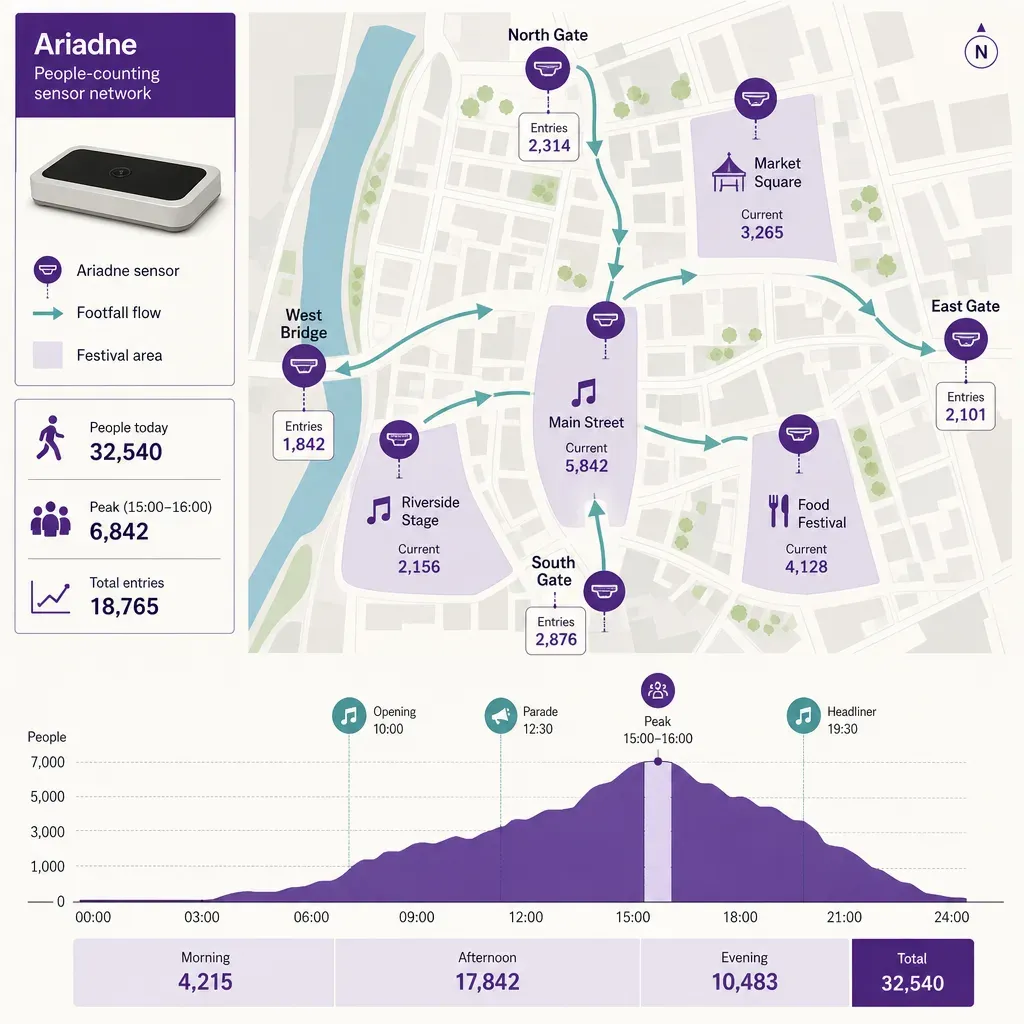
Footfall data feeds the staffing plan in four ways.
- Historical curve as the baseline. Last year's hourly inbound and occupancy data is the starting point. The roster lines up the largest staff numbers with the historic peaks and tapers them off in the genuinely quiet windows.
- Comparable-day adjustments. Weather, day of the week, and overlapping events shift the curve. The team makes named adjustments against the historical baseline before the day, rather than discovering the difference on the day.
- Live reallocation. On the day, live occupancy by zone tells the duty manager where to move stewards from one street to another. A square that is filling faster than the plan needs more presence, and a quieter zone can spare it.
- Post-event review. After the event, the staffing roster is laid back over the actual curve. Where staffing under-served the crowd, the next plan adds. Where it over-served, the next plan saves the budget. Year over year, the roster gets closer to the curve.
Retail and food and beverage preparation
An event day is also a commercial day for every wine merchant, restaurant, bakery, and craft shop on the route. Retailers and food and beverage operators do not need the same live dashboard as the safety team. They need a clear, hourly picture of when their street will be busy, so they can staff the counter, prepare the stock, and brief their team.
A town centre management organisation that holds the footfall data is well placed to share that picture. A simple briefing the day before the event, with the expected hourly curve for each main street and last year's actuals for comparison, gives small businesses something far more useful than the marketing line that the event will be big. After the event, the same data tells them what their street actually saw. Two seasons of that data, and the retailer is making stock and staffing decisions against a measured pattern, not a memory.
Signage timing and crowd routing
Variable signage, whether digital boards at the entry points, printed boards at junctions, or simple steward-held arrow boards, is one of the cheapest interventions in event crowd management. It is also one of the easiest to time badly. A board that opens a secondary route too early sends the morning's gentle arrivals to a back street and leaves the main square feeling empty. A board that opens it too late directs people toward a square that is already at the amber threshold.
Live flow and occupancy numbers turn the signage decision into a routine. The signage plan lists the alternate routes, the conditions under which each one is activated, and the person responsible. When the main square hits amber, the steward at the bridge raises the secondary-route board. When the main square drops back to green, the primary route is restored. The decision is no longer a judgement call made by one person at a time of peak stress. It is a written rule with a measured trigger.
Why camera-free measurement is the right fit for an event
A wine festival or a town festival is a public event in a public space, with thousands of visitors who did not sign up to be filmed. The municipality also has its own privacy commitments, and a town that is proud of its old streets is not the kind of place that wants a visible camera array trained on the crowd. The cleanest answer is to measure without a camera in the first place.
Ariadne measures this with Hybrid Fusion, its patented camera-free method. Time-of-Flight depth sensing counts every visitor at the entrances, capturing geometry rather than images, while patented phone signal sensing follows movement through the interior, detecting the signals a phone emits even in airplane mode. The sensor streams both feeds to Ariadne, where Hybrid Fusion combines them into one trajectory per visit and computes counts, dwell, and paths. The streams carry no identifier: no MAC address, no device ID, no biometric data, and no camera is involved. Identifiers are stored only when a visitor explicitly opts in, which keeps the method GDPR-friendly and outside biometric territory.
For an event team, the practical consequences line up with what the day needs. There is no camera and no video, so there is no image of a festival visitor to store or to lose. The streams carry no MAC address by default and no device identifier, so there is no personal data in the count. Identifiers are stored only when a visitor explicitly opts in, which on a public square the town does not need to offer. The result is hourly footfall, live occupancy, and dwell per zone, produced without anything that a data protection officer would classify as personal data. The sensor lineup is at the Ariadne hardware page, and the data handling is set out in the privacy policy.
Setting the system up for the next event
If your town is planning to use footfall data on its next event day for the first time, the work breaks into four steps. None of them needs a research department, and none of them needs to wait for the event to be over.
- Define the event zone and its sub-zones. Draw the boundary of the event on a map. Inside it, mark the entry points, the main squares, the stages, and the connecting streets. Each of those becomes its own counting zone with its own capacity number.
- Place sensors at the entry points and inside the zones. Entry counts come from sensors at the named entrances. Occupancy and dwell come from sensors inside the squares and along the lanes. Coverage does not need to be perfect on day one. It needs to cover the points where a safety or staffing decision will be made.
- Agree thresholds with the safety partners in writing. Green, amber, and red for each zone, agreed with police and fire, signed into the event safety plan, and rehearsed in the pre-event briefing. The footfall number means nothing until the action attached to it is agreed.
- Plan the post-event review before the event. Decide what numbers will be exported, who will write the review, and who will read it. The review is what turns one event into a baseline, and the baseline into a year-on-year improvement.
Across the broader category, the model that towns like Bernkastel-Kues are following is set out in more detail on the smart cities industry page, and the underlying counting method is documented at the people counting solution page.
FAQ
Does the system use cameras on the festival route?
No. Ariadne counts with Hybrid Fusion: Time-of-Flight depth sensing plus patented phone signal sensing, never cameras. Time-of-Flight captures geometry rather than images, and signal sensing captures no MAC address by default, so the measurement involves no video, no faces, and no biometric data.
Can event-day data be compared with the rest of the year?
Yes, and that comparison is one of the more valuable outputs. The same sensors that report live occupancy during a wine festival report baseline footfall on a quiet Tuesday in February. With both sides of the comparison in the same system, the town can describe the lift the event produced, the dwell change on the connecting streets, and the spillover into the days either side. That is the data a tourism office and a town centre management organisation want when they make the next year's case for funding.
Is the data accurate enough for safety thresholds?
Time-of-Flight depth sensing at the entrances counts every visitor crossing the threshold, independent of whether they carry a phone, with geometric accuracy in the order of 30 centimetres. Inside the zones, signal-based sensing resolves distinct visitors and tracks how long they stay. That combination is reliable enough to drive an amber-red threshold model, provided the thresholds are set in writing with the safety partners and the system is checked in the pre-event walk-through.


