
What city tourism analytics actually is
A destination marketing organisation is in a difficult position. It is asked to grow visitor numbers, attract the right kind of visitor, defend its budget at council level, and report progress every year, often on the back of a hotel-stay figure and a customer survey. The hotel figure misses day-trippers entirely. The survey is run once or twice a year and reflects whoever bothered to fill it in. Between those two data points sits the rest of the picture: how many people walked through the old town on a Wednesday in May, which attractions they reached, how long they stayed, and whether the summer festival actually pulled extra footfall compared with a normal weekend. Closing that gap is the work city tourism analytics does. A continuous, anonymous-by-design people count on the main visitor streets and at the main attractions turns the year into measured data rather than estimates between surveys.
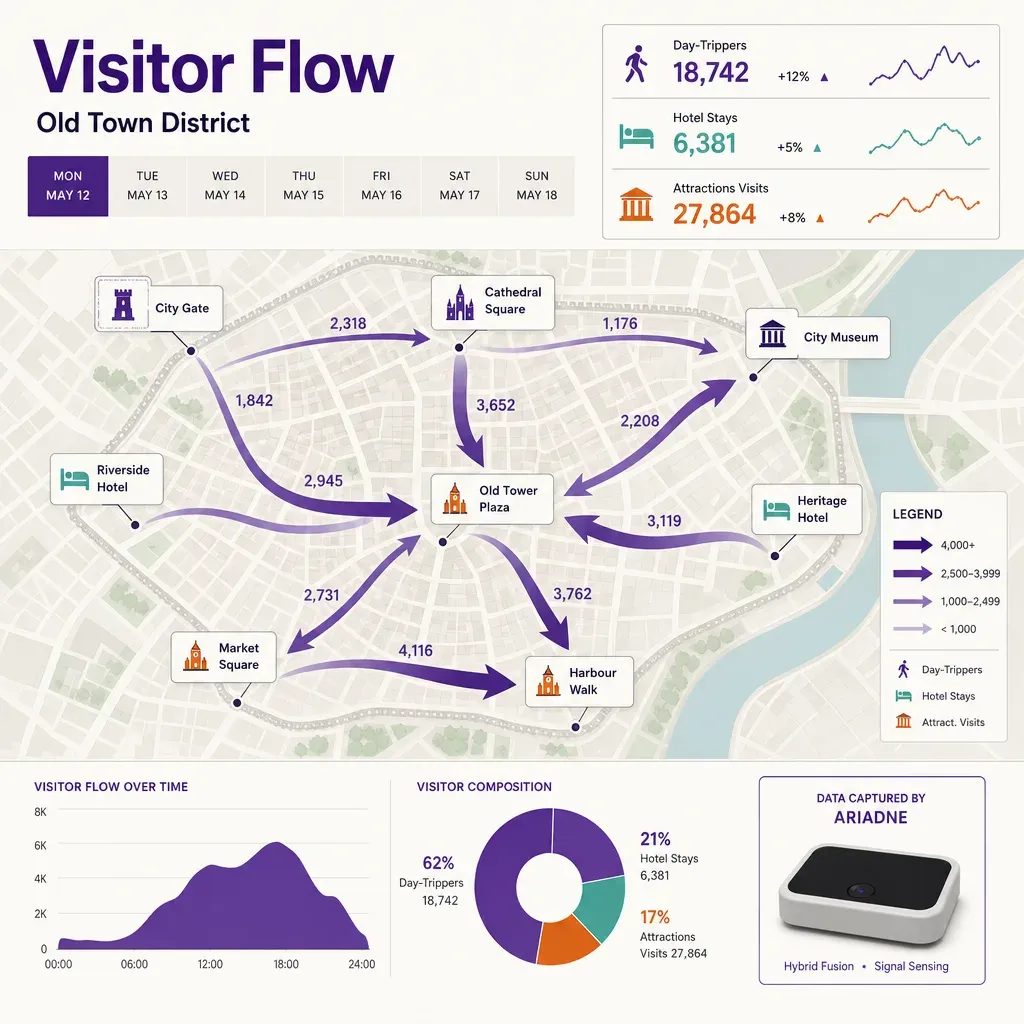
This post is for the DMO, the city tourism office, and the smart-city team that supports them. It walks through the questions visitor-flow data can answer, the patterns that show up once a city has a few months of counts on the books, and the choices to make before commissioning a counting programme that will sit on public streets for years.
Five patterns visitor-flow data exposes
When a city instruments its main visitor zones with continuous counters, five patterns stop being hunches and start being numbers a DMO can present to a board.
Overnight visitors versus day-trippers
The hotel-night figure most DMOs already publish captures overnight stays and nothing else. In a city with strong day-trip catchment, from a cruise port, a nearby capital, a regional rail hub, the day-tripper share can be larger than the overnight share, and it behaves differently. Day-trippers concentrate around midday, cluster on a small number of headline attractions, and leave by late afternoon. Overnight visitors spread their footfall across breakfast and evening windows and reach quieter side streets where the smaller museums and the independent restaurants sit. Footfall on the main street by hour, compared with hotel-stay data for the same period, gives the DMO a measured split between the two and a defensible answer to the question "who are we actually serving?".
By-attraction distribution
Cities have headline sites and they have the quieter sites the tourism office wishes more people would visit. A counter at each main draw, at the market square, the museum entrance, the viewpoint, the secondary museum, the heritage trail, lets the DMO read distribution rather than infer it. The pattern that usually emerges is a sharp concentration at one or two anchors and a long tail at the rest. That is the input the DMO needs for two real decisions: where wayfinding budget should go to spread load, and which secondary site needs a programming push because it is genuinely undervisited rather than under-promoted.
Seasonality at hourly resolution
Seasonality is the part everyone thinks they understand, until they look at the counts. Continuous data shows that the shoulder seasons behave differently from the peak, not just at lower volume but at different hours of the day. Morning crowds in October are softer than morning crowds in July at the same weather. School holidays from neighbouring countries push spikes on weeks that are otherwise quiet locally. A wet July afternoon collapses outdoor footfall and pushes the indoor museum into capacity overload. Hourly seasonality, read across a full year, replaces a single peak-versus-off-peak generalisation with something a marketing team can actually plan against.
Length of stay
Hotel data gives length of stay in nights for the people who stay overnight. It says nothing about the visitor who arrives on the morning train, walks the old town for four hours, eats lunch, and catches the train back. With sensors across the visitor zone, the average dwell of a visitor inside the zone becomes a measured figure, by season and by day of the week. A DMO that knows a typical Saturday day-tripper stays three hours and twenty minutes can plan the messaging, the wayfinding, and the F&B partnerships around an actual time budget, not a guess.
Peak-day versus typical-day comparison
Every visitor city has a peak day. A festival weekend, a Christmas market opening, a public holiday. The DMO and the city operations team both need to know how that day compares with a typical weekend in the same season. Footfall on the main street on the festival Saturday, set against the four preceding Saturdays at the same hour, gives the multiplier directly. That multiplier is what feeds the conversation about extra cleaning, extra public transport, extra retail and F&B staffing, and the safety briefing for the police and stewards. The same comparison, run after the event, tells the DMO whether the marketing spend on the festival actually moved the number or whether the weather did.
What this looks like in a small German visitor city
Several small German cities run tourism programmes against continuous footfall data of this kind. Ariadne works with a number of them. The patterns above are not theoretical for those teams; they show up in the dashboards every week and they shape budget decisions every year. A small wine-region town like Bernkastel-Kues, for example, uses footfall data to compare festival weekends with normal weekends, to understand which side streets pull visitors away from the river promenade, and to set the staffing and cleaning plan around measured demand rather than last year's notes.
The picture is the same in shape across other German visitor towns of this size: a known peak season, an unknown shoulder pattern that becomes clear once a year of data is on the books, and a long tail of secondary attractions that get more or less love from visitors than the tourism office expected. The DMO that has those numbers in front of it is not arguing from anecdote when it goes to council for next year's budget.
Why privacy is the gating question for a DMO programme
Tourism counting sits on public streets, in public squares, and at the entrances of cultural sites. The people being counted are residents on their way to work as well as visitors. A city that instruments its centre with anything that feels like surveillance will lose the conversation with residents first, and with the data protection authority second. The bar a DMO programme has to clear is concrete: no images of identifiable people captured by default, no faces processed, no device identifiers logged without an explicit opt-in, and a story that can be told to a journalist or a council committee without caveats.
Camera-based counting can be made compliant, but it leads with a visible lens pointed at the public. The conversation has to happen every year. A method that captures no image in the first place avoids the conversation entirely, because there is no image to redact, anonymise, or lose. That is the position a careful DMO wants to start from before it puts a sensor on a public street.
How Ariadne measures a visitor city
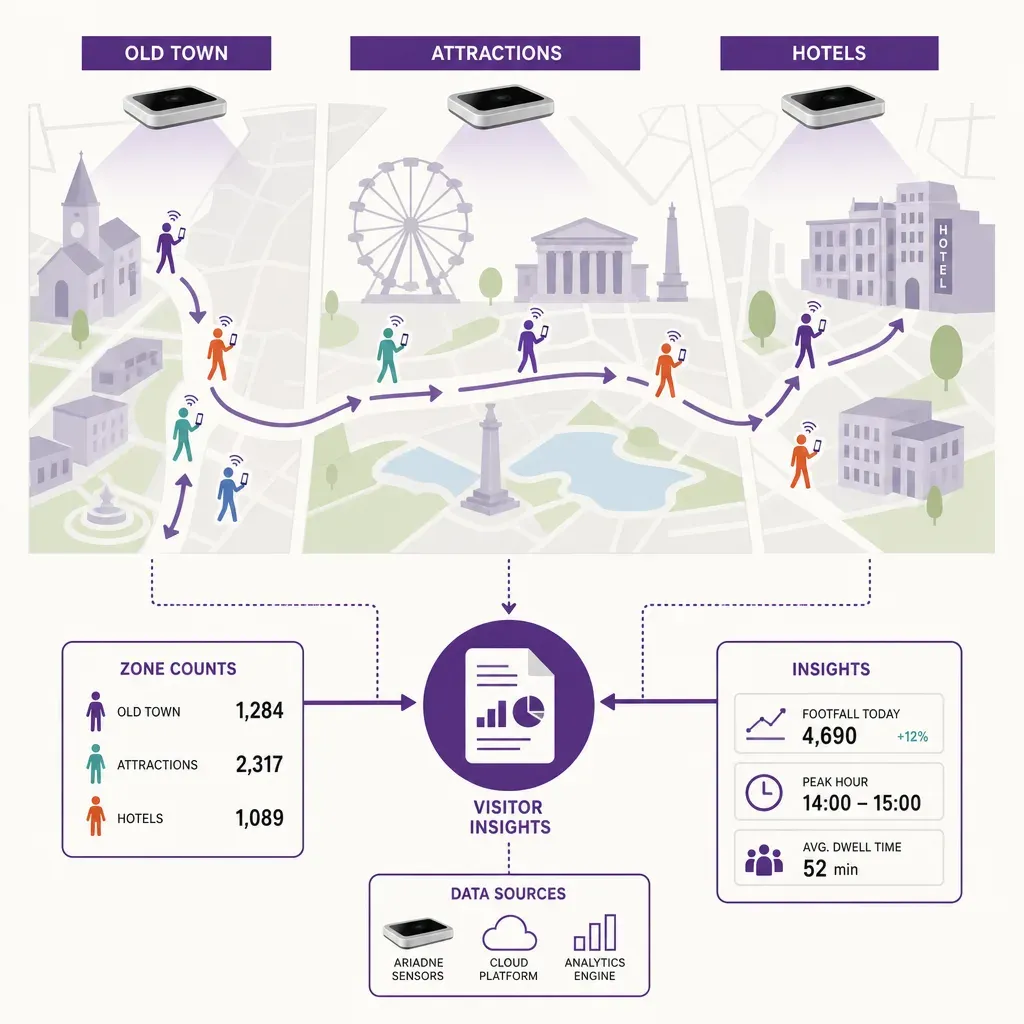
Ariadne measures this with Hybrid Fusion, its patented camera-free method. Time-of-Flight depth sensing counts every visitor at the entrances, capturing geometry rather than images, while patented phone signal sensing follows movement through the interior, detecting the signals a phone emits even in airplane mode. The sensor streams both feeds to Ariadne, where Hybrid Fusion combines them into one trajectory per visit and computes counts, dwell, and paths. The streams carry no identifier: no MAC address, no device ID, no biometric data, and no camera is involved. Identifiers are stored only when a visitor explicitly opts in, which keeps the method GDPR-friendly and outside biometric territory.
For a tourism programme, the practical consequences are direct. Time-of-Flight depth sensors at the entrances of attractions, at the heads of the main visitor streets, and at the gates of festival sites count every visitor crossing the zone without forming an image of them. Phone signal sensing inside the visitor zone follows movement between attractions, so the DMO sees not just point counts but the journeys, which side street connects which two anchors, which secondary site sits on a real visitor route, and which one is geographically off the path. Neither stream carries a MAC address or a device identifier by default. The full sensor lineup sits in the Ariadne hardware overview, the data handling is set out in the privacy policy, and the underlying method is documented on the how-it-works page.
What a DMO can do with the data once it arrives
Data is only useful when a team uses it. A tourism office that has visitor counts on the main street, dwell at each attraction, and a typical-day baseline can answer four questions that previously sat as opinions in a meeting.
- Where should the next wayfinding budget go? If the data shows two anchors absorbing seventy per cent of footfall and a heritage trail behind them carrying twelve, the case for better signage from the anchors towards the trail writes itself.
- Which weeks should the marketing push protect? Shoulder weeks with measured softness, not all shoulder weeks, are where campaign spend earns its keep. The data shows which weeks are actually quiet.
- How well did the festival travel? A multiplier against the four prior weekends, by hour, says whether the campaign worked. A drop in the multiplier from last year, year on year, says whether the format is tired.
- Which secondary attraction needs a different intervention? A site with low entries but high dwell is loved by the people who find it and needs better promotion. A site with high entries but low dwell is visited and then left; it needs a programming change, not more marketing.
A short procurement checklist for a tourism programme
If a DMO or a smart-city team is putting a visitor-counting programme together, these are the questions worth putting to any vendor in writing before a pilot.
- Does the system capture any personal data? Ask explicitly about images, faces, MAC addresses, and device identifiers. You want a clear no by default, with any identifier limited to explicit opt-in.
- Is there a camera anywhere on the public street? If the answer is yes, expect a yearly conversation with residents, journalists, and the data protection authority. A method that uses no camera removes the conversation.
- Can the system report by attraction, not just by city? A single city-level number is not actionable for tourism marketing. Confirm the system reports per zone, so each attraction, square, and street can be read on its own.
- Does the data carry hourly resolution across a full year? Tourism patterns are about hours of the day across seasons, not monthly totals. Confirm the system stores and exports hourly counts back at least a year.
- Can the output integrate with existing tourism dashboards? The DMO already reports against hotel-night data, transport data, and marketing-spend data. Counts that export cleanly into those tools get used. Counts trapped in a vendor portal do not.
- How is the data stored, and where? For a public-sector programme in Europe, the answer should be EU hosting, clear retention rules, and a contract that lets the city take its data with it.
FAQ
Do the sensors use cameras?
No. Ariadne counts with Hybrid Fusion: Time-of-Flight depth sensing plus patented phone signal sensing, never cameras. Time-of-Flight captures geometry rather than images, and signal sensing captures no MAC address by default, so the measurement involves no video, no faces, and no biometric data.
Can footfall data tell us the difference between day-trippers and overnight guests?
Not on its own, and no honest vendor will claim it can. Footfall counts the people who cross a sensor. Combined with the hotel-night data the DMO already publishes, the gap between total visitor footfall in the centre and the overnight figure approximates the day-tripper volume, and the time-of-day pattern, sharp midday peak versus spread morning and evening, confirms the split. That combination is what city tourism analytics gives a DMO, not a single magic number from one source.
How long before a counting programme produces useful seasonality data?
A useful baseline starts at roughly twelve months of continuous data, because seasonality is a year-long shape. Useful within-season comparisons start much earlier: by week three or four, the typical weekday-versus-weekend pattern is visible, and by month two the DMO can already compare a special event against the four prior weekends in the same season. The honest framing for the procurement business case is that the first year builds the baseline and the second year is when the data starts pulling its weight in decisions.
Can this kind of counting cover a whole city centre?
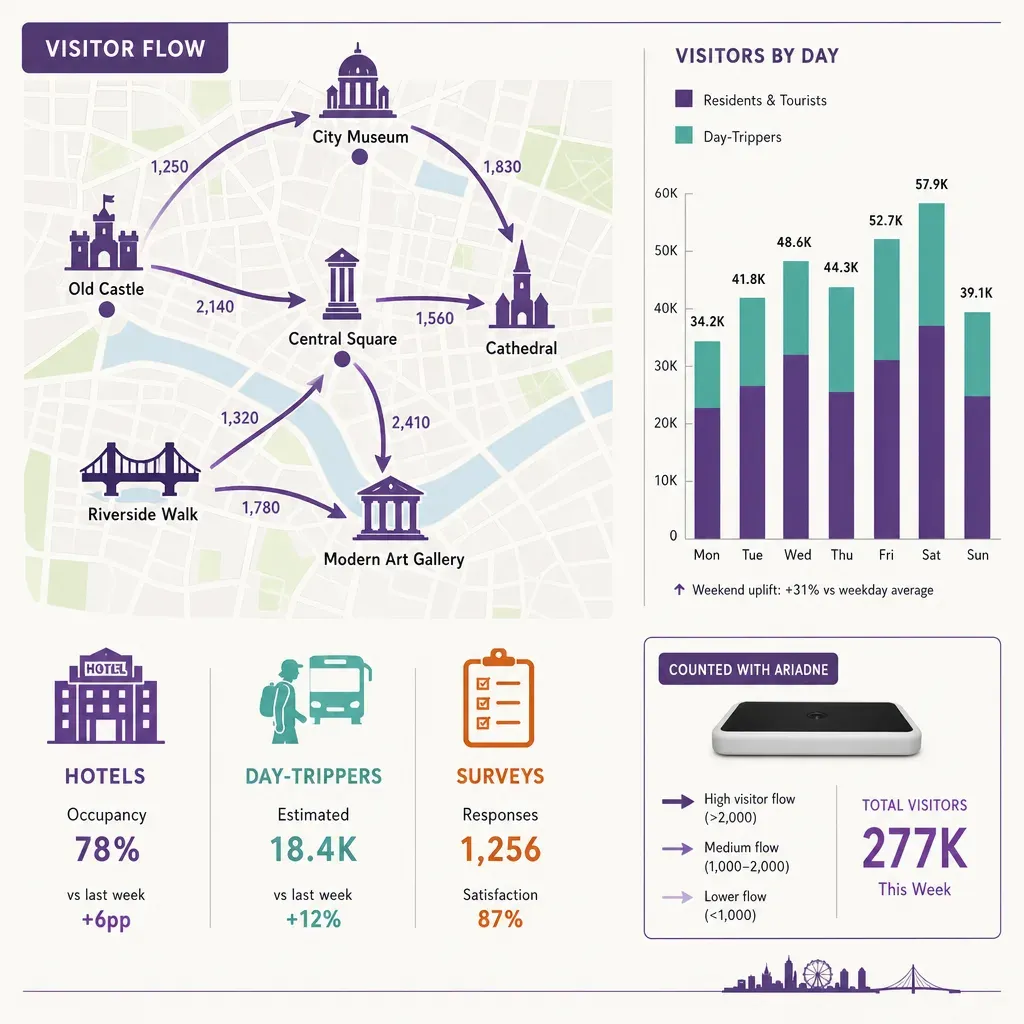
Yes, with planning. The sensors go where the counts matter, at the main visitor entrances, at the most-visited attractions, at the heads of the main streets, and at the festival sites. A small visitor city can be instrumented well with ten to twenty sensing points; a larger old town will need more. The goal is not to count every square metre but to read the zones that drive the tourism story, and to read them continuously across the year rather than in spot surveys.


