
A bookstore is built for browsing, which is its charm and its measurement problem at once. People come in to wander, to read a few pages, to lose half an hour among the shelves, and many of them leave without buying. That is normal and even healthy. But it means the gap between visitors and buyers is wide, and a shop that only watches the till has no real sense of how wide. A quiet takings day might be a day when few people came in, or a day when plenty came in and browsed and bought nothing. Those are different problems with different fixes, and you cannot tell them apart without counting the people, not just the sales.
This is a guide to footfall counting for a bookshop, written with the margin-tight independent in mind. It covers visitor-to-buyer conversion and dwell, measuring whether an author event or window display actually worked, counting at the door in a quiet, book-led space without a camera, and how an owner turns the entry curve and the dwell map into the staffing, layout, and events decisions they make all year.
What does footfall counting do for a bookstore?
A bookstore depends on browsing, so the gap between visitors and buyers is wide and meaningful. Footfall counting shows how many people came in against how many bought, which turns a vague sense of a quiet day into a conversion number you can act on. It also reveals dwell, which sections hold attention, and whether an author event or window display actually pulled people through the door. For independents watching margin, that is the difference between staffing on a hunch and staffing on the curve.
The conversion number is the heart of it. Takings alone hide the denominator. Once you know how many people came in, every quiet day and every busy one becomes a question you can answer rather than a mood you absorb.
The bookstore pain point: a shop full of browsers and no idea how many converted
The browse is the bookshop's whole proposition, and it is also what makes the shop hard to read. A clothing store can roughly sense its conversion because trying something on signals intent. A bookshop cannot, because browsing looks identical whether it ends in a purchase or not. The shop can feel busy with people happily reading and still ring up very little, or feel quiet and convert most of the few who came in. The owner standing behind the counter genuinely does not know which, because the human sense of "busy" is unreliable and the till only records the half of the story that ended in a sale.
For an independent on thin margins, that blind spot is expensive. Staffing is the obvious cost: putting two people on for a quiet afternoon, or one person on for a busy one and watching the queue and the questions go unanswered. But it runs deeper. Without the visitor count, the owner cannot tell whether a soft week was a footfall problem, fix it with the window and local promotion, or a conversion problem, fix it with the layout, the recommendations, the events. The two need opposite responses, and the till alone cannot choose between them.
There is a particular trap in a bookshop that the count guards against: mistaking a popular shop for a profitable one. A bookshop can become a much-loved place that people come to browse, read, and linger in, and still struggle, because affection and footfall are not the same as sales. An owner who senses the shop is "doing fine because it is always busy" may be reading a high-traffic, low-conversion situation that needs work on recommendations and merchandising, not reassurance. The count is what turns that feeling into a number honest enough to act on, and for a margin-tight independent the difference between a fond hunch and a real conversion rate can be the difference between a good year and a closed door.
Visitor-to-buyer conversion and dwell
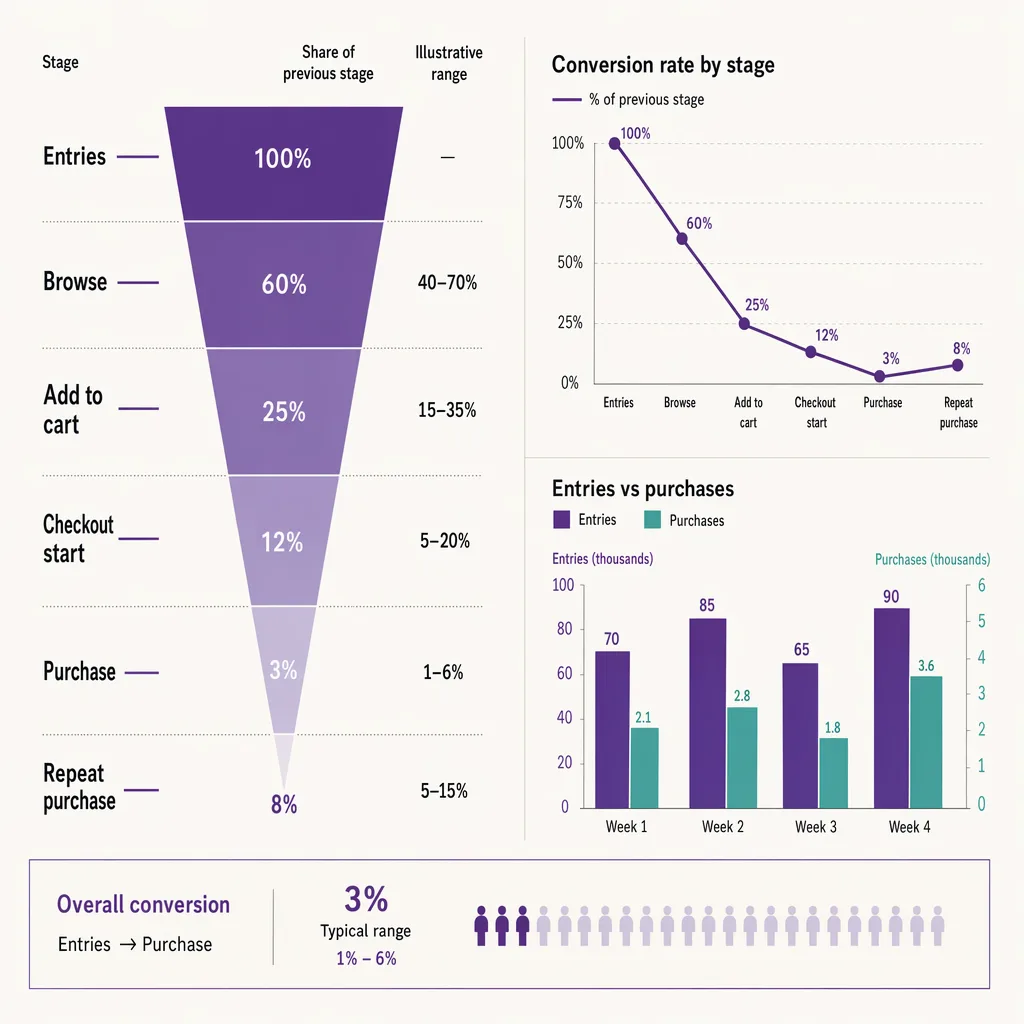
A door count gives the bookshop the number it has been missing: people in. Set against transactions, that is a conversion rate, and it converts the daily mood into a metric. The conversion rate formula is the same arithmetic any retailer uses; the bookshop difference is that the rate is expected to be lower, because browsing without buying is part of the format, so what matters is the trend and the comparison, not the absolute figure against a clothing shop.
Dwell adds the second dimension. A bookshop wants people to linger, because dwell and discovery are how books get bought that nobody came in for. Counting that follows movement through the interior shows which sections hold attention and which are passed by, which is the input for where to put the table of new releases, the staff picks, the seasonal display. Sales per visitor respects that a bookshop trades on a mix of small and occasional larger baskets, and pairs naturally with the dwell picture: the sections people linger in are the ones worth merchandising hardest.
In a bookshop, dwell deserves more weight than it gets in most retail, because the format actively wants it. A clothing retailer worries that a long dwell with no purchase is a sign of friction; a bookshop knows that browsing is how the unplanned buy happens, the customer who came for one title and leaves with three because the staff-picks table caught them on the way to the till. So the sections worth merchandising hardest are not only the busiest by traffic but the stickiest by dwell, and the move a bookshop owner makes is to put the impulse-friendly stock, the new releases, the discounted hardbacks, the local-interest table, where the data shows people already slow down. That is the opposite of hiding it at the back and hoping; it is meeting the browse where it already lingers.
Did the event or window work? Measuring an activation
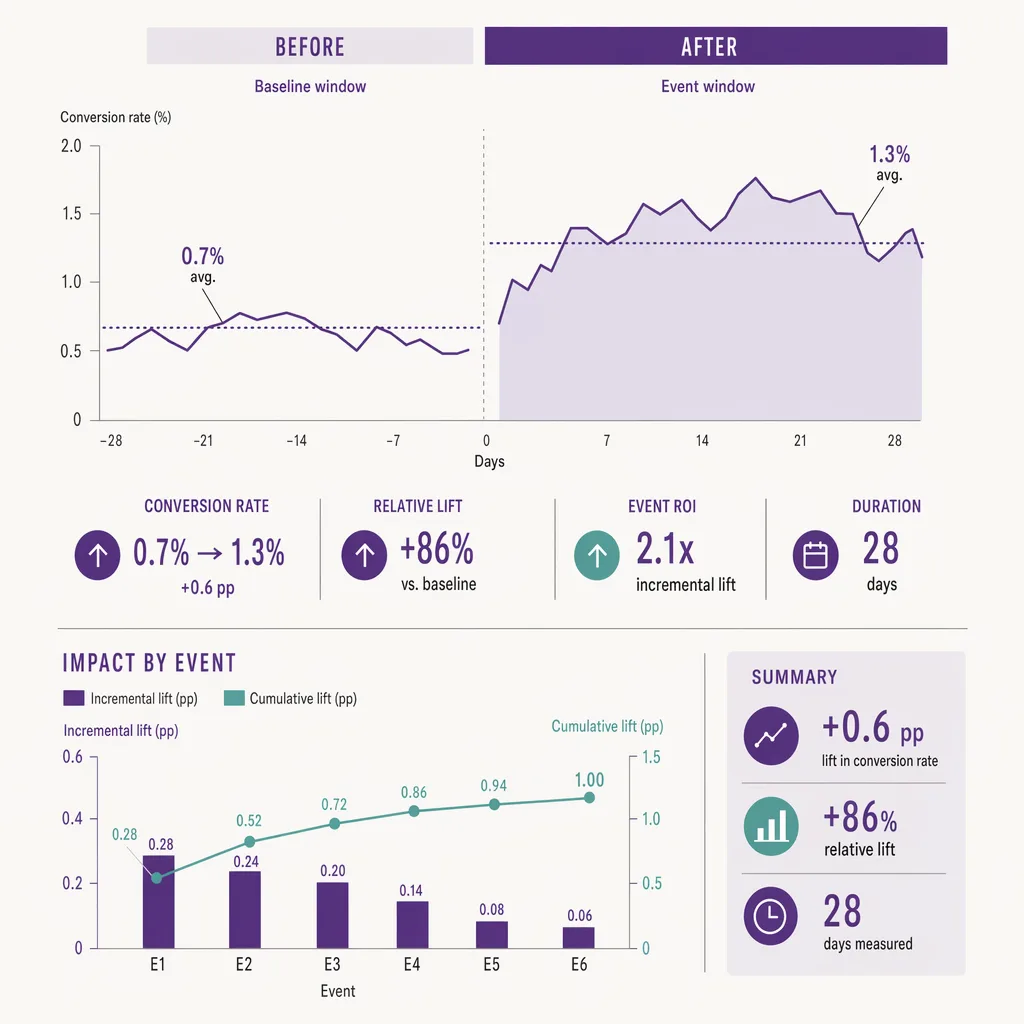
Independents lean on events and windows to pull people in: an author signing, a launch, a themed window, a local-interest table. The honest question afterwards is always whether it actually worked, and "it felt busy" is not an answer you can plan next quarter on. Footfall counting gives you the before-and-after: did the event evening or the window change measurably lift entries against a normal comparable day, and did that lift convert into sales or just into browsers?
This is exactly the discipline of measuring an activation: a defined intervention, a footfall measurement against a baseline, and an honest read on whether it moved the number. For a shop deciding whether to keep running author events that take real effort to organise, that before-and-after count is the difference between repeating what works and repeating what merely felt good. Camera-free counting gives you the entry data to run that comparison cleanly.
The honest version of this measurement separates two things an event can do, because they are not equally valuable. An author signing or a launch can lift entries on the night, which is a footfall win, but the question that decides whether to run it again is whether those extra people bought, and whether any of them came back. An evening that filled the shop with people who came for the author, queued for a signed copy, and left is a different proposition from one that pulled in new browsers who have since returned as customers. The count shows the entry lift cleanly; pairing it with the till for the evening and watching whether footfall held up in the following weeks shows whether the event built anything lasting or simply borrowed a busy night. For a small shop weighing real organising effort against thin margins, that is the read worth having before committing to a season of events.
Counting at the door, camera-free, in a quiet retail setting
A bookshop is a calm, considered space, and the people in it are reading, thinking, lingering. A camera over the floor is tonally wrong for that, and it brings the data-protection weight of recording identifiable people when all the shop needs is a count.
Ariadne measures this with Hybrid Fusion, its patented camera-free method. Time-of-Flight depth sensing counts every visitor at the entrances, capturing geometry rather than images, while patented phone signal sensing follows movement through the interior, detecting the signals a phone emits even in airplane mode, and tracks that movement to about one-metre precision. The sensor streams both feeds to Ariadne, where Hybrid Fusion combines them into one trajectory per visit and computes counts, dwell, and paths. The streams carry no identifier: no MAC address, no device ID, no biometric data, and no camera is involved. Identifiers are stored only when a visitor explicitly opts in, which keeps the method GDPR-friendly and outside biometric territory.
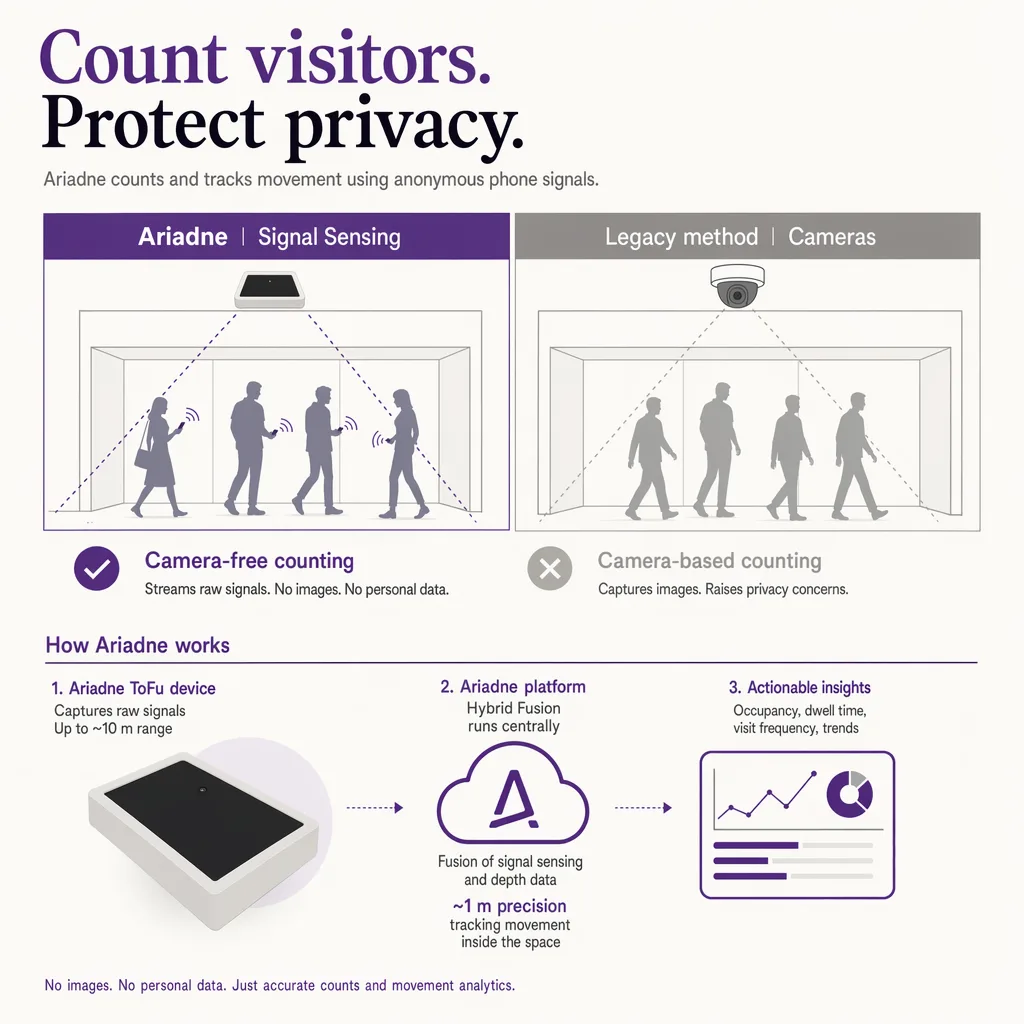
For a bookshop that means the entry count and the section dwell picture come with no footage of any customer and nothing personal stored. The same fit applies in other quiet, book-led spaces: a library counts visits this way for funding-grade figures without surveilling its readers, and a bookshop gets the same calm, accurate count at the door.
From counts to action: staffing, section layout, event ROI
The data turns into three decisions a bookshop owner makes regularly.
Staffing is the first and most immediate. The entry curve across the day and week shows when the shop is genuinely busy, so you put a second person on for the real peak and not for a flat rota that guesses. For a margin-tight independent, matching cover to the curve is direct money saved and service protected at the same time.
Section layout is the second. The dwell picture shows which parts of the shop hold attention and which are passed by, so the new-release table, the staff picks, and the seasonal display go where people actually linger rather than where they have always been.
Event ROI is the third. With a baseline footfall to compare against, every event and window becomes measurable: did it lift entries, did the lift convert, was it worth the effort. That lets an owner build a calendar of what genuinely pulls people in rather than repeating what merely felt lively. The full discipline of turning these counts into decisions is the same one any retailer uses, sized down to an independent's reality.
How a bookshop owner actually uses the numbers
For a small independent, the data lives in three short habits rather than a screen anyone watches. The weekly one is the conversion read: people in against transactions, which tells the owner whether a soft week was about footfall or about selling, and points the fix at the window or at the floor accordingly. The seasonal one is the dwell map, checked when deciding where the new-release table and the staff picks should sit, so the impulse stock meets the browse where people already slow down rather than where the shelves have always been. The occasional one is the event read, run each time the shop puts effort into a signing, a launch, or a themed window, comparing the night against a normal day and watching whether the lift converted and held. None of this asks an owner who would rather be talking about books to become an analyst. It gives them three honest answers, was it traffic or selling, where do people actually linger, and did the event build anything, on the kind of margin where guessing wrong is expensive.
FAQ
Why count footfall in a bookstore when browsing is normal?
Because browsing is exactly what makes a bookshop hard to read from the till alone. A busy-feeling day of browsers and a genuinely quiet day can ring up the same takings, and they need opposite responses. Counting visitors gives you the denominator, so you can tell a footfall problem from a conversion problem and fix the right one.
What conversion rate should a bookshop expect?
Lower than a clothing store, because browsing without buying is part of the format. The useful figure is not the absolute number against other retail but your own trend over time and the comparison between normal days and event days. The rate is a tool for spotting change, not a grade against a different kind of shop.
Can footfall data tell me if an author event worked?
Yes, and this is one of its most useful jobs for an independent. By comparing entries on the event day against a normal comparable day, and checking whether the lift converted into sales, you get an honest before-and-after read instead of relying on whether the evening felt busy.
Does counting a bookshop involve a camera?
No. Ariadne counts camera-free, with Time-of-Flight depth sensing at the door and phone-signal sensing through the interior, so there is no video of customers and nothing personal stored. That suits a calm, considered space where surveillance would be tonally wrong, the same way a library counts its visitors.
Why does dwell matter more in a bookshop than in other shops?
Because browsing is how the unplanned book gets bought. A clothing retailer treats a long dwell with no purchase as friction; a bookshop knows it is the customer who came for one title and leaves with three. The dwell map shows which sections hold attention, so the new-release table and staff picks go where people already slow down rather than at the back.
How do I tell if an author event was actually worth it?
Separate two things the event can do. It can lift entries on the night, which the count shows cleanly, and it can build lasting custom, which only shows up if the lift converted at the till and footfall held in the following weeks. An evening that filled the shop and left is different from one that brought new browsers who came back. For a small shop weighing real effort, that fuller read is the one worth having.
---


