
The question a pop-up is supposed to answer
A three-month pop-up in a shopping center is rarely a quiet line item. The brand pays a meaningful activation fee, the landlord hands over a piece of common-area floor that could have hosted other tenants, and a marketing team on at least one side, often both, builds a campaign around the opening. By the end of the run, somebody is going to ask whether the pop-up worked. The honest answer needs more than a photo of opening night and a queue at the till. It needs a number that says how the activation moved center-level footfall, and how much of the traffic the pop-up itself saw was incremental to a visit that would have happened anyway.
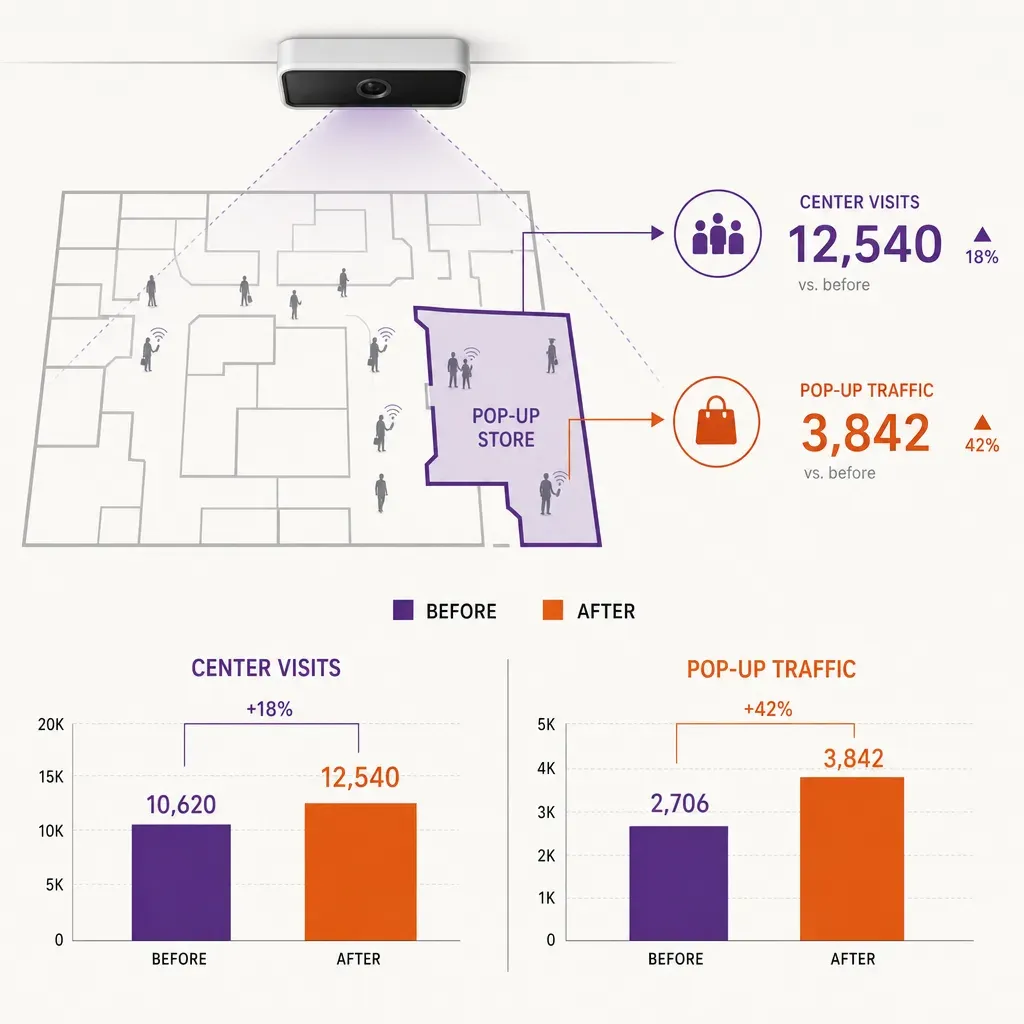
That is a measurement problem before it is a marketing one. A shopping center has footfall every week of the year, with strong, predictable rhythms. The job is to separate the part of footfall that the pop-up actually caused from the part that the calendar, the weather, and the rest of the leasing mix were going to deliver regardless. This piece sets out the methodology that works for a three-month activation in a shopping center: choosing the right baseline, controlling for contamination, attributing at the pop-up zone and at the center as a whole, and defining success differently for retail brand, food and beverage, and experiential pop-ups.
Two measurement layers, not one
Pop-up measurement collapses if you ask it to answer only one question. There are two things going on at the same time, and they need separate readings.
- Zone-level performance. How many visitors actually entered the pop-up footprint during the run, how long they stayed, and how that compared with the surrounding common area before the activation arrived. This is the brand's primary number. It is what they pay the activation fee against.
- Center-level lift. Whether the pop-up brought net new visitors to the property, or whether it mostly redistributed visitors who would have come anyway. This is the landlord's primary number. It decides whether the activation earned its place on the leasing schedule next year, or whether the floor is worth more let to a different use.
Conflating the two is the single most common mistake in pop-up reporting. A pop-up that draws a long queue inside the building has not necessarily lifted center-level visits; it may have pulled traffic from an adjacent atrium or from the food court. A pop-up that produced modest zone traffic may nevertheless have driven a measurable bump in centerwide arrivals on its launch weekends. The two readings answer different questions, and any honest debrief reports both.
Picking the right baseline
A lift number is the gap between what happened and what would have happened without the pop-up. The whole methodology hinges on the second half of that sentence. Three baseline designs are practical for a three-month activation in a shopping center, and they suit different cases.
Pre-period: simple, fragile
The most basic baseline is the center's footfall in the weeks immediately before the activation opened, used as a proxy for what footfall would have continued to look like. It is easy to compute and easy to explain, and for a short activation in a quiet calendar window it sometimes survives.
For a three-month run, it almost never does. Three months is long enough to cross a seasonal turn, a school holiday, a major retail event, or a tenant change elsewhere in the center. A pre-period baseline will quietly hand the pop-up credit, or blame, for any of those structural shifts. Use it only as a sanity check, not as the headline lift number.
Year-over-year: stronger, still imperfect
A better baseline compares each week of the activation against the matching week one year earlier, adjusted for the calendar (Easter shifts, school terms, public holidays) and for known shocks (a major refurbishment, a new anchor opening, a transport disruption). Year-over-year handles the obvious seasonality and weekday mix that a pre-period misses.
It still has two blind spots. First, the prior year is a single sample, and one weather pattern or one bad weekend can move the comparison. Second, year-over-year assumes the center itself is otherwise unchanged, which is rarely true over twelve months. A serious year-over-year baseline therefore extends the comparison to a two- or three-year window where possible, and explicitly excludes weeks that contained obvious structural shocks.
Holdout: the gold standard, when it is available
The strongest baseline is a holdout: a portion of the audience or the catchment that is deliberately left out of the activation's promotion, so that its footfall can serve as a control group for the part that was exposed. Two flavours are practical for a pop-up.
- Geo holdout on paid media. If the pop-up's launch campaign is bought into a defined catchment, the catchment can be split into a treatment region and a holdout region with the campaign suppressed in the holdout. Footfall to the center from each region is measured (anonymous mobility data is usually the source) and the lift is the difference. This isolates the marketing contribution to the pop-up's launch.
- Activation holdout across comparable centers. A landlord with a portfolio can run the same kind of pop-up at one or two centers and measure footfall at comparable centers that did not host it. This isolates the activation's effect on center-level footfall, not just the campaign's effect.
Holdouts are harder to set up. They cost some sales, they require committed planning, and they are only worth it for a tentpole activation. But when the question is whether a three-month pop-up moved center-level footfall, a holdout is the only answer a finance director will fully respect. For a deeper walk through holdout designs in a mall context, the mall marketing attribution piece covers the same logic across the wider campaign mix.
Contamination controls
Even with the right baseline, a three-month activation lives inside a building that is doing many other things at once. Three sources of contamination quietly inflate or deflate a lift number, and any serious measurement plan controls for them up front.
Other campaigns running in parallel
If a tenant runs a major sale during the pop-up window, or the center funds a separate seasonal campaign, both will move footfall in ways the pop-up did not cause. The simplest control is to log every concurrent campaign on the same timeline and either include it in the baseline model or model its effect explicitly. The harder control is to admit that some campaigns simply cannot be cleanly separated, and to widen the confidence interval around the lift figure accordingly.
Weather
Weather moves mall footfall by double-digit percentages on extreme days. A pop-up that opens during a heatwave or a cold snap can look like a hero or a flop for reasons that have nothing to do with the activation. The control is to model footfall as a function of temperature, rainfall, and a severe-weather flag, fitted on at least a full year of pre-campaign data. A campaign baseline that ignores the weather is not a baseline.
Cannibalization inside the center
A pop-up in one atrium may pull visitors who would otherwise have lingered in the food court, browsed an adjacent anchor, or used the entrance the activation now blocks. From the brand's point of view that is a feature; from the landlord's it is a wash. Zone-level measurement across the rest of the building catches this: if the pop-up's gain in entries roughly matches a loss in adjacent zones, the activation moved traffic around rather than into the center. This is one of the most useful pieces of data to share with the brand at the debrief, because it sets honest expectations for the next booking.
Attribution at the zone and at the center
Once a baseline is in place and the obvious contaminations are controlled, two attribution reads sit on top of the data.
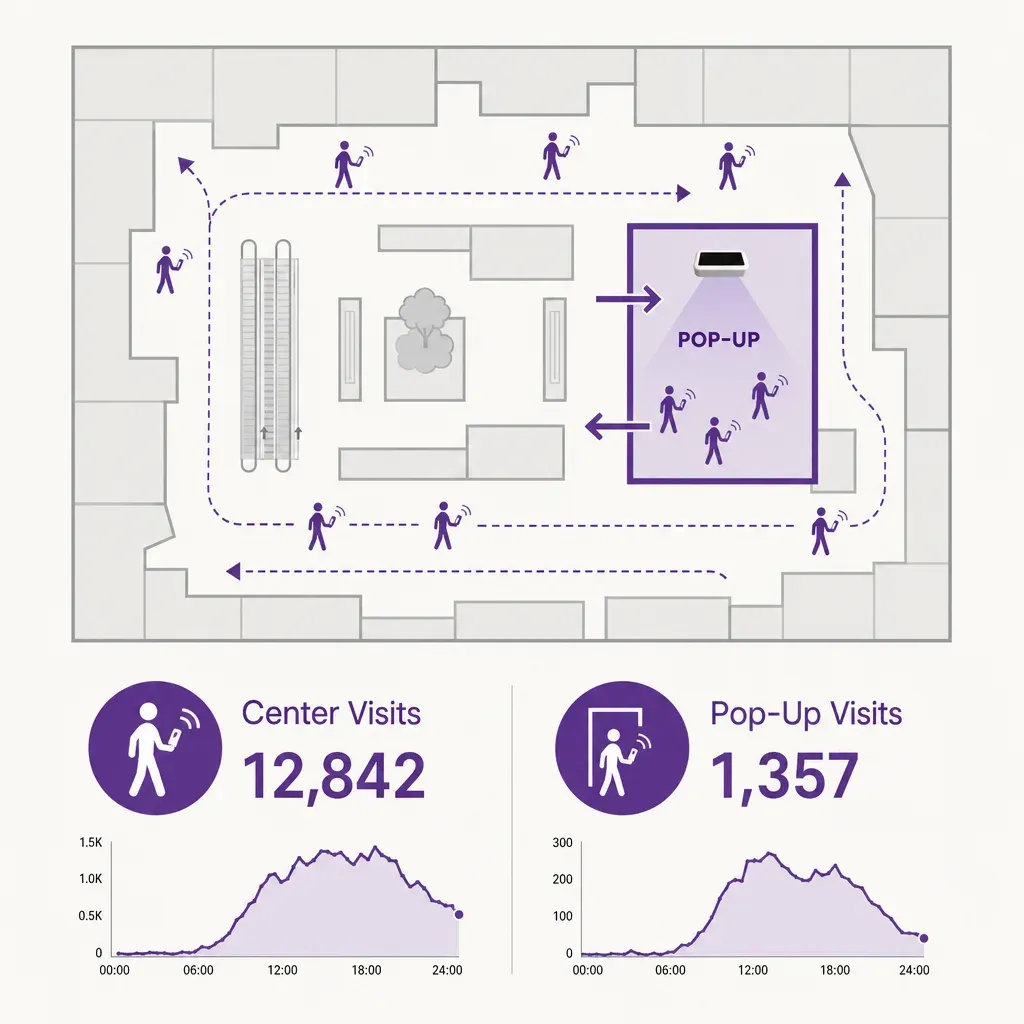
Zone-level attribution
Inside the building, the pop-up zone is the primary subject. The reading is direct: how many visitors entered the zone during the run, how that compared with the same footprint as common area before the activation arrived (often measured by a sensor at the same boundary, with the prior six to twelve weeks as the local baseline), and how dwell time inside the zone moved. A pop-up that converts traffic with a tasting, a demo station, or a fitting area should also see a dwell signal, not just an entry signal.
Two further breakdowns matter at the zone. First, group composition: whether the visitors arrived as singletons, pairs, or family groups, since the brand's product range is rarely calibrated for all three. Second, day-part mix: a food and beverage pop-up that earns most of its zone traffic at lunch is a different proposition from one that earns it after seven in the evening, and the landlord can price the next slot accordingly. The same data shape, applied to the wider common-area portfolio, is set out in the common area utilization piece.
Center-level attribution
Center-level attribution is the question the landlord cares about most: did the pop-up bring net new visitors to the property? The reading is the centerwide entry count during the run, against the baseline. A few rules of thumb help interpret the result honestly.
- If center-level footfall lifts while zones outside the pop-up hold flat. The activation almost certainly brought incremental visitors. This is the strongest result a pop-up can produce, and it justifies the floor it took.
- If the pop-up zone lifts while adjacent zones drop in roughly equal share. The activation moved existing visitors around the building rather than adding new ones. The brand may be delighted; the landlord should be cautious. This is the case where a flat activation fee can quietly cost more than it earns.
- If center-level footfall does not move and the pop-up zone does not either. Either the activation did not work, or the baseline was harder than the launch could clear (a wet quarter, a tenant change). Either way, the report has to say so.
What success looks like by activation type
A single definition of pop-up success is unhelpful, because the three common activation types are bought for different reasons.
Retail brand pop-ups
A retail brand running a three-month pop-up is usually testing the catchment or supporting a wider campaign. The numbers that matter are zone entries, the share of zone visitors who dwell beyond a meaningful threshold (often a minute or more), and the conversion to till transactions where the brand can share that figure. Center-level lift is a bonus rather than the brief. A retail pop-up that hits its zone-traffic target without lifting the building has still done its job for the brand.
Food and beverage pop-ups
Food and beverage activations are bought partly as a destination play. The brief is to give visitors a reason to come and a reason to stay. Success therefore reads on three numbers: zone entries during the lunch and evening day-parts, dwell time across the center on activation days (because a food and beverage pop-up should extend the average visit), and incremental footfall on the days the operator has on-site, since pop-up F&B tends to run shorter hours than fixed tenants.
Experiential and brand-marketing pop-ups
An experiential pop-up, a sponsored exhibit, an installation tied to a film release, a sampling-led activation, is bought to draw visitors who would not otherwise come. Center-level lift is the headline number here, especially on launch weekends and on bank holidays. Zone-level dwell matters too, because the brand wants engagement, not just a glance. Experiential pop-ups are also the activation type most likely to repay a proper geo holdout, because the marketing layer is doing real work and the landlord wants to know how much.
How Ariadne measures pop-up activations
Pop-up measurement needs three things at once: a clean entry count at the activation zone, a dwell read inside the zone, and a steady center-level count that has been collected long enough to support a credible baseline. A measurement system that bolts on for a single activation will never produce a clean before-and-after; the baseline has to already be there when the pop-up arrives.
Ariadne measures this with Hybrid Fusion, its patented camera-free method. Time-of-Flight depth sensing counts every visitor at the entrances, capturing geometry rather than images, while patented phone signal sensing follows movement through the interior, detecting the signals a phone emits even in airplane mode. The sensor streams both feeds to Ariadne, where Hybrid Fusion combines them into one trajectory per visit and computes counts, dwell, and paths. The streams carry no identifier: no MAC address, no device ID, no biometric data, and no camera is involved. Identifiers are stored only when a visitor explicitly opts in, which keeps the method GDPR-friendly and outside biometric territory.
For a shopping-center operator running pop-ups across the year, three properties of that method matter in this specific use. First, the Time-of-Flight sensor at each entry, escalator, or zone boundary counts every visitor, and the patented signal sensing inside resolves how long those visitors stayed and in what groups, so zone entries, dwell, and group composition come from the same anonymous count rather than two different systems. Second, the same sensors that cover the rest of the common area cover the pop-up footprint, so the prior six to twelve weeks of the same square metres as plain common area become the local baseline the activation is read against, without any extra install. Third, no camera is involved at any point, and the streams carry no MAC address by default, so a pop-up that wants to credibly tell its visitors it does not photograph them can mean it. Fusion happens centrally in the Ariadne platform, which keeps the device itself simple and lets the lift calculation pull a full year of pre-activation history alongside the live counts. The hardware sits in the Ariadne sensor lineup, the underlying counts feed the wider people counting platform, and the data handling is set out in the privacy policy.
FAQ
How long does a baseline need to be to measure a three-month pop-up?
At least one full year of pre-activation footfall is the working minimum, so the baseline can absorb seasonality, the school calendar, and major retail events. Two years is better, because it lets you discard the prior year's odd weeks (a heatwave, a transport strike) without losing the whole comparison. The pre-period of six to twelve weeks immediately before the activation is useful for the zone, but not for the center.
Should I always run a geo holdout?
No. A geo holdout suppresses paid media in part of the catchment, which costs some footfall. It is worth it for a tentpole experiential or food and beverage activation where center-level lift is the headline number and the budget can defend a clean reading. For a routine retail brand pop-up, a year-over-year baseline with weather and concurrent-campaign controls is usually proportionate.
How do I tell cannibalization from genuine lift?
Read the pop-up zone alongside the adjacent zones and the centerwide entry count on the same dates. If the pop-up gains while adjacent zones lose roughly in step, the activation moved traffic around the building. If the pop-up gains while adjacent zones hold flat and the centerwide count lifts, the activation added visitors. If the pop-up gains while adjacent zones drop and the centerwide count is flat, you are looking at a pure redistribution that the landlord should price into the next booking.
Do I need cameras to measure a pop-up?
No. Ariadne counts with Hybrid Fusion: Time-of-Flight depth sensing plus patented phone signal sensing, never cameras. Time-of-Flight captures geometry rather than images, and signal sensing captures no MAC address by default, so the measurement involves no video, no faces, and no biometric data.
Can the pop-up brand see the data on the space they hired?
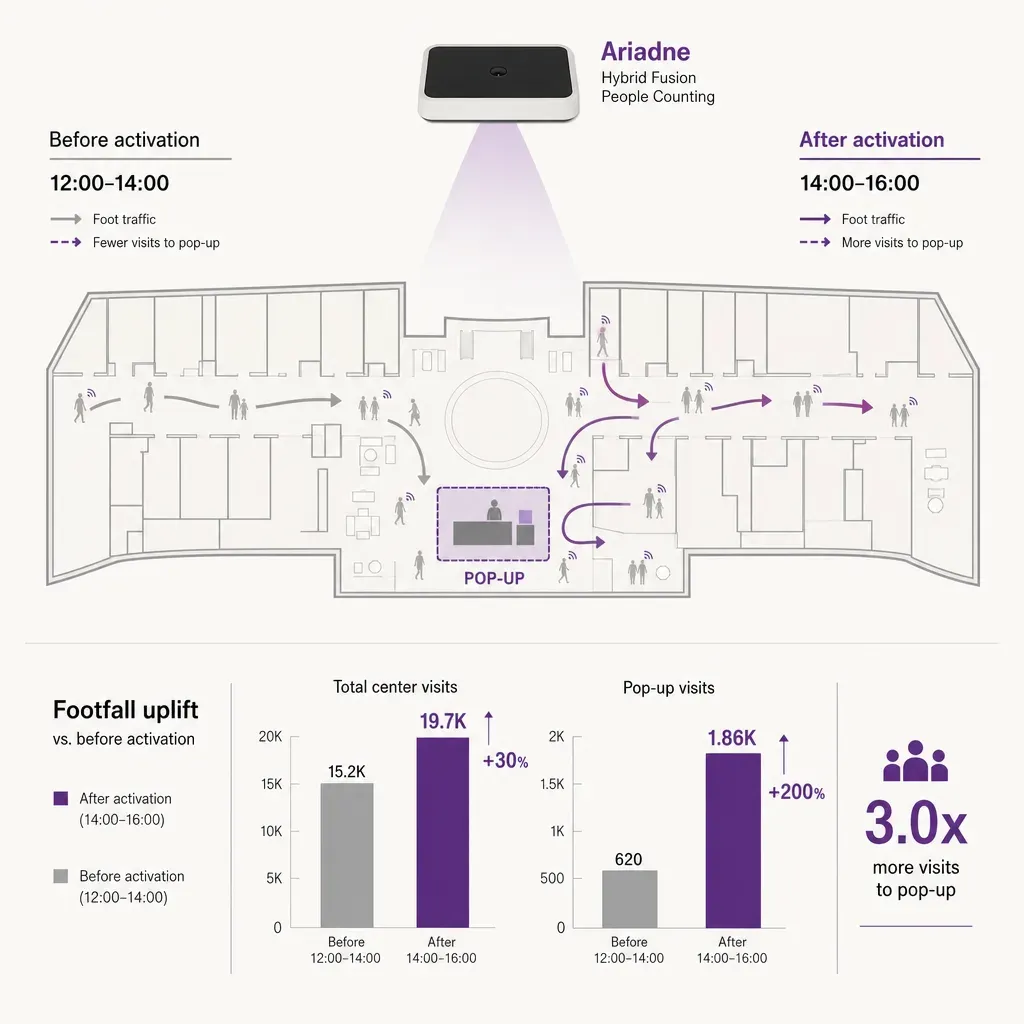
Yes, and sharing it is normally the right move. A landlord can hand over expected through-flow, dwell distribution, and group composition for the zone during the planned run, and report the same figures back after the run closes. Because the underlying measurement collects no personal data, the report is about the space and the audience profile rather than about individual visitors, which keeps the conversation focused on the activation rather than on privacy.


