
What library foot traffic counting actually measures
Ask a library how busy it is and you will usually get a door count: a single number on the way in, sometimes a turnstile reading, sometimes a clicker at a staffed desk. That number is useful, but on its own it answers almost none of the questions a modern library service has to answer. A door count cannot tell the difference between a person who came in to return a book and leave, a student who stayed six hours in the reading room, and a parent who brought three children to a storytime session. Those are three very different kinds of use, and library funding increasingly depends on telling them apart.
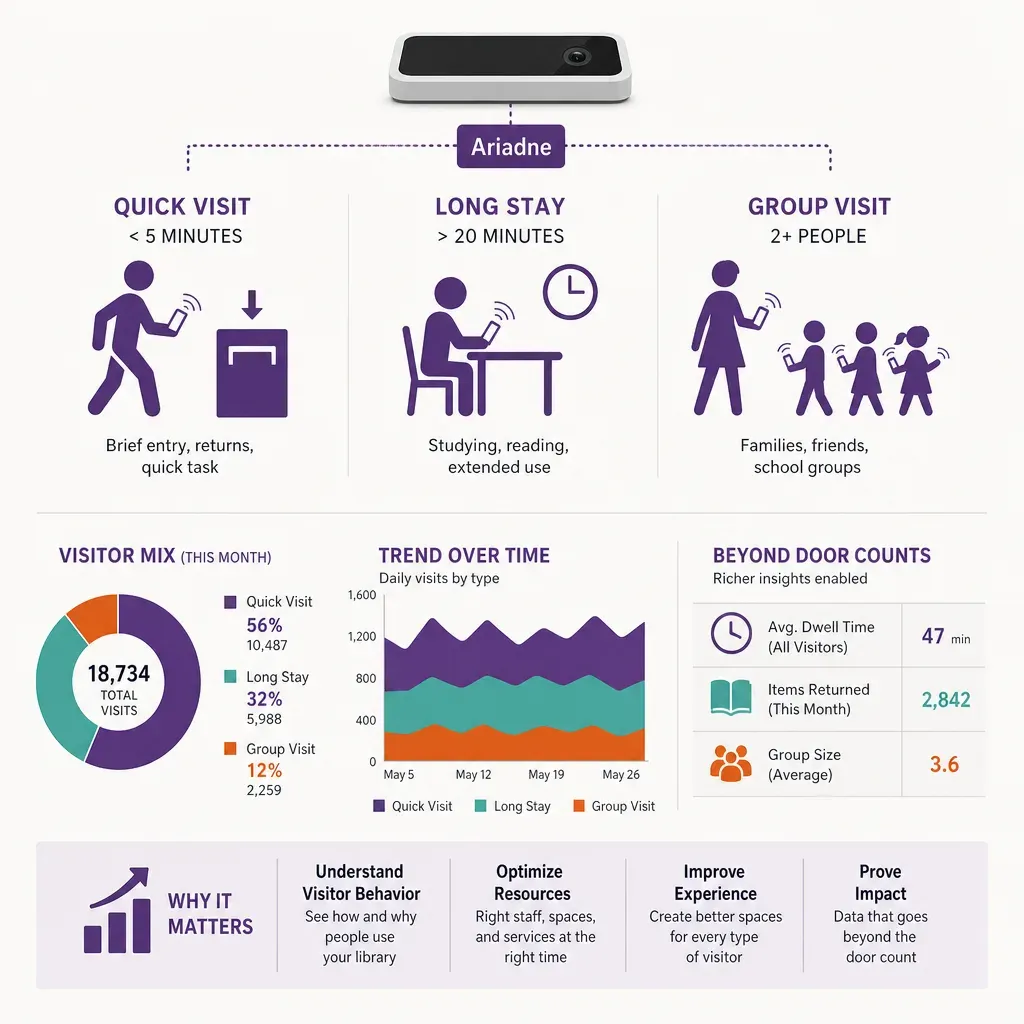
It helps to separate three things that are often lumped together under the word "visits."
- Door counts. Every crossing of the entrance, in both directions. This is the rawest figure and the easiest to capture, but it counts staff, deliveries, and the same person passing the threshold twice on a coffee run. It overstates real public use unless it is cleaned up.
- Visits. Distinct trips into the building by members of the public over a period. A visit is what most funders mean when they ask for attendance, and it is what door counts approximate badly. The gap between the two is exactly the part that needs better measurement.
- Program attendance. People who came specifically for a scheduled activity: a storytime, a job-search workshop, a maker session, a community meeting. This is usually logged by hand on a sign-in sheet, which is labour-intensive and almost always undercounts drop-ins who never signed anything.
A library that can only report door counts is, in practice, reporting one number and inferring the other two. A library that can measure footfall properly can report all three, broken down by hour, by zone, and by day of the week. That difference is the whole subject of this guide.
Why footfall data justifies funding
Public libraries compete for budget against every other line in a council or municipality, and the case for that budget is rarely made on the strength of the collection alone. It is made on use. A library that can show steady, well-evidenced demand is in a far stronger position at budget time than one that can only point to a circulation figure that has been falling for a decade because borrowing has moved partly to e-books and digital lending.
Footfall data supports the funding case in several concrete ways.
- It shows demand that circulation hides. As physical borrowing declines, in-person use of space, computers, study rooms, and staff help has often held steady or grown. Door counts and visit data make that visible, where a circulation report alone would make the library look like it is shrinking.
- It defends opening hours. Hourly footfall is the evidence that decides whether a quiet Tuesday morning is genuinely empty or just under-promoted, and whether a proposed cut to evening hours would strand a real cohort of users. For example, a branch seeing 1,200 visits on a typical weekday, with a clear peak between 3 and 6 in the afternoon, has a concrete argument against losing its after-school window.
- It values the programs. Accurate program attendance, captured automatically rather than from sign-in sheets, lets a service show which sessions draw people and which do not, and report participation numbers to the funders who paid for them without the usual hand-counting error bar.
- It supports the per-visit cost story. Cost per visit is one of the few metrics that lets a library be compared fairly with other public services. It is only as trustworthy as the visit count underneath it, which is a strong reason to measure visits properly rather than estimate them from a noisy door count.
None of this requires inventing demand. It requires measuring the demand that already walks through the door, in enough detail that the people holding the budget can see it.
The privacy expectations of a public institution
Libraries hold themselves to a privacy standard that is unusually high, and they do it on principle, not only on compliance. The freedom to read without being watched is close to the core of what a public library is for. A patron should be able to look up anything, sit anywhere, and stay as long as they like without feeling monitored. Anything that resembles surveillance, a visible camera array trained on the reading room, a system that recognises faces, a sense of being followed through the stacks, cuts against that mission even where it would be technically lawful.
The legal bar is concrete on top of the principle. Under the GDPR, images of identifiable people are personal data. Facial recognition produces biometric data, a special category that needs a strong legal basis and is very hard to justify for a simple headcount. Most public libraries are also part of a public body, with their own data protection obligations, an information governance team, and often a board or committee that will ask pointed questions about any new sensor in the building. The practical test they apply is short: does the system capture anything that could identify a patron? If the honest answer is no, the conversation with the data protection officer is straightforward.
The cleanest way to clear that bar is not to soften a camera feed after the fact. It is to choose a method that never captures identifying data in the first place. There is nothing to anonymise later because nothing identifying was collected to begin with, and for an institution whose reputation rests on the privacy of its readers, that distinction is the whole point.
What camera-free counting looks like
Camera-free counting measures people without ever forming an image of them. Two sensing methods do this well, and a system built for a busy library tends to use both.
- Time-of-Flight depth sensing at the entrance. A ceiling-mounted sensor fires infrared pulses and measures how long they take to return, which gives the height and shape of whatever passes below it to roughly 30 centimetres. It counts every patron crossing the threshold, independent of whether they carry a phone, and it reads geometry rather than images. There is no picture to store and nothing to recognise. Mounted overhead at a doorway, it can also separate two people walking in together and discount staff passing through a back route.
- Phone signal sensing inside the building. In the reading rooms, study areas, and program spaces, sensors detect the radio signals a phone emits, even in airplane mode, to follow movement and resolve how long people linger in a zone. This is what distinguishes a quick in-and-out from a long study session, and it is what turns a flat door count into a real picture of how the building is used.
Neither method uses a camera, and neither produces video, faces, or biometric data. That is the property a library needs above all others: the system can report exactly how busy the children's area is, how long students stay in the silent study room, and how many people attended a Saturday workshop, while a patron walking through the building is never photographed, recognised, or identified.
From door counts to zones: what a real picture looks like
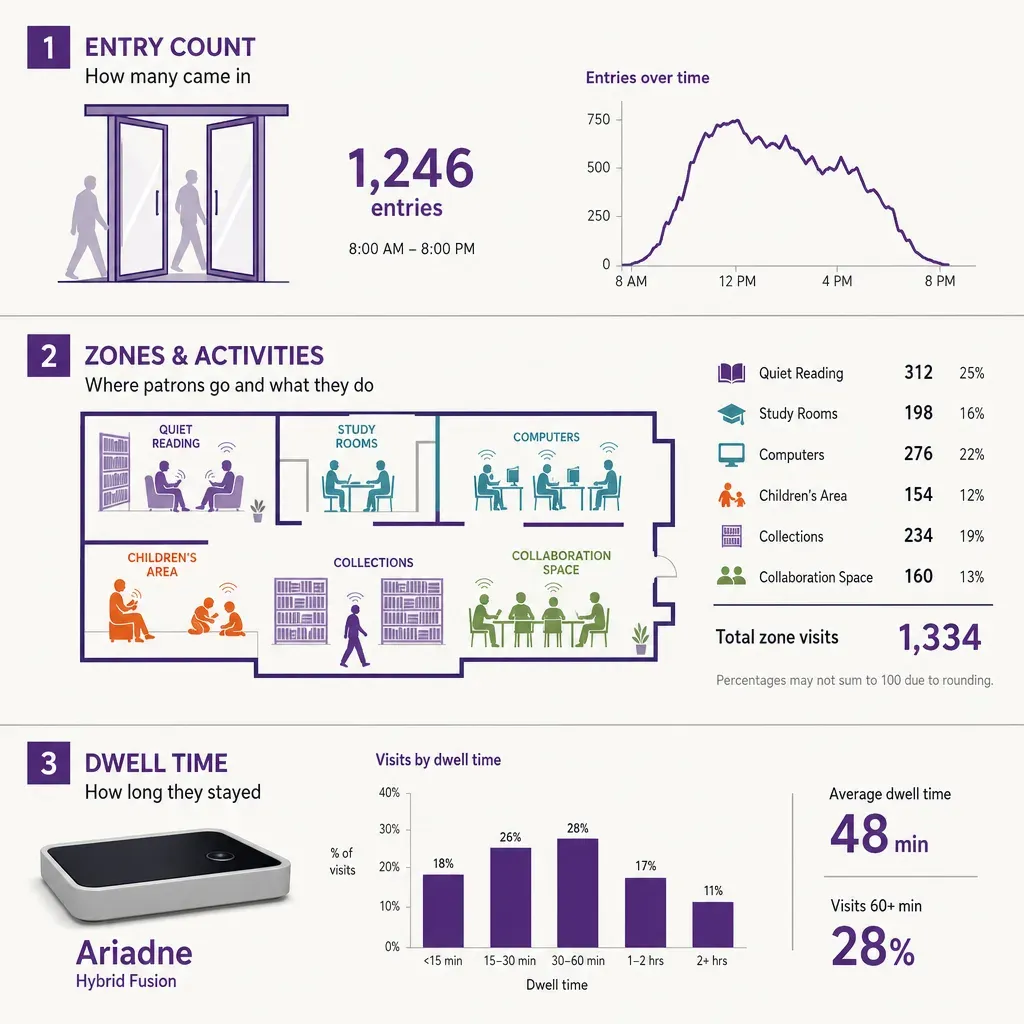
A single entrance count is the floor of what a public library can measure, not the ceiling. The value is in breaking the building down by space. With sensors placed across a branch, you can treat the children's area, the reading room, the computer suite, the study floor, and each program room as its own counting zone, and read three things for each one:
- Entries. How many patrons came into the zone over any chosen period.
- Live occupancy. How many people are in the zone right now, which is the figure staff watch on a busy afternoon or against a fire-capacity limit for a packed event.
- Dwell time. How long, on average, a patron stays, which separates a space people pass through from one that genuinely holds them for an hour or a morning.
Put those zones together and you get a flow picture of the whole branch: when people arrive, where they go, which spaces fill in the after-school rush, which sit quiet at mid-morning, and how a one-off event reshapes the day. That is the data a service manager uses to plan staffing, a head of libraries uses to defend hours and programs, and a finance team uses to report visits and per-visit cost with numbers they can stand behind. The same camera-free principles scale up to wider work on visitor flow across public spaces, where a library is one node in how a town or city understands how its public buildings are used.
How Ariadne fits
Ariadne builds the two sensing methods above into one system, designed so that nothing identifying is captured at any point. It is the same people counting platform used across other public and commercial buildings.
Ariadne measures this with Hybrid Fusion, its patented camera-free method. Time-of-Flight depth sensing counts every visitor at the entrances, capturing geometry rather than images, while patented phone signal sensing follows movement through the interior, detecting the signals a phone emits even in airplane mode. The sensor streams both feeds to Ariadne, where Hybrid Fusion combines them into one trajectory per visit and computes counts, dwell, and paths. The streams carry no identifier: no MAC address, no device ID, no biometric data, and no camera is involved. Identifiers are stored only when a visitor explicitly opts in, which keeps the method GDPR-friendly and outside biometric territory.
For a public library, the practical consequences line up with the privacy bar described earlier. There is no camera and no video, so there is no image of a patron to store or to lose. The streams carry no MAC address by default and no device identifier, so there is no personal data in the count. Identifiers are stored only when a patron explicitly opts in, for example by logging into guest Wi-Fi, which is a choice the library can simply decline to offer. The result is per-zone entries, live occupancy, and dwell time across the building, plus clean visit and program-attendance figures, produced without anything an information governance team would classify as personal data. The sensor hardware sits in the Ariadne sensor lineup, and the data handling is set out in the privacy policy.
A buyer checklist for libraries
If you are evaluating a footfall system for a public library or a library service, these are the questions worth putting to any vendor in writing before a trial.
- Does it capture any personal data? Ask whether the system records images, faces, MAC addresses, or device identifiers. You want a clear no by default, with any identifier limited to explicit opt-in.
- Is there a camera anywhere in the path? A method built on Time-of-Flight depth and signal sensing avoids cameras entirely, which is the cleanest answer to give a board, a committee, or an information governance team.
- Can it separate visits from raw door counts? Confirm that the system can discount staff, deliveries, and double-crossings, so the visit figure you report to funders is defensible rather than inflated.
- Can it report by zone, not just at the door? For a library, the children's area, study floor, and computer suite each tell a different story. Confirm the system zones the building and reports occupancy and dwell per space.
- Can it count program attendance automatically? Ask whether a program room can be measured as its own zone, so attendance is captured without a sign-in sheet and without undercounting drop-ins.
- Do the figures export cleanly for reporting? Visit, occupancy, and attendance data should drop into the annual returns and funding reports the service already produces, not sit in a dashboard nobody else can read.
FAQ
Does the system use cameras?
No. Ariadne counts with Hybrid Fusion: Time-of-Flight depth sensing plus patented phone signal sensing, never cameras. Time-of-Flight captures geometry rather than images, and signal sensing captures no MAC address by default, so the measurement involves no video, no faces, and no biometric data.
Is camera-free footfall counting acceptable for a public library?
It is well suited to one, and the reason is straightforward: a method that captures no images, no faces, and no device identifiers by default is not processing personal data, so the heaviest GDPR obligations do not attach to it. That matters more for a library than for almost any other building, because the privacy of patrons is part of the institution's purpose, not just its compliance paperwork. Confirm the specifics with your own data protection officer or information governance team, but a no-personal-data design is the easiest case to put to one.
What is the difference between a door count and a visit?
A door count is every crossing of the entrance, including staff, deliveries, and the same person passing twice. A visit is a distinct trip into the building by a member of the public. The gap between the two is what overstates use when a library reports door counts alone, and closing that gap, by discounting staff and double-crossings, is what makes a visit figure defensible to funders.
Can it measure program attendance without a sign-in sheet?
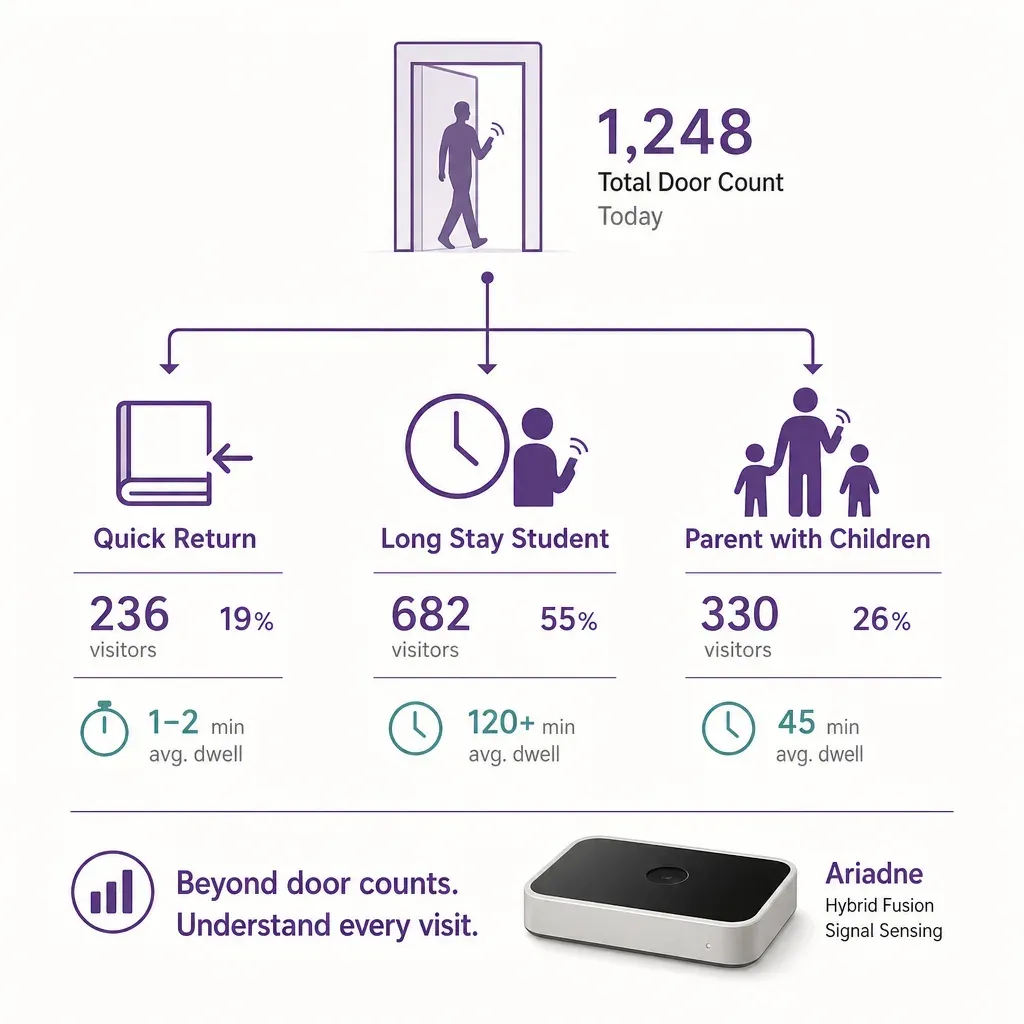
Yes. If a program room is set up as its own counting zone, the system reports how many people entered it during a session, which captures drop-ins that a sign-in sheet usually misses and removes the hand-counting work from staff. The figure is a count of people in the space, with no record of who they were.


