
What is sales per visitor?
Sales per visitor (SPV) is the revenue a store earns divided by the number of people who walk in. It answers one blunt question: on average, how much money does each visitor leave behind? Most retailers track conversion rate, the share of visitors who buy, and treat it as the headline store-performance number. The trouble is that conversion rate ignores how much each buyer spends. A store can lift conversion and still earn less per visitor if baskets shrink. Sales per visitor folds both effects, the share who buy and the size of what they buy, into a single figure you can trend day to day and compare across stores.
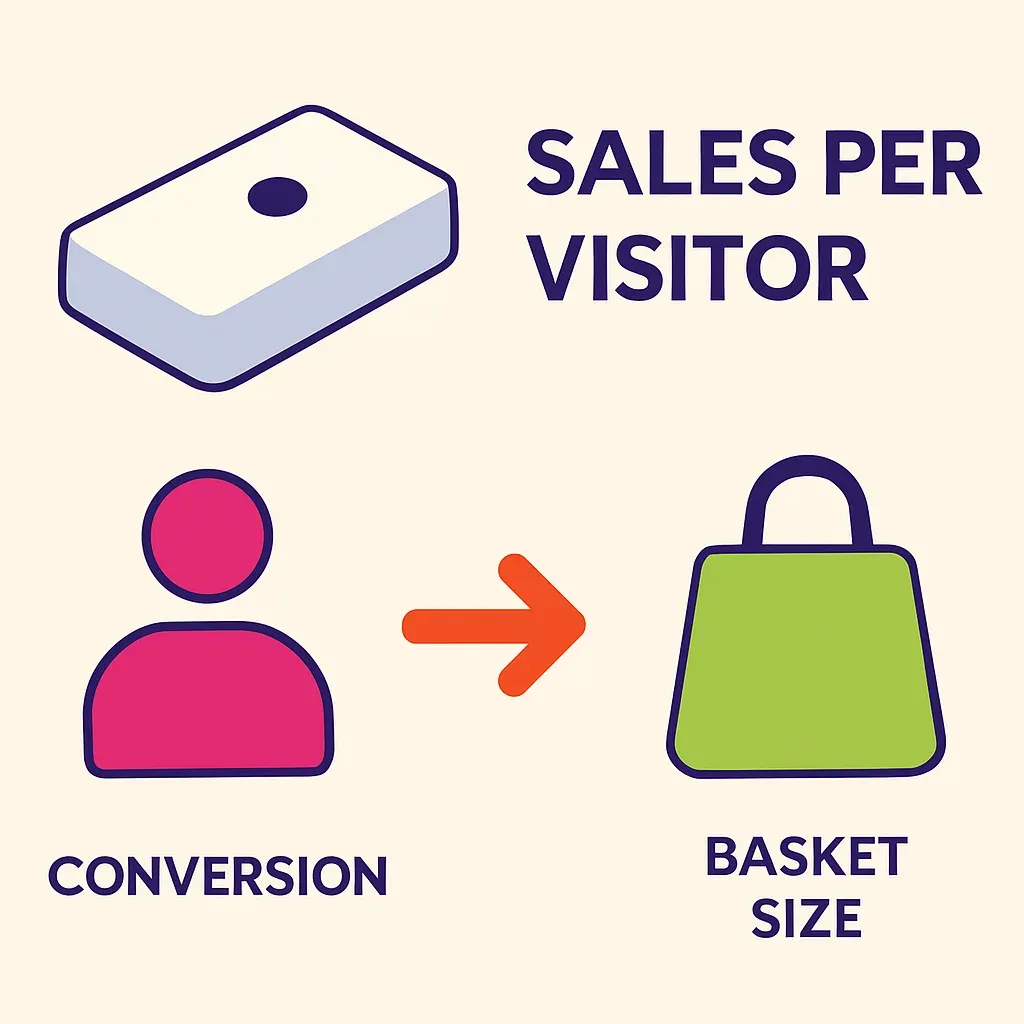
Because it is denominated in visitors rather than buyers, SPV also tells you something conversion alone cannot: the value of the traffic you draw in but do not yet sell to. That makes it a merchandising and staffing metric, not just a finance one.
The sales per visitor formula
The formula is one line:
- Sales per visitor = total sales revenue / total visitors
Use net sales for the period and the count of people who entered over the same period and the same doors. The visitor count is the entry count, not the number of transactions and not door swings. Here is a worked illustration with explicitly chosen numbers, not a benchmark:
- Total sales for a trading day: 12,000 in your currency.
- Visitors who entered that day: 800.
- Sales per visitor: 12,000 / 800 = 15 per visitor.
Every visitor was worth 15 on average that day, whether or not they bought anything. Now hold sales flat and imagine the same store on a quieter day with 500 visitors and the same 12,000 in sales: SPV rises to 24. The higher figure is not automatically better. It can mean you converted a smaller, more committed crowd, or simply that fewer browsers diluted the average. SPV is most useful read as a trend against your own history and against comparable stores, never as an absolute target lifted from someone else.
Sales per visitor vs conversion rate vs average transaction value
These three metrics are linked by simple arithmetic, and seeing the link is the whole point of SPV. Conversion rate is the share of visitors who buy. Average transaction value (ATV) is what each buyer spends. Multiply them and you get sales per visitor:
- Sales per visitor = conversion rate x average transaction value
Take the same worked numbers. If 800 visitors produced 160 transactions, conversion rate is 160 / 800 = 20 percent. If those 160 transactions totalled 12,000, average transaction value is 12,000 / 160 = 75. Multiply: 20 percent x 75 = 15 per visitor, which matches the figure above. That identity is why SPV beats conversion rate alone. Conversion can rise while SPV falls, and the single conversion number will not warn you.
Worked illustration of the trap: a promotion pulls in deal-seekers. Conversion climbs from 20 to 25 percent, which looks like a win on the conversion dashboard. But the deal shrinks average transaction value from 75 to 50. Sales per visitor moves from 15 to 0.25 x 50 = 12.50, a fall of nearly 17 percent. More visitors bought, each bought less, and the store earned less per visitor. Only SPV catches that, because it watches both levers at once.
What moves sales per visitor
Because SPV is conversion multiplied by basket size, anything that moves either lever moves SPV. The useful diagnostic is to ask which lever changed:
- Conversion levers. Staffing at peak, fitting-room and queue waits, stock availability of advertised lines, and how well the entrance and front-of-store convert browsers into the store proper.
- Basket levers. Range and adjacency of products, cross-sell and add-on prompts at the till, price architecture, and whether higher-value lines are visible and in stock.
- Traffic mix. The kind of visitors you draw. A campaign that brings in browsers raises footfall and can lower SPV even when nothing about the store changed, which is exactly why you read SPV next to footfall, not in isolation.
How to act on sales per visitor
Merchandising
Read SPV by zone and by day-part to see where value is created and where traffic is wasted. If a department draws heavy footfall but posts low SPV, the visitors are arriving and the merchandising is not converting them or not lifting their basket. That is a layout, adjacency, or pricing question, not a traffic one. Compare SPV before and after a range change or a fixture move to judge it on value per visitor rather than raw sales, which can rise simply because more people walked in.

Staffing
SPV by hour, set against an accurate visitor count by hour, tells you when staff coverage is actually paying off. If SPV sags during a known footfall peak, the store is full of visitors who are not being converted, often a coverage or queue problem at exactly the busiest moment. Match labour to the hours where added coverage lifts conversion enough to move SPV, and stop staffing to door swings or to gut feel. To do any of this you need an entry count you trust, which is where the denominator problem comes in.
The retail capture rate of your storefront, the share of passers-by you pull inside, sits upstream of SPV: it governs how many visitors enter in the first place, and SPV then measures the value of each one.
Getting an accurate visitor denominator
Sales per visitor is only as trustworthy as the visitor count under the line. Sales figures come from the point of sale and are exact. The denominator is the soft part: if you count door swings, staff trips, and re-entries as separate visitors, you inflate the count and understate SPV. If a counter loses groups, it deflates the count and overstates SPV. Either way the metric drifts, and you make merchandising and staffing calls on a number that is wrong in a direction you cannot see. An accurate, identifier-free entry count is the foundation the whole metric rests on.
Ariadne measures this with Hybrid Fusion, its patented camera-free method. Time-of-Flight depth sensing counts every visitor at the entrances, capturing geometry rather than images, while patented phone signal sensing follows movement through the interior, detecting the signals a phone emits even in airplane mode. The sensor streams both feeds to Ariadne, where Hybrid Fusion combines them into one trajectory per visit and computes counts, dwell, and paths. The streams carry no identifier: no MAC address, no device ID, no biometric data, and no camera is involved. Identifiers are stored only when a visitor explicitly opts in, which keeps the method GDPR-friendly and outside biometric territory.
For SPV that means a visitor count that holds at peak, resolves families and pairs as the distinct people they are, and does not drift across a full trading day as people exit and re-enter. Pair that count with point-of-sale revenue and SPV becomes a number you can act on. See how Ariadne does this for stores on the retail stores page, and the method behind it on the people counting hub.
Related reading
FAQ
Is sales per visitor the same as sales per transaction?
No. Sales per transaction, also called average transaction value, divides revenue by the number of purchases, so its denominator is buyers. Sales per visitor divides revenue by everyone who entered, buyers and non-buyers alike. SPV is the broader figure because it captures the value of the traffic you draw but do not yet sell to.
What is a good sales per visitor figure?
There is no universal target. SPV depends on your prices, category, and store format, so a figure that is strong for a discount grocer would be weak for a jeweller. Read it as a trend against your own history and against comparable stores in your estate, and watch the direction of travel rather than chasing a number borrowed from elsewhere.
Why does sales per visitor beat conversion rate on its own?
Because conversion rate ignores basket size. Conversion can rise while sales per visitor falls, for example when a promotion brings in deal-seekers who buy less each. SPV is conversion multiplied by average transaction value, so it moves only when real value per visitor moves, and it warns you when a conversion win is hollow.
Do you need cameras to count visitors?

No. Ariadne counts with Hybrid Fusion: Time-of-Flight depth sensing plus patented phone signal sensing, never cameras. Time-of-Flight captures geometry rather than images, and signal sensing captures no MAC address by default, so the measurement involves no video, no faces, and no biometric data.


