
Why fashion needs its own funnel
Most retail-analytics conversations end at one number: the storewide conversion rate, transactions divided by store visits. That ratio works as a headline for any vertical, but it hides what is actually happening inside a fashion store. A shopper in a hardware aisle either picks up the drill bit she came in for or she does not. A shopper in a fashion store has a longer journey: she walks the floor, finds two or three pieces she likes, carries them into a fitting room, looks in the mirror, and decides whether the items leave the store with her or go back on the rail. The fitting room is where the buying decision actually happens, and a funnel that does not name it is a funnel with a missing step.
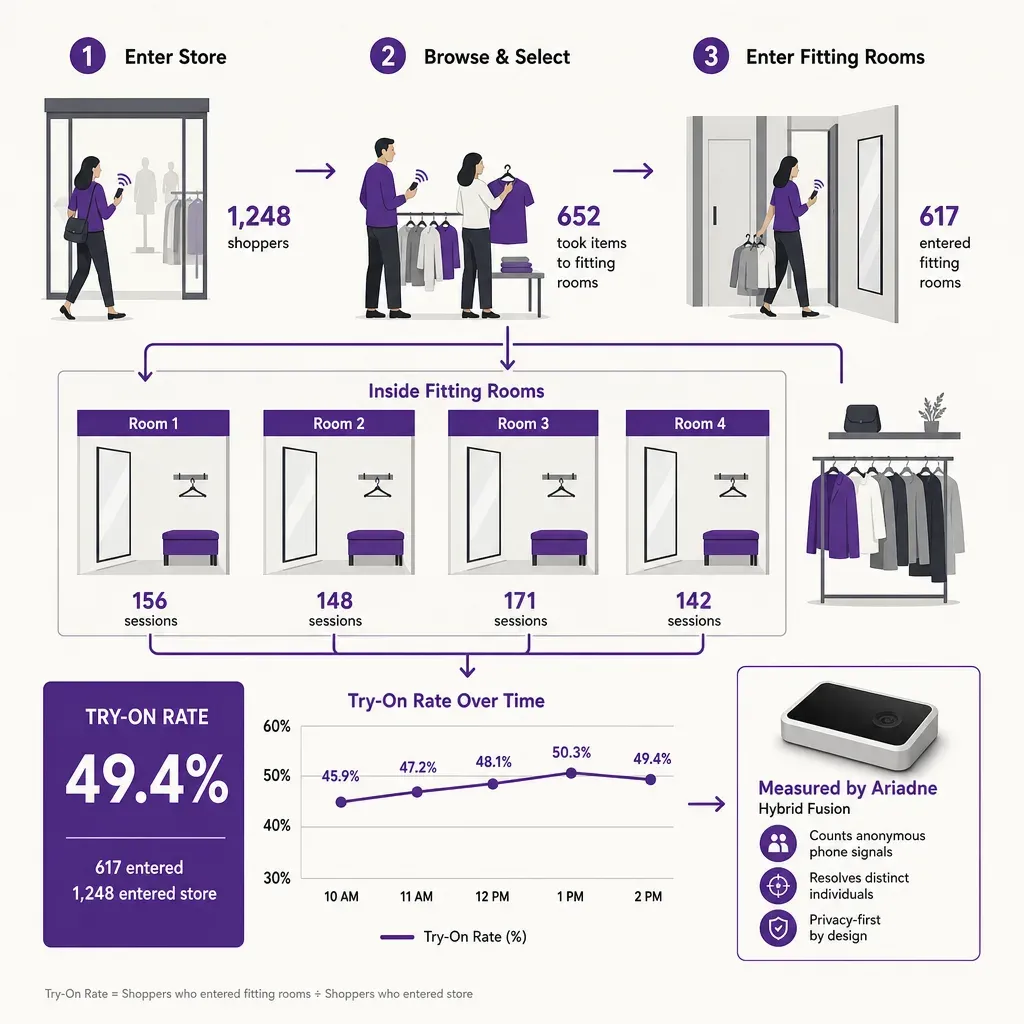
The fashion funnel has three measurable stages: store visits, fitting-room try-ons, and purchases. Between each stage there is a ratio worth tracking. Between visits and try-ons sits the try-on rate. Between try-ons and purchases sits a fitting-room conversion rate. Reading those two ratios together explains why a storewide conversion rate moves the way it does, and where the lost sales actually sit. This post is about the first of those ratios, the try-on rate, and why fashion retail stores should track it as a separate KPI.
Defining the try-on rate
The try-on rate is the share of store visitors who enter a fitting room. Written as a formula it is fitting-room entries divided by store visits over the same period, expressed as a percentage. A store with 1,000 visits on a Saturday and 220 fitting-room entries has a try-on rate of 22 percent. The denominator is a clean store-entry count, the numerator is a clean fitting-room-entry count, and the period is the same window for both.
Two notes on the definition. First, fitting-room entries, not unique try-on sessions. A shopper who walks in with five pieces and back out is one entry; the count is honest about the customer behaviour rather than the inventory carried. Second, store visits, not transactions. The denominator is the top of the funnel, the people through the door, not the people who already converted. That is what makes the ratio diagnostic of how well the store is moving shoppers into the next stage rather than a restatement of conversion.
Typical try-on rates depend heavily on category, store format, and how the merchandise is laid out. A premium tailored-clothing store may see a third of its visitors try something on, while a fast-fashion store with self-service rails and short consideration cycles will sit lower. Treat any benchmark number as a directional reference rather than a target; the useful comparison is the same store against itself over time, not your store against a number from someone else's chart.
Why the try-on rate predicts conversion
Fitting-room entry is the most reliable purchase-intent signal a fashion store has. A shopper who carries items to a fitting room has committed time and effort, the items are in her hands, she has chosen to evaluate them seriously rather than abandoning them on a table. Industry studies have consistently found that try-on-room shoppers convert at multiples of floor-only shoppers; the exact multiple varies by brand and category, but the direction of the effect is uncontroversial. Whatever your fitting-room conversion rate is, it sits well above the storewide rate, which means the try-on rate is the variable that has the largest direct lever on conversion overall.
Algebraically the relationship is simple:
- Storewide conversion rate = try-on rate x fitting-room conversion rate + non-try-on conversion rate x (1 - try-on rate).
Because the fitting-room conversion rate is much higher than the non-try-on conversion rate, moving the try-on rate moves the storewide number more than almost any other floor-level variable. A store that lifts its try-on rate from 18 to 24 percent, without changing anything else in the equation, will see its storewide conversion rate rise by a meaningful amount on the same traffic. That is why merchandising teams that learn to read the try-on rate as a leading indicator stop relying on the storewide rate as the only score.
What the try-on rate diagnoses
A try-on rate that sits below where it should is rarely a problem with the fitting room. It is usually one of three problems further upstream, and each one has a different fix.
Floor merchandising and findability
If shoppers are not picking items off the rail, they are not carrying anything to the fitting room. That sounds obvious, but the diagnosis is often confused with conversion. A store with a high pick-up rate but a low try-on rate has a different problem (perhaps a fitting-room queue that turns shoppers away, perhaps an unintuitive route to the rooms) from a store with a low pick-up rate. The try-on rate, read alongside basket size and time on rail, separates the two.
Fitting-room access and friction
A long queue, a closed fitting-room area at lunchtime when staff are on break, a single attendant rationing rooms because there is no occupancy reading: each of these costs visitors who would have tried on. A drop in the try-on rate during the busiest hours of the day, with no drop in store visits, is a strong signal that access has become the binding constraint. The fix is operational, not merchandising, and it shows up cleanly in the data.
Assortment and size availability
A shopper who picks up an item, walks toward the fitting room, then puts it back because her size is missing on the rail is a lost try-on. Floor-level stock-out behaviour is hard to see in EPOS data and easy to read in the gap between pick-up and try-on. Stores that systematically track the try-on rate next to size availability find the assortment fix faster than stores that rely on sell-through alone.
How to read the try-on rate over time
The try-on rate is most useful when read on the same time grain you read the rest of the store funnel: day-part, day-of-week, and week-over-week. Three patterns are worth flagging.
- Day-part dips. A try-on rate that holds steady from open to lunch and then drops in the afternoon usually means the fitting-room area cannot handle peak traffic. The lever is staffing or zone management.
- Weekend versus weekday gap. A wide gap between Saturday and Tuesday, in the wrong direction (try-on rate lower on Saturday despite higher traffic) is access friction at scale. Weekends are when the store earns the week, and a try-on rate dragged down by queues is real lost revenue.
- Trend against new-arrival drops. A try-on rate that rises in the two weeks after a new arrival drop and then settles back is a healthy signal that the assortment is doing its job. A flat trend across a drop suggests the new pieces are not being picked up off the floor, which is a visual-merchandising question rather than an inventory one.
Read alongside the wider conversion math, the try-on rate also pairs cleanly with retail capture rate at the storefront and sales per visitor at the till, so a fashion store can see whether a shortfall lives at the entrance, in the consideration window, or at the fitting-room door.
How to measure the try-on rate honestly
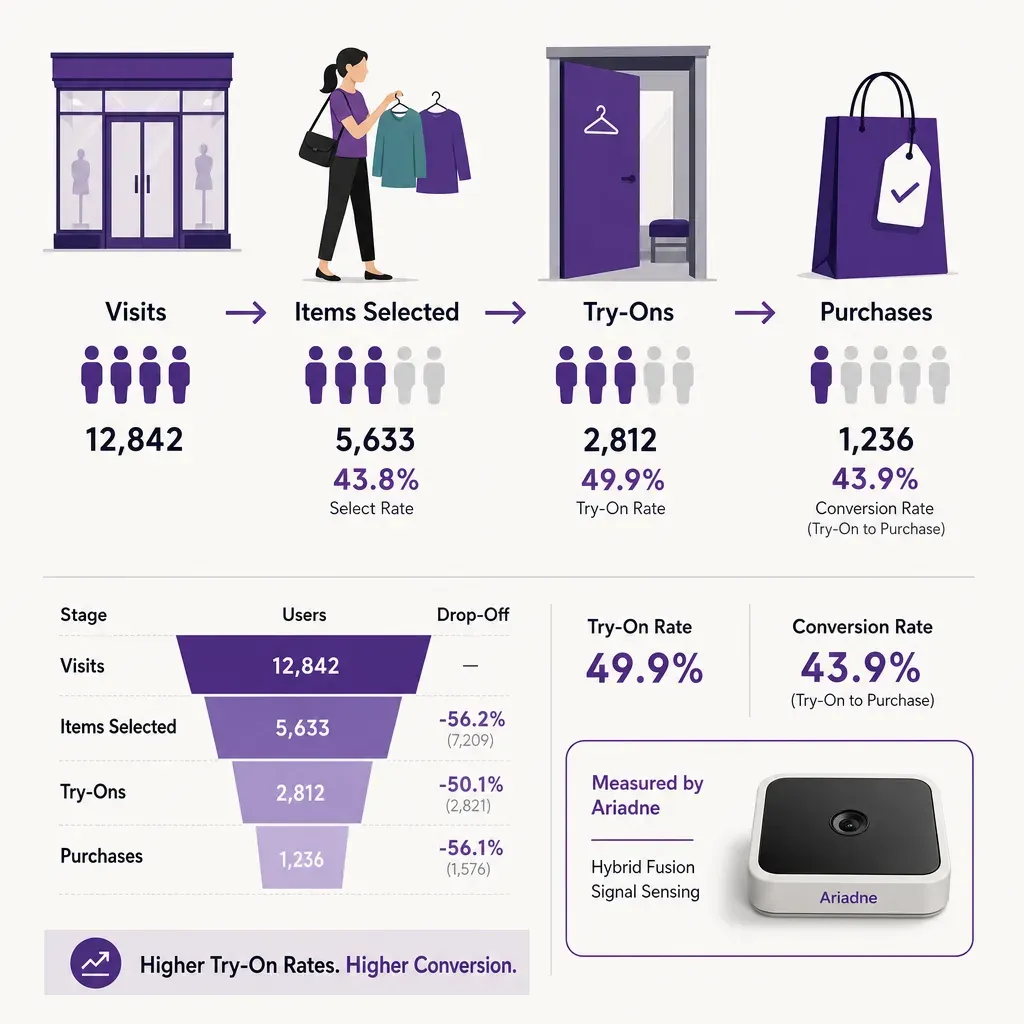
The try-on rate is only as useful as the two counts that feed it. Two requirements matter more than the rest.
- A clean store-entry count. The denominator has to be the number of shoppers, not transactions, not loyalty taps. That means counting at every store entrance during open hours, ignoring staff movements, and adjusting for group size so a family of four arriving together is read as four people rather than one.
- A clean fitting-room-entry count, measured at the door. The numerator has to be each entry into the fitting-room area, counted at the threshold. Manual tallies and request counts will both miss visitors who walk straight in, and shopping-bag tags will miss anyone trying on without a basket. The honest measurement is a sensor above the door, counting in and out, with no sensor inside the room itself.
The second requirement is also where most fashion retailers stop. Fitting rooms are intimate private spaces and many retailers cannot put cameras inside them, even where it would be technically lawful. The right answer is not to soften the camera feed after the fact, but to choose a method that never looks inside the room at all. Fitting-room utilization covers the operational side (queue management, dwell, attendant routing) in more detail; here the point is narrower: the numerator of the try-on rate can be read from the doorway alone.
How Ariadne measures it
Ariadne treats the fitting-room area as a counted zone with a single defined entry threshold. One Time-of-Flight sensor sits above the doorway into the fitting-room area, counting each visitor crossing in and out. There is no sensor inside the rooms, no camera at the door, and no listening device anywhere in the area. The same Time-of-Flight method, deployed at the store entrances, produces the denominator. Both counts feed the same platform, on the same clock, so the ratio is computed on consistent inputs rather than reconciled across two systems.
Ariadne measures this with Hybrid Fusion, its patented camera-free method. Time-of-Flight depth sensing counts every visitor at the entrances, capturing geometry rather than images, while patented phone signal sensing follows movement through the interior, detecting the signals a phone emits even in airplane mode. The sensor streams both feeds to Ariadne, where Hybrid Fusion combines them into one trajectory per visit and computes counts, dwell, and paths. The streams carry no identifier: no MAC address, no device ID, no biometric data, and no camera is involved. Identifiers are stored only when a visitor explicitly opts in, which keeps the method GDPR-friendly and outside biometric territory.
Three properties of that method matter for the try-on rate specifically. First, the doorway sensor captures geometry rather than images, so the count is honest about how many visitors crossed the threshold without recording who they were. Second, the streams carry no MAC address by default and no device identifier, so a fashion retailer can publish a try-on rate to head office without the retailer's data-protection officer having to interpret what was collected at the fitting-room door. Third, fusion happens centrally in the Ariadne platform rather than inside the sensor, which keeps the device itself simple and the privacy posture clean. Combined with a people counting deployment at the store entrances, the result is a try-on rate computed from two camera-free, identifier-free counts on the same clock. The sensor hardware sits in the Ariadne sensor lineup, and the data handling is set out in the privacy policy.
A worked illustration
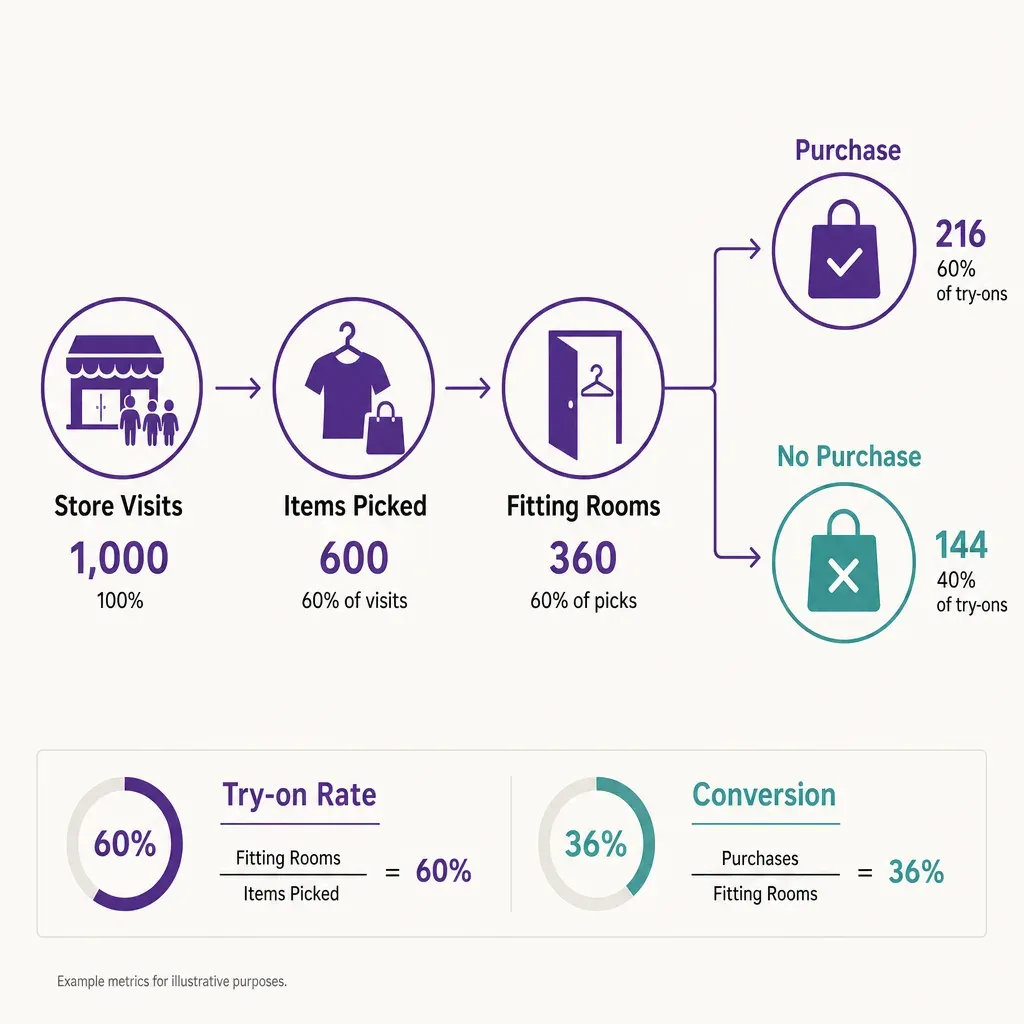
Numbers in this section are illustrative, used to show the shape of the math rather than reported as anyone's actual result. Take a mid-sized fashion store recording 1,000 visits on a typical Saturday. Of those, 200 walk into the fitting-room area, a try-on rate of 20 percent. Of the 200 who try on, 90 buy, a fitting-room conversion rate of 45 percent. Of the 800 who do not try on, 24 buy, a non-try-on conversion rate of 3 percent. The storewide conversion rate works out to 11.4 percent.
Now suppose the merchandising team lifts the try-on rate from 20 to 26 percent by improving the path to the fitting rooms and adding a part-time attendant to keep the queue moving on Saturdays. Holding the two conversion rates steady, the storewide rate moves from 11.4 percent to 13.9 percent. On 1,000 visits, that is 25 incremental transactions on a single day, generated by an operational change rather than a price change or a marketing push. The point of the illustration is not the exact arithmetic; it is that the try-on rate is the variable a fashion store can move with floor-level work, and the storewide rate is where the result shows up.
Related reading
FAQ
What is the try-on rate in fashion retail?
It is the share of store visitors who enter a fitting room, computed as fitting-room entries divided by store visits over the same period and expressed as a percentage. A store with 1,000 visits and 220 fitting-room entries on a given day has a try-on rate of 22 percent.
Why is the try-on rate a separate KPI from conversion?
Because fitting-room shoppers convert at multiples of floor-only shoppers, the try-on rate is the floor-level variable that moves the storewide conversion rate most directly. Tracking it separately tells a merchandising team whether a conversion shortfall sits in pick-up, in fitting-room access, or at the till, which are three different problems with three different fixes.
Is fitting-room counting compatible with privacy law?
It can be, when the count is read at the door of the fitting-room area rather than inside the rooms. A Time-of-Flight sensor above the doorway captures geometry rather than images, with no MAC address or device identifier in the stream, so the measurement does not produce personal data. There is no sensor in the room itself, and no camera anywhere in the area. Confirm the specifics with your own data-protection officer, but a doorway-only design is the easiest case to make to one.
Do I need cameras to measure the try-on rate?
No. Ariadne counts with Hybrid Fusion: Time-of-Flight depth sensing plus patented phone signal sensing, never cameras. Time-of-Flight captures geometry rather than images, and signal sensing captures no MAC address by default, so the measurement involves no video, no faces, and no biometric data.
What is a typical try-on rate?
It varies widely by category and store format, with premium tailored-clothing stores running higher than fast-fashion stores by quite a margin. Treat any single industry number as directional rather than as a target. The comparison that drives store-level decisions is the same store against itself over time, by day-part and day-of-week, not your store against an average from a different format.


