
Why fitting rooms are the hardest room to measure
Most of a fashion store is straightforward to instrument. The entrance is a public threshold. The tills are a public counter. The aisles are public floor. A sensor or a camera trained on those spaces sits inside well-understood ground for a retailer and for a customer. The fitting room is the exception. It is the one place inside the store where a shopper is undressing, and the social contract around that space is clear: no camera, no recording, no one watching. Many chains write the rule into their loss-prevention policies in exactly those words.
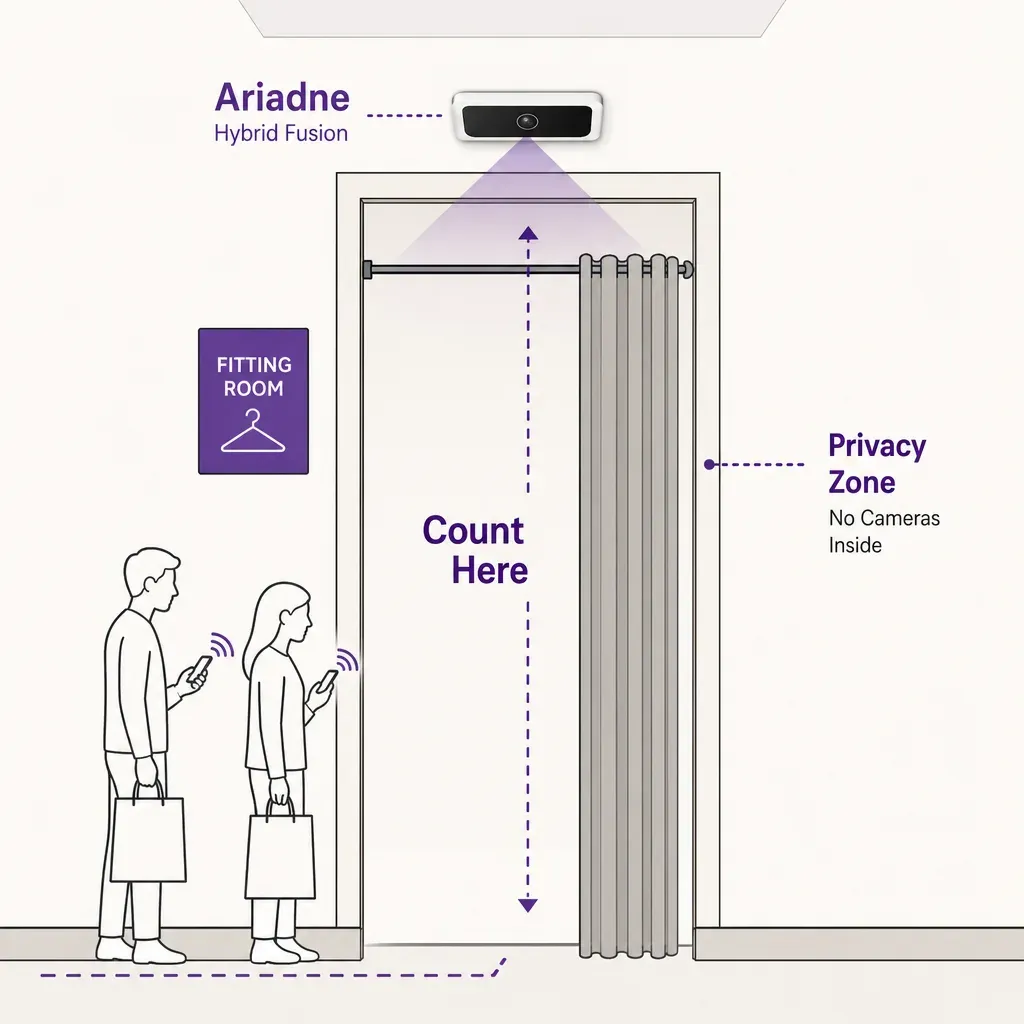
That creates a problem for the store manager. Fitting rooms are where the conversion decision actually happens. A visitor who picks up four items and tries them on is several times more likely to buy than one who never opens a door. The utilization of those rooms, how many people are in them, how long they stay, how often they queue outside, predicts the day's basket and the staffing the floor needs. Retailers know this and want the data. They also know they cannot have a camera or a microphone behind that curtain to get it.
The way out is to stop trying to measure inside the room. Everything a store actually needs to know about fitting-room utilization is visible at the door, where a visitor enters and where they leave. Count those two events well, with a sensor that captures geometry rather than images, and you get the operational picture without ever placing a device inside a private space.
Fitting room utilization, defined
Fitting room utilization is the share of available room-time that is occupied over a chosen period. If a store has eight fitting rooms open for ten hours, that is 80 room-hours of capacity per day. If those rooms collectively logged 56 occupied hours, utilization for the day was 70 percent. The same calculation runs by hour, by day-part, or by week, and it sits next to four other numbers that together make the metric useful:
- Entries. How many distinct visits the fitting-room cluster received over the period. This is the denominator for try-on rate and the headline volume figure for floor staff.
- Average dwell. How long a visitor stayed inside, measured as the gap between their entry and their exit at the door. Short dwells suggest a fast no, long dwells suggest deliberation or a fitting issue.
- Live occupancy. How many rooms are currently in use. This is the figure a supervisor needs in the moment to decide whether to open a held-closed room, reassign staff, or step in to help a queue.
- Queue indication. How often live occupancy hits 100 percent of open rooms, and for how long. Sustained full occupancy is the operational definition of a fitting-room queue, and a strong leading indicator of try-on abandonment.
Utilization on its own is a flat percentage. Read alongside entries, dwell, and queue time, it tells you whether the cluster is busy, fast, slow, or jammed, which is what you actually want to know to run the floor.
Counting at the door, not in the room
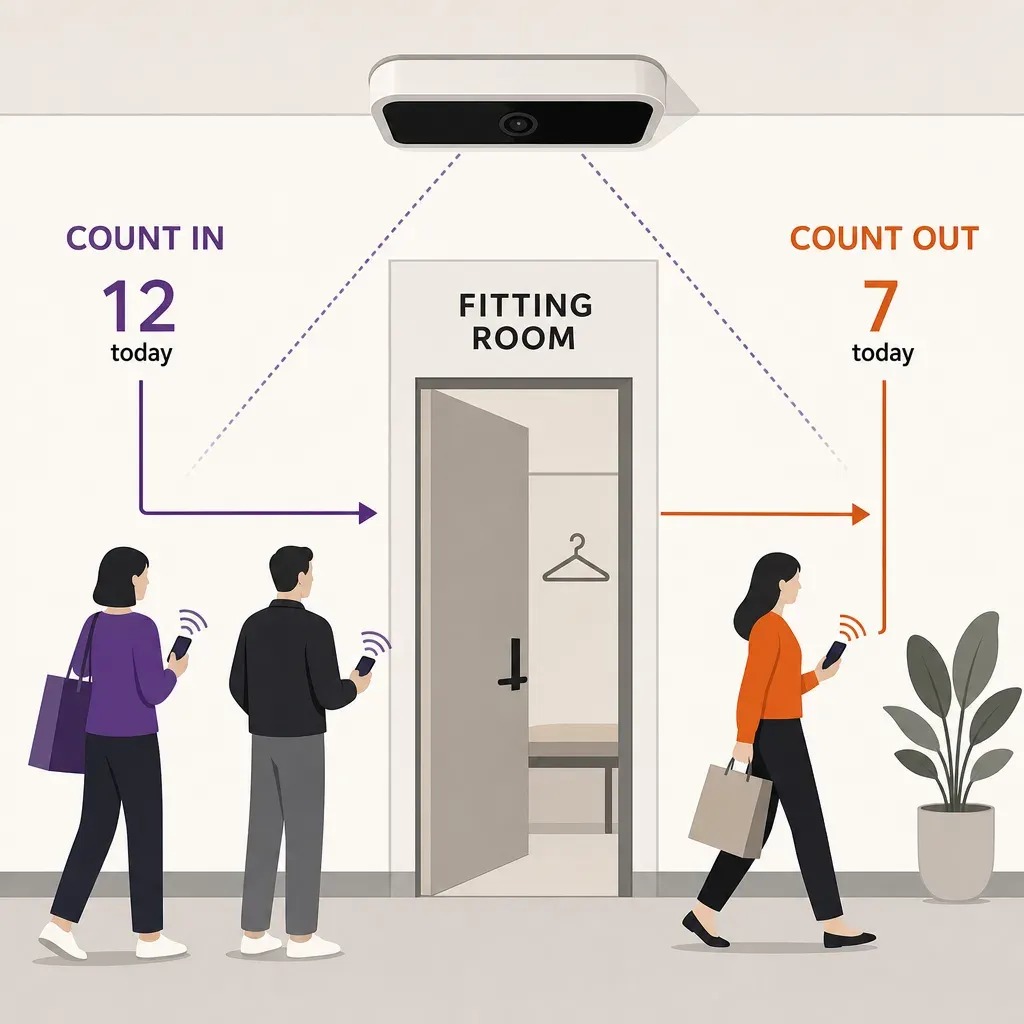
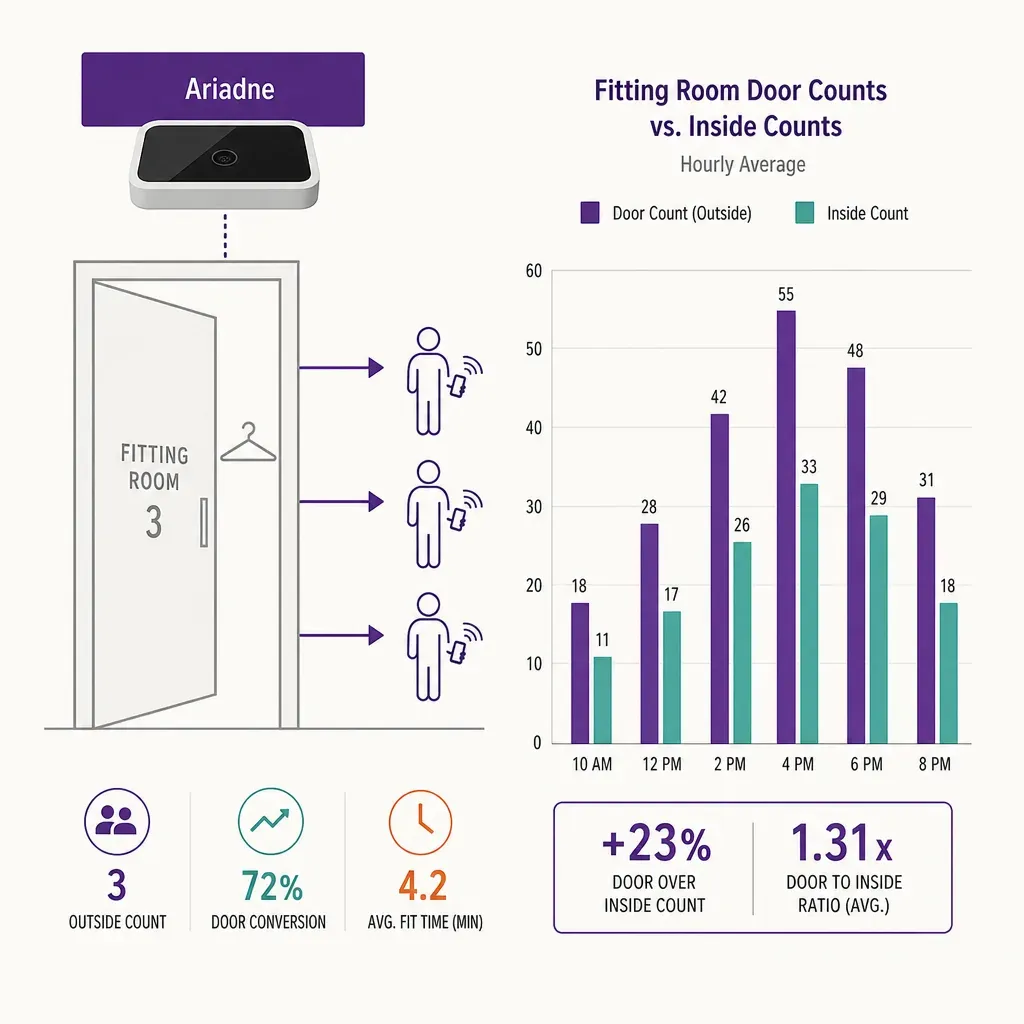
The privacy story and the measurement story are the same story. A fitting room can be measured without a sensor inside it, because every visit has to cross a door twice. One Time-of-Flight sensor mounted above the door of each fitting room records the entry on the way in and the exit on the way out. That is enough to derive every figure listed above.
A Time-of-Flight sensor fires infrared pulses at the floor below and measures how long they take to return. The return distances form a depth map of whatever is in the doorway, and the sensor reads height and shape from that depth rather than from any image. There is no lens trained on the room. There is no picture stored. There is no facial recognition step, because there is no face data in the stream to recognise. What the sensor produces is a geometry signal saying that a person-sized shape crossed the doorway in one direction, which is exactly the information a count requires.
Mounted on the corridor side of the door, above the threshold, the sensor sees only the brief moment of the crossing. It does not see the interior of the room. It does not see the visitor undressed. It cannot, by construction, because the doorway is the only thing inside its field of view. From a privacy review point of view, that geometry rules out the worry that motivates the no-camera policy in the first place.
The same hardware sits above the store entrance and at the entry to the fitting-room corridor, so the visitor's journey through the broader funnel uses the same sensing method end to end. None of it is a camera. The wider methodology behind Ariadne's people counting extends across the store, not just at the fitting-room door.
How the data plugs into the fashion conversion funnel
Fashion conversion is rarely one number. It is a sequence of step ratios that, multiplied together, give the headline rate. Fitting-room utilization is the metric that prices the most expensive step.
- Store visits. Counted at the entrance, the denominator for everything below.
- Try-ons. Counted at the fitting-room door, this is the number of visits that took at least one product to a room.
- Try-on rate. Try-ons divided by store visits. This is covered in detail in try-on rate as a fashion conversion metric.
- Purchases. Counted at the till from the point-of-sale system, joined to the same period.
- Try-on to purchase. Purchases divided by try-ons. Industry observation across category benchmarks puts this ratio in the 40 to 70 percent band for womenswear; the exact figure for any given store is what staff training is judged against.
Fitting-room utilization is the step that explains the variance in the back end of that funnel. A store with high try-on rates and high utilization is selling well; a store with high try-on rates but blocked utilization is leaking conversions at the cubicle door. The diagnostic difference between those two situations is invisible without the per-room data.
What the utilization data lets a store manager do
The point of measurement is the decision that follows it. Four operational decisions sit downstream of solid fitting-room data, in order of how directly they move revenue.
Open the right rooms at the right time
Stores routinely keep some rooms closed at quiet hours to save staff cost on tidying returns. The trade-off is fine when foot traffic is low and obvious when it is high. Per-hour utilization tells the supervisor when to open held-closed rooms before the queue forms. As an illustrative example, a store that sees utilization climb above 80 percent for the third consecutive 15-minute interval is about to queue; opening one more room at that point is a different outcome than opening it after the queue has already cost three try-ons.
Staff the floor for the assist, not the till
Sales associates affect the back end of the funnel most directly when a visitor is in or near a fitting room. Live occupancy tells the supervisor where to position the floor at the times that matter. A store running a clienteling program can use the same data to decide when a stylist should walk a regular customer to a held room rather than the queue.
Catch the cubicle that runs slow
Per-room dwell distributions surface the rooms that take noticeably longer to clear, which is usually a hardware issue: a broken hook, a stuck door, a mirror angled wrong. Operations teams that look at these distributions tend to find one or two rooms in a fleet that are quietly underperforming and easy to fix.
Build a defensible try-on rate
The try-on rate covered in the sister post depends on a credible count of fitting-room entries. A camera-free, door-mounted sensor gives that count without the data-protection footnote a camera would attach to it, which makes the rate something the store can publish internally and benchmark across the fleet without an additional review.
How Ariadne fits
Ariadne packages this as a single measurement method across the store. One sensor sits above each fitting-room door, more sensors sit at the store entrance and at gate points the merchandising team cares about, and the figures roll into the same dashboard a regional team uses for the whole estate.
Ariadne measures this with Hybrid Fusion, its patented camera-free method. Time-of-Flight depth sensing counts every visitor at the entrances, capturing geometry rather than images, while patented phone signal sensing follows movement through the interior, detecting the signals a phone emits even in airplane mode. The sensor streams both feeds to Ariadne, where Hybrid Fusion combines them into one trajectory per visit and computes counts, dwell, and paths. The streams carry no identifier: no MAC address, no device ID, no biometric data, and no camera is involved. Identifiers are stored only when a visitor explicitly opts in, which keeps the method GDPR-friendly and outside biometric territory.
For a fashion store the practical consequences are the ones the privacy review asks about. There is no camera at any point in the path, and no camera or microphone inside any room. The Time-of-Flight sensor at the fitting-room door reads geometry, not images, and is mounted so that its field of view ends at the doorway. The patented signal sensing that gives the rest of the store its movement picture is positioned in the wider sales floor and is not used inside the fitting-room corridor itself, because nothing inside a fitting room needs to be measured. The fitting-room count is the door event, and that is all. The sensor hardware sits in the Ariadne sensor lineup, and the data handling is documented in the privacy policy.
A buyer checklist for fashion retail
If you are evaluating a fitting-room measurement system, these are the questions to put to any vendor in writing before a trial. They sit on top of the general checklist for any in-store counting system.
- Is anything mounted inside the fitting room? The clean answer is no. A vendor that proposes any device inside the cubicle is the wrong vendor for this use case, regardless of what the device claims to do.
- Is there a camera anywhere in the fitting-room path? A method built on Time-of-Flight depth sensing at the door avoids cameras entirely, which is the answer a board or a data protection officer needs to hear.
- What is captured at the door? The honest answer is the height and shape of a crossing, sampled briefly. No image, no face, no MAC address by default, no device identifier. That is the threshold for staying outside personal-data territory.
- Can it report per room, not just per cluster? Per-room data is what catches the slow cubicle and informs which rooms to open first. A vendor that only reports cluster totals will leave that operational layer on the table.
- Does it give live occupancy and queue indication? These are the figures supervisors act on in the moment. End-of-day data is useful for the weekly review but cannot drive the same-day decision.
- Will the figures join cleanly to the point-of-sale data? Try-on to purchase is meaningful only when the two sides are matched on the same time window. Ask how the export looks before you sign.
Related reading
FAQ
Does the system put any sensor inside the fitting room?
No. A Time-of-Flight sensor is mounted above each fitting-room door, on the corridor side, and its field of view ends at the doorway. Nothing is mounted inside the room itself, and there is no camera or microphone in the cubicle. The entry and exit at the door give every figure the store needs to manage utilization.
Does the system use cameras?
No. Ariadne counts with Hybrid Fusion: Time-of-Flight depth sensing plus patented phone signal sensing, never cameras. Time-of-Flight captures geometry rather than images, and signal sensing captures no MAC address by default, so the measurement involves no video, no faces, and no biometric data.
Can you tell how long a specific person stayed in a room?
The system records the time between an entry and the next exit at the same door, which is the dwell for that visit. It does not identify who the visitor was. There is no face data captured, no device identifier captured by default, and no record that could be matched to a named individual. The figure is an anonymous duration, useful in aggregate for utilization and per-room operations, and not tied to a person.
How does this connect to the wider fashion conversion funnel?
Fitting-room entries are the middle step in the funnel, between store visits at the entrance and purchases at the till. The ratio of entries to visits, covered in the post on try-on rate, is one of the strongest leading indicators of the day's basket, and utilization explains why that ratio rises or falls when staffing and room availability change.
Is fitting-room counting GDPR-compliant?
A method that captures no images, no faces, and no device identifiers by default is not processing personal data, so the heaviest GDPR obligations do not attach to it. That is a stronger position than blurring a camera feed, because there is nothing identifying captured at any point. Confirm the specifics with your own data protection officer, but a no-personal-data design is the easiest case to make to one. For the broader retail context, see Ariadne for retail stores.


