
Most footfall questions are about the day: how many people came in, when the peak hit, whether it beat last week. Density is a different question, and it is asked in the moment. It is not "how many visited" but "how many are inside this space right now, and is that too many." That shift, from a daily total to a live reading of how packed a floor is, is what turns counting from a marketing metric into an operational and safety one.
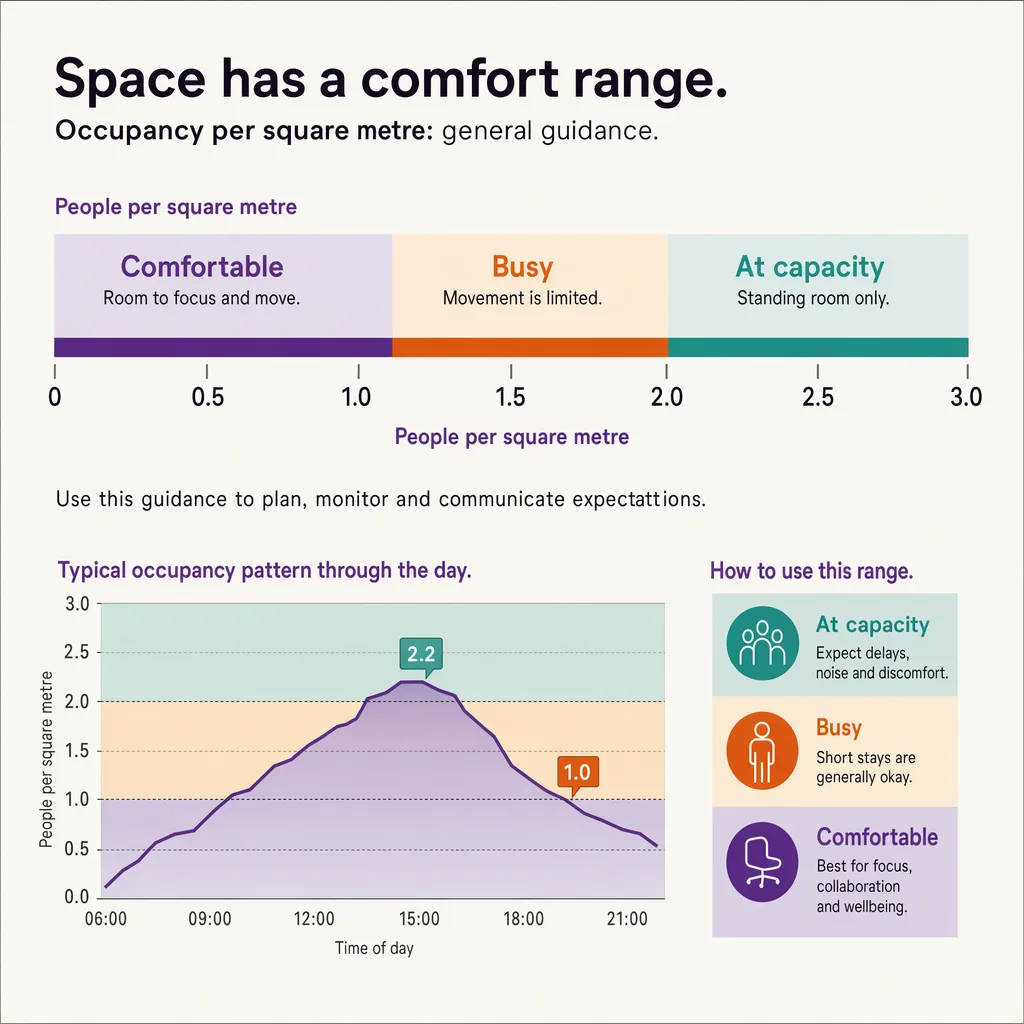
This post defines shopper density, shows how it is derived from live occupancy, and sets out where the thresholds sit for comfort, for service, and for safety. It is not a table of legal limits, because those vary by country, venue type, and the judgement of the responsible person on site. It is a working explanation of the metric and how a store or centre uses it to act before a floor gets uncomfortably or dangerously full.
What is shopper density and how is it measured?
Shopper density is how many people occupy a given area at a moment in time, usually expressed as people per square metre or as a percentage of a space's rated capacity. It is measured from live occupancy, meaning entries minus exits kept as a running count for a defined area, divided by the usable floor area. Density matters for two reasons. The first is comfort, because a space that feels packed pushes shoppers back out and shortens the visits of the ones who stay. The second is safety, because crowding beyond a threshold becomes an egress and crush risk. Setting and watching a density threshold lets a store or centre trigger flow control before either problem lands, rather than reacting once the floor is already too full.
The rest of this post breaks that down: how the running count becomes a density figure, what the comfort and safety bands mean, and how a live density reading turns into a decision at the door.
From live occupancy to density: a running count divided by usable area
Density starts with occupancy, and occupancy starts with counting in both directions. A single entry count tells you arrivals over a day. A live occupancy figure needs every entry and every exit, netted continuously, so at any second you know how many people are inside a defined area. Get one direction wrong and the error does not average out. It compounds across the day, so a small per-hour miscount can leave the running total badly off by closing time. That is why occupancy is the least forgiving thing footfall hardware is asked to do, and why the accuracy of bidirectional counting matters more here than for a simple daily total.
Once you hold a reliable live occupancy for an area, density is arithmetic: the running count divided by the usable floor area of that area. "Usable" is the word that does the work. You measure against the space people can actually stand and move in, not the gross leased area, so fixtures, back-of-house, and walls come out of the denominator. The same 500-visitor reading is comfortable in a large open floor and alarming in a narrow one, and only the usable-area figure captures that difference.
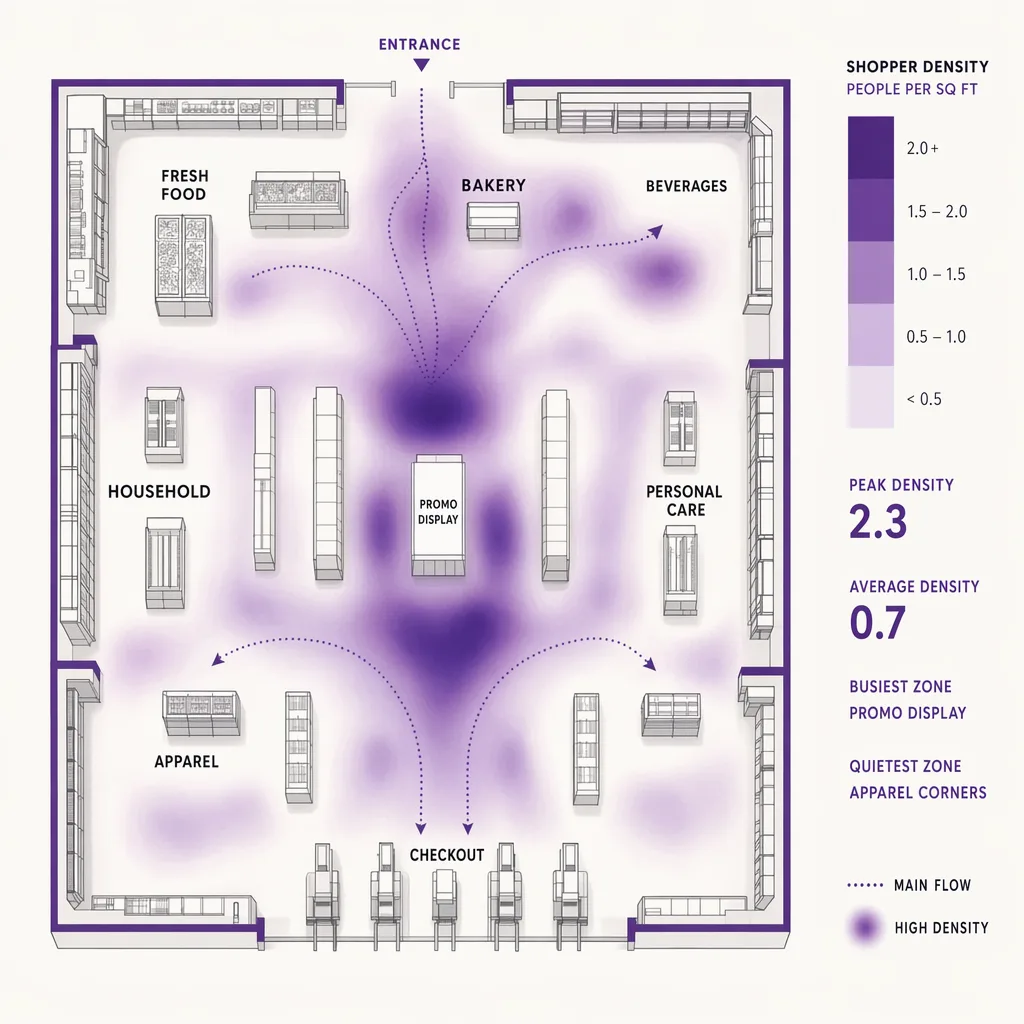
Density is most useful when it is zoned rather than building-wide. A whole-store average can look fine while a single aisle, an entrance lobby, or a checkout bank is congested. Defining an area for each space that fills up independently, and holding a live occupancy for each, gives a density reading that reflects where people actually bunch. That maps naturally onto how real-time occupancy is already measured for capacity and staffing.
Density thresholds: comfort, service, and safety bands
There is no single number that means "too dense" for every space, but density does move through recognisable bands as it rises. At low density people move freely, browse without brushing past each other, and the space feels open. As it climbs, movement slows, shoppers start routing around each other, and queues form more readily. Higher still, free movement becomes difficult, people feel hemmed in, and the space reads as unpleasantly crowded well before it reads as unsafe. Push past that and the concern stops being comfort and becomes crowd safety.
Comfort and service bands are commercial choices, set to the space and its format. A discount store trading on volume tolerates a denser floor than a premium boutique whose whole proposition is room to browse. A useful practice is to set an internal comfort threshold below any safety limit, so the first alert is about protecting dwell and conversion, not about risk. Cross-read against how long people stay: a floor that is dense and where dwell time is holding up is trading well, while a floor that is dense and shedding dwell is pushing people out.
The safety band is not a commercial choice, and it is where care is needed. Crowd-safety guidance discusses densities at which movement becomes restricted and at which crowd forces become dangerous, but the specific figures, and the legally enforceable occupancy limits for a given building, vary by jurisdiction, building code, and venue type. Treat any single people-per-square-metre figure you read as illustrative rather than a universal standard. The occupancy limit that actually governs your space comes from local regulations, your fire and safety certification, and the responsible person on site. Confirm it with the local authority and a qualified safety professional; do not set it from a blog.
Occupancy caps and egress: the safety case
The reason occupancy caps exist is egress, not comfort. A space is rated for a maximum number of people partly on how quickly everyone in it can leave through the available exits in an emergency. Exceed that number and the exit routes can no longer clear the floor in the time the safety case assumes, which is the situation crowd-safety regulation is written to prevent. This is why a maximum occupancy is a hard ceiling set against the building, and why density monitoring in a retail or centre setting is ultimately a way of never getting near that ceiling by accident.
For most stores the cap rarely binds on an ordinary day. It binds on the days that matter most: a launch, a sale, a seasonal peak, a promoted event, the exact moments when footfall spikes and a manager is least free to eyeball the floor. A live occupancy reading against a defined cap is what lets those days run safely without a person standing at the door counting on a clicker. Venues that run genuinely dense crowds treat this as core operational data rather than an afterthought, the same discipline behind crowd management data at events and the counting of dense concourses at large venues. A standing retail floor uses a lighter version of the same idea, but the mechanism is identical: a live count, a defined area, and a threshold that triggers before the cap.
Real-time density and flow control: alerts and metering entry
A density figure is only useful if something happens when it crosses a line. That is the job of real-time monitoring: watch the live reading per area, and fire an action when it passes the comfort threshold and again as it approaches the safety cap. The action is flow control, and it scales with the situation.
The lightest form is an alert to staff so someone attends the busy zone, opens a checkout, or eases a bottleneck before it grows. A firmer form is metering entry: holding new arrivals briefly at the door, or at the entrance to a busy zone, so the number leaving keeps pace with the number joining. A queue that is managed at the entrance is safer and calmer than a crush that forms inside. The point of doing this on a live reading, rather than a schedule, is that crowding does not follow the clock. It follows the promotion, the weather, and the event next door, and only a live count catches it as it happens rather than after.
Real-time density also produces a record worth keeping. The peak occupancy each area reached, how long it sat above the comfort band, and how often metering was needed all feed back into how the space is laid out and staffed. A zone that repeatedly runs hot may need a wider aisle, a relocated fixture, or more cover at peak, decisions that are easier to defend with a density history than with a memory of a busy afternoon.
Measuring occupancy accurately without cameras: bidirectional counts kept as a live area total
Everything above rests on one thing: an accurate, live, bidirectional count for each defined area. If the count drifts, the density figure drifts with it, and a safety threshold set against a drifting number is worse than none. That is where the counting method matters, and where accuracy and privacy do not have to trade off against each other.
Ariadne measures this with Hybrid Fusion, its patented camera-free method. Time-of-Flight depth sensing counts every visitor at the entrances, capturing geometry rather than images, while patented phone signal sensing follows movement through the interior, detecting the signals a phone emits even in airplane mode, and tracks that movement to about one-metre precision. The sensor streams both feeds to Ariadne, where Hybrid Fusion combines them into one trajectory per visit and computes counts, dwell, and paths. The streams carry no identifier: no MAC address, no device ID, no biometric data, and no camera is involved. Identifiers are stored only when a visitor explicitly opts in, which keeps the method GDPR-friendly and outside biometric territory.
For density this matters in two ways. The Time-of-Flight depth count is device-independent, so it registers every person regardless of whether they carry a phone or how it is set, which is exactly what a running occupancy total needs to stay accurate over a long trading day. And because groups are common in the busiest moments, the counting layer has to resolve people entering together rather than reading a family as one, which is why counting groups accurately is part of getting occupancy right. Held together, that gives a live count per area that a comfort and safety threshold can be set against with confidence. For a centre reading density across many tenants and common areas, shopping centre analytics shows how the same measurement supports flow and safety across a whole property.
FAQ
What is a safe shopper density per square metre?
There is no single universal figure. Crowd-safety guidance discusses densities at which movement becomes restricted and at which crowd forces become dangerous, but the enforceable limit for your space depends on local regulations, building code, exit capacity, and venue type. Treat any single number as illustrative and confirm your actual occupancy limit with the local authority and a qualified safety professional.
Do I need cameras to measure shopper density?
No. Ariadne counts with Hybrid Fusion: Time-of-Flight depth sensing plus patented phone signal sensing, never cameras. Time-of-Flight captures geometry rather than images, and signal sensing captures no MAC address by default, so the measurement involves no video, no faces, and no biometric data.
How is density different from footfall?
Footfall is a count of arrivals over a period, usually a day. Density is a live reading of how many people are inside a defined area at a moment, divided by the usable floor of that area. Footfall tells you how busy the day was; density tells you how packed the floor is right now.
How do you turn a live occupancy reading into flow control?
Set a comfort threshold below the safety cap for each area. When the live reading crosses the comfort line, alert staff to attend the zone; as it approaches the cap, meter arrivals at the door or zone entrance so the number leaving keeps pace with the number joining. Acting on a live reading catches crowding as it happens rather than after.
Why does counting accuracy matter more for density than for daily totals?
Because occupancy is a running net of entries minus exits, an error in either direction compounds across the day instead of averaging out. A count that drifts leaves the live total, and any safety threshold set against it, unreliable by closing time, which is why bidirectional accuracy is the least forgiving requirement here.
---


