
Why a retail labor cost benchmark is harder than it looks
Most retailers want one number: a labor cost benchmark they can hold their stores against. A single percentage is easy to put in a board pack and easy to argue about in a quarterly review. The problem is that one number rarely tells the same story across two different formats. A grocery store carrying fresh produce, a specialty fashion store with a high-touch service model, a quick-service restaurant on a transit corridor, and a drug store on a residential high street all sit inside the same retail industry on paper, but each one has a structurally different relationship between staffing and revenue. Comparing them with a single ratio without acknowledging that structure is what makes a benchmark misleading.
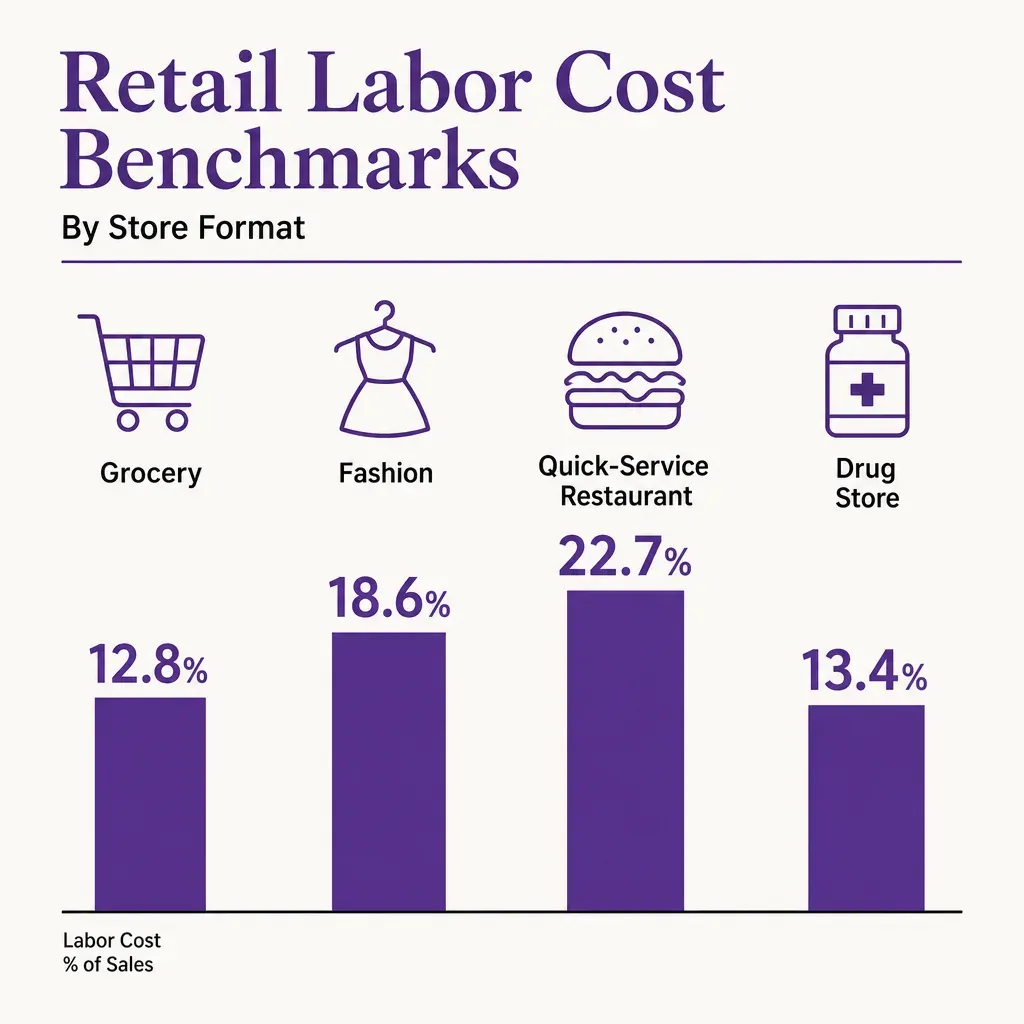
This piece is a methodology guide, not a study. It walks through the three calculations a retail operations team usually means by labor cost (labor as a share of revenue, labor per leased hour, labor per transaction), what each one tells you, and where the typical ranges sit by format. The ranges below are illustrative industry expectations drawn from how retailers talk about their own P&L in public filings and trade press, not numbers measured by Ariadne. They are intended as orientation for an internal conversation, not as a target a store should be held against without context.
The three calculations a retail labor cost benchmark usually means
Before you can benchmark anything, the team has to agree on what labor cost means and what it is being divided by. Three calculations dominate the conversation, and they answer different questions.
Labor as a share of revenue
The most common version is the labor cost ratio: total store labor cost divided by store revenue over the same period. It tells you how many cents of every euro of sales went to paying the people in the store. The strength of the ratio is that it ties labor directly to the value it produces. The weakness is that it is sensitive to anything that moves revenue independently of staffing, including price increases, promotional discounting, and channel mix. A store with a heavy promotional calendar can look more efficient on labor as a share of revenue without anyone working differently, simply because the denominator moved.
What counts as labor cost in the numerator also varies. The cleanest definition is fully loaded labor: base pay, employer social contributions, paid leave accrual, and a fair share of training and onboarding time. Bonus and commission may be inside or outside depending on how the team manages variable pay. Whichever line is drawn, the same line has to be drawn for every store being compared, and the same line has to be drawn period over period.
Labor per leased hour
The second calculation is labor cost per leased hour of trading: total store labor cost divided by store gross leasable area in square metres, then divided by the trading hours in the period. It strips revenue out of the picture and asks how much labor was spent per unit of floor space and time. The strength of this version is that it does not move with discounting and is easier to compare across stores of different size. The weakness is that it ignores how productive that labor was. A store that holds labor per leased hour flat while sales fall is not actually winning.
Labor per transaction
The third calculation is labor per transaction: total store labor cost divided by the number of transactions in the period. It is most useful in formats where the transaction is a fair unit of work, like grocery and quick service, and least useful in formats where the work happens before the transaction does, like specialty fashion with a fitting-room model where most of the labor goes into customers who do not buy on that visit. Many specialty retailers therefore track labor per visit (using a footfall count from a people counting system) rather than labor per transaction, because it reflects how much of the work is service rather than checkout.
Why retail labor cost benchmarks differ by format
Before looking at typical ranges, it is worth being precise about why two retailers in the same shopping centre can sit very far apart on the same ratio without either of them being mismanaged. The cost line and the revenue line both move with structural factors that are not about scheduling discipline.
- Service intensity. A specialty fashion store with a fitting-room service model needs more labor per visit than a self-service mass-market store. The work per customer is genuinely higher.
- Gross margin. A grocery store works on thin margin and high volume, a specialty fashion store on wider margin and lower volume. The same labor cost ratio means a very different amount of gross profit absorbed by labor.
- Average basket size. A large basket spreads checkout and floor labor across more revenue. A small-basket format like drug store or convenience absorbs more labor per euro of sales for the same headcount.
- Trading hours and unsocial-hour premiums. A format that trades long hours (grocery, quick service) carries more nights and weekends in the schedule, where labor often costs more per hour. The ratio reflects that mix, not just the schedule.
- Self-checkout and assisted-checkout penetration. Where self-checkout is established, the checkout part of the labor line is smaller and the floor support part is larger. Two grocery stores at the same labor cost ratio can have very different labor structures behind it.
- Country and minimum-wage context. Statutory minimum wage and employer social contribution rates vary across the markets a retailer trades in. A pan-European benchmark blends them together, which is fine for a board view and misleading for a single-store review.
Typical ranges by retail format (illustrative)
The ranges below describe how retailers in five common formats tend to talk about their own labor cost ratio in public filings and trade commentary. They are deliberately wide and they are not Ariadne-measured. They are useful as orientation for an internal conversation about which side of typical your stores sit on, not as a target.
Specialty fashion
Specialty fashion stores carrying a service model tend to talk about labor as a share of revenue in roughly the low to mid teens, often cited in the area of 12 to 17 percent of net sales, with stores in higher-rent locations or with deep service expectations sitting at the upper end and value chains sitting below. Per-visit labor is more meaningful than per-transaction labor in this format because of the conversion rate. The same store can look inefficient on labor per transaction in a soft month and reasonable on labor per visit, because the foot traffic did not change as much as the conversion did.
Mass-market apparel and general merchandise
Larger-format apparel and general merchandise stores running on a self-service model usually sit in the high single digits to low teens on labor as a share of revenue, often cited in the area of 8 to 13 percent. The bulk of the labor goes into replenishment, fitting-room operations, and checkout rather than one-to-one service. Labor per leased hour is often the more useful internal benchmark, because the store size and trading hours dominate the cost line.
Grocery
Grocery is a thin-margin, high-volume format and the labor cost ratio reflects that. Many publicly listed grocers report total store labor in the area of 9 to 14 percent of revenue, with discount banners at the lower end of that range and full-service banners with a fresh, deli, or in-store bakery offer higher. Because the gross margin is also thinner, the share of gross profit absorbed by labor is high. Labor per transaction is the more comparable measure between grocery stores than labor as a share of revenue, because basket size is more stable than promotional mix.
Quick-service restaurants (QSR)
Quick-service restaurants tend to talk about labor cost as a share of revenue in the area of 25 to 32 percent at company-operated stores, which is structurally higher than non-food retail because of how food production sits inside the trading floor. Labor per transaction is the standard internal measure and varies sharply with daypart: a busy lunch hour and a quiet afternoon are very different shops. Demand-led shift planning is normal practice in this format because the cost line is too large to flat-staff.
Drug and health and beauty
Drug stores and health-and-beauty formats vary widely depending on whether they carry a pharmacy counter and how much advisory service the format expects. A pure health-and-beauty store on a high street often sits in the area of 9 to 14 percent of revenue, similar to mass-market apparel. A store with a pharmacy counter sits higher because the regulated counter carries a fixed staffing requirement that is not very flexible with traffic.
Across all five formats, the same point holds: the ratio is informative only after the structural context is set out. A board pack that compares specialty fashion at 14 percent against grocery at 12 percent and concludes that grocery is more efficient on labor is comparing two formats that should not be compared at the same ratio at all.
How to make a labor cost benchmark useful internally
If the ratio on its own is brittle, the right move is not to abandon it but to put it inside a small structure that lets the operations team interpret it. Four practices help.
- Define labor cost once and apply it everywhere. Write down what is in the numerator (base pay, employer social contributions, paid leave accrual, training time, variable pay) and apply that definition across every store and every period. Most disagreements about whether a store is on or off benchmark are really disagreements about the definition.
- Hold the format constant when you compare. Compare specialty fashion to specialty fashion and grocery to grocery, not retail to retail. If the portfolio is mixed, use format-specific benchmarks rather than a portfolio average.
- Read the ratio with a footfall denominator alongside it. Labor per visit, calculated using a continuous foot-traffic count from a people counting system, separates the labor question from the conversion question. A store with a labor cost ratio that has crept up because conversion fell looks very different from one where the schedule actually drifted.
- Hold the variable cost line accountable hourly, not weekly. Weekly labor budgets aggregate too much. Hourly labor against hourly forecast traffic is what tells the duty manager whether the right people are on the floor right now, and is the level at which most labor cost is actually controlled.
Where the footfall denominator comes from
Several of the calculations above need an honest count of how many people came into the store, broken down by hour and ideally by zone. That is a measurement problem rather than a finance problem, and it is the one Ariadne is built to solve.
Ariadne measures this with Hybrid Fusion, its patented camera-free method. Time-of-Flight depth sensing counts every visitor at the entrances, capturing geometry rather than images, while patented phone signal sensing follows movement through the interior, detecting the signals a phone emits even in airplane mode. The sensor streams both feeds to Ariadne, where Hybrid Fusion combines them into one trajectory per visit and computes counts, dwell, and paths. The streams carry no identifier: no MAC address, no device ID, no biometric data, and no camera is involved. Identifiers are stored only when a visitor explicitly opts in, which keeps the method GDPR-friendly and outside biometric territory.
Counts produced this way feed the labor-per-visit calculation and the hourly demand forecast that sits behind a demand-led schedule. The streams carry no images, no faces, no MAC address by default, and no device identifier, so the footfall denominator does not pull personal data into a finance review. The detail of the data handling is set out in the privacy policy, and the wider retail context sits at Ariadne for retail stores.
Related reading
FAQ
Is there a single retail labor cost benchmark a store should hit?
No, and being told there is one is usually a sign the benchmark is too coarse to be useful. The ratio that matters depends on the format, the country, the trading hours, and what is included in the labor line. The ranges in this piece are illustrative orientation, not targets. A useful internal benchmark is one your finance and operations teams have defined together for your format and your markets, and which they review against a footfall denominator rather than revenue alone.
Should we use labor as a share of revenue or labor per visit?
Both, for different questions. Labor as a share of revenue is the right number for finance reporting, because it ties labor to the value it produces. Labor per visit is the right number for operations, because it separates the staffing question from the conversion question. A store that has missed budget on labor cost ratio because conversion fell needs a different intervention from one where the schedule itself drifted, and reading the two ratios side by side is how you tell the difference.
Where does Ariadne fit into a labor cost benchmark conversation?
Ariadne is the measurement layer underneath it. The platform produces continuous, camera-free counts of how many people entered the store and where they spent time, by hour and by zone. Those counts feed the labor-per-visit denominator and the hourly demand forecast a demand-led schedule needs. Ariadne does not set the benchmark or hold a store to it: that is the retailer's call. It supplies the honest traffic data the benchmark conversation depends on.


