
Why footfall to revenue correlation is the headline metric
If you can only ask a retail analytics system one question, the question worth asking is whether visitors who walk into the store turn into sales. Every other figure feeds into this one. Capture rate explains how many people the window pulled in. Conversion explains how many of those bought. Dwell explains how long they considered it. The footfall to revenue correlation is the relationship that ties the whole pipeline together, and a retailer who understands it can defend marketing spend, judge a layout change, and decide whether weak weeks are a traffic problem or a sales problem.
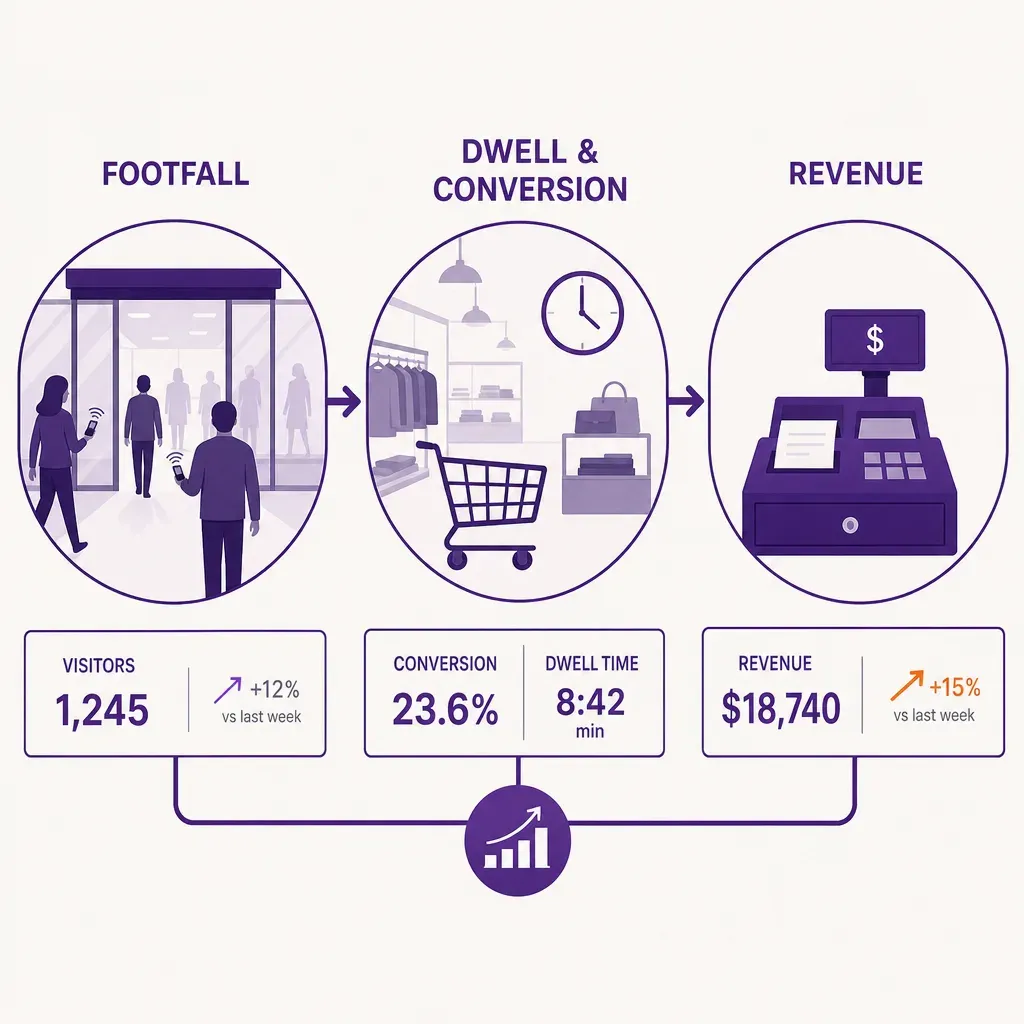
The relationship sounds simple. More visitors usually mean more revenue. In practice, the correlation between hourly visitors and hourly revenue in a single store is rarely the clean line a CFO would expect. It is noisy, it varies by category, and at small sample sizes it can look misleadingly weak. This post is about how to set the correlation up so it actually answers the question, what kinds of strength to expect at different volumes of data, and why some retailers genuinely see weak correlations even when the system is working.
The numbers in this piece are illustrative, not measured. They reflect the patterns retail analysts working with people counting and point-of-sale data typically report, and they are written as ranges and rough orders of magnitude rather than as findings. The point is the method, not the figures.
What the correlation actually measures
Foot-traffic-to-revenue correlation is a statistical measure of how closely two time series move together: the number of visitors entering the store in a given window, and the gross revenue rung up over the same window. The most common metric used is the Pearson correlation coefficient, which ranges from minus one to plus one. A coefficient of one would mean revenue moves in perfect lockstep with traffic. Zero would mean traffic tells you nothing about revenue. Negative values would imply more visitors come with less revenue, which is rare in retail but does occur in specific edge cases (a busy store can convert worse because staff are stretched, for example).
Most working retail teams care less about the exact coefficient and more about what it implies. A strong, stable correlation gives leadership a useful inference: if you can move traffic, you can predict the revenue lift within a sensible band. A weak or unstable correlation means traffic is not, on its own, a reliable lever, and the business has to look at conversion, basket size, or category mix to explain its sales line.
The headline number is therefore only the start of the analysis. The interesting work is in the setup that produces it.
Setting up the correlation: matching windows
The first decision is the time window you correlate on. The choice changes the answer more than any other part of the methodology, and it is the place most internal analyses go wrong.
Hourly
Hourly windows are the most diagnostic. A store with 200 visitors on Saturday and 80 on Tuesday will produce two daily points; the same store produces hundreds of hourly points across a month. Hourly correlation also captures the within-day dynamics that matter for staffing decisions. The cost is noise: a single transaction worth several hundred euros lands in one hour and not the next, which inflates revenue variance relative to the underlying pattern. Use hourly when you have enough volume to absorb the noise, which typically means a busier store or a multi-month sample.
Daily
Daily windows smooth out the bumps and are the default for most operating reviews. A single year produces around 300 trading days, enough for a stable correlation in most categories. The trade-off is that daily aggregation hides the within-day patterns. A store can run a strong morning conversion and a weak afternoon, average out to a normal day, and present a clean correlation that masks an opportunity.
Weekly
Weekly windows are useful for executive reporting because they remove day-of-week and weather noise, but they leave so few data points (52 a year, fewer if a store has only been measured for a few months) that the correlation becomes statistically thin. Use weekly for narrative, not for inference.
A reasonable working default for a single store is daily correlation as the headline number, with hourly correlation as a diagnostic that explains the daily picture. Comparing the two often reveals more than either does alone.
The daypart join: matching on minutes, not on days
Hourly correlation requires the two feeds to be aligned on the same time grid, and this is the place most internal analyses introduce a subtle error. Point-of-sale systems timestamp a transaction when it is rung at the till, which is the end of a visit. People counters timestamp an entry when the visitor crosses the door, which is the beginning of the visit. The two events are separated by the dwell time of the visit, which in most retail formats is anywhere from a few minutes to half an hour.
If you join the feeds naively on hour, a transaction at 11:55 is correlated with the visitors who walked in between 11:00 and 12:00, even though the actual buyer entered the store at 11:30 in the previous hour. The effect at a single window is small. The effect at the start and end of trading is larger, because the entry curve and the revenue curve are offset by the average dwell. The cleanest fix is to lag the revenue series back by the average dwell time before correlating, so that a visit's revenue is attributed to the hour the visitor entered. Where dwell is short and uniform (a convenience store, a coffee shop), the correction is small. Where dwell is long and variable (a fashion store, a furniture showroom), the correction matters and can change a correlation strength noticeably.
A more conservative version of the same idea is to aggregate by half-day rather than by hour. The intra-day dwell offset is absorbed inside the half-day window, and the correlation is robust without needing a lag adjustment. This is the approach worth using when dwell data is unreliable or absent.
Seasonality control: the part that quietly inflates the number
A raw correlation between daily visitors and daily revenue in a typical store will look strong, often in the 0.7 to 0.9 range. Most of that strength is not what the analysis is trying to claim. It is the day-of-week cycle. Saturdays have more visitors and more revenue than Tuesdays, so the two series rise and fall together every week. A correlation that captures only this pattern is not telling leadership that traffic drives revenue. It is telling them that weekends are busier than weekdays, which they knew already.
The standard fix is to remove the predictable seasonal components from both series before correlating. The minimum set of controls worth applying:
- Day-of-week. Each day's visitor count and revenue is expressed as a deviation from the average for that day of the week over the period.
- Time-of-year. December, school holidays, sale periods, and back-to-school all introduce systematic moves. A simple month-of-year adjustment is enough for many categories; fashion and toys may need a finer calendar.
- Trading hours changes. A late-night opening introduces hours that had no traffic and no revenue before. Correlate only on hours when the store is open, not on the 24-hour clock.
- Trading days only. Drop closed days entirely rather than imputing zero, which would correlate two zeros and inflate the headline number.
After these controls, the correlation that remains is the within-week, within-season relationship between the visitors a store happens to receive on a given day and the revenue it happens to ring. This is the number worth caring about. It is usually meaningfully lower than the raw figure and meaningfully more useful.
Outlier handling: the days that bend the line
Retail data has a recognisable distribution of unusual days. Sale launches, public holidays, weather events, refurbishments, system outages, and one-off marketing campaigns all produce points that sit far from the underlying pattern. A small number of these days can move a correlation coefficient by 0.1 or more, in either direction, depending on whether the outlier reinforces or contradicts the trend. Leaving them in is misleading. Dropping them silently is worse, because the analyst is then deciding which days count without saying so.
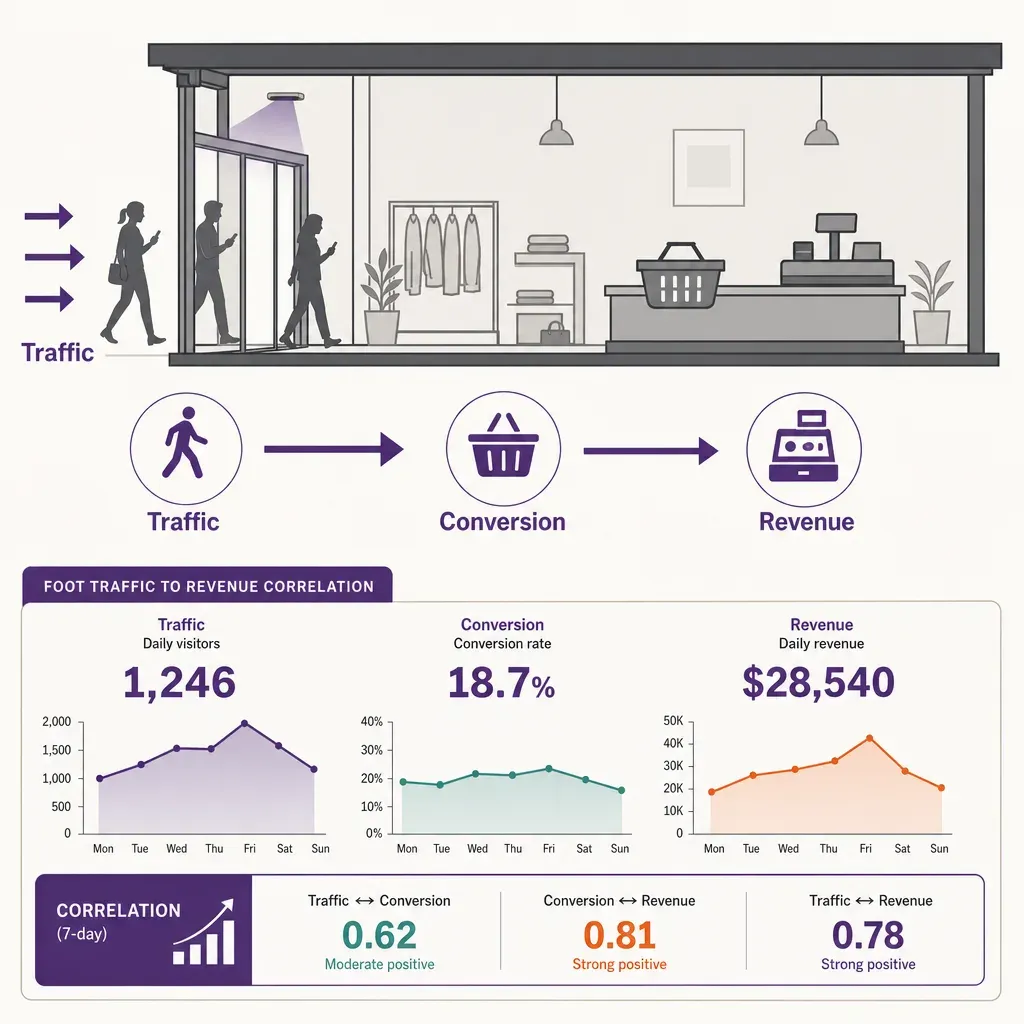
Working approach: identify and flag the outliers explicitly, then run two versions of the correlation, one with and one without. If the two versions agree, the underlying relationship is robust. If they disagree, the headline figure should be reported with the qualifier. A useful threshold is daily visitors or revenue more than three standard deviations from the seasonally-adjusted mean, which catches the genuinely unusual days without trimming normal variance.
What correlation strengths are typical at what data volume
With the methodology above in place, what kind of correlation should a retailer expect to see? The honest answer is: it depends on category, store maturity, and how long the data has been collected. The ranges below are illustrative, drawn from common patterns in retail analytics literature and field experience, not from a single measured study. They are a starting point for sanity-checking your own figures, not a benchmark to hit.
Categories with short visits and small baskets
Convenience stores, pharmacies, quick-service food, coffee. Visits are short, conversion is high (most people who walk in buy something), and basket size is narrow. Daily correlation between visitors and revenue, after seasonal control, often sits in roughly the 0.6 to 0.8 range with three months or more of data. Traffic is a strong predictor here because there is not much else moving.
Mid-basket, mid-dwell categories
Apparel, beauty, accessories, home. Conversion is lower, basket varies more, and a single high-value visitor can shift the revenue line independently of traffic. After seasonal control and a dwell-lagged join, daily correlation often sits in the 0.4 to 0.7 band. A figure under 0.4 here is worth investigating; a figure over 0.7 sometimes indicates seasonality has not been fully removed.
High-ticket, low-frequency categories
Furniture, jewellery, premium electronics, car showrooms. A visit might or might not produce a sale that day, and the sales that do happen are large. Daily correlation is structurally weaker, often in the 0.2 to 0.5 range, because the variance of revenue is dominated by a few transactions per day rather than by traffic. This is not a measurement failure. It is a category property. For these formats, weekly or monthly correlations, or correlating traffic with leads / quotes / orders rather than with revenue, is more diagnostic.
All three ranges assume at least a few hundred trading days of clean data, the seasonal controls described above, and a single store. Multi-store roll-ups produce different numbers, because aggregating across stores removes some single-store noise and adds new sources (catchment differences, store-level conversion). The same methodology applies; the expected strengths shift.
Why some retailers see weak correlations
Not every store will show a clean traffic-to-revenue line, and it is worth knowing the structural reasons why. When the correlation is weak, the cause is almost always one of the following, and the fix is rarely the analytics setup itself.
- Conversion is the dominant lever, not traffic. Some stores already pull most of the visitors a catchment can offer, and additional traffic does not lift revenue because the visitors who would buy are already coming in. In these stores, conversion and basket size are the levers, and a flat correlation between traffic and revenue is real information, not a measurement error.
- The category sees rare, high-value transactions. As noted above, furniture or jewellery stores can have a perfectly healthy business and a low daily correlation, simply because a few large purchases dominate the revenue line.
- Staff capacity is binding. If the store regularly receives more visitors than the staff can serve, traffic above a threshold stops contributing to revenue, and the correlation flattens at the top. This shows up as a non-linear relationship that a straight Pearson coefficient understates; a scatter plot reveals it immediately.
- Loyalty and online attribution. Visitors browse in store, buy online, and the in-store traffic counter never sees the revenue. The store appears to have weaker correlation than it does. The fix here is on the data side, not the measurement: tie loyalty IDs across channels and account for the cross-channel attribution in revenue, or work with conversion to recorded leads rather than to till-rung revenue.
- Wrong window or wrong join. A naively-aggregated hourly correlation without a dwell-lag adjustment, or a daily correlation that has not been seasonally adjusted, can produce numbers that look weak in one direction and strong in another. Before concluding that the relationship itself is weak, confirm the methodology has not understated it.
The fifth point is the one most worth checking first, because it is the one entirely within the analyst's control.
How to read the result without overclaiming
A correlation coefficient is not a causal claim. A 0.7 daily correlation between traffic and revenue does not mean that pulling in one more visitor will produce a predictable amount of revenue. It means that on busy days, revenue tends to be higher than on quiet days, after the obvious seasonal patterns are taken out. The right next move is to convert the correlation into the operational questions it can actually answer:
- Marketing defence. If a campaign moves measured traffic, the historical correlation gives a defensible band for the revenue lift you should expect to see. If the actual revenue lift is inside that band, the campaign worked through traffic. If it sits well above or below, conversion or basket size shifted at the same time.
- Layout and merchandising. If traffic is flat but the correlation strengthens after a fitting room redesign or a category move, conversion improved, which is the kind of operational evidence a store team can act on. Ariadne Analytics keeps the two series side by side for exactly this comparison.
- Catchment vs. operations. A store that scores low on traffic-to-revenue correlation in a healthy category is usually telling you that operations are the lever, not the catchment. That is a different roadmap to a store that scores high.
Measuring the traffic side cleanly
The methodology only works if the visitor count is accurate and properly attributed to the store, not inflated by staff movements, returning visitors counted twice, or group entries (a family of four counted as four separate decision-makers). Inaccurate traffic on either tail of the correlation drags the coefficient down for reasons that have nothing to do with the underlying relationship.
Ariadne measures this with Hybrid Fusion, its patented camera-free method. Time-of-Flight depth sensing counts every visitor at the entrances, capturing geometry rather than images, while patented phone signal sensing follows movement through the interior, detecting the signals a phone emits even in airplane mode. The sensor streams both feeds to Ariadne, where Hybrid Fusion combines them into one trajectory per visit and computes counts, dwell, and paths. The streams carry no identifier: no MAC address, no device ID, no biometric data, and no camera is involved. Identifiers are stored only when a visitor explicitly opts in, which keeps the method GDPR-friendly and outside biometric territory.
For a retail store, the practical setup is a sensor at each entry, group sizing turned on so that a family or a couple is counted as the decision-making unit that matters for revenue, and zoning inside the store to separate browsing traffic from staff areas. The data feeds straight into the same hourly or daily series that the correlation method above operates on. No cameras, no MAC addresses, no faces, which keeps the measurement outside the GDPR perimeter and avoids the in-store conversion penalty that visible video surveillance can produce. Hardware is documented in the Ariadne sensor lineup, and data handling is set out in the privacy policy.
From there the correlation is a standard analytics exercise, and the more interesting work begins: testing whether layout changes shift conversion, whether marketing campaigns shift traffic, and whether the relationship between the two is stable enough to forecast on. The headline number is a starting point, not the answer. See the wider retail store analytics view for how the rest of the metrics line up around it.
Related reading
FAQ
What is a good footfall to revenue correlation?
There is no single benchmark, because category and store type set the ceiling. As a rough guide, after seasonal control and dwell-lagged joining, daily correlations in the 0.6 to 0.8 range are common for convenience and quick-service categories, 0.4 to 0.7 for mid-basket apparel and beauty, and 0.2 to 0.5 for high-ticket categories where a few transactions dominate revenue. The figures are illustrative ranges based on common retail analytics patterns, not measured benchmarks. The more useful question is whether your store's correlation is stable over time and consistent with its category.
Why is my correlation weaker than I expected?
The most common reasons are methodology rather than measurement: an hourly join that has not been lagged by dwell, a raw correlation that has not had day-of-week and seasonality removed, or a sample that is too short for the category. Once those are addressed, a genuinely weak correlation usually points to a real business pattern: a store that converts well at any traffic level, a category whose revenue is driven by a small number of large transactions, or a binding staff-capacity constraint. Each of those is information, not a failure of the analytics.
How much data do I need to compute the correlation?
Long enough to cover the seasonality that drives the business. For most retail formats, three months is a working minimum and twelve months is preferable, because the latter covers the full calendar of sale events, holidays, and weather patterns. Hourly correlations need less elapsed time than daily ones because each trading day contributes many data points, but they need a longer span to capture the full mix of weekday and weekend patterns. Less than a month of data is too thin for any reliable inference.
Do I need cameras to measure footfall for this analysis?
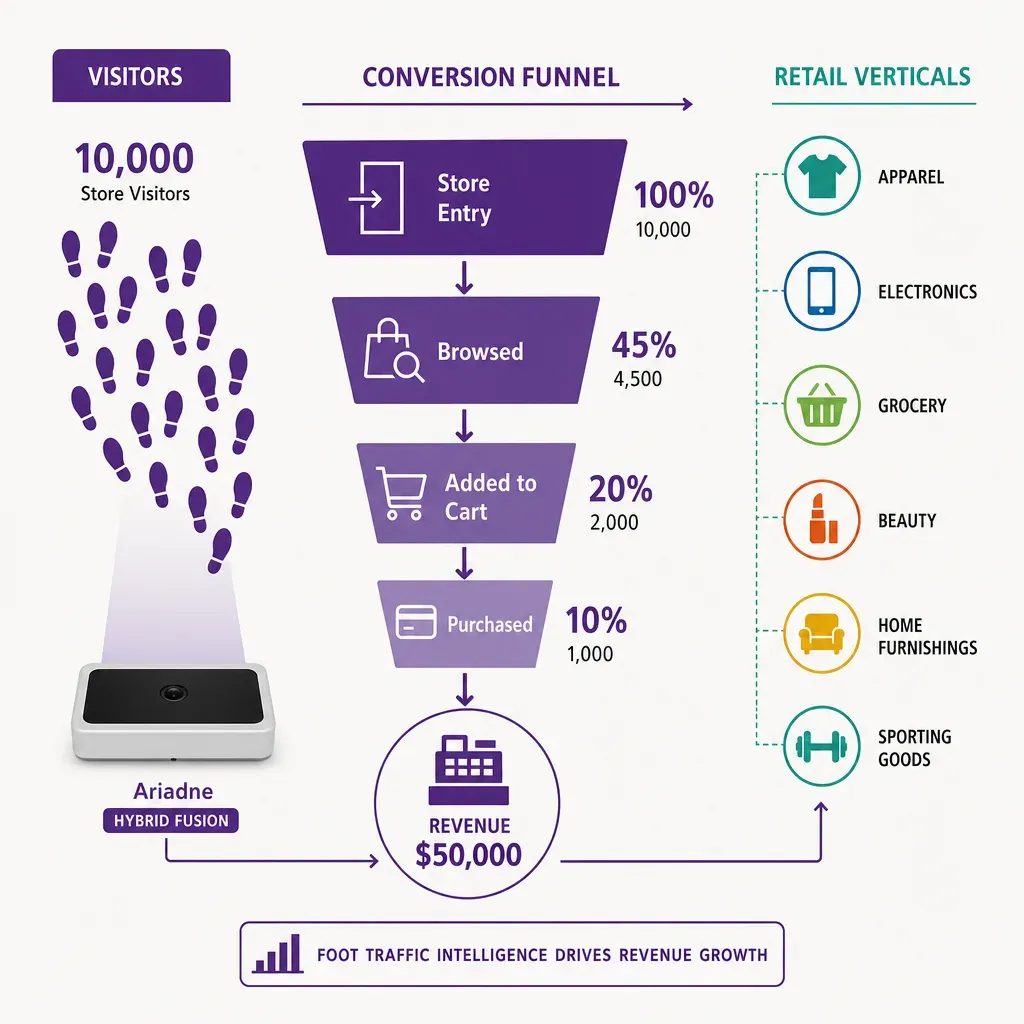
No. Ariadne counts with Hybrid Fusion: Time-of-Flight depth sensing plus patented phone signal sensing, never cameras. Time-of-Flight captures geometry rather than images, and signal sensing captures no MAC address by default, so the measurement involves no video, no faces, and no biometric data.


