
A hardware or DIY store serves two customers who barely overlap, and it serves them from the same floor. The trade buyer arrives early, knows exactly what they need, wants to be in and out fast, and treats the trade desk as the priority. The retail DIY shopper comes later, often at the weekend, browses, asks questions, and wanders the aisles deciding on a project. These two have different rhythms, different needs, and different peaks, and a store that staffs to one of them inevitably fails the other. The morning trade rush hits a counter set up for the afternoon browser, or the Saturday DIY crowd queues at tills staffed for a quiet weekday. The fix starts with seeing the two traffic shapes separately, which is what people counting does that the till cannot.
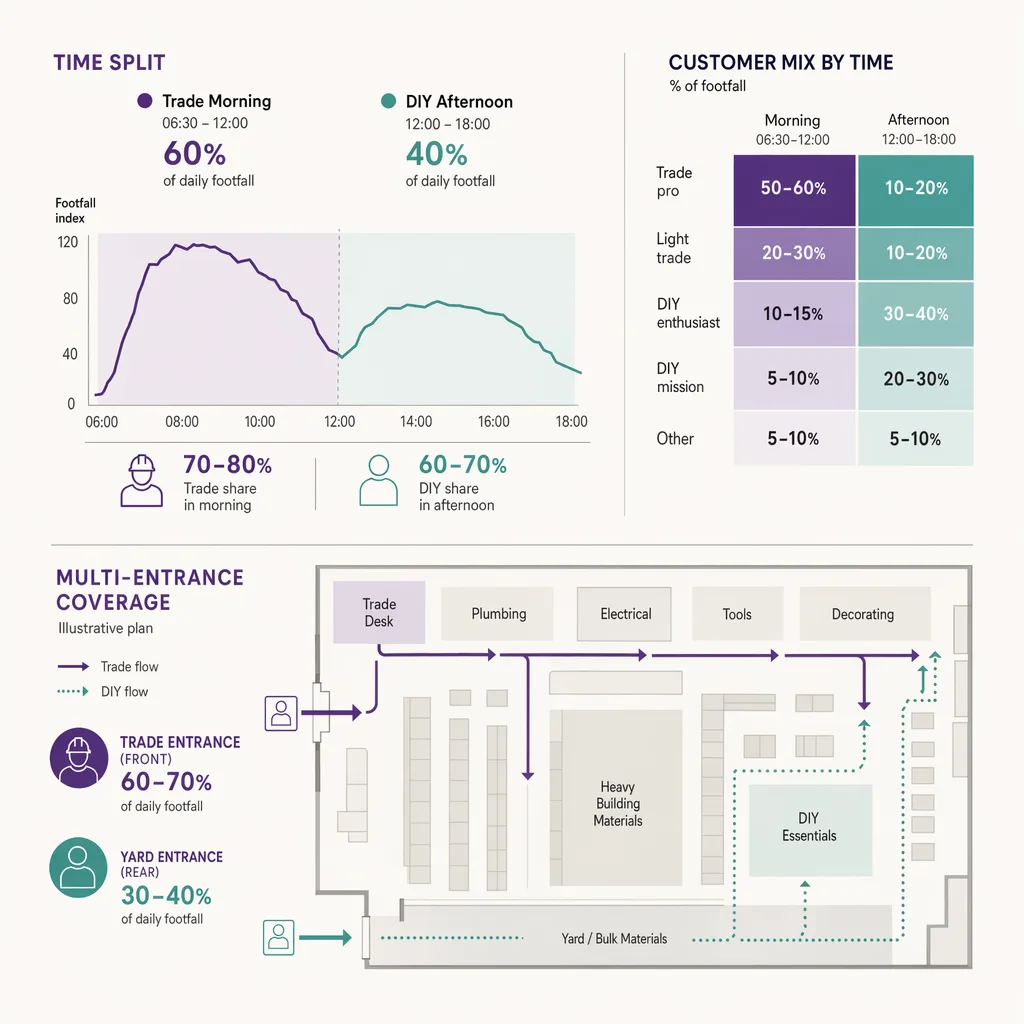
This is a guide to people counting in a hardware or DIY store. It covers the trade-versus-retail traffic split, counting every entrance on a large site including the trade and yard doors, measuring conversion and aisle draw across a big-box floor, and how a store manager turns the two traffic curves into the weekly staffing and layout calls. It is a counting how-to, not a marketing-attribution story.
Why count people in a hardware or DIY store?
A hardware store serves two very different customers from one floor: trade buyers who arrive early and move fast, and retail DIY shoppers who browse later in the day. People counting shows the real shape of each, so the trade desk and the retail tills are staffed for their own peaks rather than a flat rota. Across a large store it also measures conversion and which aisles draw traffic, on a site big enough that a single door counter would miss the side and trade entrances entirely.
The two-customer split is the angle that makes hardware different from generic store counting. The same daily total can be a trade-heavy morning or a retail-heavy weekend, and the staffing response is opposite. Counting that resolves the shape, not just the total, is what makes it useful here.
The hardware pain point: trade and DIY customers peak at different times on the same floor
A general store has one broad customer and a daily traffic curve to staff against. A hardware store has two curves laid on top of each other, and they peak at different times. Trade buyers tend to load the early hours: builders, plumbers, and electricians picking up materials before a job, moving fast, often heading straight for the trade desk or the heavy-materials end rather than browsing. The retail DIY shopper tends to fill the later day and the weekend: slower, project-led, asking for advice, comparing options down an aisle.
If you only see the combined daily total, the two curves blur into one and you staff to an average that serves neither well. The trade desk is understaffed at the morning rush, so fast-moving professional customers who value speed above all wait, and some take their account elsewhere. The retail tills and aisle help are thin at the weekend peak, so the browsing DIY crowd queues and goes unadvised exactly when good advice converts a project into a full basket. The store feels adequately staffed on paper and fails both customers in practice, because the paper used one number where the floor has two.
The cost lands differently on each customer, which is why averaging them is so damaging. The trade buyer is a relationship and a recurring account: a builder who waits too long at the trade desk on a Monday morning does not complain, they simply open an account at the merchant down the road and the store loses every order that buyer would have placed for years, not just today's. The DIY shopper is a basket-size opportunity: a project customer who cannot find help in the aisle buys the one thing they came for and leaves the paint, the brushes, and the filler they would have added with a word of advice. One failure is a lost lifetime account, the other a thinned basket, and a flat rota built on the blended total quietly inflicts both. Seeing the two curves apart is the only way to defend against the two different losses.
Trade-morning vs retail-afternoon traffic shapes
Counting separates the two curves so you can staff each to its own shape. The morning trade pattern and the afternoon-and-weekend retail pattern show up clearly once you are counting entries by time rather than reading the till, and they are stable enough across the week to plan against. Weekday versus weekend patterns are sharper in hardware than almost anywhere, because the trade week and the DIY weekend pull in different directions, and the day-of-week view makes that split obvious.
The staffing payoff is direct: put trade-desk and goods-out cover on for the early rush, weight retail tills and aisle advice toward the afternoon and weekend, and stop running a flat rota that is wrong for both halves of the day. Staffing to the traffic shape rather than a fixed schedule is the single change that most improves both the trade experience and the retail one, because each gets cover when its own peak actually lands.
Counting every entrance on a large store, including the trade and yard doors
A hardware big-box is not a single-door shop, and that breaks naive counting. There is the main retail entrance, often a trade entrance or counter with its own door, frequently a builders' yard or drive-through materials area with its own access, sometimes a garden or seasonal entrance. A single break-the-beam counter on the front door, on a site like this, simply misses the trade and yard traffic entirely, which is precisely the traffic you most need to see separately. To count a hardware store properly you have to count every way in, and attribute the trade and yard doors distinctly from the retail front.
This is also why the discipline of counting across a large-format store applies more than small-format thinking does. A big hardware floor has the same multi-entrance, multi-zone reality as a department store, and the counting has to match that scale: every entrance instrumented, and the interior followed so you know not just who came in but where on the floor they went.
Attributing the doors distinctly is also what makes the trade-versus-retail split measurable in the first place, not just visible. A trade entrance that feeds the counter and the heavy-materials end carries a different customer from the retail front that opens onto the aisles, so counting them separately is, in effect, counting the two customer types as they arrive. A single blended total cannot do that no matter how accurate it is, because it has already mixed the two streams at the threshold. The yard and drive-through access is the one most often left out and the one that matters most for the trade picture, since materials runs are exactly the fast, high-value trade traffic the store most needs to staff for. Counting the way in is counting the customer.
Conversion and aisle draw across a big-box floor
With every entrance counted, conversion becomes real. Total entries against transactions gives the conversion rate, and on a hardware floor that rate is worth reading separately for the trade and retail streams where you can, because a trade buyer almost always buys and a DIY browser often does not. Blending them hides both. Counting the entrances distinctly is what lets you see the two conversion behaviours instead of one muddy average.
Aisle draw is the interior half. A big-box hardware store has aisles that work hard and aisles that are passed by, seasonal ends that pull and dead corners that do not.
Ariadne measures this with Hybrid Fusion, its patented camera-free method. Time-of-Flight depth sensing counts every visitor at the entrances, capturing geometry rather than images, while patented phone signal sensing follows movement through the interior, detecting the signals a phone emits even in airplane mode, and tracks that movement to about one-metre precision. The sensor streams both feeds to Ariadne, where Hybrid Fusion combines them into one trajectory per visit and computes counts, dwell, and paths. The streams carry no identifier: no MAC address, no device ID, no biometric data, and no camera is involved. Identifiers are stored only when a visitor explicitly opts in, which keeps the method GDPR-friendly and outside biometric territory.
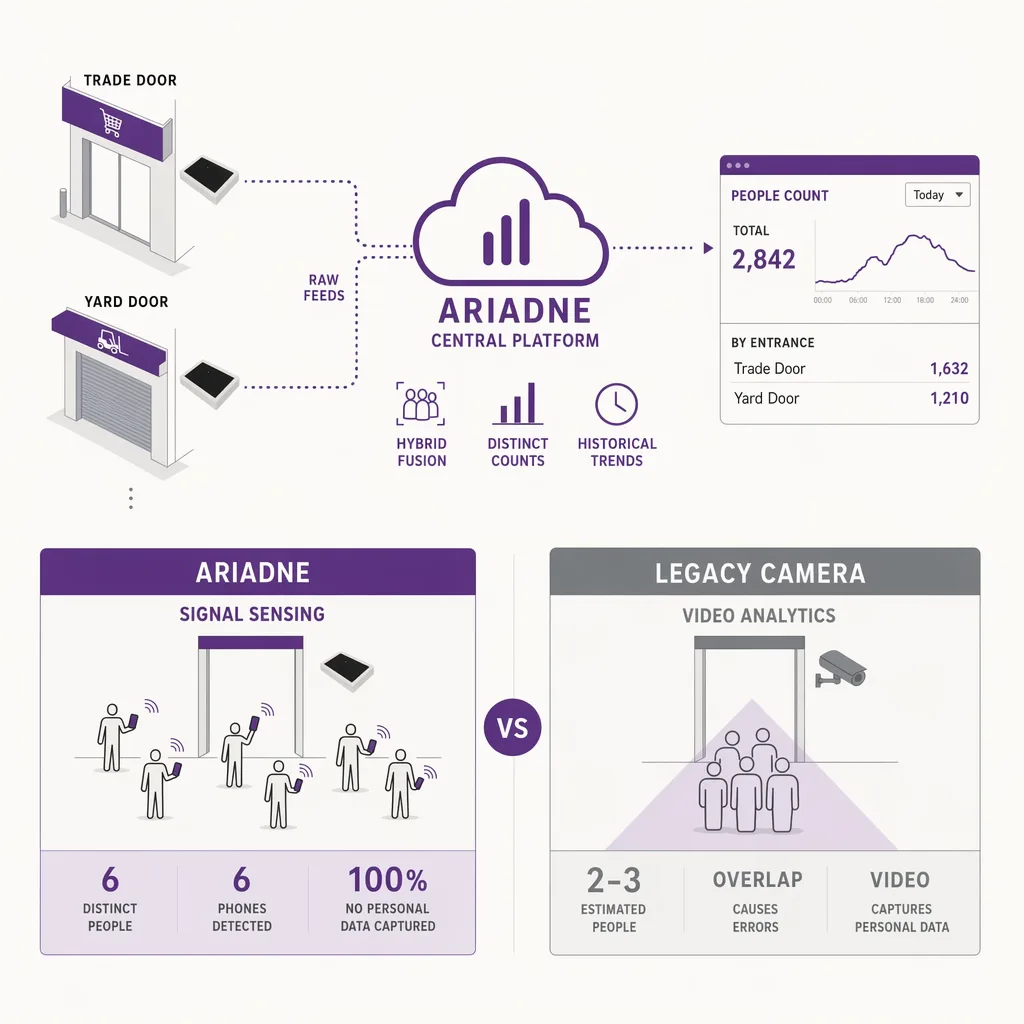
For a hardware store that means depth sensing at each entrance, including the trade and yard doors, counts groups accurately and keeps the streams separate, while the interior signal sensing shows which aisles and ends draw traffic across the big floor. It is camera-free, which keeps the install simple and the data clean of anything personal.
From counts to action: trade-desk cover, till staffing, range and layout
The data drives the decisions a hardware store manager makes week to week.
Trade-desk and goods-out cover is the first. The morning trade curve tells you when the professional rush actually lands, so you staff the counter and the heavy-materials end for speed when it matters and protect the trade relationships that depend on not waiting.
Retail till and advice staffing is the second. The afternoon-and-weekend retail curve tells you when to weight tills and aisle help toward the browsing DIY crowd, so the project shopper gets advice and a short queue at the peak that converts their basket rather than thinning it.
Range and layout is the third. The aisle-draw picture shows which parts of the floor pull traffic and which are passed by, which is the input for where seasonal ranges, promotions, and high-margin lines should sit, and which dead zones need a rethink rather than a refill. Acting on the counts the same way the retail discipline prescribes turns the two traffic curves and the aisle map into a floor that serves both customers and a range that follows where they actually go.
How a hardware store manager actually uses the numbers
The manager's main artefact is the day-of-week view with the two curves drawn separately, because that is what builds the rota. It shows where the trade morning peaks and where the retail afternoon and weekend land, and the rota follows: trade-desk and goods-out cover weighted to the early hours, retail tills and aisle advice weighted to the afternoon and weekend, rather than a flat schedule that is wrong at both ends. The conversion read, taken separately for the trade and retail streams where the door attribution allows it, is the monthly check on whether the cover is actually working, because a trade buyer almost always buys while a DIY browser often does not, and blending them hides both. The aisle-draw picture is the slower, seasonal input, used when deciding where the seasonal range goes, which dead end needs a rethink, and where the high-margin lines should sit on the busy path. The manager is not reading a dashboard all day; they are answering whether the rota matches the two curves, whether both streams are converting, and whether the floor layout follows where each customer actually goes.
FAQ
Why split trade and retail traffic in a hardware store?
Because they peak at different times and need opposite staffing. Trade buyers load the early hours and want speed at the counter; DIY shoppers fill the afternoon and weekend and want advice in the aisles. The same daily total can be a trade-heavy morning or a retail-heavy weekend, so counting the two shapes separately is what lets you staff each to its own peak instead of an average that serves neither.
Will one counter on the front door cover a big hardware store?
No. A large hardware store usually has a main retail entrance, a trade entrance or counter, and often a builders' yard or drive-through with its own access. A single front-door counter misses the trade and yard traffic entirely, which is the traffic you most need to see separately. Every entrance has to be counted, with the trade and yard doors attributed distinctly from the retail front.
Can people counting show which aisles draw traffic?
Yes. Interior flow data shows which aisles and seasonal ends pull traffic across the big floor and which are passed by, which informs where promotions, seasonal ranges, and high-margin lines should sit and which dead zones need a rethink. It is the same large-format discipline a department store uses, applied to a hardware big-box.
How should I measure conversion in a DIY store?
Count total entries across every entrance and set them against transactions for the conversion rate. Where you can, read trade and retail conversion separately, because a trade buyer almost always purchases while a DIY browser often does not, and blending them hides both behaviours. Counting the entrances distinctly is what makes the split possible.
Does hardware store people counting use cameras?
No. Ariadne counts camera-free, with Time-of-Flight depth sensing at each entrance, including the trade and yard doors, and phone-signal sensing through the interior. There is no video and no biometric data, which keeps the install straightforward across a large site and the data clean of anything personal.
How does counting the trade and yard doors separately help, beyond a more accurate total?
A trade entrance feeds a different customer from the retail front, so counting the doors distinctly is, in effect, counting the two customer types as they arrive. A blended total has already mixed the streams at the threshold and cannot separate them afterwards. The yard or drive-through access is the most often omitted and the most important for the trade picture, because materials runs are the fast, high-value traffic the store most needs to staff for.
What is the single most useful view for staffing a hardware store?
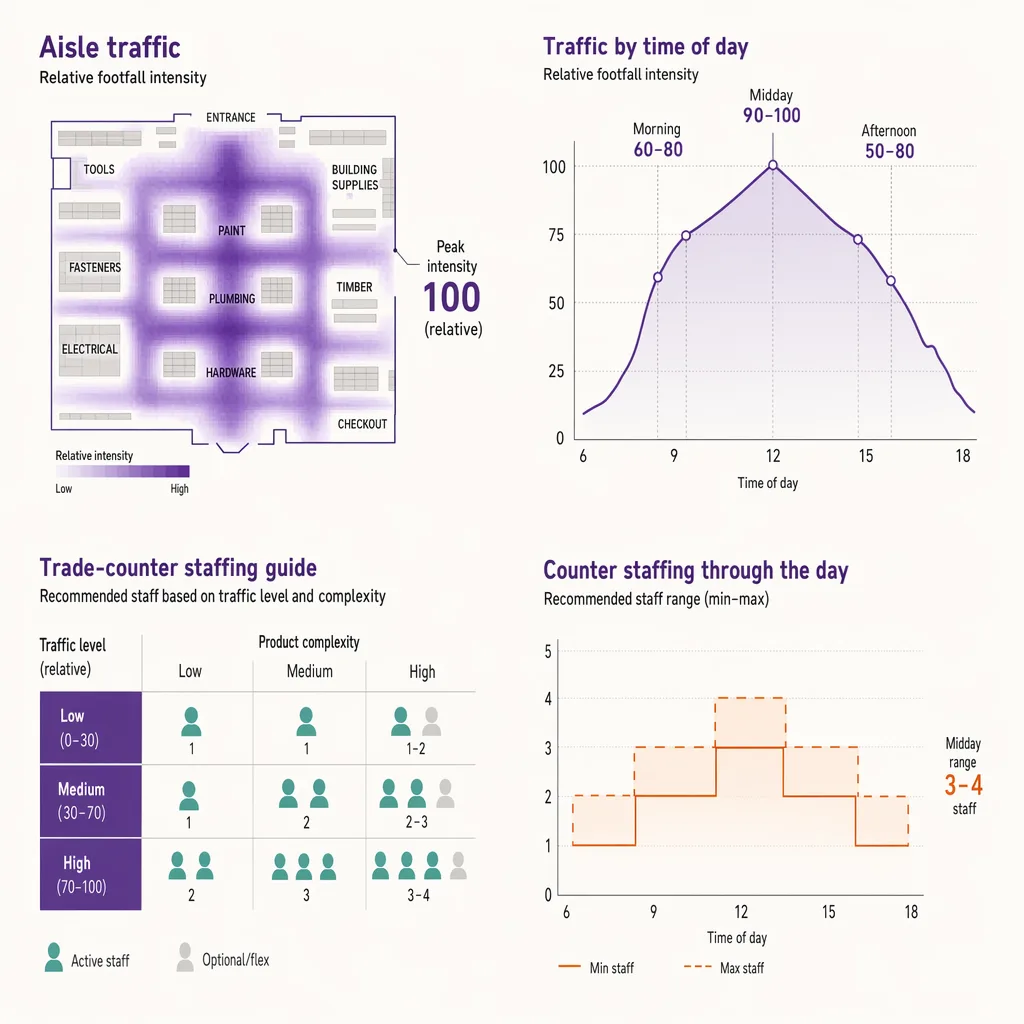
The day-of-week view with the trade and retail curves drawn separately. It shows where the trade morning peaks and where the retail afternoon and weekend land, which is exactly what a rota needs: trade-desk and goods-out cover weighted early, retail tills and aisle advice weighted to the afternoon and weekend, instead of a flat schedule that is wrong at both ends.


