
Ask any gym member what they hate most and "the floor was rammed" comes up before price. Ask the operator and you get a version of the same problem from the other side: the busiest hours are obvious from the queue at the squat racks, but nobody can put a number on them, so the rota is set by habit and the equipment plan is set by guesswork. Access turnstiles record a swipe, but a swipe is not a headcount on the floor, and it tells you nothing about which zone filled up.
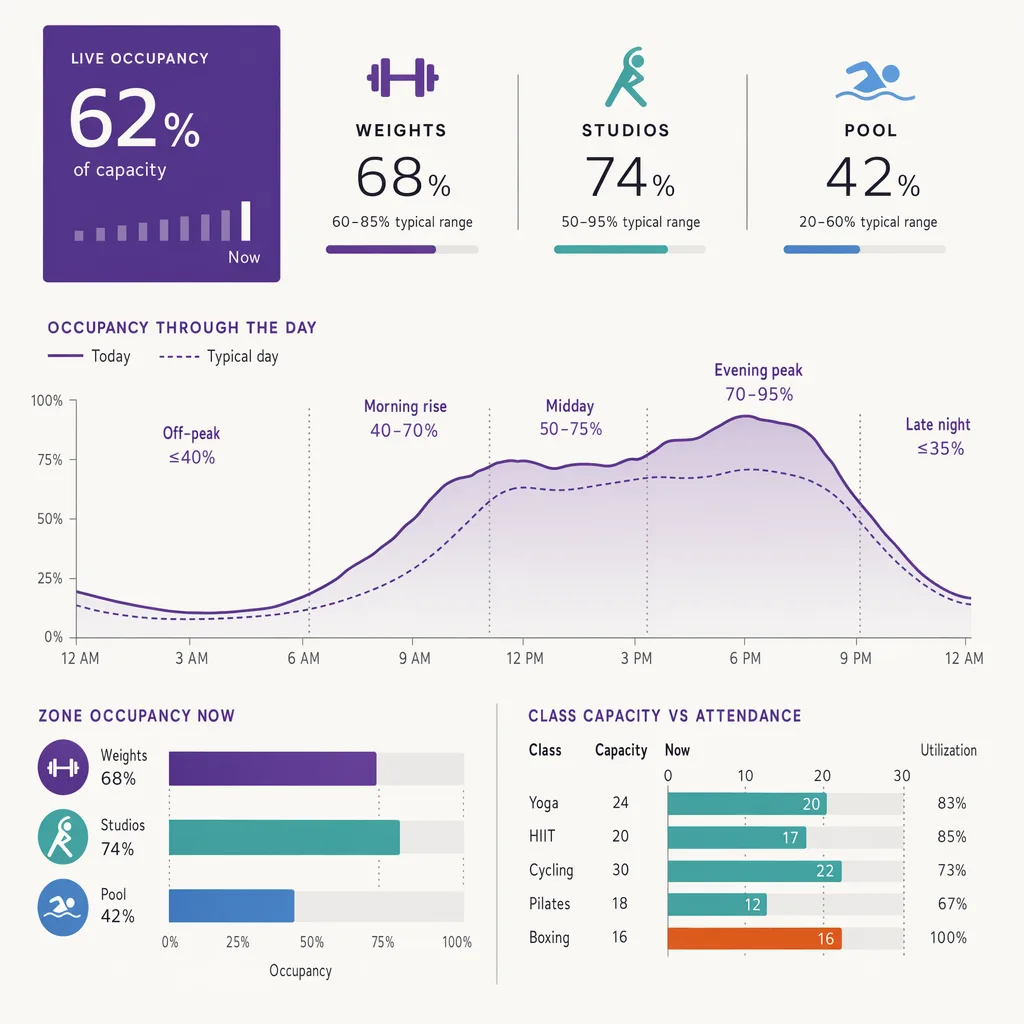
People counting closes that gap. It holds a live occupancy figure for the whole site and for individual areas, it shows which hours and which zones actually fill, and it does so without putting a camera anywhere near a space where members are changing, weighing themselves, or simply self-conscious. This is a guide to what counting does in a gym, why a camera is the wrong tool here, and how the data turns into class schedules, staffing, and the "how busy is it right now" figure members increasingly expect.
How does people counting work in a gym?
A gym people counter measures live occupancy and entry traffic at the door, so the floor team knows how busy each area is without counting heads by eye. It separates members who tailgate in together, holds an accurate live count for capacity limits, and shows which hours and which zones (free weights, studios, pool) fill up. Done without cameras, it gives capacity and staffing data without recording anyone's workout or face, which matters in a space where members are changing and self-conscious.
The count is the foundation. Everything below, the live number on the app, the class sizing, the off-peak promotion, comes from the same accurate entry and zone data.
The gym pain point: members hate a packed floor, but you cannot staff for a peak you cannot measure
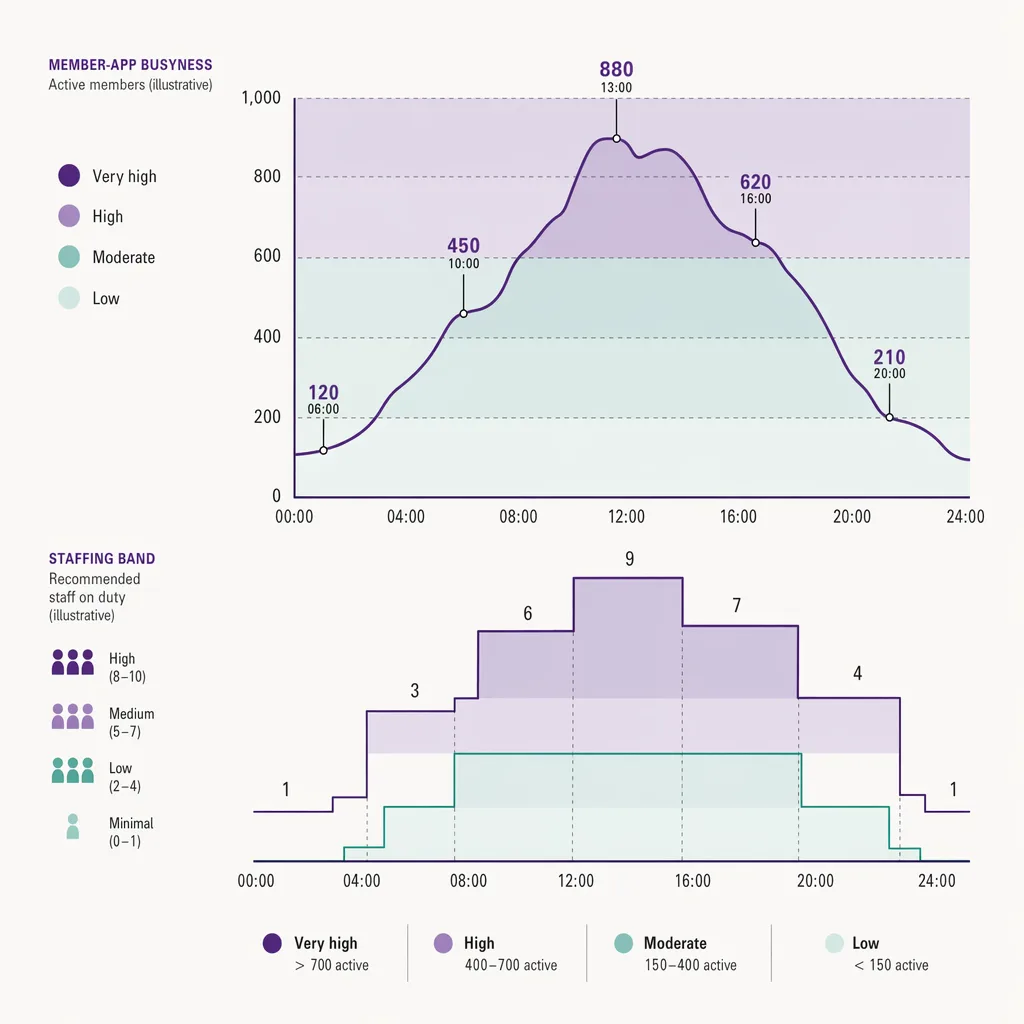
A gym's busiest period is not a mystery in general terms. Most sites know the post-work rush exists. What they do not know precisely is when it starts, how steep it is, how long it holds, and how it differs between a Monday and a Friday. Without that, the duty rota is a flat shape laid over a spiky demand curve. You end up with too many staff at 14:00 and too few at 18:00, the racks back up, and a member who pays monthly and can cancel monthly remembers the wait.
The shape of the curve matters as much as its height. A site with a sharp single evening spike needs a different rota from one that sees a morning peak, a lunchtime bump, and an evening crush, and those two profiles can sit a few miles apart in the same chain. A gym next to a business park empties at the weekend and fills hard between 17:30 and 19:30 on weekdays. A residential gym does the opposite, running quiet on weekday mornings and busy on Saturday mid-morning. A manager who can see those two curves side by side stops copying one site's rota onto another and starts setting cover from the demand each building actually has.
Access control makes this worse, not better, because it looks like data. A turnstile logs swipes, and swipes feel like attendance. But a swipe at 17:45 does not tell you whether that member is still on the floor at 18:30, and a member who tailgates in behind someone else is never counted at all. Two friends arriving together on one held door is a common gym pattern, and a simple beam counter reads them as one. There is a second swipe problem too: many members swipe in once and stay for ninety minutes, while others swipe in for a twenty-minute session, so swipe totals overstate the headcount that is actually on the floor at any given minute. To staff the floor and set capacity limits you need the live occupancy, by zone, held accurately through the exact crush that breaks naive sensors. That is the case for proper real-time vs historical counts rather than a swipe log read after the fact.
Live capacity counts for the floor and the app
The single most useful number a gym counter produces is the live one: how many people are in the building, and in each major zone, right now. It drives three things at once.
First, capacity. Occupancy limits in a gym come from a mix of fire regulation, insurance, and the simple practical ceiling of how many people the equipment can serve before the experience degrades. The exact figure varies by site and jurisdiction, so this guide does not quote a universal cap. What matters is that you cannot hold to any cap you cannot see, and an accurate live occupancy measurement gives the front desk a real number rather than a guess.
Second, the member-facing "how busy is it now" feature. A growing number of chains publish a live busyness indicator in their app, and members plan around it. That indicator is only as good as the count behind it. If it says quiet and the floor is full, the feature erodes trust faster than having no feature at all.
Third, the floor team's own awareness. A live zone count tells a duty manager that the studio is at capacity and the free-weights area is backing up before the complaints start, which is the difference between redirecting a class or opening a second area and finding out from a bad review.
In practice a duty manager uses the live number in small, repeated ways across a shift. At the start of the evening they watch the front-door count climb and know when to call the second person down from the office before the queue forms at the desk, rather than after. When the studio count hits its ceiling they stop directing walk-ins toward a class that is already full and send them to the floor instead. When a member at the desk asks whether it is worth coming back in an hour, the manager has a real answer instead of a shrug. None of these are dramatic interventions; together they are the difference between a floor that feels managed and one that feels like it is happening to the staff.
Zone-level traffic: weights vs studios vs pool, and when each peaks
A gym is not one space with one peak. The free-weights area, the cardio floor, the studios, and the pool each have their own rhythm, and they rarely peak together. Counting at the entrance to each zone, not just the front door, surfaces those separate curves.
The practical payoffs are concrete. If the studio fills for the 18:00 class but sits empty at 19:30, that is a scheduling signal, not a marketing one. If the free-weights area is the bottleneck every weekday evening while the cardio floor has space, the equipment ratio is wrong for the membership you actually have. If the pool peaks at lunchtime and the gym floor peaks after work, the lifeguard and floor-staff rotas should not be the same shape. None of this is visible from a single door count, and all of it is visible from zone counts read against the hour of the day.
Zone data also settles arguments that otherwise run on opinion. The classic one is the request for more squat racks or a second functional-training rig. Without numbers, that decision turns on whoever complains loudest. With a zone count, a manager can show that the free-weights area sits at or near its practical ceiling for ninety minutes every weekday evening while the studio next door is half empty, which reframes the question from "buy more kit" to "give the bottleneck the space the quiet zone is wasting." The same data flags the opposite case: a zone that the membership voted for in a survey but barely uses in practice, which is a refurbishment budget that could go somewhere the traffic actually is. A studio room running at a fraction of capacity for most of its timetabled hours is a strong candidate for a different class format, a personal-training space, or a reservable bookable room, and the count is what turns that from a hunch into a proposal a regional manager will sign off.
Reading zone counts against class timetables
The sharpest gym-specific use of zone data is laying the studio count directly over the class timetable. A class that is fully booked on the app but shows only two-thirds of that headcount walking into the studio has a no-show problem, which is a retention and revenue signal worth chasing. A class that is never full on the app but consistently draws walk-ins who could not book tells you the cap is set too low. A 06:00 class that the timetable treats as a flagship but that the count shows running near-empty most mornings is a slot to move or cut. The timetable is a set of intentions; the zone count is what actually happened, and the gap between the two is where most of the easy scheduling wins sit.
Why a camera is the wrong tool in a gym, and how camera-free counting fits
A gym is one of the worst possible places to put a counting camera. Members move between the floor and changing areas, the building is full of mirrors that confuse image-based sensors, and the entire setting trades on people feeling comfortable being seen working out, or not seen at all. A camera over the door of a space like this is a privacy conversation you do not want to have, and in many cases a compliance burden you do not need to take on. This is the core of the argument for a camera-free people counting approach and, more broadly, why camera-free fits sensitive spaces.
Ariadne measures this with Hybrid Fusion, its patented camera-free method. Time-of-Flight depth sensing counts every visitor at the entrances, capturing geometry rather than images, while patented phone signal sensing follows movement through the interior, detecting the signals a phone emits even in airplane mode, and tracks that movement to about one-metre precision. The sensor streams both feeds to Ariadne, where Hybrid Fusion combines them into one trajectory per visit and computes counts, dwell, and paths. The streams carry no identifier: no MAC address, no device ID, no biometric data, and no camera is involved. Identifiers are stored only when a visitor explicitly opts in, which keeps the method GDPR-friendly and outside biometric territory.
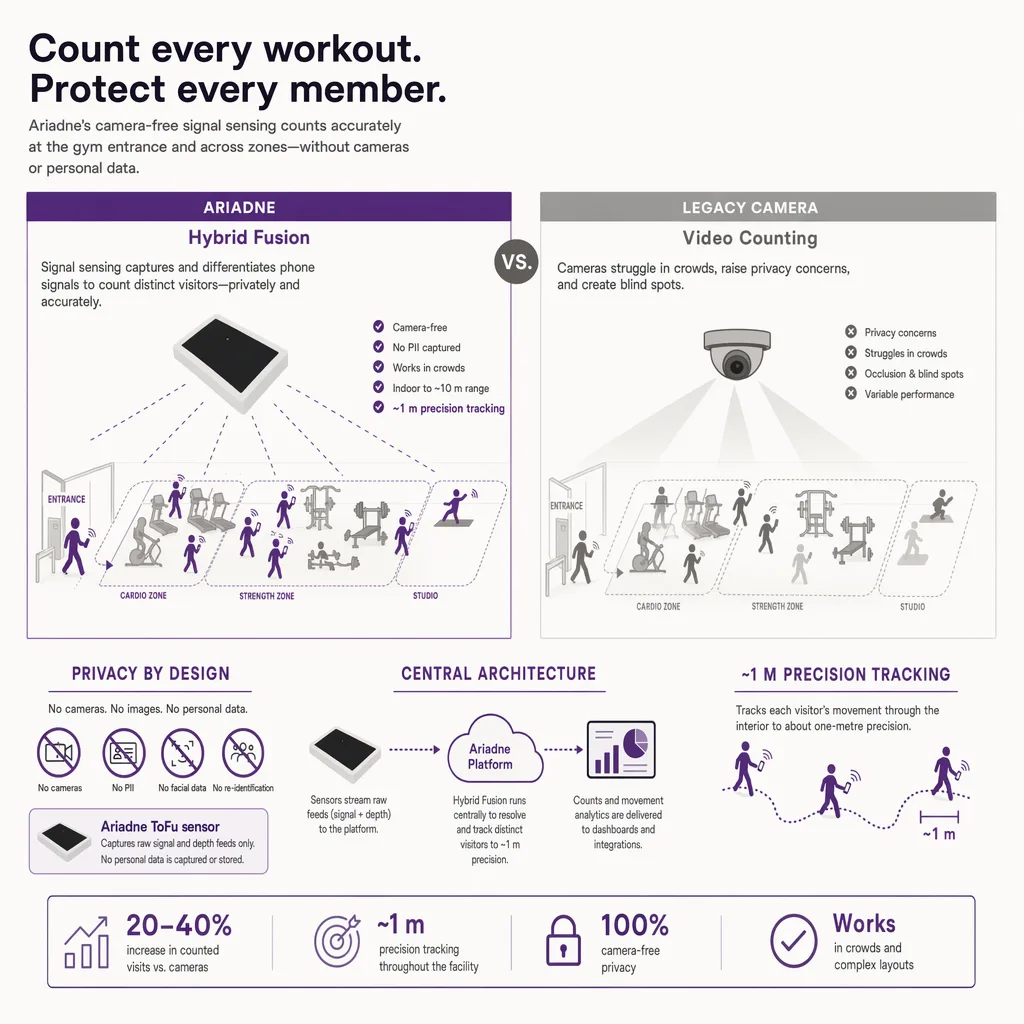
Read against the gym's problems, that method fits cleanly. The depth sensing at the door handles the tailgating pattern, two members on one held door, because it sees two separate shapes rather than one broken beam. It works regardless of the mirrored walls and changing light that defeat an image-based counter. And it never records what a member looks like or what they are doing, which is the only acceptable answer in a space this personal.
This matters beyond the member's comfort. A gym that markets itself on privacy, and many do, cannot square that promise with a camera over the changing-room corridor, no matter how the footage is handled. A method that captures geometry and signal rather than images keeps the marketing and the install honest: there is no footage of anyone's session to leak, to subpoena, or to reassure a nervous member about. The conversation with a member who asks "are you watching me train" has a clean answer rather than a hedged one.
From counts to action: class scheduling, off-peak promotions, equipment ratios
The data is only worth collecting if it changes a decision. Three decisions it changes most directly:
Class scheduling. If the studio's busy windows do not line up with the timetable, move the classes, not the members. A class that fills at 18:00 and empties at 19:30 is telling you to add an 18:00 slot and cut the 19:30 one.
Off-peak promotions. Counting shows the genuinely quiet hours, the mid-morning and early-afternoon troughs, which is where an off-peak membership or a daytime class can add revenue without making the evening crush worse. The promotion is aimed at the trough you can see, not the trough you assume.
Equipment and staffing ratios. The zones that bottleneck every evening are the ones to expand or rebalance, and the hours that spike are the ones to staff. Matching cover to the curve is the same discipline retailers apply when they talk about staffing to the busy hours: put the people where the demand is, not evenly across the day.
What the data settles at the membership and estate level
Counting earns a second role above the single site, in the hands of a regional or operations manager running a portfolio of gyms. Two questions come up constantly at that level, and both are usually answered by anecdote today.
The first is capacity strain against membership growth. Sales targets push membership up, but the floor has a ceiling, and the point at which a popular site starts shedding members to churn is often the point at which the evening crush became unbearable. A live occupancy history shows how close each site runs to its practical ceiling at peak and how often it crosses the line where the experience degrades. That is a far better input to a sales cap or an expansion decision than waiting for the cancellation rate to spike and then guessing why.
The second is comparing sites fairly. Two gyms with similar membership numbers can run very different floors: one converts its members into frequent, spread-out visits, the other has a long tail of members who rarely come and a small core who crush the evening. Visit frequency and the shape of the daily curve, not just the headline membership count, tell you which site is genuinely well used and which is selling memberships against a floor that cannot hold the attendance if everyone turned up. For a chain deciding where to invest in more space or more kit, that distinction is the whole decision.
FAQ
Does a gym people counter use a camera?
No. A camera-free counter measures the shapes of people passing under a depth sensor at the door and, for interior movement, reads phone signals, without ever capturing an image. That is the right fit for a gym, where members move between the floor and changing areas and the building is full of mirrors that defeat image-based sensors.
How does a gym counter handle members who walk in together?
Depth sensing at the door sees two separate shapes even when two members come through on one held door, so it counts both. A simple break-the-beam sensor reads them as one, which is the most common cause of undercounting in gyms. This is the same counting members who walk in together problem that breaks naive counters everywhere.
Can I show members how busy the gym is right now?
Yes, if your counter holds an accurate live occupancy figure. Many chains publish a live busyness indicator in their app, and it is only as reliable as the count behind it. An accurate zone-level count lets you show busyness for the whole site or for individual areas.
Does the counter track which members are present?
No. Camera-free counting records how many people are in a space, not who they are. No face, no device identifier, and no record of any individual workout. Identity is only ever attached when a visitor explicitly opts in to something that needs it.
What occupancy limit should a gym use?
That depends on fire regulation, insurance, and the practical capacity of your equipment, and it varies by site and jurisdiction, so there is no universal number. The point of counting is to hold to whatever your limit is with a real figure rather than a guess at the door.
Can counting tell me whether a class no-show problem is real?
Yes, if you count the studio separately. Lay the studio entry count over the booked numbers on the app and the gap is your no-show rate. A class that is fully booked but consistently draws fewer bodies than it booked is losing slots that other members would have taken, which is a retention and revenue signal worth acting on.
How does counting help with off-peak pricing?
It shows the genuinely quiet hours rather than the ones you assume are quiet. An off-peak membership or a daytime class is only worth promoting against a trough the data confirms is real, so you fill the empty hours without pushing more members into the evening crush that is already the main reason people cancel.
---


