
A decade ago, airports focused on shortening lines. Today the mission is bigger: optimize the entire passenger journey.
People counting has evolved from a tactical metric to a strategic capability. Airports no longer just want to know how many passengers pass a checkpoint; they need to understand why people dwell, where bottlenecks form, what drives concession revenue, and how to act in real time.
This shift has sparked a re-evaluation of the technologies behind passenger analytics. For years, stereoscopic 3D camera systems set the standard for precise counting in controlled spaces. Camera-free methods now measure movement across the whole terminal, not only at a fixed line. This guide walks airport leaders through both approaches, not to pit one against the other, but to help you choose for a terminal where flow, behaviour, and experience are linked.
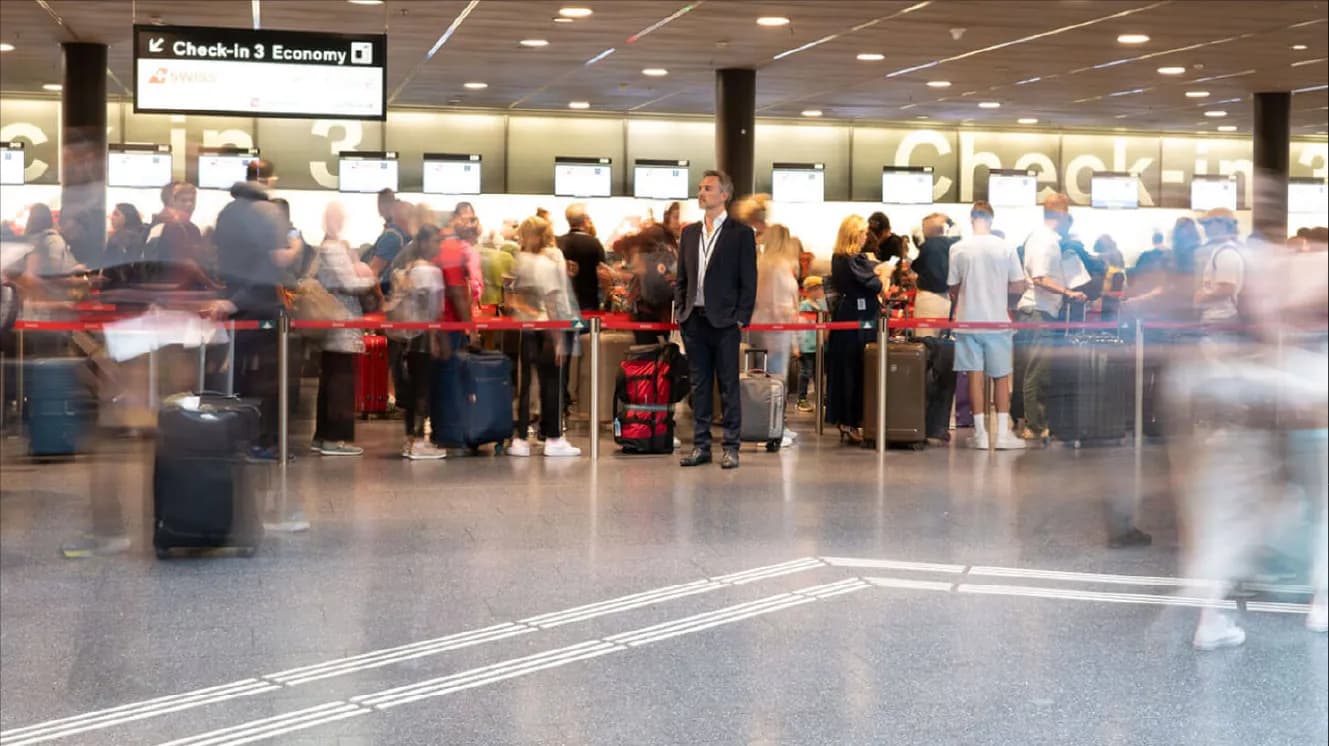
The Optical Legacy: What 3D Cameras Do Well
Stereoscopic 3D cameras emerged when structured spaces demanded structured tools. Mounted overhead, these sensors capture depth and movement and process data locally to minimize privacy exposure. Airports could finally understand:
- How long queues lasted at immigration
- How fast security was processing passengers
- What staffing levels worked best on Mondays vs. Fridays
It worked and still works well in controlled environments like check-in counters, security lines, and narrow concourses.
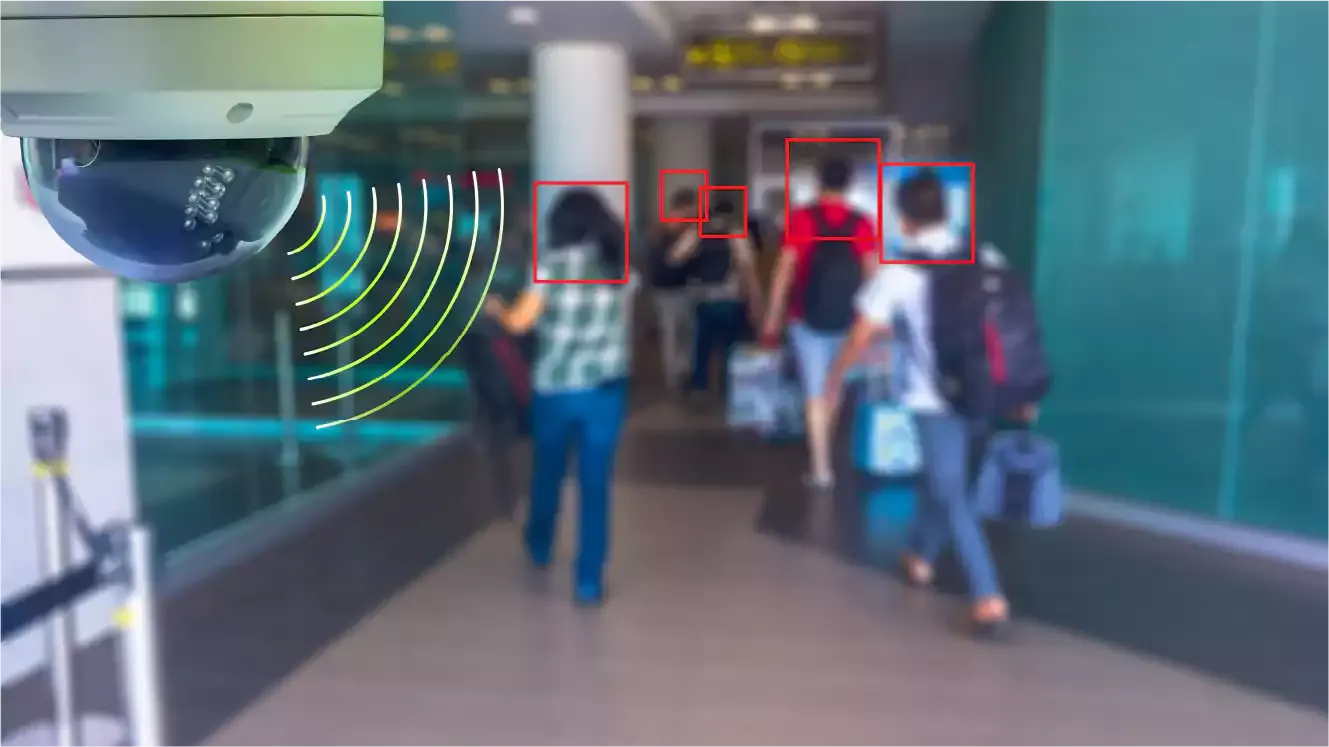
But what about non-linear spaces?
Gates, lounges, shops, boarding bridges, baggage belts: real airports are full of irregular, dynamic zones. Here, optical systems reveal their limits:
- Line-of-sight dependence: No coverage if vision is blocked
- Fixed infrastructure needs: High installation cost across large terminals
- Limited commercial insight: Great at queues, weak on retail flow
Optics are excellent at knowing “how many.” But airports needed to know “what else.”
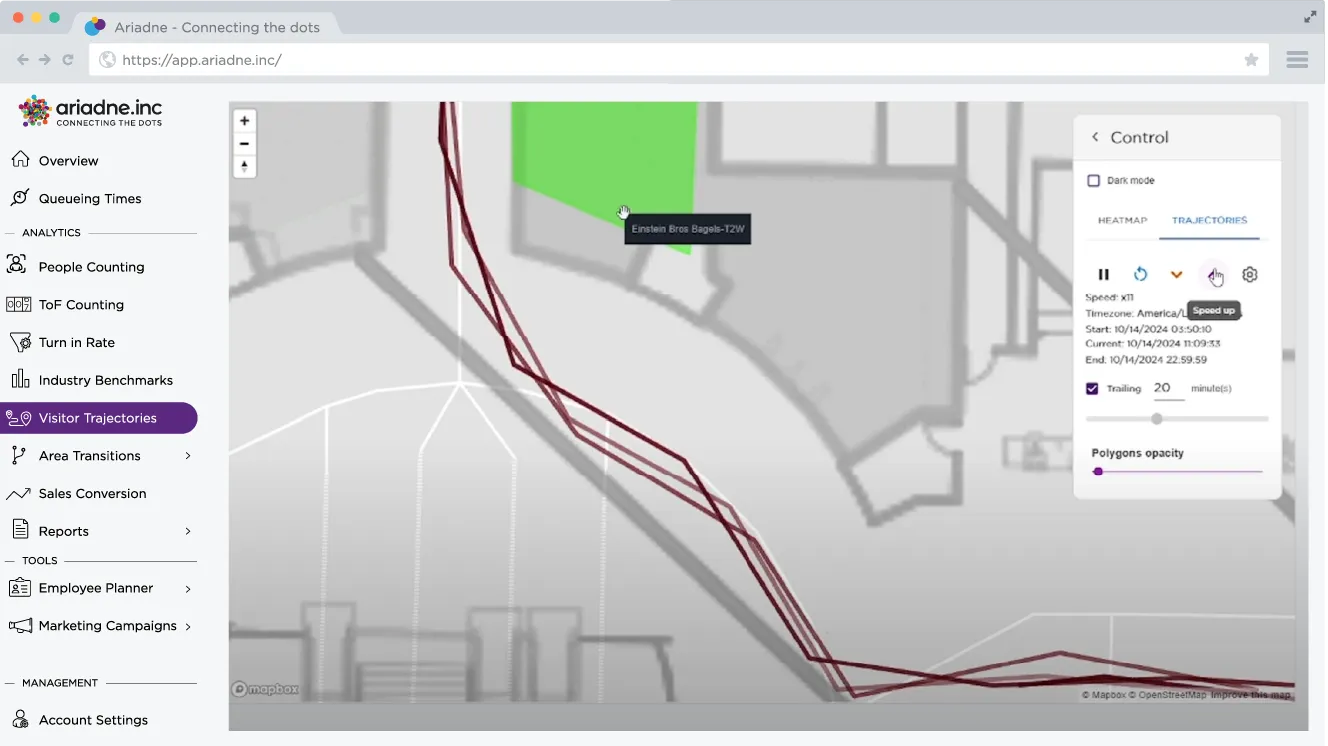
Rethinking People Counting with Ariadne’s Passive Signal & Fusion Technology
Ariadne approaches the problem differently. Instead of installing cameras to see people, it measures where passengers go, how long they dwell, and which way they move, without video and without capturing personal data.
Ariadne measures this with Hybrid Fusion, its patented camera-free method. Time-of-Flight depth sensing counts every visitor at the entrances, capturing geometry rather than images, while patented phone signal sensing follows movement through the interior, detecting the signals a phone emits even in airplane mode, and tracks that movement to about one-metre precision. The sensor streams both feeds to Ariadne, where Hybrid Fusion combines them into one trajectory per visit and computes counts, dwell, and paths. The streams carry no identifier: no MAC address, no device ID, no biometric data, and no camera is involved. Identifiers are stored only when a visitor explicitly opts in, which keeps the method GDPR-friendly and outside biometric territory.
That means:
- Tracking groups vs. individuals
- Recognizing returning visitors who have opted in
- Measuring how a marketing campaign affects actual footfall
- Changing digital signage content as zone occupancy changes
- Delivering real-time heatmaps to operations or retailers
Ariadne’s system transforms basic movement data into passenger journey analytics, giving airports a 360° view of operational efficiency and passenger behavior.
Comparing Use Cases: Where the Difference Becomes Clear
Let's walk through typical airport zones and see how each approach performs. For the full selection criteria, see how to choose airport people counting technology.
Security & Immigration Queues
3D cameras: Ceiling-mounted stereo sensors track heads with high spatial precision. For predicting wait times, throughput, and SLA compliance, optical systems are proven and strong.
Ariadne measures directional flow toward and away from checkpoints and combines queue length with real-time alerts, so staff can be redeployed or passengers rerouted while the queue is forming.
Verdict: 3D cameras lead in fixed-line tracking. Ariadne adds alerts and integrations, and its accuracy should be verified at your own checkpoints, as with any system.
Retail Zones and Food Courts
3D cameras only counts pass-bys accurately, but struggle to explain why people stop, how long they stay, or whether they return.
Ariadne measures dwell time, route patterns, and returns, and relates flow to sales. Fusion lets commercial teams compare behaviour with marketing touchpoints for campaign attribution.
Verdict: Ariadne provides both footfall and context, essential for commercial teams and airport tenants.
Multi-Terminal Hubs & Legacy Infrastructure
3D cameras require structured planning. Each area needs ceiling clearance, wiring, and calibration, which slows expansion and raises costs.
Ariadne thrives on flexibility. Sensors can be deployed using existing Wi-Fi infrastructure or discretely mounted, covering complex layouts, temporary gates, and seasonal zones with ease.
Verdict: Ariadne wins for scalability, cost-efficiency, and retrofit simplicity.
Privacy Is the New Standard
In today’s world, GDPR isn’t optional, it’s expected. Both platforms are compliant, but their philosophies differ.
3D cameras anonymize video on-device but inherently capture visual frames.
Ariadne never uses video at all. No faces, no images, and no identifiers unless a visitor opts in.
This gives Ariadne a distinct advantage in markets like Europe, Canada, the Middle East, where privacy regulations are strict and expanding.
Verdict: where optical systems are legally or culturally sensitive, Ariadne offers privacy by design rather than a workaround.
From Counting to Converting: A New Strategic Role
A decade ago, people counters lived in operations. Today, retail, advertising, and data science teams all rely on movement intelligence. Airports are data-rich ecosystems, and counting is just the start.
- Retail revenue optimization
- Digital signage ROI attribution
- Space leasing based on true dwell zones
- Passenger journey mapping for loyalty and personalization
- Event analytics for seasonal activations or promotional zones
Verdict: Ariadne turns movement into monetization.
Conclusion: The Future Belongs to Fusion
3D cameras helped airports understand lines. Ariadne helps airports understand the journey. Optical systems count passengers in well-defined spaces; Ariadne connects operations, commerce, and experience in one real-time view.
If your airport is planning for a future where every journey counts and every square metre matters, start with how the measurement works.
This article covers airports. For the general case, and how camera-free counting works in any venue, see people counting without cameras.
Discover Ariadne's Fusion technology for airports


