
The five years that broke the anchor model
Between 2020 and 2025, the department-store anchor stopped being the reliable draw that mall leasing was built on. The chains that defined the format spent the period closing stores, shrinking floor plates, restructuring under court protection, or exiting whole regions. The boxes they vacated, often the largest and most prominent units in the scheme, sat empty long enough to change how landlords, lenders, and specialty tenants thought about what an anchor actually is.
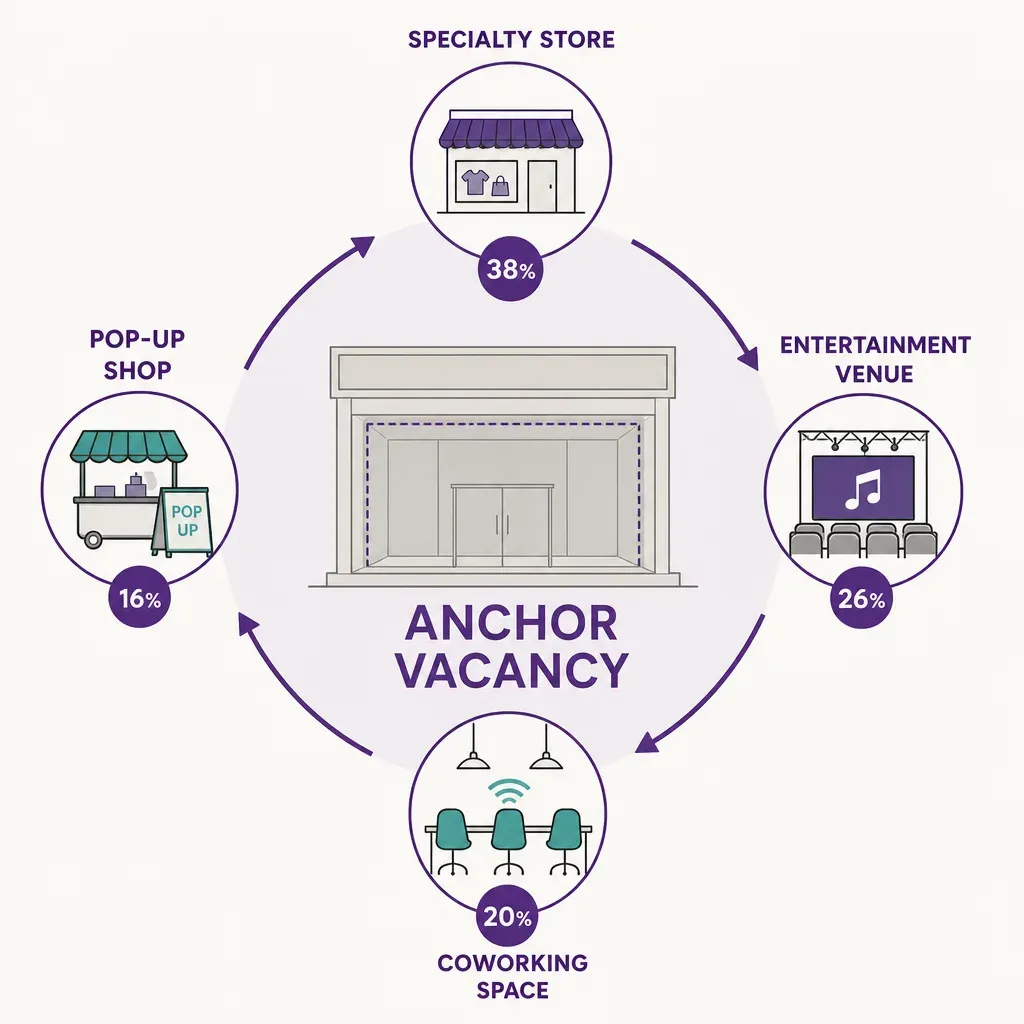
This is not a single bad year. It is a five-year arc with a consistent direction. The pandemic accelerated a decline that began before it, then the recovery exposed how thin the underlying demand had become. By 2025, the question for most shopping center owners is no longer whether the department-store anchor will return to its old role, but what mix of uses will replace it and how to measure the result.
This post sets out the shape of the decline, the categories of replacement that have absorbed the floor space, and what landlords are doing with footfall data through the transition. It is a general industry view rather than a roster of named centers, because the pattern repeats across markets in similar ways, even where the specific tenants and properties differ.
What the decline actually looked like
Department stores entered the 2020s already weakened. The format depended on a wide assortment under one roof at a time when shoppers had moved to specialty stores for depth and to online platforms for price and convenience. Footfall to the anchor box had been softening for years, and the cross-shopping that anchor leases relied on, the assumption that a customer visiting the anchor would walk the mall on the way in or out, had been thinning in line with it.
Across the five years from 2020 to 2025, four things happened in sequence in most mature markets. Different countries hit each stage at slightly different times, but the order held.
- Forced closures and chain restructurings. The early period of the decade combined emergency closures with the corporate restructurings of chains that had been carrying too much debt and too much floor space into the downturn. The result was a wave of permanent store closures concentrated in the largest, most expensive boxes.
- A slow, partial recovery. When stores reopened, the chains that survived did so with smaller, more focused estates. Visits per remaining store were often higher, but the total floor area operating under each banner was meaningfully lower than it had been before. Mid-tier and regional chains that did not consolidate fast enough kept losing ground.
- Long-dated vacancies in the biggest units. Because the vacated units were so large and so specifically built for one tenant, reletting them as a single store proved difficult. Many sat dark for a year or more, and the visible vacancy at the headline end of the mall did its own damage to the perception of the scheme, even when the rest of the lineup was trading.
- Conversion rather than replacement. By the second half of the period, the dominant response stopped being a search for another department store and became a redevelopment exercise: subdivide the box, mix in non-retail uses, and accept that the old anchor model was not coming back.
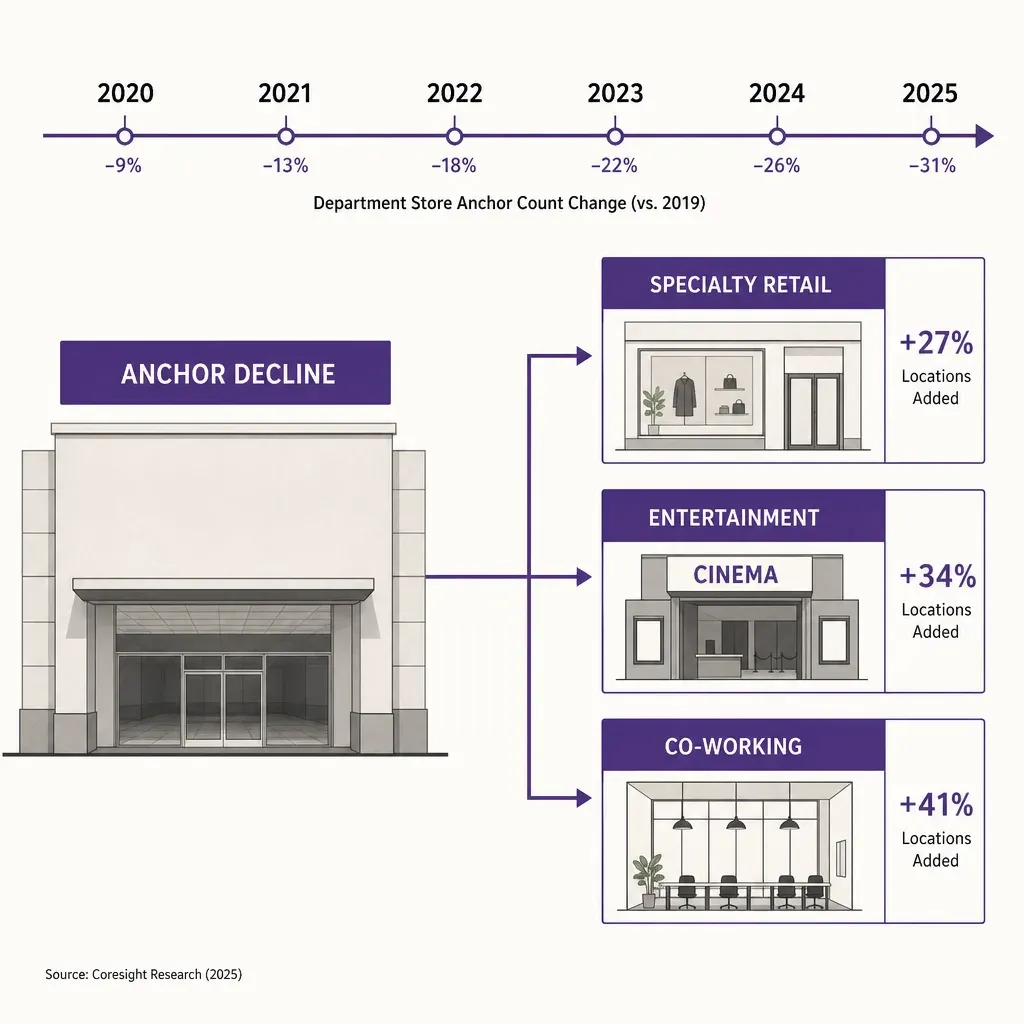
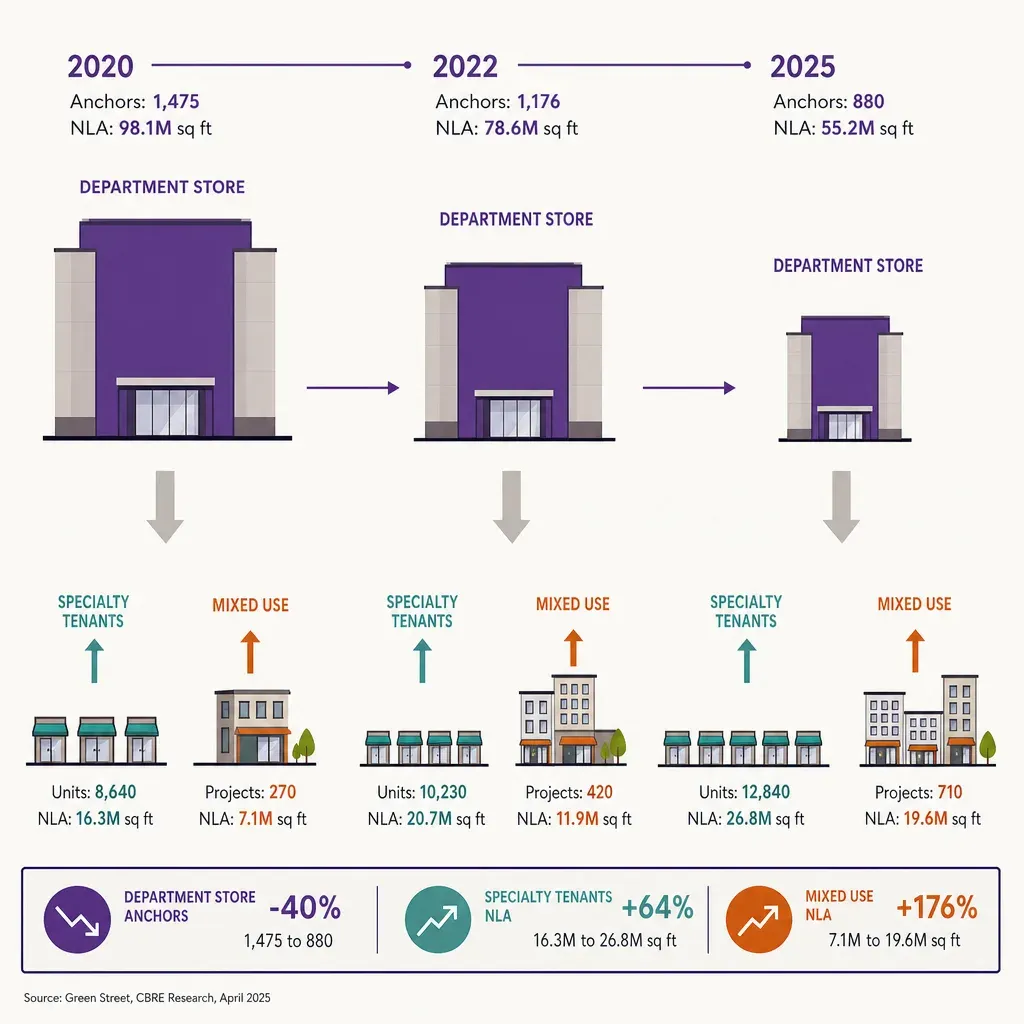
Anyone working with public market data, retail consultancy reports, or central-bank retail surveys from the period can see the same arc in different units. The exact percentages vary by country, by format (regional mall, lifestyle center, outlet), and by source, so this post does not present a single headline number as if it were a measurement of every market. The shape is what matters: a structural reduction in department-store floor space, concentrated in the largest units, that has not reversed.
Why the department-store draw stopped working
The decline was not only a corporate story. Beneath it sits a shift in how shoppers use a trip to a center, and the anchor model has not adapted to it.
- Online ate the assortment advantage. The original case for a department store was that it carried everything in one place. When the everything case moved online, the in-person reason to walk a 15,000 square metre floor weakened. The remaining reasons (touching the product, immediate availability, returns) are better served by specialty retailers and by smaller format experiences than by a single broad box.
- Trip patterns shifted away from the long weekly visit. Shoppers come more often for shorter, more purposeful trips, and they combine retail with food, services, and leisure on the same visit. The anchor format was designed for a destination shop that has become rarer.
- The cross-shop assumption frayed. Specialty leases priced in the assumption that a department-store visit would feed traffic past the rest of the units. When anchor visits fell and trip purposes narrowed, that spillover thinned, and the rent that was justified by it stopped being justified.
- Capital costs followed the demand curve down. As earnings from department-store leases contracted, the capital needed to refurbish ageing boxes became harder to justify against the same square metres redeveloped into uses with stronger demand. Lenders started to value the same floor space differently depending on what was in it.
Read together, those forces explain why the unit that vacated rarely came back as the same kind of tenant. The market that had supported it as the primary draw had been quietly shrinking for a decade, and the events of the first half of the 2020s simply brought the gap between supply and demand into the open.
What replaced the anchor
The interesting part of the period is what owners actually did with the floor space. Three categories of use have absorbed most of the former anchor footprint in mature markets, and the better redevelopments have combined more than one of them rather than picking a single replacement.
Food and beverage, expanded well beyond the food court
The most common single replacement is hospitality. The old food court (a ring of fast-food units around shared seating) has been displaced by full restaurants, casual dining, dark-kitchen halls, and bar concepts that take significant floor space and trade across the day and into the evening. Where a department store generated one peak around weekend afternoons, a strong food and beverage cluster generates lunch, after-work, dinner, and weekend peaks, and it brings back the trip purposes the anchor lost.
The leasing logic is different too. Food and beverage tenants pay differently from a fashion or homewares anchor, frequently on turnover and percentage rents rather than long flat covenants, which gives the landlord upside if the cluster trades well and shares the risk if it does not.
Experiential and entertainment uses
The second category is everything that pulls people on a trip but does not sell goods off a shelf. Cinemas have continued to anchor schemes where they can deliver consistent programming. Beside and beyond them, owners have brought in trampoline parks, climbing gyms, e-sports venues, indoor minigolf, family entertainment centers, and immersive exhibition operators. The unifying feature is dwell: an experiential tenant brings a visitor for an hour or two with a planned stop, and the visitor often eats in the center either side of the activity.
Experiential floor space is not easy. It is operationally intensive, the formats fail more often than national fashion chains do, and the rents on a square-metre basis are usually lower. What it offers in exchange is foot traffic that is not arbitraged away by an online channel, which is exactly the property landlords need from the new anchor.
Non-retail mixed-use floors
The third category is non-retail use carved into or built on top of the scheme: medical and dental clinics, dialysis centers and diagnostic imaging suites, co-working operators, civic and council services, libraries and learning spaces, gyms and fitness clubs, and in many redevelopments, residential floors built above the retail. Each places a population on or beside the site that has to come and go regularly, and which therefore generates footfall by living and working there rather than by visiting on a shopping trip.
This is the deepest structural change. Once a clinic or a gym sits where a department store used to be, the asset stops being a pure shopping center and becomes something closer to a neighbourhood hub. The leasing pitch changes accordingly. The case for a small tenant near the new anchor is no longer that they will catch a department-store shopper, but that they will be in front of a daily flow of patients, members, students, or residents. The mixed-use anchor tenant model is a fuller treatment of how that works; the point here is that the trend was visible across the 2020 to 2025 window in scheme after scheme.
How landlords run the scheme through the transition
Replacing an anchor is a multi-year project that touches the lease structure, the construction budget, and the rest of the tenant mix at the same time. The owners who handle it best treat the transition as a sequence rather than a single switch, and they instrument the scheme so that each stage is decided on observed data rather than on guesswork.
- Establish the real footfall baseline. Before any redevelopment work begins, the owner needs a clean baseline of how much traffic the scheme actually generates without the lost anchor, by entrance, by day, and by hour. Without that baseline, no later claim about uplift from the new anchor can be tested.
- Subdivide for optionality. The single-tenant box that the chain occupied is rarely the right unit for the replacement. Splitting it into smaller leasable units, with the services and access designed in early, opens up the food and beverage and experiential options that the original footprint blocked.
- Sequence the leasing so the scheme is not dark in the meantime. A visible empty anchor degrades the rest of the lineup quickly. Phased fit-out, pop-up programming, and temporary uses (markets, events, exhibitions) keep the floor in use during the works, which protects the footfall the surrounding specialty tenants are paying rent against.
- Measure the contribution of each new tenant. When the first new tenant opens, the question is not just how it trades in isolation. It is whether the rest of the center sees more traffic, and where. Footfall data by zone and by hour is what answers that, and it is what supports the rent on the next tenant signed in.
- Renegotiate the co-tenancy clauses to match the new model. Specialty leases written around the old anchor often contain protections tied to a named department store. As the replacement strategy emerges, those clauses need to be reworked to reference the new draw, whether that is a stated occupancy of the redeveloped floors, the presence of a defined experiential operator, or a footfall threshold the owner is prepared to commit to.
The thread running through that sequence is evidence. The old anchor model let landlords lean on the reputation of a national name. The new model leans on what the scheme actually does in foot traffic, week after week, which is something only an instrumented building can show.
The footfall question, in practice
When the anchor was a single department store, the landlord rarely needed independent footfall data. The tenant's own sales reported through the percentage-rent clause was a usable proxy, and the rest of the mall's performance was assumed to follow from that one number. In a redeveloped scheme with two or three smaller anchors and a different mix of uses, that proxy is gone. The owner is the only party with line of sight across the whole site, and the whole-site view has to be built from footfall sensing rather than borrowed from any one tenant.
The questions a landlord typically asks of that data through a transition are concrete: how the new food and beverage cluster moves lunchtime traffic, whether the experiential anchor pulls visitors into the units around it or simply parks them next door, how the residential or clinic floor changes the early-morning and mid-week baseline, and where in the building the dead hours have shifted to as the new uses come in. None of those questions can be answered by an annual headline count. They are answered by per-zone, per-hour footfall that runs continuously across the redevelopment.
A worked-through illustration helps. Consider a hypothetical regional center that lost its main department-store anchor in 2021, kept the unit dark for eighteen months, and reopened it through 2023 as a subdivided floor: a food hall on one side, a family entertainment operator on the other, and a small clinic with its own entrance off the car park. With a clean baseline from before the redevelopment, the landlord can read each of the three new arrivals separately, compare the footfall they generate with the unmeasured assumptions the old anchor was carrying, and price the next round of specialty leases on what the new uses actually deliver. The specific numbers in any real scheme would differ; the point is that the decisions rest on observed flow, not on the marquee on the box.
Measuring the new anchor without surveillance
A center that is becoming a hub for clinics, gyms, residential floors, and dining is also a center with more sensitive people on it. Patients arriving for an appointment, residents using the ground-floor retail as a neighbourhood parade, and members coming to a gym should not have to accept being identified or tracked in order to be counted. That is true for compliance reasons in most jurisdictions, and it is true for trust reasons everywhere.
Ariadne measures this with Hybrid Fusion, its patented camera-free method. Time-of-Flight depth sensing counts every visitor at the entrances, capturing geometry rather than images, while patented phone signal sensing follows movement through the interior, detecting the signals a phone emits even in airplane mode. The sensor streams both feeds to Ariadne, where Hybrid Fusion combines them into one trajectory per visit and computes counts, dwell, and paths. The streams carry no identifier: no MAC address, no device ID, no biometric data, and no camera is involved. Identifiers are stored only when a visitor explicitly opts in, which keeps the method GDPR-friendly and outside biometric territory.
For a landlord working through the post-department-store transition, the practical consequence is that the whole-site footfall picture, by zone and by hour, can be built without a camera in a clinic corridor, without identifying a resident on their way home, and without holding personal data on a gym member. The data describes the movement of a population, which is what the leasing and redevelopment decisions need, and nothing about the individuals in it.
Where this leaves the format
The five-year period from 2020 to 2025 will read in retrospect as the moment the department-store anchor moved from default position to one option among several, and increasingly the less common one. The format that pulled the post-war shopping center into being has shrunk to a footprint that the market can support, which is meaningfully smaller than the inventory it built. The schemes that remain healthy through the transition are the ones whose owners stopped looking for a like-for-like replacement and started managing a more complicated mix of uses, with the data infrastructure to see how that mix actually performs.
For owners and asset managers, the practical takeaways from the period are short. Treat the anchor as a function (reliable, repeating footfall) rather than a name. Plan for subdivision and mixed-use replacement rather than a single new covenant. Instrument the scheme before, during, and after the redevelopment so that every leasing decision is supported by what the building actually does. And keep the measurement camera-free, because the new tenant set includes uses that will not accept anything else. The deeper treatment of the model that succeeds the department-store anchor sits in the broader work on anchor tenants, with related notes on the anchor replacement playbook.
FAQ
Why did department-store anchors decline between 2020 and 2025?
The underlying demand for a broad assortment under one roof had been moving online and to specialty retail for a decade, and the events of the early 2020s, forced closures, chain restructurings, and a slow recovery, brought the gap into the open. Floor space contracted, large boxes sat empty, and the cross-shop assumption that supported specialty rents thinned out.
What is replacing department-store anchors?
Three categories of use cover most redevelopments: an expanded food and beverage offer (full restaurants, dark-kitchen halls, bars), experiential operators (cinemas, family entertainment, sports and immersive concepts), and non-retail mixed-use floors (clinics, gyms, co-working, libraries, residential). The strongest schemes combine more than one of these rather than picking a single replacement.
How do landlords measure the new anchor's performance?
With continuous footfall data by zone and by hour, across the whole scheme rather than relying on any one tenant's sales. That data establishes a clean baseline before the redevelopment, tracks each new tenant as it opens, and answers concrete questions about lunchtime flow, dwell, dead hours, and the contribution of each new use.
Does measuring footfall in a redeveloped center require cameras?
No. Camera-free counting based on depth sensing at entries and patented phone signal sensing in the interior can produce per-zone counts and dwell time without recording images, faces, or device identifiers, which matters in schemes that now mix clinics, residential floors, and gyms alongside retail.


