
What a mixed-use anchor tenant actually is
For most of the past fifty years, the anchor tenant of a shopping center was a department store. It signed a long lease on the largest box in the scheme, paid little or no rent in exchange for the traffic it pulled, and gave the smaller specialty tenants a reason to believe the location would stay busy. The whole co-tenancy model was built around that single draw: one big name at each end of the mall, and a corridor of shops in between living off the footfall those names generated.
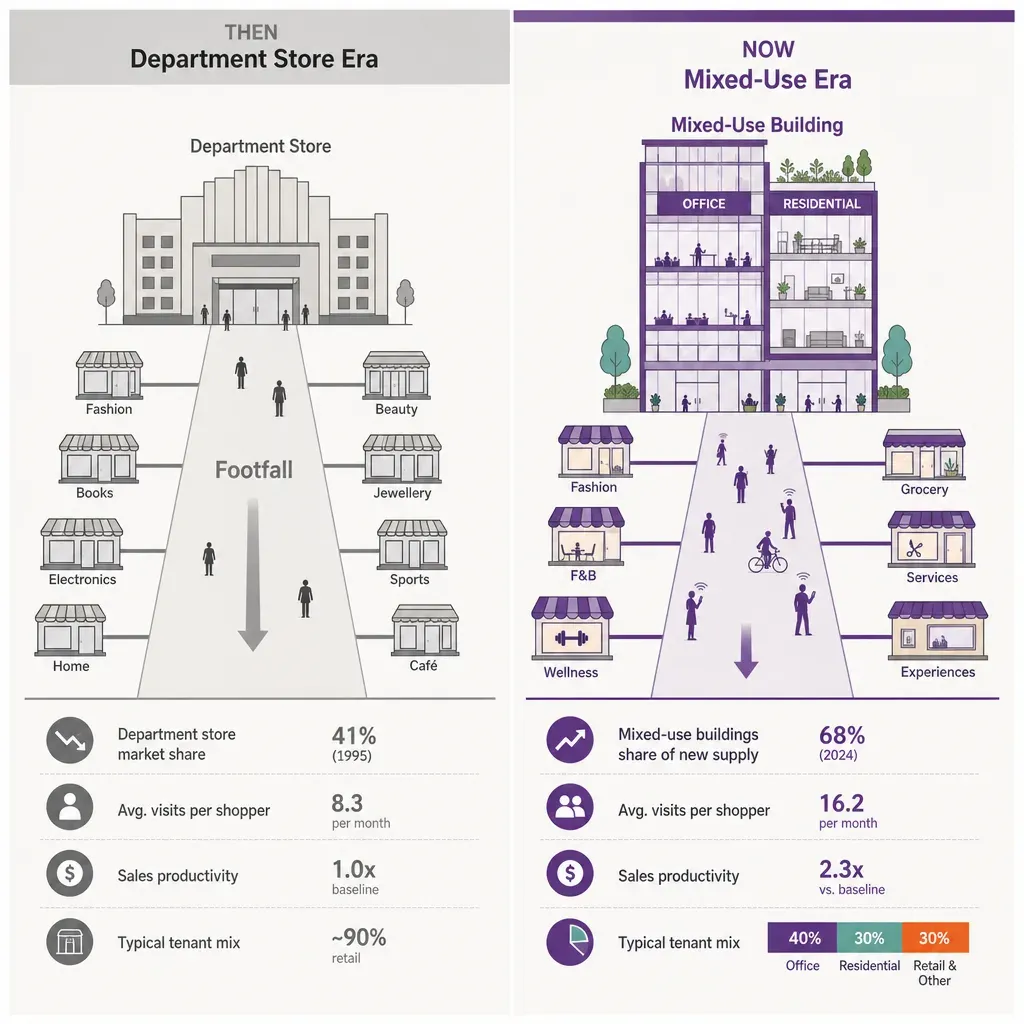
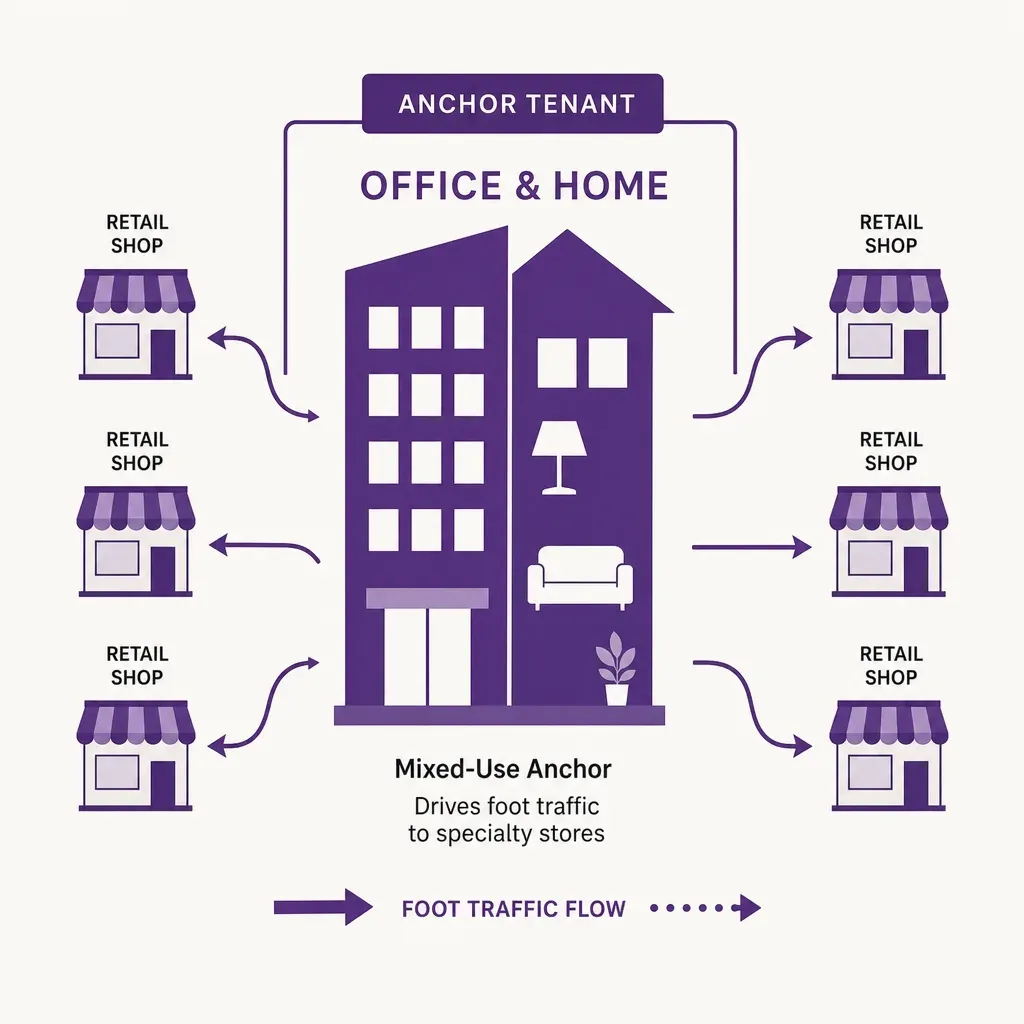
That model has been unwinding for years. Department-store chains have closed branches, shrunk their floor plates, or disappeared entirely, and the boxes they leave behind are too large and too specialised to relet to another retailer on the same terms. The replacement is rarely another store. Increasingly it is an office floor, a residential block, a hotel, a medical center, or a fitness club bolted onto the scheme. When one of those uses takes the place of the old department store as the reason people show up, it becomes the anchor. That is what a mixed-use anchor tenant is: a non-retail use that performs the anchor's old job of generating reliable, repeating footfall, even though it sells nothing on the mall floor.
The shift is not cosmetic. It changes who signs the headline lease, how the rest of the tenant mix is assembled around them, and how a landlord proves the scheme works. Owners of shopping centers who still think of the anchor as a retail problem are solving the wrong question.
Why offices, homes, and clinics became the new anchors
The logic behind the original anchor was footfall. A department store brought a large, predictable flow of visitors to a fixed point, and the specialty tenants captured a share of that flow as it moved past their doors. The mixed-use anchors that have replaced it do the same thing through a different mechanism: instead of pulling shoppers on a trip, they place a population on or beside the site that has to pass through it as part of daily life.
Each non-retail use generates footfall with a distinct rhythm, and that is precisely why they are useful as a mix.
- Offices. An office floor delivers a dense weekday-daytime population that arrives in the morning, breaks at lunch, and leaves in the early evening. For a food court or a coffee operator, that lunch peak is a guaranteed trade window that no amount of weekend retail traffic can replicate.
- Residential. Apartments above or beside a scheme create resident footfall that is the inverse of the office pattern: evenings, early mornings, and weekends. Residents treat the ground-floor retail as their convenience parade, which supports grocery, pharmacy, and everyday services that need repeat local custom rather than destination pull.
- Hospitality. A hotel adds an out-of-hours and weekend population with disposable spend and time to fill, which props up restaurants, bars, and leisure that would struggle on commuter traffic alone.
- Healthcare. A medical center, clinic, or diagnostic facility brings a steady, appointment-driven flow spread evenly across the working week, including the mid-morning and mid-afternoon lulls that retail traditionally cannot fill. The accompanying staff are a daytime population in their own right.
- Gyms and leisure. A fitness club generates two sharp peaks, early morning and after work, that bracket the office day and bring members back several times a week. That repeat frequency is worth more to a smaller tenant than a one-off shopping visit.
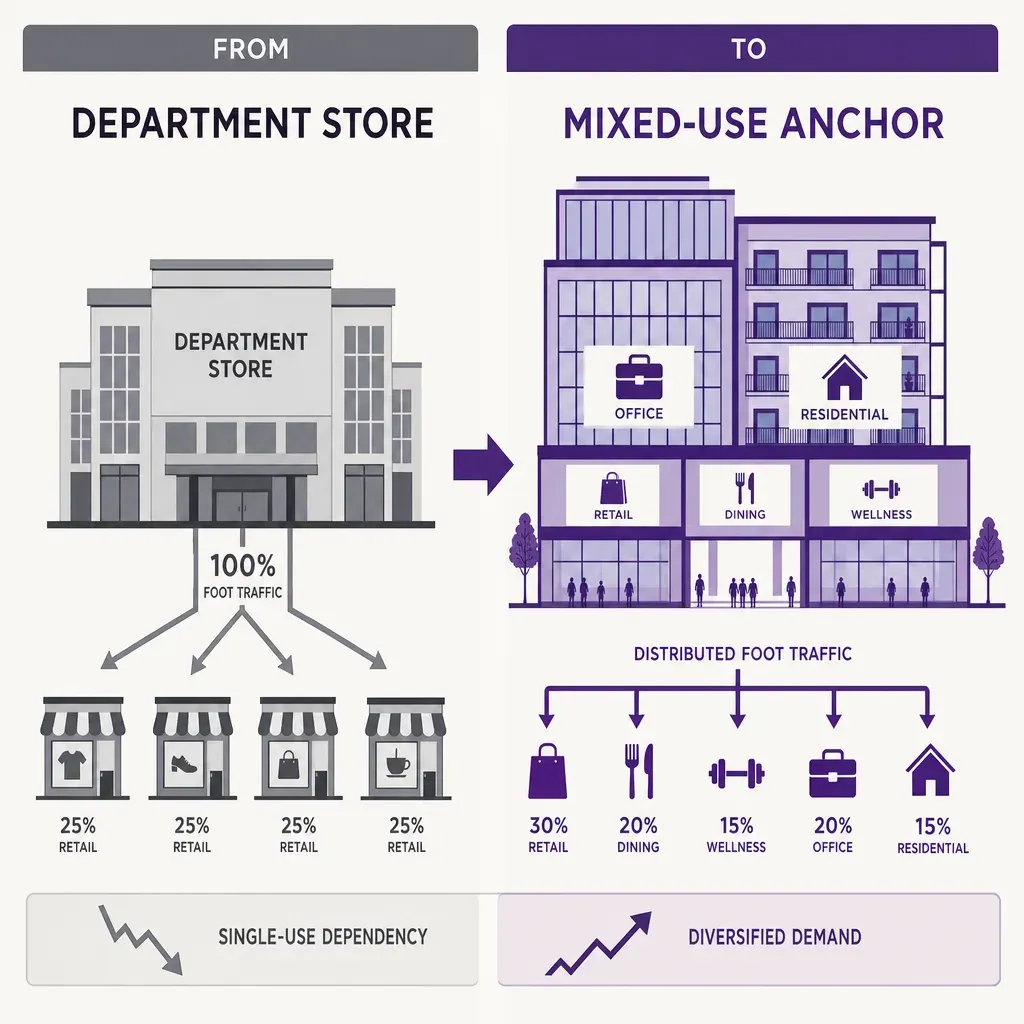
Read together, these uses fill the gaps in each other's day. The office covers the weekday daytime, residential and the gym cover the early and late edges, the hotel and healthcare smooth the midweek troughs, and weekend leisure carries the days the offices are dark. A well-assembled mixed-use scheme is one where some part of the site is generating footfall during almost every trading hour, which is exactly the stability the single department-store anchor never actually provided.
The new co-tenancy model: a population, not a name
Under the old model, the co-tenancy clause that protected specialty tenants was tied to named anchors. A typical clause let a small tenant cut its rent or break its lease if a named department store closed, on the reasoning that the store was the source of the traffic the tenant had paid to sit near. When the anchor was a single retailer, that made sense: lose the name and you lose the draw.
Mixed-use breaks that link. The draw is no longer one tenant whose departure can be written into a clause; it is the combined daytime and evening population that the office, residential, hospitality, and healthcare uses put on the site. That has two consequences for how leases are written and how the mix is judged.
- Co-tenancy shifts from named tenants to occupancy thresholds. Instead of naming a department store, a modern clause is more likely to reference an occupancy or trading-population benchmark: a minimum share of the office floors let, the hotel open and trading, or a stated level of footfall maintained. The protected thing is the population, so the clause measures the population.
- Resilience comes from spread, not from a single covenant. A scheme leaning on one department store had a single point of failure. A scheme drawing footfall from five different uses can absorb the loss of any one of them, because the others keep a population on the site. The mix itself is the insurance policy, which changes how a landlord underwrites the scheme and how a lender views its income.
This is why the leasing conversation has moved away from chasing a marquee retail name and toward curating a balanced set of footfall generators. The question is no longer which store will anchor the scheme. It is which combination of uses keeps a viable population moving through the site across the whole week.
Reading cross-use footfall to set the tenant mix
If the anchor is now a population rather than a name, the landlord has to be able to see that population to manage it. The old proxy for anchor performance was the department store's own sales figures, which the landlord rarely saw and which told them nothing about the rest of the scheme. The mixed-use equivalent is footfall data read across uses: how many people the offices, homes, hotel, clinic, and gym actually put onto the site, when, and where they go once they are there.
That cross-use view answers leasing questions the old model could not.
- Where the daytime population actually spends. If the office floors deliver a strong lunch peak, footfall data shows whether that peak reaches the food and beverage units, or whether workers leave the building entirely. That tells the leasing team whether the food offer is sized and placed correctly, or whether the trade window is leaking off-site.
- Which uses feed which tenants. By reading the pattern of visits, a landlord can see whether the residential block supports the grocery unit on weekday evenings, whether hotel guests reach the restaurants, and whether gym members pass the units near the entrance they use. That linkage is the evidence base for the next round of leasing decisions.
- Where the dead hours are. Every mix has troughs. Footfall by hour and by zone shows exactly when and where the site goes quiet, which is where the next use, a clinic to fill the midweek lull or evening leisure to carry the dark office hours, should be targeted.
- What the population is worth to a prospective tenant. A retailer or operator weighing a unit wants to know the realistic flow past the door, by day and by hour, not a single annual headline. Honest, granular footfall data is a stronger leasing pitch than a department-store name ever was, and it is one a landlord can actually stand behind.
For illustration, consider a hypothetical mixed-use scheme with several thousand office workers above ground-floor retail. If footfall data showed the weekday lunch peak concentrating at one entrance and barely reaching the units at the far end of the mall, the leasing team would have a concrete reason to reposition the food offer or revisit the rents on the units that the daytime population never reaches. The numbers in any real scheme would differ; the point is that the decision rests on observed flow rather than on assumptions about what an anchor brings.
Measuring cross-use footfall without surveillance
A mixed-use scheme raises a privacy question the old single-use mall did not. The site now combines residents who live there, employees who work there, hotel guests, patients visiting a clinic, and ordinary shoppers, and the people involved have a reasonable expectation that walking through a building they live or work in does not mean being identified or tracked. Any footfall measurement that underpins leasing decisions has to count the population without recording who anyone is.
Ariadne measures this with Hybrid Fusion, its patented camera-free method. Time-of-Flight depth sensing counts every visitor at the entrances, capturing geometry rather than images, while patented phone signal sensing follows movement through the interior, detecting the signals a phone emits even in airplane mode. The sensor streams both feeds to Ariadne, where Hybrid Fusion combines them into one trajectory per visit and computes counts, dwell, and paths. The streams carry no identifier: no MAC address, no device ID, no biometric data, and no camera is involved. Identifiers are stored only when a visitor explicitly opts in, which keeps the method GDPR-friendly and outside biometric territory.
For a landlord, the practical consequence is that the cross-use footfall picture, counts and flow by hour and by zone, can be built without a camera in the residential lobby, without identifying an employee on their way to lunch, and without holding personal data on a patient arriving for an appointment. The data describes the movement of a population, which is exactly what the leasing decision needs, and nothing about the individuals in it.
What this means for owners and asset managers
The move to mixed-use anchors is not a minor adjustment to an old playbook. It changes the basic unit the landlord is managing, from a named retail covenant to a balanced population of uses, and it changes the evidence the landlord runs the scheme on, from a tenant's private sales figures to footfall the owner can measure directly.
For an owner or asset manager working through it, a few principles hold up:
- Assemble the mix for coverage, not prestige. The goal is a site with footfall in almost every trading hour, which means deliberately pairing uses whose peaks and troughs offset each other rather than chasing a single big name.
- Write co-tenancy around occupancy, not just names. Where the draw is a population, the protections should reference occupancy and footfall thresholds, so they track the thing that actually generates traffic.
- Instrument the scheme so the population is visible. If the anchor is footfall, the landlord needs to measure footfall, by use, by hour, and by zone, to lease the rest of the scheme on evidence rather than instinct.
- Keep the measurement privacy-first. On a site that mixes homes, offices, and healthcare, the counting method has to describe the crowd without identifying anyone in it, or the data will not survive contact with residents, employers, or a data protection review.
The department store anchored the mall by drawing a crowd to a single point. The mixed-use scheme anchors itself by placing a working, living, and visiting population on the site and keeping it moving through the day. The owners who do best with it are the ones who can see that population clearly, and who lease the scheme to the footfall they can measure rather than to the name on a box that no longer exists.
FAQ
What is a mixed-use anchor tenant?
It is a non-retail use, such as an office floor, residential block, hotel, medical center, or gym, that performs the traditional anchor's job of generating reliable, repeating footfall for a scheme, even though it sells nothing on the mall floor. As department stores have closed, these uses have replaced them as the reason people show up.
How does the co-tenancy model change with mixed-use anchors?
The draw is no longer a single named retailer whose closure can be written into a clause, but the combined population the mix puts on the site. Co-tenancy protections shift from naming a department store toward occupancy or footfall thresholds, and the scheme's resilience comes from drawing traffic from several uses at once rather than relying on one covenant.
Why do offices and residential work as anchors when they sell nothing?
Because the anchor's real function was always footfall, not retail sales. An office places a dense weekday-daytime population on the site, residential adds evenings and weekends, and other uses fill the gaps between. Together they keep a population moving through the scheme across almost every trading hour, which is what the specialty tenants pay to sit near.
How can a landlord measure cross-use footfall without tracking people?
With a camera-free counting method that records movement rather than identity. Counting people and reading flow by hour and by zone does not require knowing who anyone is, so a landlord can build the footfall picture that drives leasing decisions without holding personal data on residents, employees, hotel guests, or patients.


