
Common area, defined the way landlords use it
In a shopping center lease, common area means the space the landlord owns and operates but does not rent to a single retailer: atriums and concourses, food-court seating, restrooms and service corridors, escalator wells, public plazas, parking, and the soft-landscaping that sits between buildings. The retailers pay for it through a service charge or CAM contribution, and the landlord runs it. Common area is therefore the part of the asset where the landlord is both the operator and, increasingly, the merchant: a kiosk in an atrium or a pop-up in a concourse is the landlord's product, not a tenant's.
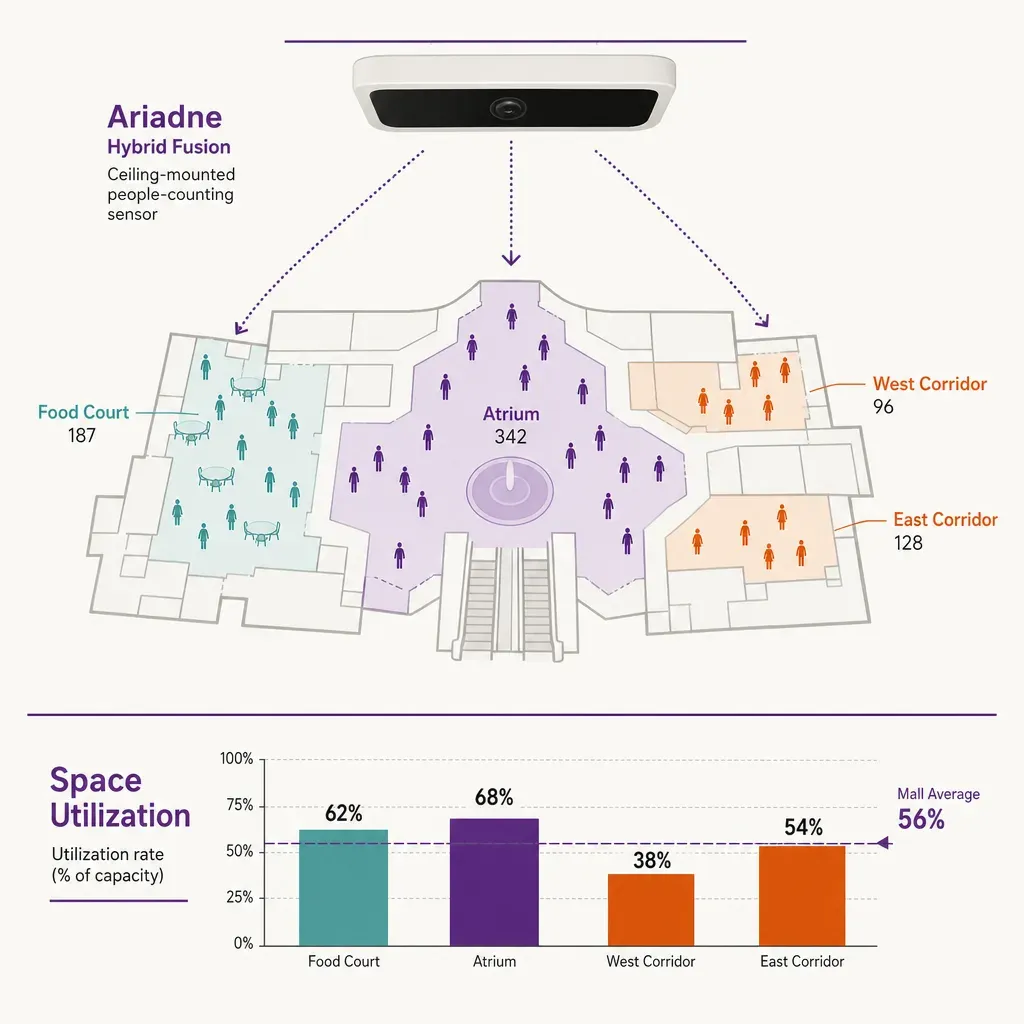
How much of the building is common area? It varies with format, but the range is often quoted at around ten to fifteen percent of gross leasable area in a typical enclosed mall, with food-court-heavy or experiential schemes sitting higher and tightly merchandised strip-style schemes lower. Treat any single figure as illustrative rather than universal; the right number is the one in your own measured-area certificate. The point of the rough range is to make clear that common area is a real share of the asset, not a rounding error, and that the landlord controls it directly.
Owners of shopping centers who manage common area as a leftover, the space between the rentable boxes, leave revenue on the floor. Owners who manage it as a portfolio of small leasable surfaces, each with its own footfall and dwell, run a more honest scheme.
Why GLA metrics fail in common area
Retail leasing has its own vocabulary: sales per square metre, occupancy cost ratio, percentage rent over a natural break. Those metrics make sense for a shop because there is a tenant on the hook for the space and a till counting transactions. Common area has neither. A kiosk in the middle of an atrium may sell, but the atrium itself is sold by the day or the week as an activation surface, not by the year as a shop. The question a landlord faces is not what does this kiosk turn over, it is how much value does this piece of floor produce for the owner across all the uses we put it to.
Three differences matter when measuring common area against GLA-let space.
- Multiple uses, one surface. A single atrium might host a charity stall on Monday, a car promotion on Wednesday, a brand sampling on Saturday, and an empty seating area in between. The space is doing four jobs across the week. A flat utilisation figure has to account for all of them, not just the booked activations.
- Through-flow as well as dwell. A corridor is not a sales floor. People walk through it. Its value to a kiosk or pop-up is partly its capture of dwell time and partly its sheer through-flow, the number of qualified visitors crossing it during the day. Measuring only one half misreads the surface.
- Operator's risk, not tenant's risk. When a shop underperforms, the tenant carries it. When a common-area kiosk underperforms, the landlord does. That changes the relationship between data and decision: you cannot lean on a tenant's till to tell you the truth about the location.
The metrics that work in common area are the ones that describe how much of the right kind of visitor uses the space and for how long.
The four numbers that describe a common-area surface
For each defined common-area zone, four readings together give a landlord a useful picture of utilisation. The exact thresholds differ by scheme, but the framework is portable.
- Through-flow. How many visitors pass through the zone in a given hour, day, or week. This is the gross footfall the surface sees and the denominator that everything else is read against.
- Dwell time. The average minutes a visitor spends inside the zone. A concourse with a few seconds of dwell is a route; a food court with twenty minutes of dwell is a destination. Activations, kiosks, and signage all read differently against those two surfaces.
- Group size. Whether the visitors arrive as singletons, pairs, or family groups, which changes what a sampling stand or a kiosk should stock. Group sizing comes from Ariadne's patented signal sensing, which can tell two phones that move together apart from two strangers crossing the same point.
- Day-part mix. When the zone is busy. A food-court atrium runs on a lunch and dinner curve; an entrance plaza runs on a weekend curve; a corridor next to an anchor runs on the anchor's curve. The day-part shape decides what a paid activation can credibly promise to advertisers and sponsors.
Put those four together and a common-area zone stops being a generic patch of floor and starts behaving like a small media surface with its own audience profile.
What landlords use the data for
Once a center can read each common-area zone on those four numbers, four leasing and operations decisions sit on top of the data.
Pricing kiosks and pop-ups by zone, not by floor
A flat per-day rate for an atrium across the whole center treats all atriums as equivalent. They are not. An atrium in front of a fashion anchor on a Saturday is a different product from a corridor outside the back of a department store on a Tuesday. Through-flow and dwell readings give a landlord a defensible price tier for each surface, so a pop-up brand pays for what it actually receives.
Programming events and activations against measured demand
A center that schedules events on instinct ends up under-utilising the dead weeks and overbooking the strong ones. With through-flow by hour and day, the calendar shifts toward the surfaces and time windows that already pull crowds, and the marketing team puts paid activations where they will be seen rather than where they are convenient.
Defending the service charge
Retail tenants pay for common area through service charge and routinely ask what the landlord does with it. Through-flow and dwell on the concourses, the food court, and the entrance plazas give the landlord a concrete answer: the spaces the tenants are paying to maintain are measurably used by the customers the tenants are paying for. That moves the conversation away from a line-item argument and toward a value-of-asset one.
Reporting to investors and lenders
Mall valuations have moved on from headline rent rolls toward visitor data, especially for centers with a large experiential or food-court component. Common-area utilisation, broken down by zone, is the operational evidence that the non-retail surfaces of the asset are working. It also makes a clean exhibit alongside the leasing schedule when the asset is refinanced or sold.
How dwell and through-flow inform pop-up leasing
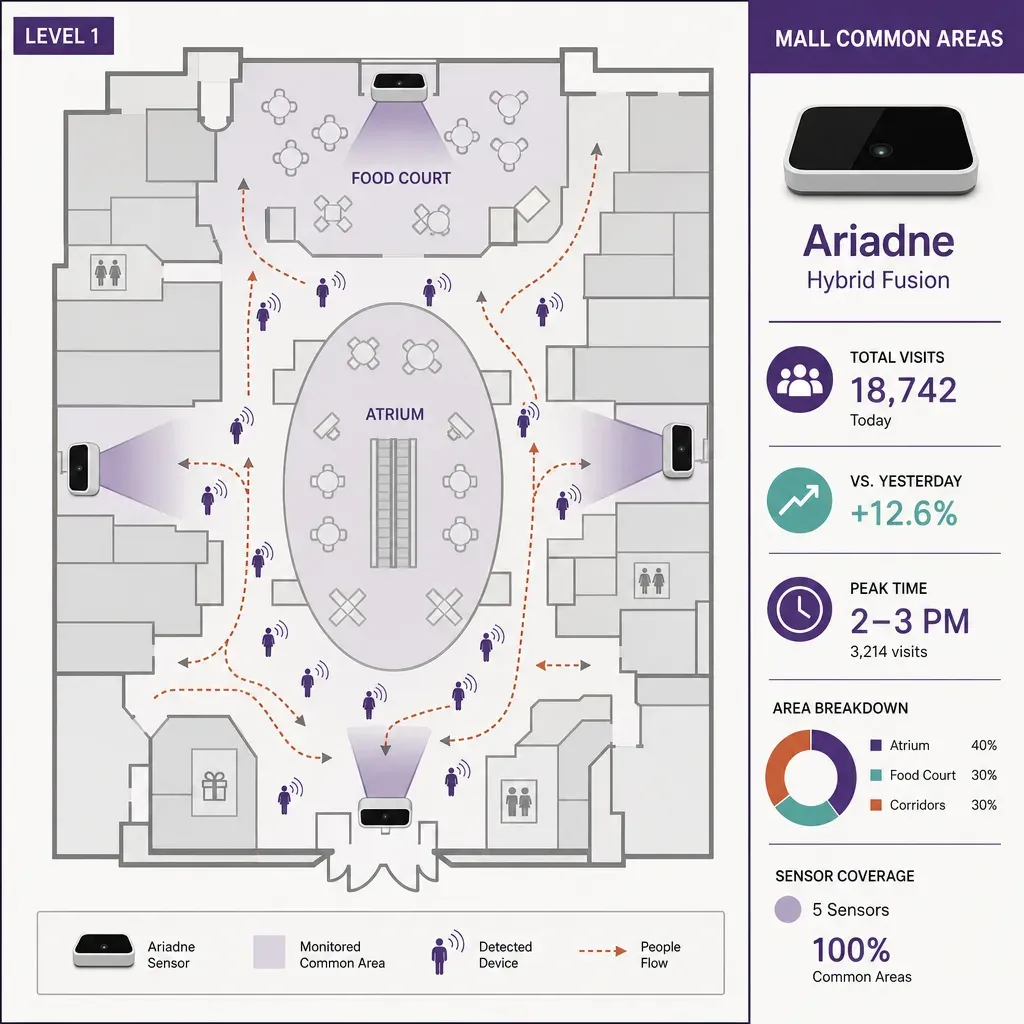
A pop-up activation is a short-tenor lease on a piece of common area, usually two to twelve weeks, paid as a fee rather than a base rent. The brand that takes the space wants to know what it is buying; the landlord wants to price the space at what it is worth. Three numbers do most of the work in that negotiation.
- Expected through-flow. How many visitors will physically cross the zone during the run of the activation, measured from comparable weeks across the prior year. This is the equivalent of a circulation figure for a print ad.
- Dwell distribution. Not just the average dwell, but the share of visitors who linger more than thirty or sixty seconds, which is the share who could actually engage with a stand. Most concourse activations have a tiny conversion window, and the dwell distribution is what predicts it.
- Group composition. Whether the audience at that time of day is dominated by adults travelling alone, mixed groups, or families. Group sizing tells a beauty brand and a kids product brand very different stories about the same square metres.
Once those three numbers are baked into the proposal, the conversation with the brand changes. The landlord is no longer selling a generic atrium for a flat weekly rate; it is selling a measured audience to a measured surface. The same data, read after the activation closes, gives both sides an honest debrief: did the through-flow show up, did the dwell rise during the run, did the group profile match what was sold. That is the loop that turns common area into a repeatable line item.
Common-area data also feeds the rest of the leasing book. Reading the four numbers next to mall dwell time and the wider anchor tenant analysis lets a landlord see how a new mixed-use anchor tenant moves footfall onto a particular plaza or corridor, which is exactly the place that activation revenue is earned.
How Ariadne measures common-area utilisation
Common-area measurement asks for two different things at once: a clean through-flow count at the entries and choke points of each zone, and a faithful read of how long people linger inside the zone. A device that only counts at a door cannot do the second job, and a device that only triangulates inside cannot do the first. Ariadne builds the two together into a single piece of hardware.
Ariadne measures this with Hybrid Fusion, its patented camera-free method. Time-of-Flight depth sensing counts every visitor at the entrances, capturing geometry rather than images, while patented phone signal sensing follows movement through the interior, detecting the signals a phone emits even in airplane mode. The sensor streams both feeds to Ariadne, where Hybrid Fusion combines them into one trajectory per visit and computes counts, dwell, and paths. The streams carry no identifier: no MAC address, no device ID, no biometric data, and no camera is involved. Identifiers are stored only when a visitor explicitly opts in, which keeps the method GDPR-friendly and outside biometric territory.
For a shopping-center operator, three properties of that method matter in common area specifically. First, the Time-of-Flight sensor at each entry, escalator, or zone boundary counts every visitor, and the patented signal sensing inside resolves how many of those visitors stayed and for how long, so through-flow and dwell are read on the same anonymous count instead of two separate systems. Second, group sizing comes from the signal sensing rather than the depth sensor, so the four-person family that crosses the threshold together is read as a group of four rather than four anonymous heads. Third, no camera is involved at any point and the streams carry no MAC address by default, so a public concourse that the public expects to walk through without being photographed stays a public concourse without being photographed. Fusion happens centrally in the Ariadne platform rather than inside the sensor, which keeps the device itself simple and the privacy posture clean. The hardware sits in the Ariadne sensor lineup, the underlying counts feed the wider people counting platform, and the data handling is set out in the privacy policy.
Related reading
FAQ
What counts as common area in a shopping center?
Any part of the asset the landlord owns and operates rather than rents to a single retailer: atriums, concourses, escalator wells, food-court seating, restrooms, service corridors, public plazas, and parking. Retailers contribute to its upkeep through service charge or CAM, but the landlord runs the space and earns directly from activations on it.
What share of a mall is common area?
It varies by format, but a figure of roughly ten to fifteen percent of gross leasable area is often quoted for a typical enclosed center, with food-court-heavy or experiential schemes higher and tightly merchandised strip-style schemes lower. Use your own measured-area certificate rather than a single industry number; the range is useful only to show that the common-area share of the asset is material.
How do you measure common-area utilisation?
Read each defined zone on four numbers: through-flow, dwell time, group size, and day-part mix. Through-flow tells you how many visitors crossed the space. Dwell tells you how many of them stopped. Group size tells you who they were. Day-part mix tells you when. Those four together describe a common-area surface as a small media product with its own audience profile.
Do I need cameras to measure common area?
No. Ariadne counts with Hybrid Fusion: Time-of-Flight depth sensing plus patented phone signal sensing, never cameras. Time-of-Flight captures geometry rather than images, and signal sensing captures no MAC address by default, so the measurement involves no video, no faces, and no biometric data.
How is common-area utilisation different from GLA performance?
Gross leasable area is rented to a retailer who carries the operating risk and produces a till figure. Common area is operated by the landlord, who carries the risk on any kiosk or activation directly. GLA metrics report tenant outcomes; common-area utilisation reports landlord-operated surface usage, which has to be measured from footfall and dwell because there is no tenant till to lean on.
Can pop-up brands access the data on the space they hire?
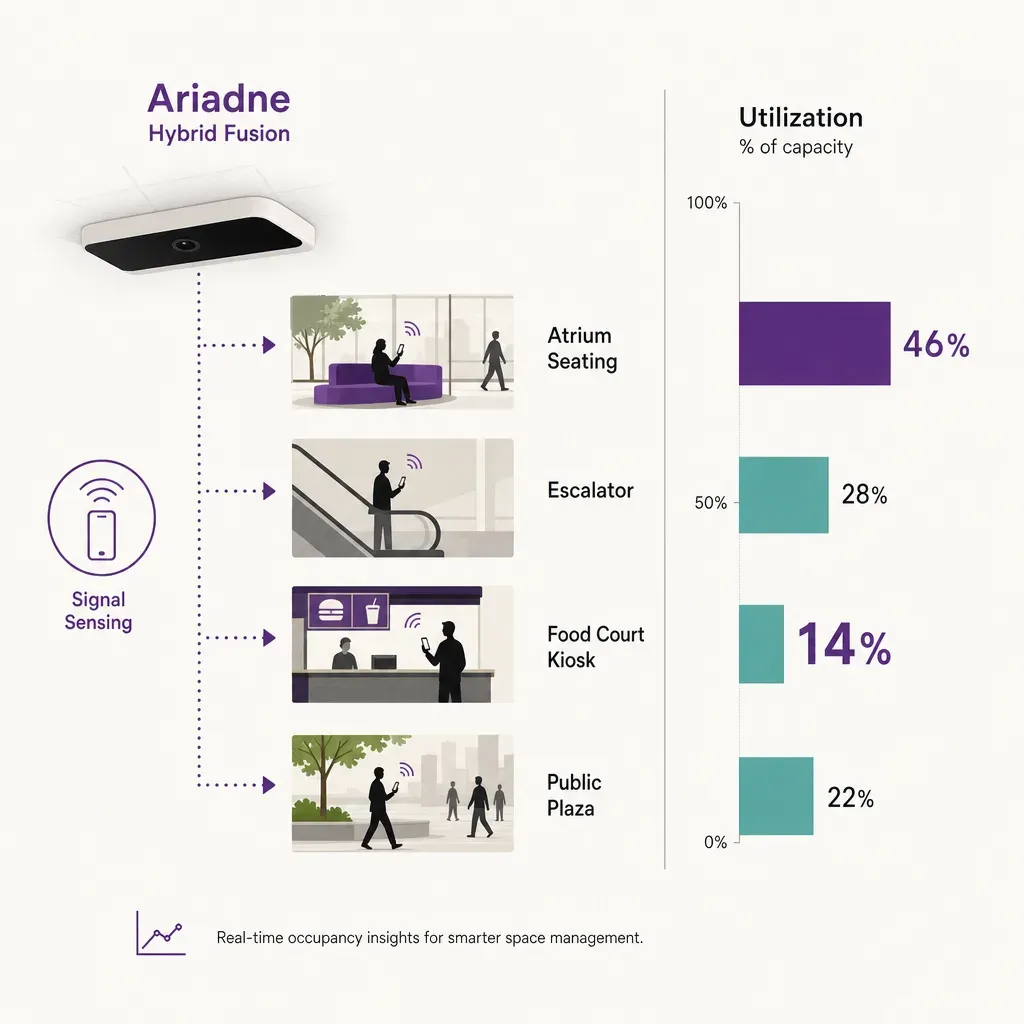
Yes, that is normally how the conversation goes both before and after the activation. A landlord can share expected through-flow, dwell distribution, and group composition for a zone during the planned run, and report the same figures back after the run closes. Because the underlying measurement collects no personal data, the report is about the space rather than about individual visitors.


