
If you are choosing an indoor location technology, the two names that come up most often are Bluetooth Low Energy (BLE) beacons and ultra-wideband (UWB). They are frequently mentioned in the same breath, which hides the fact that they solve the problem in very different ways and at very different price points. Picking the wrong one usually means either paying for precision you will never use, or building a system that can never reach the accuracy your use case actually needs.
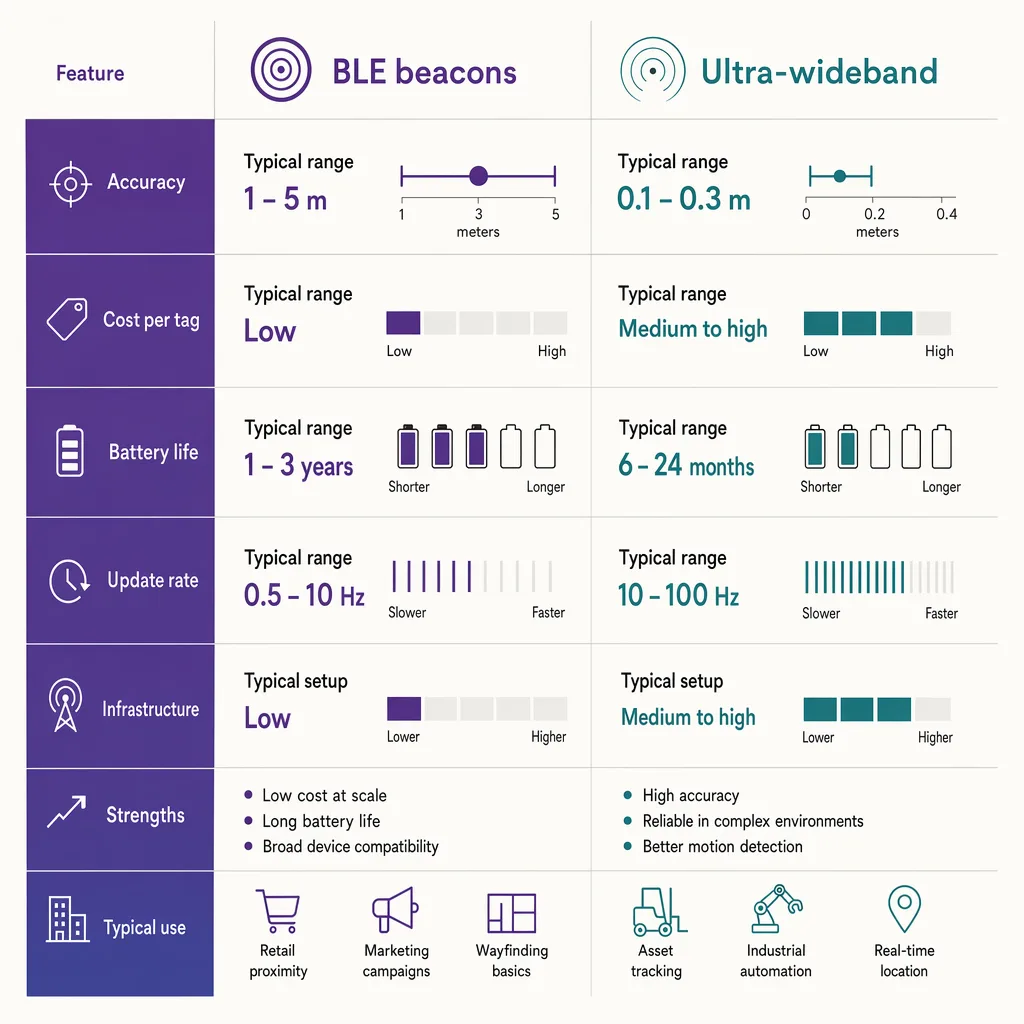
This post runs the two head to head. It covers how each one locates a device, how far apart their accuracy really sits, what each costs to install and run, and where the honest cut-off is between them. The goal is a decision you can defend, not a preference. For the wider survey of every indoor positioning method, see the full positioning method survey; this post is the two-technology comparison that survey does not run in depth.
What is the difference between BLE beacons and UWB?
Both locate a device indoors, but they trade accuracy against cost. BLE beacons estimate position from Bluetooth signal strength, which is inexpensive and battery-friendly but usually accurate only to a few metres and sensitive to interference. UWB measures signal travel time with precise timing, reaching tens of centimetres, at the cost of more expensive anchors and UWB-capable tags. As a rule of thumb: BLE suits proximity, zone-level presence, and low-cost rollouts; UWB suits high-precision asset tracking where a few metres of error is unacceptable.
The rest of the post explains why that gap exists, because the accuracy difference is not a tuning parameter. It comes straight from the physics of how each one measures, and understanding that physics is what lets you predict how each will behave in your building rather than trusting a vendor's best-case number.
How each one locates: RSSI proximity versus time-of-flight ranging
A BLE beacon is a small radio that broadcasts a short identifier on a regular interval. It does not know where anything is. The positioning happens on the receiving side: a phone or a fixed receiver reads the beacon's signal and estimates distance from how strong that signal arrives, a value called RSSI (received signal strength indicator). Closer usually means stronger, so a receiver that hears several beacons at once can estimate its position from the pattern of strengths.
The weakness is that radio signal strength is a poor distance gauge. A wall, a metal shelf, a crowd of people, or a phone held in a pocket all change how strong a signal arrives without the device moving at all. That is why BLE positioning lands in the range of a few metres rather than centimetres, and why it is far more reliable at answering "which zone is this device in" than "exactly where in the zone."
UWB works on a different principle. Instead of guessing distance from signal strength, it measures how long a radio pulse takes to travel between a tag and a fixed anchor, then converts that travel time into distance. Because UWB uses a very wide frequency band and extremely short pulses, it can time that journey with enough precision to resolve distance to tens of centimetres. Fixed anchors around the space each range to the tag, and the intersection of those distances pins the tag's location. Signal strength barely matters here, which is exactly why obstructions and interference degrade UWB far less than they degrade a strength-based method.
The short version: BLE infers position from how loud a signal is, UWB calculates it from how long a signal took. That single difference drives everything downstream, including the accuracy gap and the cost gap.
Head-to-head comparison
The figures below are the documented, typical-market behaviour of each technology, not a measurement of any one product. Exact numbers vary by hardware, building, and configuration, so treat every range as directional rather than a hard specification.
| Factor | BLE beacons | UWB |
|---|---|---|
| Positioning method | Signal strength (RSSI) inference | Time-of-flight ranging (timing) |
| Typical accuracy | A few metres, zone-level | Tens of centimetres |
| Anchor / receiver infrastructure | Light: inexpensive beacons, often existing phones as receivers | Heavier: dedicated anchors that need power and placement |
| Tag or device requirement | Broadly supported by existing smartphones | Requires a UWB-capable tag or device |
| Battery | Very low draw; coin-cell beacons can run for a long time | Higher draw on active tags; shorter service intervals |
| Hardware cost per point | Low | Higher, several times a beacon in typical deployments |
| Interference sensitivity | High: walls, metal, bodies, and crowding distort RSSI | Lower: timing is far more resistant to obstruction |
| Best-fit use | Proximity, zone presence, low-cost rollout at scale | High-precision asset tracking, safety zones, exact location |
Read the table as a single trade curve. Everything BLE gives up in accuracy, it buys back in cost and simplicity. Everything UWB spends on anchors and tags, it returns as precision. There is no configuration that gives you UWB accuracy at BLE cost, which is why the choice is a genuine decision rather than a search for the "better" one.
Choose BLE when, choose UWB when
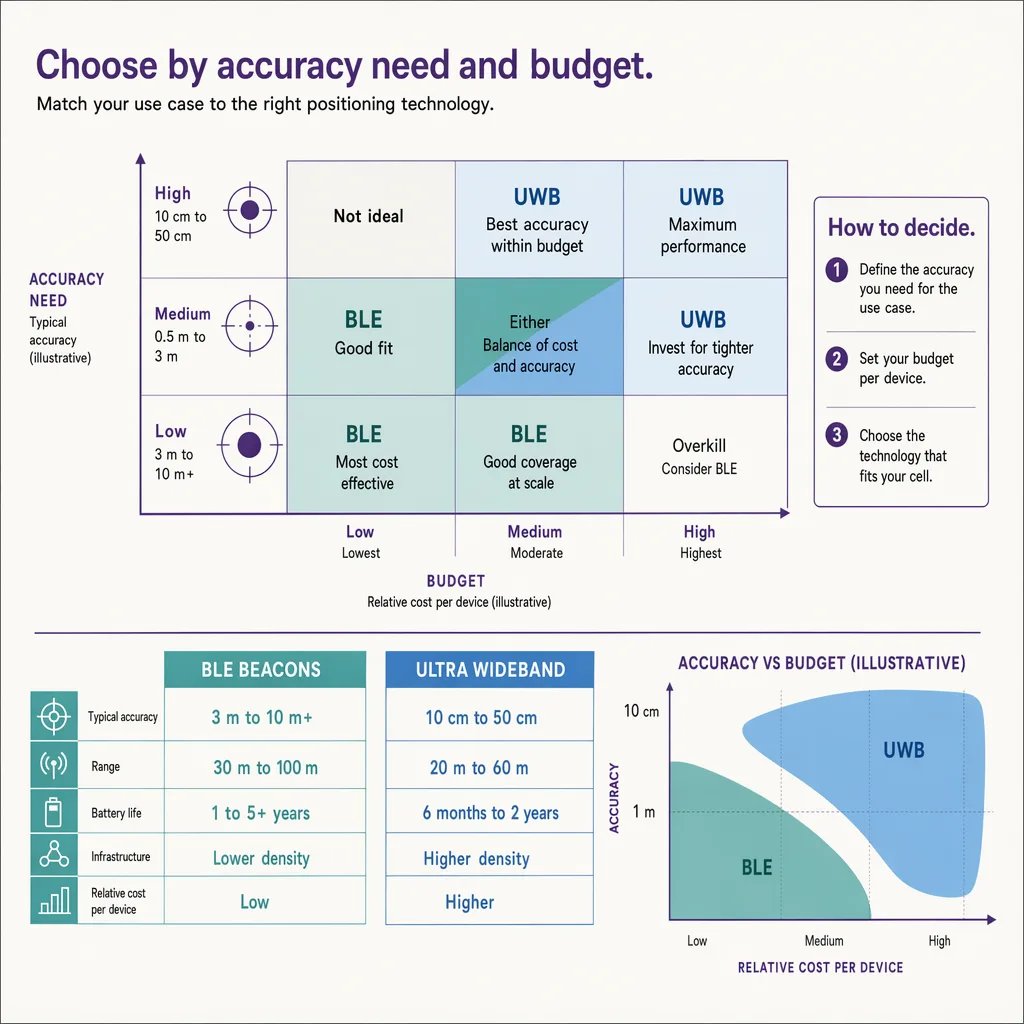
The decision comes down to how much accuracy your use case truly requires, and how much infrastructure you are willing to install and maintain to get it.
Choose BLE beacons when zone-level answers are enough. Proximity marketing, "you are near this exhibit" prompts, presence detection in a room, and coarse indoor context all work well within a few metres of accuracy. BLE also wins when scale and budget dominate: covering a large venue with inexpensive beacons that existing phones can read is far cheaper than wiring a building with UWB anchors, and coin-cell beacons keep running with almost no maintenance.
Choose UWB when a few metres of error would break the use case. Tracking a specific tool on a factory floor, locating equipment in a hospital, enforcing a precise safety exclusion zone, or driving an interaction that has to know exactly which of two nearby items a user picked up all need the decimetre precision that only travel-time ranging delivers. You accept the anchor infrastructure and the tag requirement because the alternative, being wrong by a few metres, is not acceptable.
The failure mode to avoid is specifying UWB for a job BLE would have done. If the real requirement is "which zone" rather than "exactly where," UWB adds cost and installation burden for precision the application never uses. The reverse mistake, expecting centimetre accuracy from a strength-based method, simply cannot be tuned into working. Match the technology to the accuracy the outcome needs, not to the highest number on a datasheet. For what accuracy figures actually mean once a system is in a real building, see what accuracy figures actually mean, and for the deeper physics of travel-time ranging, how UWB positioning works.
What neither is built for: anonymous, tag-free visitor flow at scale
Both BLE and UWB share an assumption worth naming, because it decides whether either fits a whole category of problems. Both locate a device. A BLE proximity experience needs the visitor to carry a phone running the right app and to have Bluetooth on. UWB needs the thing being located to carry a UWB tag. That is exactly right for asset tracking, where you control the tags, and workable for opt-in app experiences, where the visitor chooses to participate.
It is a poor fit for measuring general visitor flow through a public space. Most people crossing a mall, an airport concourse, or a station are not carrying your tag and have not installed your app, so a tag-or-app method only ever sees the participating minority and misses everyone else. Methods that try to widen the net by capturing device radio traffic run into a different wall: modern phones randomise their identifiers, so approaches built on reading unique device signatures have grown steadily less reliable, a problem covered in why Wi-Fi probe methods fall short. And the moment a method starts holding a stable per-person identifier, it moves into territory with real privacy weight, examined in positioning and privacy.
So the honest boundary is this. If you need to locate assets or run an opt-in experience, BLE and UWB are the right tools and this comparison tells you which. If you need to understand how the general public moves through a space, without asking everyone to carry a tag or install an app, neither is built for that, and a different sensing philosophy is worth knowing about.
A third approach: camera-free positioning without beacons or tags
Ariadne takes a deliberately different route, so it is worth being precise about what it is not. Ariadne does not use BLE beacons, and it does not use UWB anchors or tags. It is not a beacon vendor competing on the trade curve above. It is a distinct, camera-free approach designed for the tag-free, anonymous visitor-flow case that neither BLE nor UWB was built to serve.
Ariadne measures this with Hybrid Fusion, its patented camera-free method. Time-of-Flight depth sensing counts every visitor at the entrances, capturing geometry rather than images, while patented phone signal sensing follows movement through the interior, detecting the signals a phone emits even in airplane mode, and tracks that movement to about one-metre precision. The sensor streams both feeds to Ariadne, where Hybrid Fusion combines them into one trajectory per visit and computes counts, dwell, and paths. The streams carry no identifier: no MAC address, no device ID, no biometric data, and no camera is involved. Identifiers are stored only when a visitor explicitly opts in, which keeps the method GDPR-friendly and outside biometric territory.
The practical distinction is who has to carry what. A BLE or UWB deployment locates a device you have tagged or a phone running your app. Ariadne's method measures movement without asking the visitor to carry a tag, install an app, or be identified at all, which is why it suits venue-wide flow analytics rather than tracking a specific tagged object. Different problem, different tool. If your question is "how does the public move through this space, privately and at scale," see tag-free indoor navigation.
Related reading
FAQ
What is the main difference between BLE beacons and UWB?
Accuracy versus cost. BLE beacons estimate position from Bluetooth signal strength, which is cheap and battery-friendly but usually accurate only to a few metres. UWB measures signal travel time with precise timing, reaching tens of centimetres, but needs more expensive anchors and UWB-capable tags.
Is UWB more accurate than BLE?
Yes, substantially. UWB typically resolves to tens of centimetres because it times how long a pulse takes to travel, while BLE lands in the range of a few metres because signal strength is a rough distance gauge that walls, metal, and crowds distort.
Is BLE cheaper than UWB?
Generally yes. BLE beacons are inexpensive, run for a long time on a coin cell, and can often be read by phones people already carry. UWB needs dedicated anchors that require power and placement, plus a UWB tag on each item you locate, so per-point cost is higher.
When should I use BLE instead of UWB?
Use BLE when zone-level accuracy is enough, such as proximity prompts, room presence, or coarse indoor context, and when low cost at scale matters. Choose UWB only when a few metres of error would break the use case, such as precise asset tracking or safety zones.
Do I need cameras for indoor positioning?
No. Ariadne counts with Hybrid Fusion: Time-of-Flight depth sensing plus patented phone signal sensing, never cameras. Time-of-Flight captures geometry rather than images, and signal sensing captures no MAC address by default, so the measurement involves no video, no faces, and no biometric data.
Does Ariadne use BLE beacons or UWB?
No. Ariadne uses neither. It is a camera-free, tag-free approach based on Time-of-Flight depth sensing and patented phone signal sensing, fused centrally in the Ariadne platform, and is designed for anonymous venue-wide visitor flow rather than tracking a tagged device.
---


