
Every retailer with more than a handful of stores eventually asks the same question: which of these are working, which are coasting, and where should the next pound of capital go. The instinct is to rank by sales, but sales flatter big stores and busy locations and tell you nothing about why a store is where it is. Grading by footfall, done properly, gets closer to the truth, because it separates how much traffic a store draws from how well it turns that traffic into money.
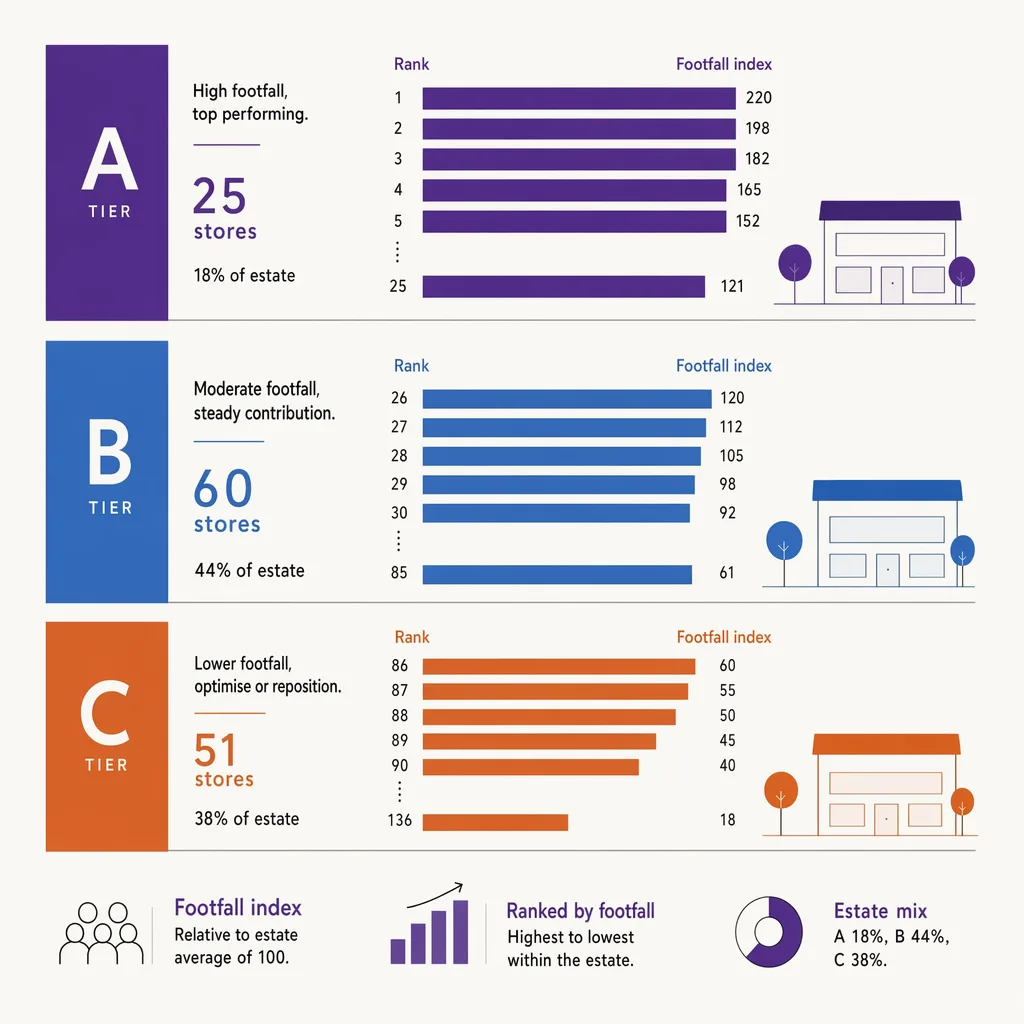
This post sets out how to grade a retail estate fairly. It covers why raw footfall is not a fair ranking on its own, which metrics to grade against, how to build A, B, and C tiers and where to set the cut lines, and what each grade should trigger. The one non-negotiable underneath all of it is consistency: a league table is only as trustworthy as the counting method behind it, and a mix of methods across the estate quietly breaks the comparison before it starts.
How do you grade stores by footfall?
Grading stores by footfall means ranking every location in an estate on how much traffic it draws and how well it converts that traffic, then sorting them into tiers, commonly A, B, and C, to decide where to invest, fix, or exit. Raw footfall alone is unfair, because a flagship on a high street will always out-count a suburban unit, so grading normalises for factors like floor area, catchment, and opening hours, and reads footfall alongside conversion and sales per visitor. The output is a league table that turns "which stores are working" from an opinion into a repeatable, comparable score.
The sections below walk each part: the normalisation that makes the comparison fair, the metrics to grade on, the tiering itself, and what to do once a store has a grade.
Why raw footfall is not a fair ranking: normalising for size, catchment, and hours
Rank an estate on raw footfall and the biggest, best-located stores win by default, which tells you nothing you did not already know. A flagship on a major high street will out-count a retail-park unit whatever the local team does, so a raw ranking rewards the property, not the performance. To grade fairly you have to strip out the advantages a store did not earn.
Three adjustments do most of that work. Floor area comes first: a large store should draw more visitors than a small one, so footfall per square metre of sales area compares a big store and a small one on even terms. Catchment comes next: a store in a dense city centre sits in front of far more passing traffic than one in a small town, so a fair grade reads footfall against the size and quality of the trade area it can realistically reach. Opening hours come third: a store trading longer hours or seven days accumulates more footfall simply by being open, so normalising to a per-trading-hour basis stops a longer roster masquerading as stronger pull.
Normalising does not mean inventing a single magic number. It means comparing like with like, so that when one store still outperforms another after you have accounted for size, catchment, and hours, the difference is real and worth acting on rather than an artefact of where the store happens to sit.
The metrics to grade on: footfall, conversion, sales per visitor, and dwell
Footfall answers only the first half of the question, which is how many people a store pulls in. The second half is what the store does with them, and that needs the KPIs that sit downstream of the count. A fair grade reads footfall together with the metrics that turn traffic into money.
- Footfall, normalised. Visitors per square metre and per trading hour, read against catchment. This is the pull half of the grade.
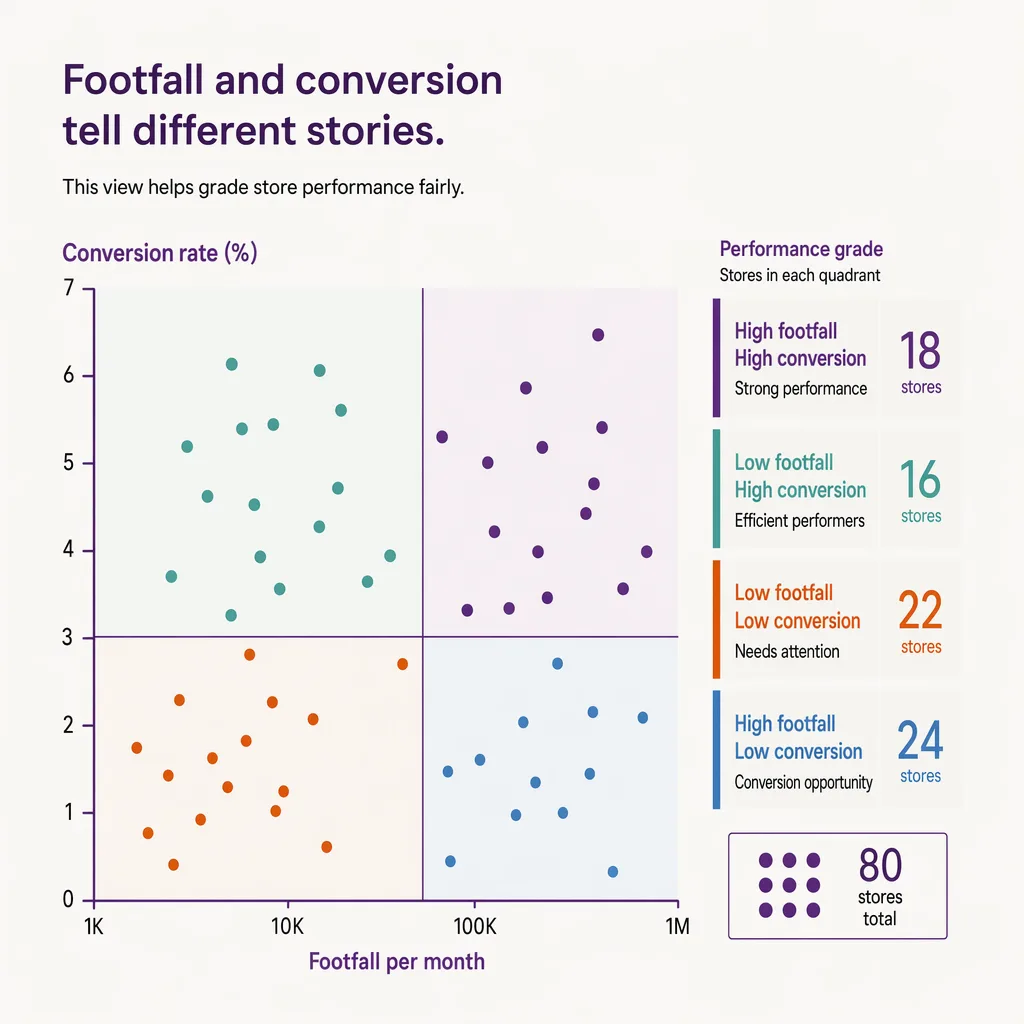
- [Conversion rate](/resources/blogs/retail-conversion-rate-formula/). The share of visitors who buy. A store with modest footfall and strong conversion is being run well and may simply sit in a smaller catchment, which is a very different story from a store drowning in traffic it cannot close.
- [Sales per visitor](/resources/blogs/sales-per-visitor-retail/). Revenue divided by footfall, which folds conversion and basket size into one figure and is often the single most comparable value line across an estate.
- Dwell and layout signals. How long visitors stay and how far into the store they get, which explains a weak conversion number and points at whether the fix is service, layout, or assortment.
Reading these together stops the grade from misfiring. A store can look weak on footfall and be excellent on sales per visitor, or look busy and convert badly. The link between footfall and revenue is what ties the pull half and the performance half into one defensible score, and grading on both halves is what keeps a high-traffic underperformer from hiding behind its own door count.
Building the tiers: A, B, and C bands and where to set the cut lines
Once every store has a normalised, multi-metric score, grading sorts them into tiers. Three bands are the common choice because they map cleanly onto three decisions: keep investing, watch and fix, or question the store's future. The cut lines are not fixed numbers, and this is the part retailers most often get wrong by importing someone else's thresholds. Bands are set to your own estate, usually by ranking all stores on the composite score and drawing the lines where the distribution actually breaks, not at a round number borrowed from a report.
| Tier | What it typically signals | Typical action |
|---|---|---|
| A | Strong normalised footfall and strong conversion or sales per visitor. The store earns its place on both halves of the score. | Protect and invest. Prioritise for refit, stock depth, and best staffing. Treat as the template other stores are read against. |
| B | Solid on one half and average on the other, for example good traffic with middling conversion, or the reverse. | Diagnose and fix. Identify whether the gap is layout, service, or assortment, then act. This is where most operational upside sits. |
| C | Weak on both halves after normalising, or structurally disadvantaged by catchment in a way effort cannot close. | Question the store. Consider remerchandising, relocation, or exit at lease break. Do not keep funding it as if it were a B. |
The tiers are illustrative, and the cut lines are estate-specific. A store that grades C in a premium estate might be a solid B in a value estate, because the whole distribution sits differently. Review the grading on a set cadence rather than once, because a store's grade should move as its trading, its catchment, and its refit cycle change. A one-off league table is a snapshot; a repeated one is a management tool.
Acting on the grade: refit, relocate, remerchandise, or exit
A grade that changes nothing is a wasted exercise. The point of tiering is to route each store to a decision, and the decisions differ by tier.
For A stores the action is to protect the advantage: they get first call on refit capital, on stock depth, and on the strongest managers, because a proven high-performer returns more on the next pound than a struggling one. For B stores the action is diagnosis, because this is where grading pays for itself. A B store with good footfall and weak conversion is a service or layout problem, not a traffic problem, and that is fixable without touching the lease. A B with weak footfall and strong conversion may be starved of traffic the estate can help supply through local marketing or better signage. For C stores the action is the hard one: work out whether the gap is closeable at all, and if the store is structurally disadvantaged rather than badly run, treat relocation or exit at the next lease break as a legitimate outcome rather than a failure to be avoided.
Grading also disciplines the capital plan. Instead of spreading refit budget evenly or reacting to whichever manager shouts loudest, the estate directs spend at the tier where it moves the score, which is usually the B band. The ROI case for consistent counting rests on exactly this: the counting layer is cheap against the misdirected capital a poor grading decision wastes.
Consistent counting across every store: why one method matters for a league table
A league table compares stores against each other, which means the comparison is only valid if every store is measured the same way. This is the quiet failure mode of estate grading. If one store counts with an old beam counter, another with a camera, and a third with a manual estimate, their footfall figures are not on the same scale, and any ranking built from them is comparing measurements as much as stores. A grade is only fair if the count under it is consistent everywhere.
Ariadne measures this with Hybrid Fusion, its patented camera-free method. Time-of-Flight depth sensing counts every visitor at the entrances, capturing geometry rather than images, while patented phone signal sensing follows movement through the interior, detecting the signals a phone emits even in airplane mode, and tracks that movement to about one-metre precision. The sensor streams both feeds to Ariadne, where Hybrid Fusion combines them into one trajectory per visit and computes counts, dwell, and paths. The streams carry no identifier: no MAC address, no device ID, no biometric data, and no camera is involved. Identifiers are stored only when a visitor explicitly opts in, which keeps the method GDPR-friendly and outside biometric territory.
The device-independent Time-of-Flight count is what makes this comparable across an estate: the same method, applied the same way in every store, so a footfall figure means the same thing in the flagship and the suburban unit. That is the property a league table needs, and it is the difference between a grade you can defend at a board meeting and one that dissolves the moment someone asks how the numbers were gathered. Landlords grade differently, ranking the tenants inside one centre rather than a retailer's own stores; grading tenants in a centre covers that view, and the same consistency argument applies. For the wider picture on measuring across many locations, see retail store analytics.
FAQ
How do you grade stores by footfall fairly?
Normalise before you rank. Adjust footfall for sales-area size, catchment, and trading hours so a big well-located store is not rewarded for advantages it did not earn, then read the normalised footfall alongside conversion and sales per visitor. Sort the resulting composite score into tiers, drawing the cut lines where your own estate's distribution breaks rather than at borrowed numbers.
What is an A, B, and C store classification?
It is a three-tier ranking of an estate. A stores are strong on both traffic and performance and get first call on investment. B stores are solid on one half and average on the other, and are where diagnosis and fixes pay off most. C stores are weak on both after normalising, or structurally disadvantaged, and are candidates for remerchandising, relocation, or exit. The bands are set to the estate, not fixed numbers.
Should stores be ranked on footfall or on sales?
On both, plus the metrics that connect them. Sales alone flatter large and well-located stores; footfall alone ignores how well a store converts. Grading on normalised footfall together with conversion and sales per visitor separates how much traffic a store draws from how well it uses it, which is the distinction a fair grade depends on.
Why does consistent counting matter for a store league table?
Because the table compares stores against each other, every store has to be measured the same way. Mixing counting methods across an estate means the footfall figures are not on one scale, so the ranking partly reflects the measurement rather than the store. One consistent, device-independent method in every store is what makes the grades comparable.
How often should you regrade an estate?
On a set cadence rather than once. A store's grade should move as its trading, catchment, and refit cycle change, so a repeated grading exercise is a management tool while a one-off table is only a snapshot. Many estates review quarterly or twice a year, aligned to the planning and capital cycle.


