
How do you calculate the ROI of people counting?
The short version: a people counter does not earn money by counting. It earns money by turning guesswork into a measured number you can act on. Once you know how many people walk in, you can read conversion as a rate instead of a hunch, schedule staff against real demand instead of last year's roster, and prove whether a campaign actually pulled people through the door. The payback almost never comes from the count itself. It comes from the levers the count opens up: a small lift in conversion, or a small correction to labour against traffic, applied across thousands of visits. This guide is the finance-side case, the version you can take to the person who signs off the spend. It walks the value levers, a clearly labelled worked payback illustration, and what to baseline so the return is provable rather than asserted. For the wider commercial context, see the retail people-counting use cases.
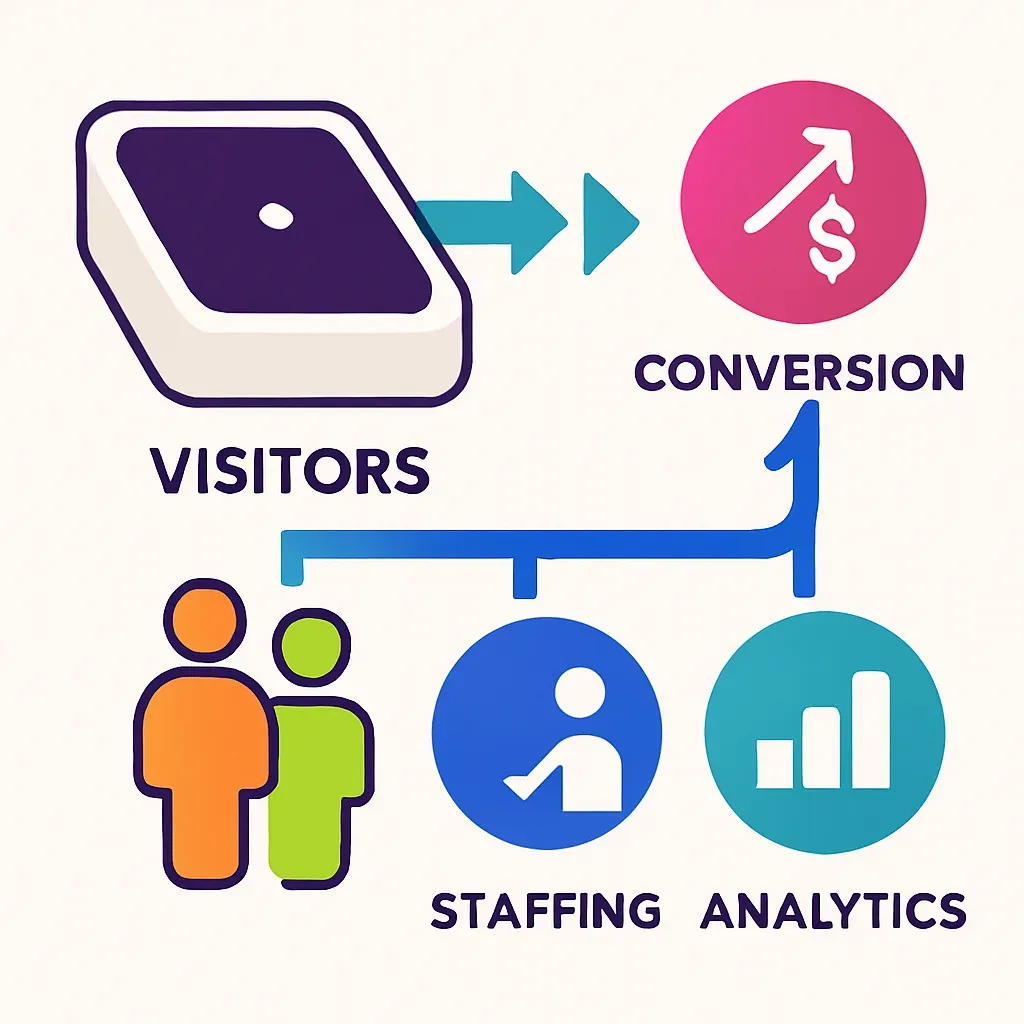
The value levers: where the return actually comes from
Counting traffic is the input. The return shows up in five places, and for most retailers the first two carry the business case on their own.
Conversion lift
Conversion is transactions divided by entries. Without a count of entries you only have the numerator, so you cannot tell a quiet day from a day you converted badly. With it, conversion becomes a rate you can manage. The lever is simple: capture and convert more of the traffic you already pay rent and marketing to attract, which is the same idea behind capture rate, the share of passing footfall you pull through the door. A store that sees its conversion sag every weekday at 4pm can act on it, because the count tells it the traffic was there and the sales were not. A fraction of a point of conversion, applied to every visit a busy store sees in a year, is usually the single largest line in the case.
Staffing to traffic
Most rosters are built on habit, not demand. Counting per 15-minute interval shows where you are overstaffed during quiet stretches and understaffed at peaks, which is where you lose sales because nobody could serve the queue. Aligning labour to the real traffic curve cuts wasted payroll in the troughs and protects conversion at the peaks. Because payroll is usually the largest controllable cost in a store, even a modest schedule correction is real money, and it recurs every week. Scheduling staff to the measured curve is exactly what footfall-based employee scheduling automates.
Marketing and campaign attribution
A promotion is supposed to bring people in. Without an entry count you can only see whether sales moved, which blends footfall and conversion together and tells you nothing about which one shifted. With a count you can separate them: did the campaign lift entries, or did it just discount the people who were coming anyway? That answer tells you which promotions to repeat and which to stop funding, and it stops you crediting a busy week to a campaign that did nothing.
Lease and rent negotiation
Landlords and shopping-centre operators quote footfall figures that suit the rent they want to charge. Your own door count is an independent number you can bring to a renewal. If a unit delivers far less qualified footfall than the headline mall figure implies, that gap gives you a stronger hand in the conversation. The counter pays for itself the first time it reshapes a multi-year lease.
Replacing guesswork
The quietest lever is the decisions you stop getting wrong. Trading hours, the size of a refit, whether a second register is worth it, which of two sites to invest in: each of these is usually settled on instinct. A reliable count turns them into questions with evidence behind them. This lever is the hardest to put a single number on, but it is the reason the others compound: every decision downstream of the count gets a little less wrong.
A worked payback illustration
The figures below are an illustration to show how the arithmetic works, not measured results and not a quote. Every input is an assumption you should replace with your own numbers. Take a single store with these stated assumptions:
- Entries. 80,000 visits a year, roughly 220 a trading day.
- Baseline conversion. 20 percent, so 16,000 transactions a year.
- Average transaction value. 40 in your currency.
- Annual revenue through this store. 16,000 transactions at 40 is 640,000.
- Counting cost. assume 1,200 a year for the sensor and platform at this site, all in.
Now apply one modest lever from the list above. Suppose the count lets you fix the weekday afternoon dip and lifts conversion by half a percentage point, from 20 to 20.5 percent. That is 400 extra transactions a year (0.5 percent of 80,000 entries), worth 16,000 in additional revenue at a 40 average. Against a 1,200 annual counting cost, the lever returns more than 13 times its cost in revenue terms in the first year, and the payback on the count itself arrives in under a month of that improvement holding.
The point is not the exact ratio, which moves entirely with your traffic, your basket, and your margin. The point is the shape: because the cost of counting is small and fixed while the levers apply across every visit, you do not need a dramatic improvement to clear the cost. A change too small to notice by eye is large in money once it is multiplied across a year of traffic. Run the same arithmetic with a labour saving instead of a conversion lift and the conclusion holds: the count is cheap, and the levers it opens up are not.
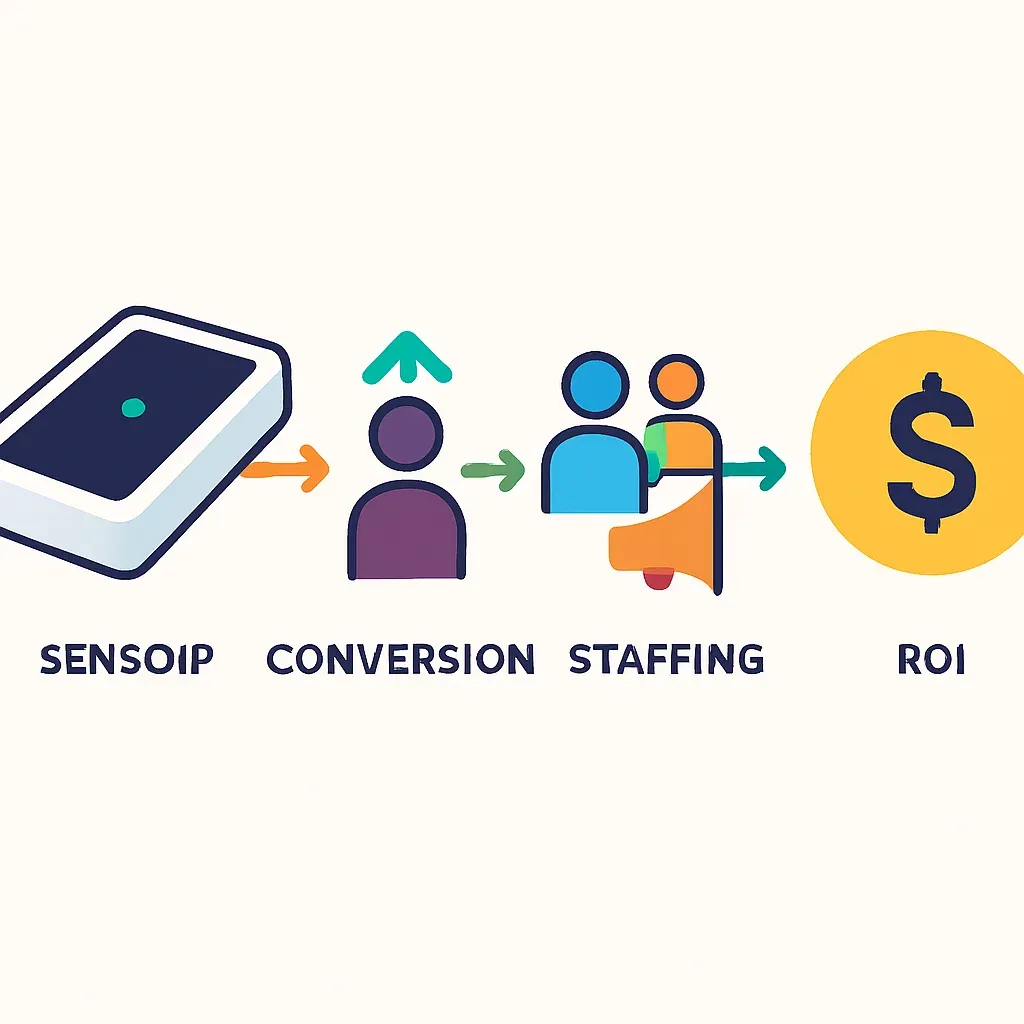
What to baseline before and after
An ROI you can defend is one you measured, not one you asserted. That means writing down the before state, changing one thing, and reading the after against it. Capture these before you start acting on the count:
- Entries, by interval. The count itself, ideally per 15 minutes per door, so you can see the traffic curve and not just a daily total.
- Conversion rate. Transactions divided by entries, by day and by hour, so a change is attributable to a time and a cause rather than to the month.
- Labour hours against traffic. Scheduled hours laid over the traffic curve, so over- and understaffing are visible before you re-roster.
- Average transaction value. So a conversion change is not confused with a basket change pulling the same revenue line.
- A clean baseline window. A few comparable weeks before any change, avoiding holidays and one-off events, so the after period has something honest to be measured against.
With that baseline in hand, change one lever at a time. If you re-roster and lift conversion in the same week, you will not know which one moved the number. Isolate the change, give it long enough to settle, then read the after against the before. That discipline is what turns a plausible story into a number finance will accept. For the practical side of acting on the count once you have it, see what to do with that data.
How Ariadne supports the measurement
An ROI case is only as good as the count under it. If the count is unreliable at peak, or if a family of four registers as one person, the conversion rate you build the case on is wrong, and a privacy complaint can end the programme before the return shows up. Ariadne is built to remove both risks.
Ariadne measures this with Hybrid Fusion, its patented camera-free method. Time-of-Flight depth sensing counts every visitor at the entrances, capturing geometry rather than images, while patented phone signal sensing follows movement through the interior, detecting the signals a phone emits even in airplane mode. The sensor streams both feeds to Ariadne, where Hybrid Fusion combines them into one trajectory per visit and computes counts, dwell, and paths. The streams carry no identifier: no MAC address, no device ID, no biometric data, and no camera is involved. Identifiers are stored only when a visitor explicitly opts in, which keeps the method GDPR-friendly and outside biometric territory.
For the business case that matters in two ways. The count holds at the peaks where conversion decisions are made, because depth sensing reads geometry rather than struggling with crowded or dimly lit entrances, and group size is resolved so the denominator is right. And because the method is identifier-free by default, with no cameras and no MAC address captured, the data sits outside biometric territory, so the programme is defensible to a data-protection officer as well as to finance. To see how the count feeds conversion, staffing, and attribution in one place, start with the people counting platform. If you are still shortlisting, a category review of people-counting systems is a useful starting point before you model your own numbers.
Related reading
FAQ
What is a realistic payback period for people counting?
It depends entirely on your traffic, basket, and margin, so treat any single figure with suspicion. The useful way to think about it is the shape, not the number: the cost of counting is small and fixed, while the levers it opens up (conversion and labour) apply across every visit. Because of that, even a fraction of a percentage point of improvement, held over a busy store's annual traffic, clears the cost quickly. Model it with your own entries, conversion, and average transaction value rather than borrowing a number from a vendor.
Do I need new EPOS or systems to measure ROI?
You need the count and your existing sales data, nothing exotic. The count supplies entries; your point-of-sale already supplies transactions and average value; your rota supplies labour hours. The ROI work is joining those three against the same time intervals. The count is the piece most stores are missing, which is why conversion has been a hunch rather than a managed rate.
Do you need cameras to count for ROI?
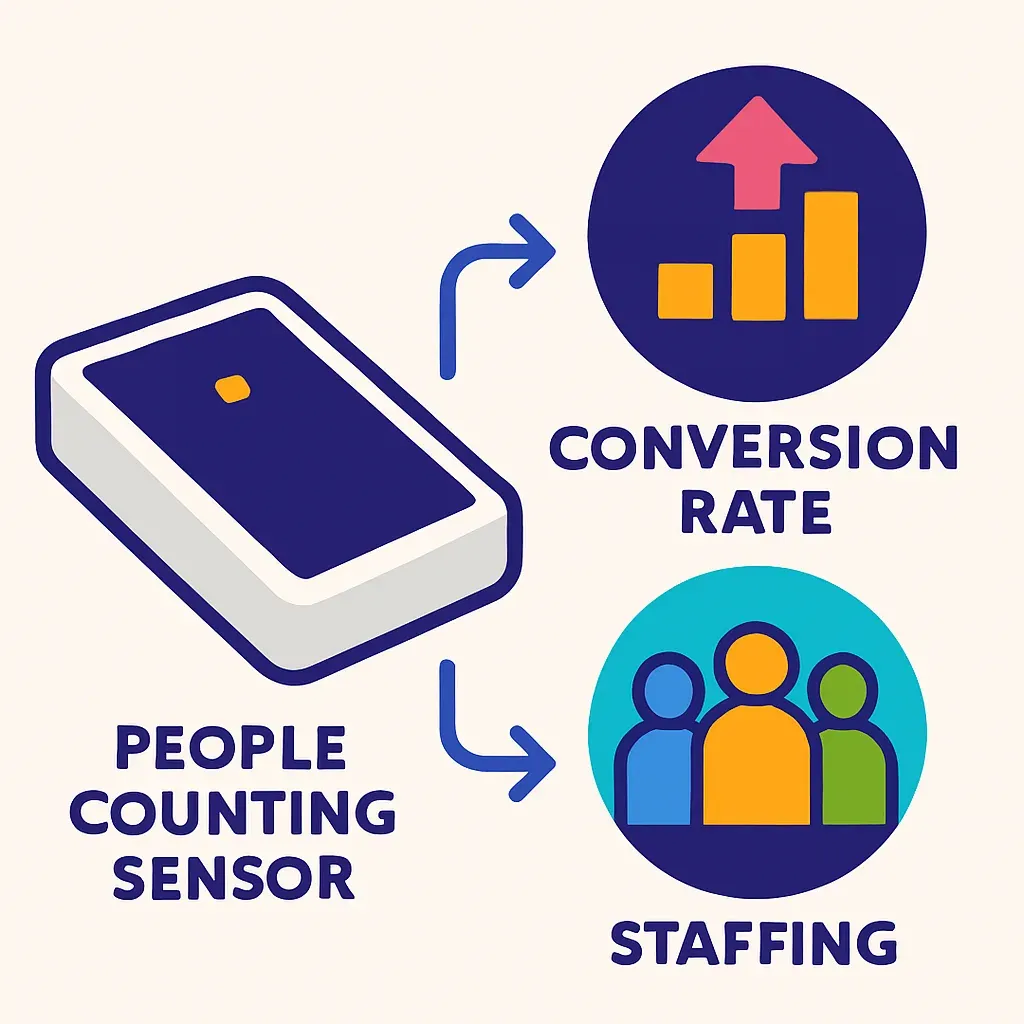
No. Ariadne counts with Hybrid Fusion: Time-of-Flight depth sensing plus patented phone signal sensing, never cameras. Time-of-Flight captures geometry rather than images, and signal sensing captures no MAC address by default, so the measurement involves no video, no faces, and no biometric data.


