
Tenant performance reporting, defined
Tenant performance reporting is the routine, structured way a shopping centre landlord shares footfall and visit data with the retailers in the scheme. It is the monthly or quarterly packet that lands in a store manager's inbox with the centre's headline numbers, the day-part and weekday-weekend mix, peak hours, and how those compare with the same period a year earlier. Done well, it is one of the most underused tools a shopping centre has for keeping good tenants and writing better renewals. Done badly, it is a PDF the retailer scans for five seconds and forgets.
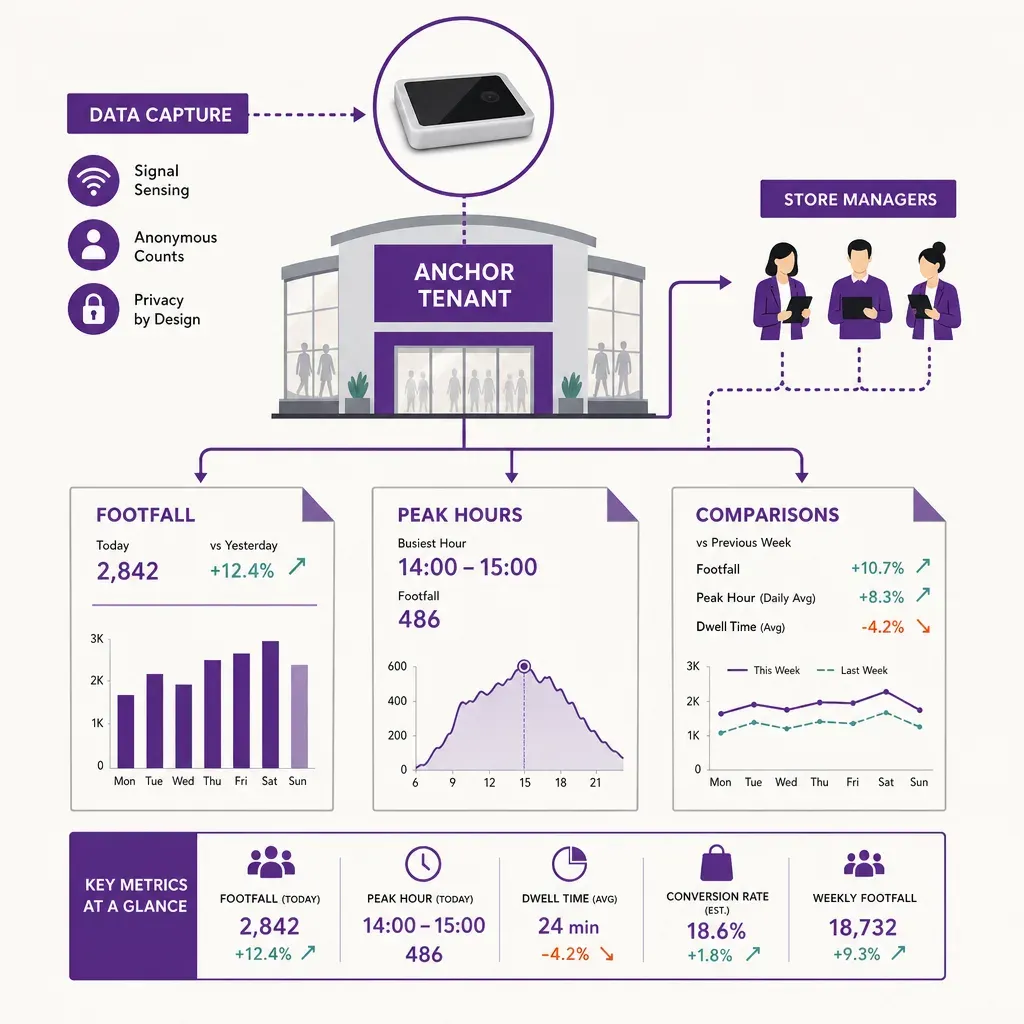
This article is for the asset manager or operations lead who has the footfall system in place and now has to decide what to put in front of tenants. It covers four things: what to share, what to keep private, how to package the report so retailers actually read it, and how to turn the same data product into a retention conversation at renewal. The figures below are illustrative examples chosen to show the mechanics. They are not market averages or measured outcomes from any specific centre.
What landlords share with tenants
The simplest way to think about the tenant report is to separate what is centre-level (the landlord's draw) from what is tenant-specific (the retailer's own performance). Centre-level data answers one question for the tenant: how busy was the building I rent in, and when. That question is squarely the landlord's job to answer, and the data is largely shareable.
A useful monthly tenant report typically includes:
- Centre-level visits. Total visits to the centre over the period, broken down by week, with year-over-year comparison. This is the headline retention number: it tells the retailer whether the building delivered the traffic the lease assumed.
- Day-part mix. Share of visits by morning, midday, afternoon, and evening. A tenant whose category leans evening (cinema-adjacent food and beverage, for example) reads this differently than a tenant who lives off weekday lunch traffic.
- Weekday and weekend split. How many of the month's visits fell on weekends versus weekdays. This is one of the most actionable numbers a tenant gets, because staffing and stock decisions hang on it.
- Peak hours and peak days. The top three busiest hours of an average week and the top three busiest days of the month. Retailers use this to align trading hours and shift patterns.
- Average dwell time. How long a typical visitor spent in the centre, with year-over-year comparison. Rising dwell is one of the cleanest signals that the centre's experience is working; falling dwell is an early warning.
- Zone-level visits where the tenant sits. Visits to the wing, level, or anchor-adjacent zone the tenant occupies. This is the closest the report should get to tenant-specific footfall, and it is most useful when the centre has clearly defined zones rather than a single open floor.
That set is enough to give a retailer a real picture of the trading environment they paid for. It also stays comfortably on the landlord's side of the data boundary: nothing in it is another tenant's performance, and nothing in it claims to measure what happened inside the retailer's store.
What landlords keep private
The other half of the discipline is what the landlord deliberately does not share. Footfall data is sensitive in ways that are easy to underestimate, and a centre that gets careless here loses tenant trust quickly. Three categories are normally off the table for the standard report.
Intra-tenant comparisons
If the centre measures zone-level visits accurately enough to know how many people walked past Tenant A's storefront versus Tenant B's, that comparison stays inside the asset management team. Sharing it with either tenant invites a one-sided conversation: the better-performing tenant uses it as leverage at renewal, the worse-performing tenant blames the landlord's marketing, and both relationships get harder. The landlord owns the comparison internally as a leasing tool, not as a tenant deliverable.
Other tenants' conversion or capture rates
The capture rate (the share of centre visitors who entered a particular store) and the conversion rate (the share of store visitors who bought) are firmly the tenant's data, not the landlord's. Where the centre measures storefront capture as part of zone analytics, that single tenant's number can be returned to that single tenant, but never compared against named neighbours. Conversion is usually only available when the tenant shares it back from their own POS, and that exchange should be governed by a written data agreement, not by a quiet line in the monthly report.
Granular per-hour or per-minute zone data near competitors
Even when a tenant is entitled to data about their own zone, releasing it at minute-level granularity creates a back door into the trading patterns of any neighbour in the same camera-free zone. Hourly aggregation is usually a reasonable floor: it is operationally useful for staffing without exposing minute-by-minute patterns that another tenant would find competitively sensitive.
The general rule is straightforward. The landlord's job is to report on the centre as a draw. The tenant's job is to report on the store as a business. The footfall system sits cleanly on the landlord's side of that line. Keeping it there is what makes tenants willing to engage with the report in the first place.
How to package the report
A tenant report is only as useful as the speed at which a busy store manager can read it. The strongest packages share three traits.
- One page of headlines, supporting detail behind it. The first page carries six to eight numbers a tenant can read in under a minute: centre visits this month, change versus last month, change versus last year, top three peak hours, weekend share, average dwell. Everything else, the weekly chart, the day-part breakdown, the zone read, sits behind that page for tenants who want to drill in.
- Year-over-year, not just month-over-month. Retail is seasonal. A 10% drop from June to July is almost always weather and calendar. A 10% drop from July last year to July this year is something the tenant and the landlord need to talk about. Anchor the report on year-over-year and let month-over-month sit alongside.
- Plain language explanations attached to each metric. A line under each chart that says what the number is, how the centre measures it, and what to do with it. A store manager reading the report at 8am should not need to re-learn what dwell time means every month.
Cadence matters too. Monthly is the natural rhythm for a tenant report, with a deeper quarterly review for the larger tenants or the ones up for renewal. Anything more often than weekly tends to push the report into the noise band where day-to-day weather and footfall variance dominate, and the tenant stops reading it. Anything less often than quarterly and the centre loses its chance to flag a softening trend before the retailer reads it as the landlord's fault.
The report as a renewal tool
The reason this matters for asset management is that the report is also the renewal conversation, twelve months early. By the time a lease term is up, the retailer has either accumulated a year of reports that argue the centre delivered traffic, or they have not. The renewal meeting is much shorter in the first case.
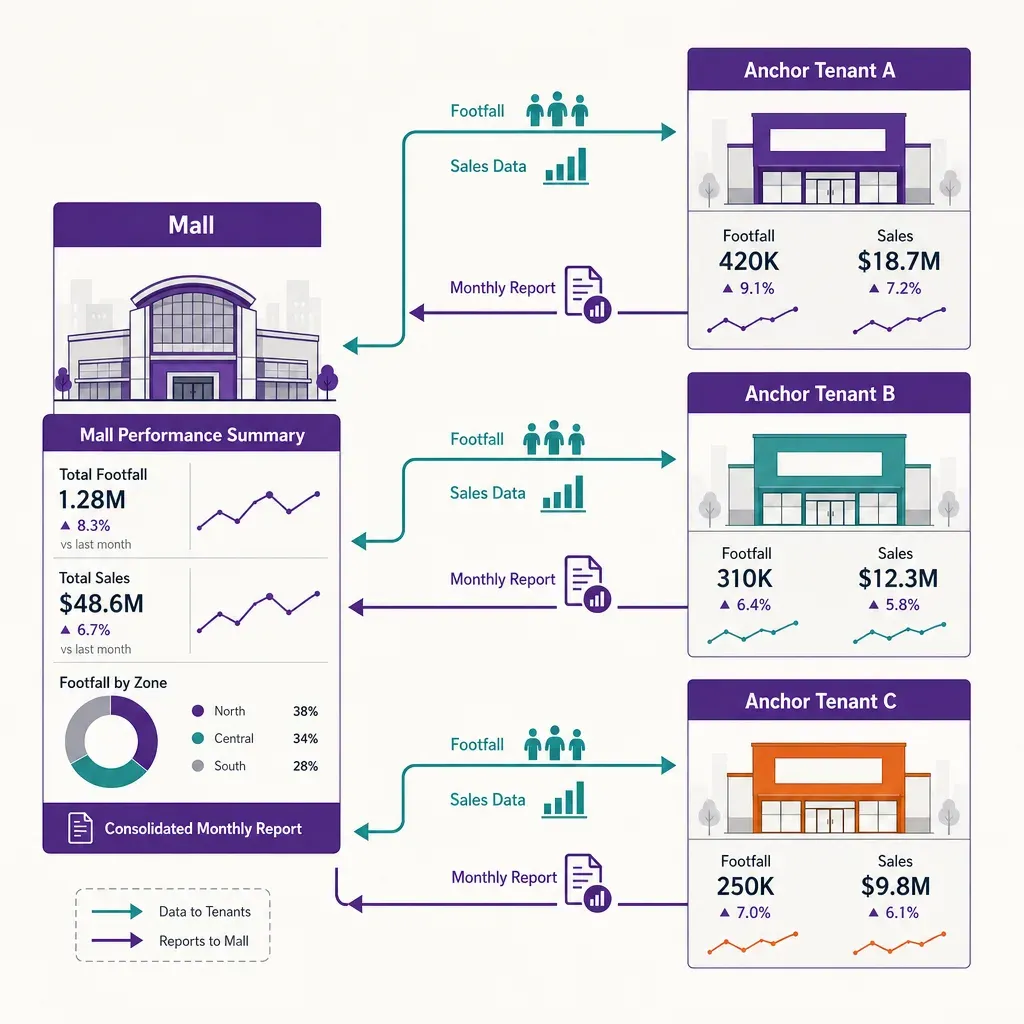
Three patterns of use are worth highlighting.
Hold-the-line renewals on flat traffic
When the centre's footfall is flat year-over-year, a clean report is the landlord's strongest argument against a rent cut. A retailer asking for a 15% reduction at renewal because business is soft is much harder to maintain that position when twelve monthly reports show centre visits within a percent of last year, dwell time slightly up, and weekend share unchanged. The conversation moves from "the centre is dying" to "our store is underperforming the trading environment," which is the right conversation to have.
Step-rent justifications on improving traffic
When centre visits are growing, the report supports a step-rent or index-plus structure at renewal without the landlord having to make the case anecdotally. A consistent year-over-year lift across twelve reports is harder for the retailer to dismiss than a slide in a renewal deck. The data does the argument; the asset manager does not.
Re-zoning conversations on shifting traffic
When the zone-level read shows that visits to a particular wing have softened, the report opens a conversation about relocation rather than a fight over rent. A tenant looking at twelve months of falling zone visits is often willing to consider a move to a healthier wing, sometimes at the same rent the landlord wanted from them anyway. That is a use case the landlord cannot get to without zone data, and one of the clearest commercial returns on the counting system.
Across all three, the underlying mechanic is the same. The landlord is converting raw footfall data into a story the retailer trusts, well in advance of the moment a commercial decision has to be made. The store manager who has read twelve reports does not need to be convinced at renewal. The store manager who has seen no data for two years arrives at the table assuming the landlord is hiding something.
How Ariadne fits
The counting system underneath a tenant report has to do two jobs at once. It has to read the building accurately enough that the numbers stand up in front of a tenant who runs a business off them, and it has to read it in a way that does not create a privacy problem the landlord then has to defend.
Ariadne measures this with Hybrid Fusion, its patented camera-free method. Time-of-Flight depth sensing counts every visitor at the entrances, capturing geometry rather than images, while patented phone signal sensing follows movement through the interior, detecting the signals a phone emits even in airplane mode. The sensor streams both feeds to Ariadne, where Hybrid Fusion combines them into one trajectory per visit and computes counts, dwell, and paths. The streams carry no identifier: no MAC address, no device ID, no biometric data, and no camera is involved. Identifiers are stored only when a visitor explicitly opts in, which keeps the method GDPR-friendly and outside biometric territory.
For a centre running tenant reports, the practical consequences are direct. The people counting feeds give centre-level and zone-level visits accurate enough to put in front of a retailer, including the day-part and weekday-weekend splits that drive staffing. Dwell time is measured across the building, not estimated from a single door count. Group sizing (whether a visit is a single person or a family of four) comes from the patented signal sensing layer, which matters for tenants whose category trades against household visits rather than individual walk-ups. The data lands in Ariadne Analytics, where the asset management team builds the monthly tenant export from the same data they use internally, and the privacy policy covers what is captured and what is not. There are no cameras to point at tenants, no biometric data to share or refuse to share, and no MAC addresses to argue about. The footfall report is exactly that: a count of visits and the time they spent in the centre.
A short checklist before the next monthly report
If you are reviewing your current tenant reporting package, these are the questions worth answering before the next cycle.
- Is the first page readable in under a minute? If a store manager has to scroll or page through to find the headline number, the report is too long.
- Is every metric anchored on year-over-year? Month-over-month belongs in the supporting detail, not in the headline panel.
- Are intra-tenant comparisons absent from the shared file? Internal leasing tools can hold them. The tenant deliverable should not.
- Is zone data aggregated to at least the hour? Minute-level zone data near neighbouring tenants exposes patterns the landlord should not be sharing.
- Does the package explain how the centre measures? A one-paragraph note on the counting method, the privacy posture, and what is and is not captured saves the asset manager from answering the same question every quarter.
- Is the file format something the retailer's head office can use? A PDF is fine for the store manager; a clean CSV or spreadsheet is what the chain's commercial team will actually open.
FAQ
Should the report compare tenants against each other?
No. Comparing one tenant's storefront capture or zone visits against a named neighbour creates a problem for the landlord no matter who comes out ahead. The better tenant uses it as renewal leverage, the worse tenant treats it as a marketing failure, and both relationships get harder. Intra-tenant comparisons belong inside the asset management team, where they inform leasing strategy, not inside the monthly file the tenant receives.
What footfall data is the tenant entitled to about their own store?
That depends on the lease. As a default, tenants are entitled to centre-level and zone-level visit data that describes the trading environment they rent in. Where the centre measures storefront capture for an individual tenant, returning that tenant's own number to them, hour-aggregated and without any comparator, is usually appropriate. Conversion data, which requires sales data the landlord does not own, belongs to the tenant and is only shared back to the centre under an explicit data agreement.
How often should the report go out?
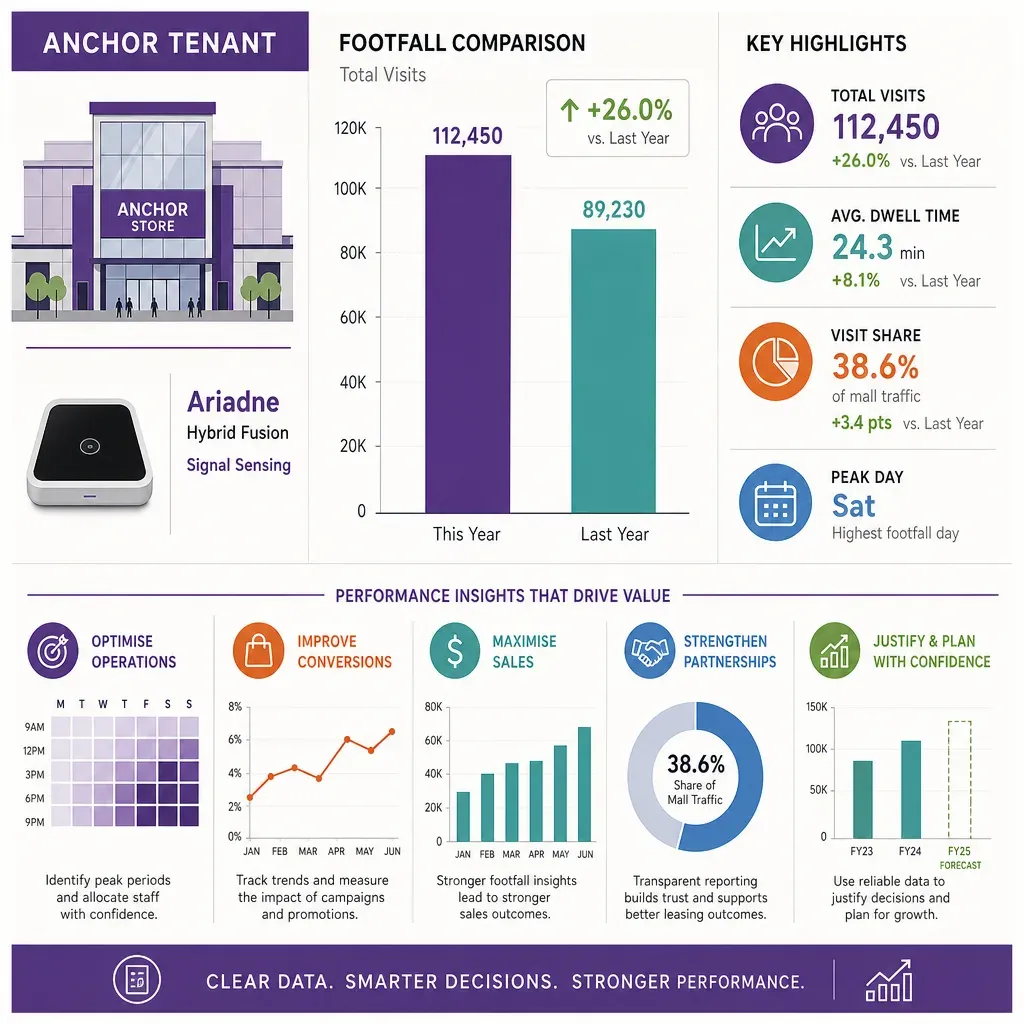
Monthly is the natural cadence for the standard package, with a deeper quarterly review for larger tenants or those approaching renewal. Weekly is usually too noisy to be useful; quarterly alone is too sparse to flag a softening trend in time for the centre to respond.


