
Most retail loyalty measurement lives at the till. A customer joins a scheme, presents a card, buys, and the transaction record does the rest. That works for the people who identify themselves and misses everyone who does not. Long before a shopper reaches a loyalty card, they show loyalty in a simpler way: they come back. Repeat visit rate measures exactly that, the share of your visits made by people who have been in before, and it does it at the level of the visit rather than the purchase.
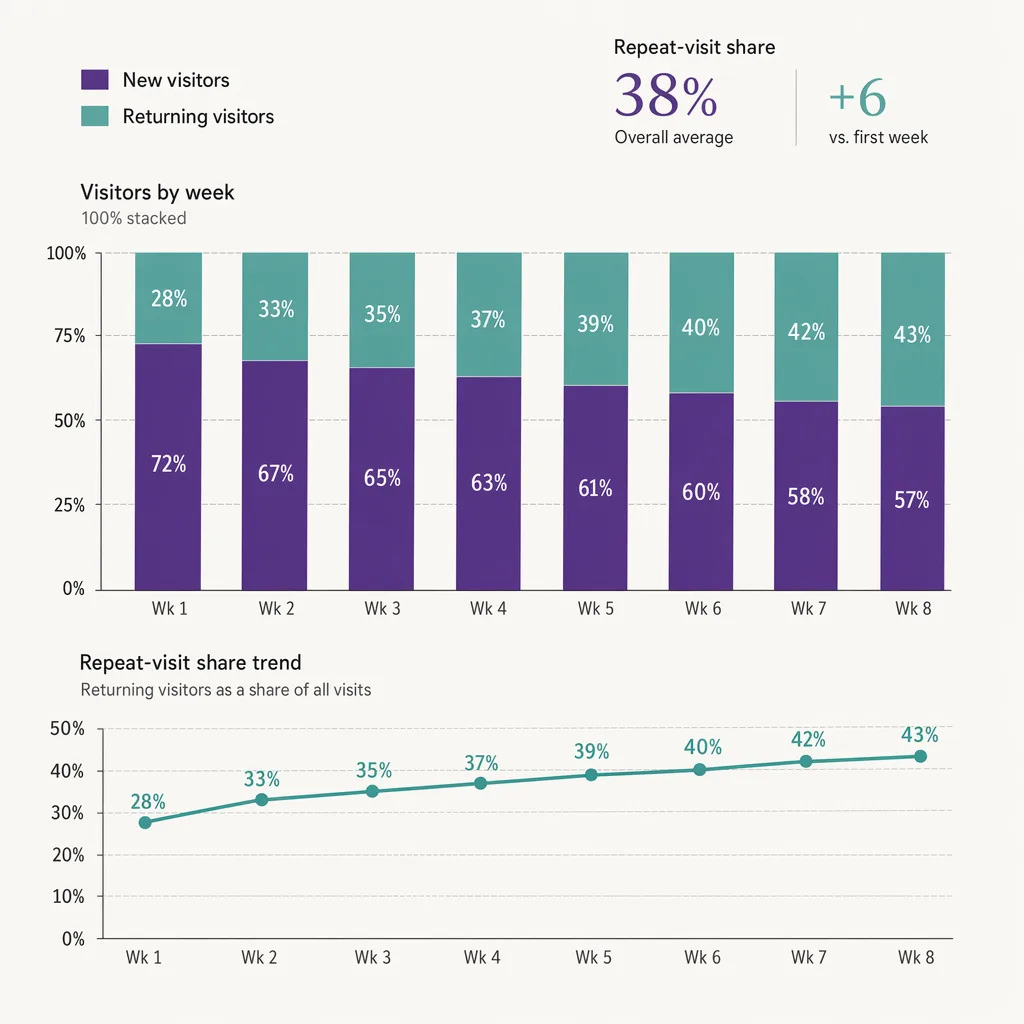
This post defines repeat visit rate precisely, gives the formula and the lookback-window choice that makes or breaks it, explains how to read the new-versus-returning split and how it differs from repeat purchase rate, and shows how visit frequency and inter-visit gap sit alongside it. It closes on the honest question the metric raises: how do you know a visitor has returned without collecting their identity. The answer shapes how the whole thing is measured.
What is repeat visit rate in retail?
Repeat visit rate is the share of store visits made by people who have visited before within a defined window, for example the percentage of a month's visits that come from returning shoppers rather than first-timers. It is a loyalty and retention signal that sits upstream of purchase: a store can grow sales either by pulling new people in or by getting the same people to come back more often, and repeat visit rate tells you which lever is moving. It is usually expressed as returning visits divided by total visits over a period, and it pairs with visit frequency (how often a returner comes back) to describe the health of your existing base.
The formula: returning visits over total visits, and choosing the lookback window
The calculation is straightforward. Repeat visit rate is returning visits divided by total visits over a period, expressed as a percentage. If a store recorded 10,000 visits in a month and 3,500 of them came from people who had visited before within the lookback window, the repeat visit rate is 35 percent. The figure is illustrative; the point is the shape of the sum, not the number.
The decision that actually determines the result is the lookback window: how far back you look to decide whether a visit counts as "returning." A shopper who last came in eighteen months ago is not the same as one who came in last week, and where you draw that line changes the metric completely. A short window (say 30 days) measures active, habitual customers and reads high only for stores people visit often, like a grocer or a pharmacy. A long window (say 12 months) captures occasional returners too and suits stores with a naturally slow visit rhythm, like furniture or a specialist retailer. There is no universal correct window; there is a window that matches your category's natural visit frequency, and then the discipline of never changing it mid-comparison. The most common way to make this metric lie to yourself is to compare a 30-day repeat rate in one period against a 90-day one in another and read the difference as a change in loyalty when it is only a change in definition.
New vs returning: reading the split, and how it differs from repeat purchase rate
Every visit falls into one of two buckets: a first-time visitor or a returning one. The split between them is more informative than the repeat rate alone, because the two halves move for different reasons and point at different levers.
A rising new-visitor share usually means acquisition is working: marketing, a new location advantage, or seasonal pull is bringing fresh people in. A rising returning-visitor share means retention is working: the store is giving people reasons to come back. Both can be good; both can be a warning. A store flooded with new visitors and few returners is spending to fill a leaky bucket, buying arrivals that never develop into a base. A store living almost entirely on returners is stable but not growing, and vulnerable if that loyal core thins. The healthy pattern is a steady returning base with a consistent inflow of new visitors converting into future returners, and the split is what lets you see which of those is happening.
Repeat visit rate is not the same as repeat purchase rate, and conflating them is a frequent error. Repeat purchase rate counts people who bought more than once and lives in transaction data. Repeat visit rate counts people who came more than once, whether or not they bought. The gap between them is itself a signal: a shopper who returns repeatedly without buying is engaged but not converting, which is a very different problem from someone who never comes back at all. Visit-level loyalty sits upstream of purchase-level loyalty, and measuring it catches interest that the till never sees. For how return visits ultimately tie back to money, see linking visits to revenue, and for the broader concept of reading loyalty from the door rather than the till, see loyalty from entry data.
Visit frequency and inter-visit gap: the metrics that sit next to repeat rate
Repeat visit rate answers "what share of visits are returners." Two related metrics fill in the picture it leaves open, and the three are best read together.
| Metric | What it measures | What it tells you |
|---|---|---|
| Repeat visit rate | Returning visits as a share of total visits over a period | How much of your traffic is loyal base versus new acquisition |
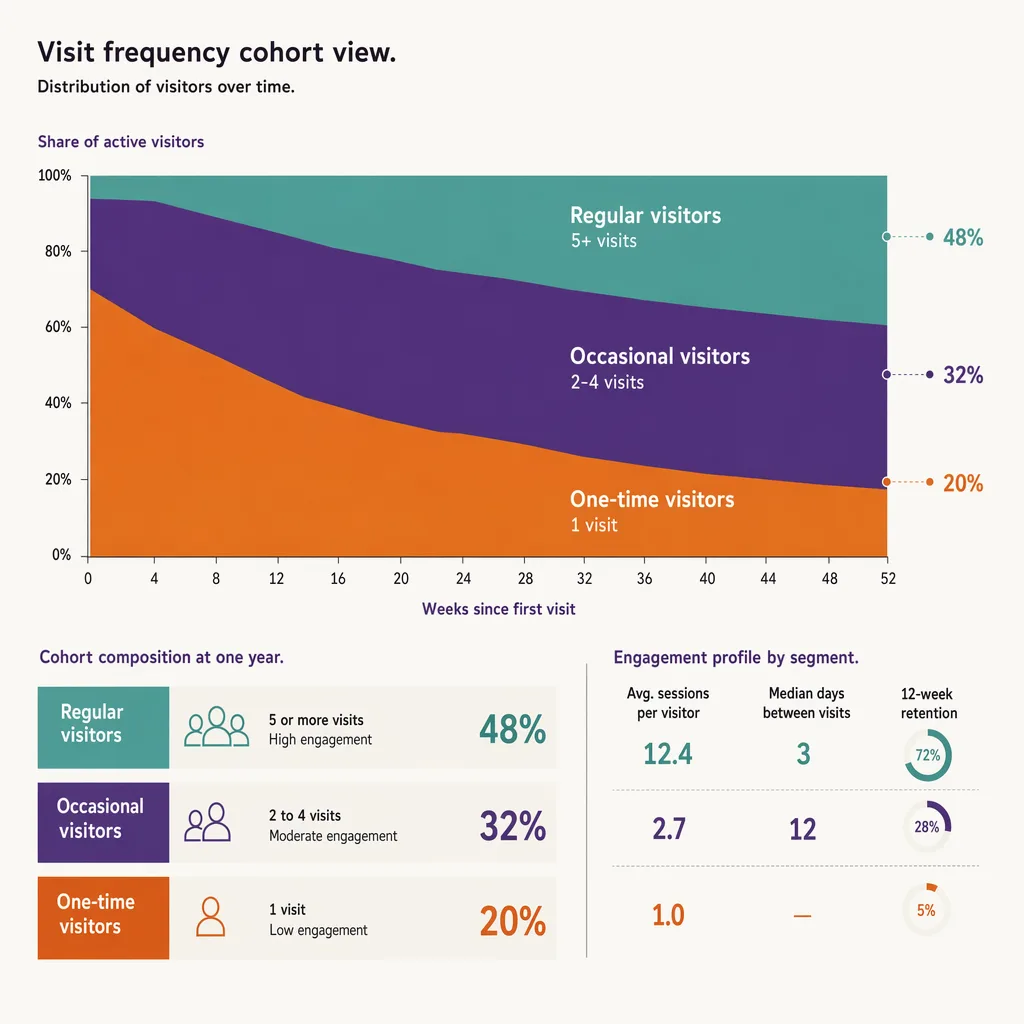
| Visit frequency | How many times a returning visitor comes back over a period | The depth of loyalty: not just that people return, but how intensely |
| Inter-visit gap | The average time between one visit and the next | The rhythm of return, and an early warning when it stretches out |
The reason to watch all three is that repeat rate alone can hide movement. Repeat visit rate can hold steady while frequency quietly falls, meaning the same share of your traffic is loyal but each loyal shopper is coming less often, which is a base that is thinning even though the headline looks stable. Inter-visit gap is the earliest of the three to move: when loyal shoppers start drifting, the gap between their visits stretches before they disappear from the returning count entirely. Read together, the three separate a base that is deepening from one that is quietly eroding. Note that a returner's next visit clusters on particular days and times, which is where these metrics meet the traffic calendar; see when returners come back.
What drives repeat visits: assortment, service, and the pull of the wider setting
Repeat visit rate is a measurement, not a lever, so the practical question is what moves it. Three forces do most of the work. Assortment is the first: a store people trust to have what they need, refreshed often enough to reward a return trip, earns repeat visits on its own merit. Service is the second, and it is underrated: a good interaction is a reason to come back and a bad one is a reason not to, and both compound over a shopper's history with the store. The third is the pull of the wider setting, which retailers inside a centre or a busy high street borrow whether they plan to or not. A store in a location people already return to for other reasons inherits some of that rhythm; a standalone unit has to generate every return trip itself.
That third force is why repeat visit rate should be read against the store's context, not in isolation. A repeat rate that looks modest for a destination flagship might be strong for a unit in a centre where footfall churns constantly, and the reverse holds too. The metric is comparable across your own stores over time; it is only comparable across stores if you account for how much return traffic each location's setting supplies for free.
Measuring returners without collecting identity
Here is the honest tension at the centre of this metric. To count a returning visit you have to recognise that a visit has happened before, and recognition sounds like tracking. It does not have to be. Ariadne's method measures whether a visit is a return without capturing who the visitor is, and the distinction is the whole point: this is not anonymised identity, because no identity is collected in the first place.
Ariadne measures this with Hybrid Fusion, its patented camera-free method. Time-of-Flight depth sensing counts every visitor at the entrances, capturing geometry rather than images, while patented phone signal sensing follows movement through the interior, detecting the signals a phone emits even in airplane mode, and tracks that movement to about one-metre precision. The sensor streams both feeds to Ariadne, where Hybrid Fusion combines them into one trajectory per visit and computes counts, dwell, and paths. The streams carry no identifier: no MAC address, no device ID, no biometric data, and no camera is involved. Identifiers are stored only when a visitor explicitly opts in, which keeps the method GDPR-friendly and outside biometric territory.
Returner detection is opt-in only and captures no personal data by default. There is no persistent profile of an anonymous shopper being built in the background; the default measurement counts visits and their patterns without an identifier attached. A repeat-visit signal at the level the metric needs comes from the visit patterns themselves rather than from identifying and following individuals, and any identity-linked measurement happens only where a visitor has explicitly opted in. That keeps the metric usable and keeps it clear of the surveillance framing that "tracking returners" would otherwise imply. For how this counting works in a store setting, see counting in a fashion store, and for why the returning count is not the same as the raw visitor count, see unique visitors vs total footfall. The full method sits at people counting analytics.
Related reading
FAQ
What is repeat visit rate in retail?
It is the share of store visits made by people who have visited before within a defined window, calculated as returning visits divided by total visits over a period. It is a loyalty signal that sits upstream of purchase: it measures whether the same people are coming back, whether or not they buy.
How do you calculate repeat visit rate?
Divide returning visits by total visits over a period and express it as a percentage. The result depends heavily on the lookback window you choose for "returning," so pick a window that matches your category's natural visit frequency and keep it fixed across every comparison.
What is the difference between repeat visit rate and repeat purchase rate?
Repeat visit rate counts people who came more than once, from visit data. Repeat purchase rate counts people who bought more than once, from transaction data. A shopper who returns repeatedly without buying shows up in the first and not the second, and that gap is itself a useful signal.
Is a returning visitor tracked or identified to measure this?
No, not by default. Ariadne counts with Hybrid Fusion: Time-of-Flight depth sensing plus patented phone signal sensing, never cameras. Time-of-Flight captures geometry rather than images, and signal sensing captures no MAC address by default, so the measurement involves no video, no faces, and no biometric data. Any identity-linked measurement is opt-in only; the default counts visits and their patterns without collecting who the visitor is.
What lookback window should I use for repeat visit rate?
One that matches how often people naturally visit your category. A short window like 30 days suits high-frequency retail such as grocery or pharmacy; a longer window like 12 months suits slow-rhythm categories such as furniture. There is no universal number, only the discipline of matching it to your rhythm and never changing it mid-comparison.


