
Every operator knows a queue is bad news, but "it gets busy at the tills" is not a number you can act on. It does not tell you when to open a second till, whether the wait is costing you sales, or which time of day the problem lands. Queue length analytics turns that vague sense into measured inputs: how many people are waiting, how long they wait, and how many give up and leave. Those numbers move a queue from a thing staff notice too late to a thing the operation can manage before it drives a walk-out.
This post defines queue length analytics as a general retail and service metric, distinct from the airport-scoped forecasting covered in queue prediction at airports. It sets out the three core measurements, explains where queues form and where to place a counting zone, and shows how a live reading becomes a staffing decision. One framing point up front: queue length analytics is an operations input, a way to run service better. It is not a certified safety system, and nothing here should be read as one.
What is queue length analytics?
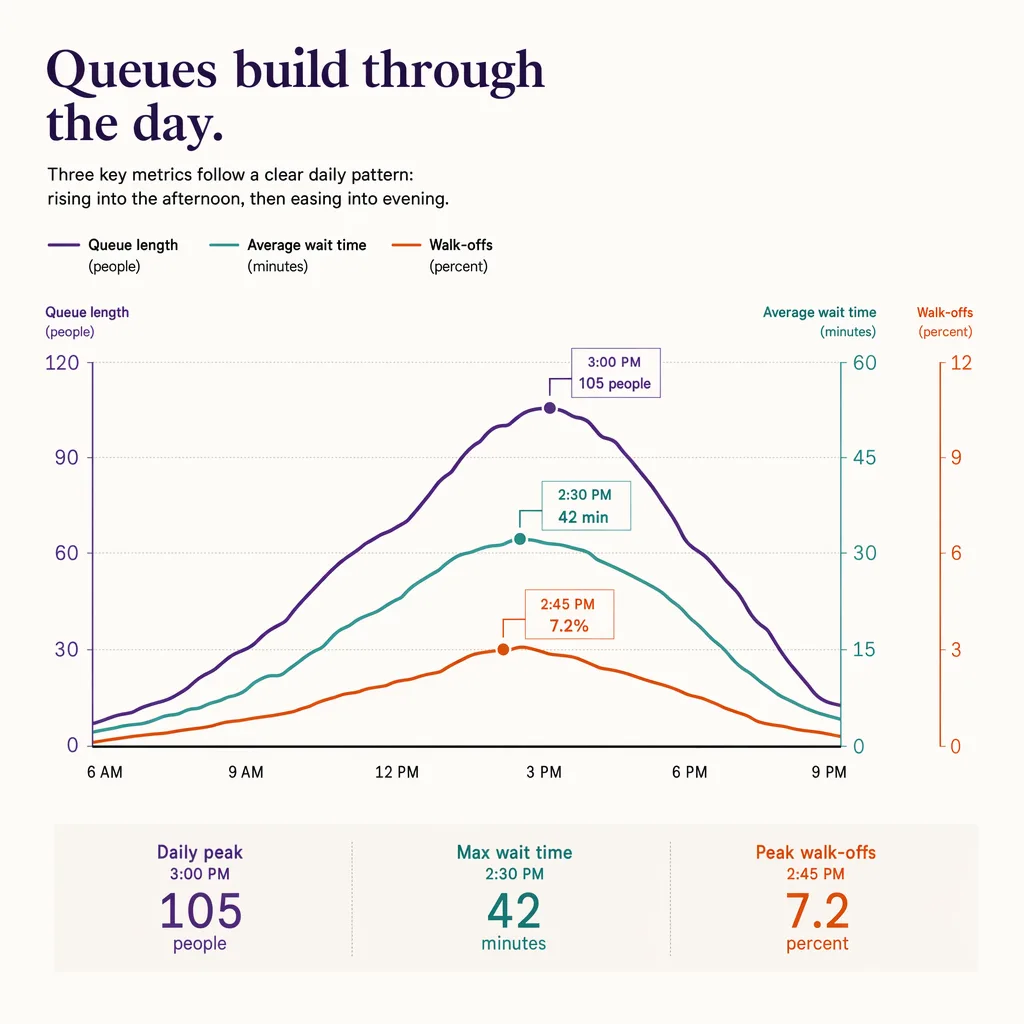
Queue length analytics is the measurement of how many people are waiting in line, how long they wait, and how often they give up before being served. The core outputs are queue length (people waiting now), wait time (how long from joining to service), and abandonment (people who leave the line). Together they turn a vague "it gets busy" into staffing and service decisions: open a till when the queue crosses a threshold, or move staff before wait time drives walk-outs. It works at checkouts, service desks, entrances, and any point where people bunch and wait.
The reason to measure all three rather than one is that they answer different questions. Queue length is the live picture, the thing you react to now. Wait time is the shopper's actual experience, the number that correlates with satisfaction and with walk-outs. Abandonment is the cost, the visits that ended in nothing because the line was too long. A queue can be short but slow, or long but fast-moving, and only reading the set together tells you which.
The three core metrics: queue length, wait time, and abandonment rate
The three measurements build on each other, and it helps to be precise about what each one is and what it drives.
| Metric | What it measures | The decision it drives |
|---|---|---|
| Queue length | How many people are waiting in the queue zone right now | Whether to open or close a service point in the moment |
| Wait time | How long a person waits from joining the line to being served | Whether service speed is acceptable or is degrading the visit |
| Abandonment rate | The share of people who join the queue but leave before being served | Whether the wait is actively costing sales or service |
Queue length is the simplest and the most immediately actionable: it is a live count of people in the waiting area, and it is what a real-time threshold acts on. Wait time is the experience metric, derived from how long people spend in the queue zone before reaching the service point; it is what a shopper remembers and what surveys pick up. Abandonment is the outcome metric, the people who joined and gave up, and it is the one that puts a cost on the other two. A rising abandonment rate is the clearest signal that a queue has crossed from an inconvenience into lost business.
A note on benchmarks: there is no universal "acceptable wait" that applies across a supermarket till, a pharmacy counter, and a service desk. What counts as too long depends on the setting, the value of the transaction, and what the customer expected. Rather than chase a single industry figure, set thresholds against your own baseline and watch how abandonment responds as wait time climbs. That relationship, at what wait time your own customers start walking, is far more useful than any published average.
Where queues form and where to place a counting zone
A queue analytic is only as good as the zone it measures. The measurement works by defining a waiting area and reading occupancy and dwell within it, so the first job is deciding where that area is.
Checkouts are the obvious case: the queue forms in a fairly predictable channel in front of the tills, and the counting zone covers that channel. Service desks, returns counters, click-and-collect points, and deli or pharmacy counters are similar, each with a defined waiting area you can bound. Entrances are a different case, where a queue can form outside or just inside the door during peak periods or when entry is being metered. The principle is the same in every case: draw a zone around where people actually bunch and wait, sized to the real footprint of the queue rather than an idealised line.
Two practical points. First, the zone has to match how the queue behaves, including when it spills past its usual bounds at peak, or the count will understate the problem exactly when it matters most. Second, a single queue may need to be distinguished from general milling nearby, which is a matter of where you draw the zone and how you read dwell within it, so that a shopper pausing near the tills is not counted as waiting in line. For settings where checkout queues and store traffic interact, counting in supermarkets covers the wider picture.
Real-time thresholds and alerts: turning a queue reading into a till-opening decision
The point of measuring queue length live is to act on it live. A raw count is only useful if it triggers a response before the queue becomes a problem, and that is what thresholds and alerts do.
The pattern is straightforward. You set a queue-length threshold, say a number of people waiting that your service level should not exceed, and the system raises an alert the moment the live count crosses it. Staff open another till or redirect cover to the counter, and the queue is worked down before wait time climbs and shoppers start to abandon. The threshold is a lever you tune: set it too high and you react too late, too low and you open tills that are not needed. The right level is the one that keeps wait time inside your target most of the time without over-staffing the quiet periods.
The value of doing this in real time rather than in a next-day report is that a queue is a now problem. A report tells you yesterday was bad; an alert lets you fix today. This depends on a genuinely live count rather than a periodic sample, which is why the underlying measurement matters; see real-time counting for how live occupancy and queue readings are produced.
Queue data and staffing: matching cover to demand
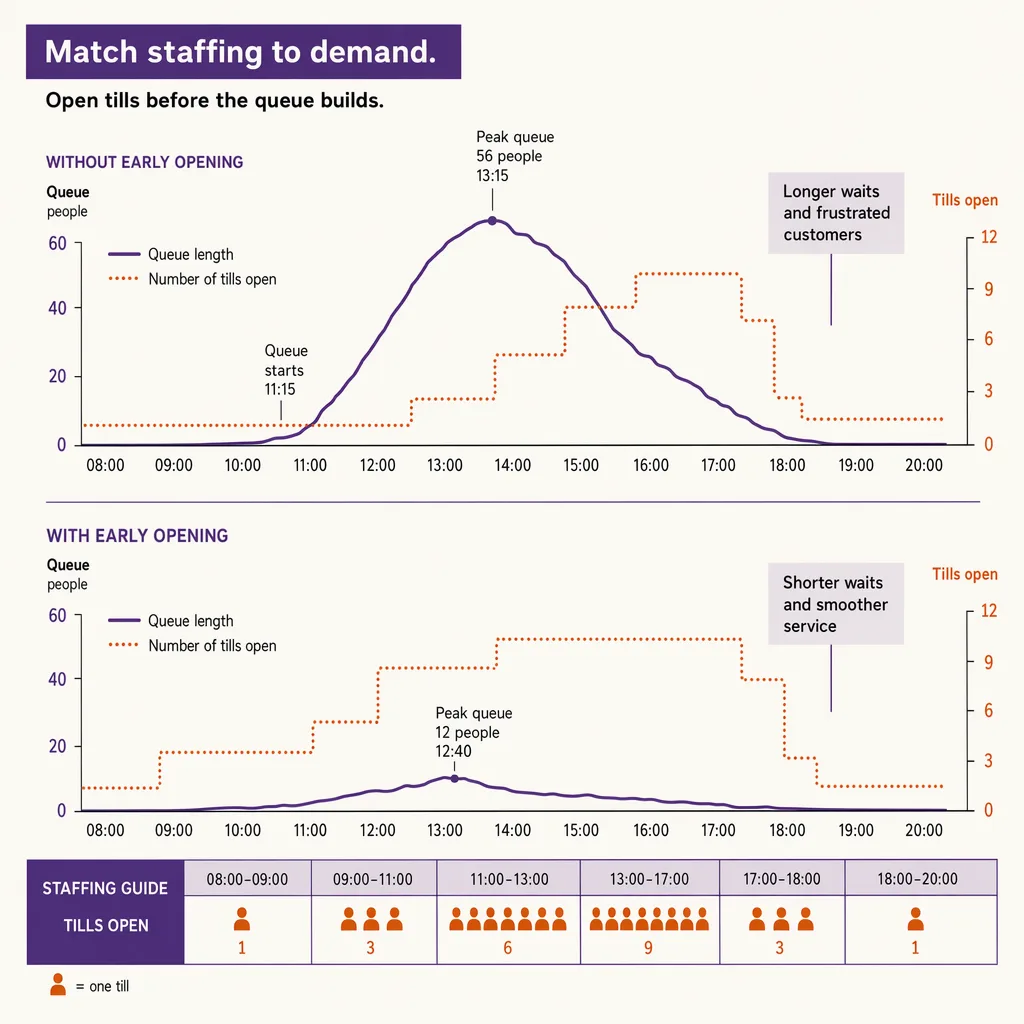
Real-time alerts handle the queue in the moment, but the deeper win is using queue history to schedule the right cover in advance so the alerts fire less often. If your queue and wait-time data show the same pattern week after week, a build-up at the deli counter every weekday lunchtime, a Saturday-afternoon checkout peak, then that pattern is a scheduling instruction, not a surprise to react to.
This is where queue analytics joins the wider staffing picture. Knowing when queues form lets you match staff cover to demand rather than to a flat roster, which is the whole idea behind the staff-to-customer ratio and behind building shifts around measured traffic rather than habit. Feeding queue and footfall patterns into the roster is exactly what demand-based scheduling does: it puts cover where the data says the pressure will be, so the queue is staffed before it forms rather than after it complains. Real-time alerts then handle the exceptions the schedule did not predict. The two work together, one planning the base cover, the other catching the outliers.
Measuring queues without cameras: occupancy in a defined zone and dwell in line
Queue analytics needs occupancy in a defined waiting zone and dwell within it, and it needs both without a camera pointed at the till and without identifying the people in the line. That is a measurement problem, and it is the one Ariadne's method is built for.
Ariadne measures this with Hybrid Fusion, its patented camera-free method. Time-of-Flight depth sensing counts every visitor at the entrances, capturing geometry rather than images, while patented phone signal sensing follows movement through the interior, detecting the signals a phone emits even in airplane mode, and tracks that movement to about one-metre precision. The sensor streams both feeds to Ariadne, where Hybrid Fusion combines them into one trajectory per visit and computes counts, dwell, and paths. The streams carry no identifier: no MAC address, no device ID, no biometric data, and no camera is involved. Identifiers are stored only when a visitor explicitly opts in, which keeps the method GDPR-friendly and outside biometric territory.
For a queue, that translates directly. Occupancy in the queue zone gives you queue length, the live count of people waiting. Dwell within that zone gives you wait time, how long people spend before reaching the service point. And a person who enters the zone and leaves without reaching the service point registers as an abandonment. All three come from reading a defined area, not from recognising anyone, so a checkout queue can be measured continuously without a camera and without capturing who is standing in it. To keep the framing honest: this is an operations input for running service better, not a certified safety system. For the analytics platform this sits within, see people counting analytics.
FAQ
What is queue length analytics?
It is the measurement of how many people are waiting in a line, how long they wait, and how many give up before being served. The three core outputs are queue length (people waiting now), wait time (how long from joining to service), and abandonment (people who leave the line). Together they turn a vague sense that it gets busy into measured inputs for staffing and service decisions.
How do you measure queue length without cameras?
By defining a waiting zone and reading occupancy and dwell within it. Queue length comes from live occupancy in the zone, wait time from how long people dwell there before reaching service, and abandonment from people who enter the zone and leave without being served. Ariadne does this with Hybrid Fusion, so no camera watches the queue and no one in it is identified.
What is a good wait time in a queue?
There is no single figure that applies everywhere, because acceptable wait depends on the setting, the value of the transaction, and what the customer expected. Rather than chase a published average, set a threshold against your own baseline and watch abandonment: the wait time at which your own customers start leaving is the number that matters.
How does queue data help with staffing?
Queue and wait-time patterns are usually repeatable, so they become a scheduling instruction. If the data shows a lunchtime build-up at a counter or a Saturday checkout peak every week, you can put cover there in advance through demand-based scheduling. Real-time queue alerts then handle the exceptions the schedule did not predict.
Is queue length analytics a safety system?
No. Queue length analytics is an operations input for running service better, matching staff to demand and reducing walk-outs. It is not a certified safety system, and it should not be relied on as one.


