
A supermarket has more data than almost any other retailer and still misses the most basic number: how many people walked in. Till receipts, loyalty scans, and basket data all describe the people who bought something. They say nothing about the shopper who came in for one thing, could not find it or could not face the checkout queue, and left. At a large-format grocer with wide automatic doors, families arriving together, and trolleys everywhere, that missing entry figure is also the hardest one to capture accurately.
This guide is about what people counting adds to a supermarket specifically: conversion that till data cannot give you, hourly staffing for the tills and the deli and the self-checkout bank, and a fair way to grade a whole estate of stores. It also covers the part most counters get wrong at a grocery door, the wide entrance with trolleys and groups, and why that needs more than a single beam. This is large-format grocery, distinct from the small-format convenience case covered elsewhere.
What does people counting do for a supermarket?
People counting gives a supermarket the one number that till data hides: how many people actually walked in. Compare entries to transactions and you get conversion; compare entries to staff on shift and you get the staffing ratio for each hour. Across a multi-store estate, the same entry data ranks branches fairly, sized by traffic rather than turnover. At wide grocery entrances with trolleys and families arriving together, accurate counting needs depth or fusion, not a single beam.
The sections below take those three uses in turn, conversion, hourly staffing, and store grading, and then deal with the accuracy problem at the door that underpins all of them.
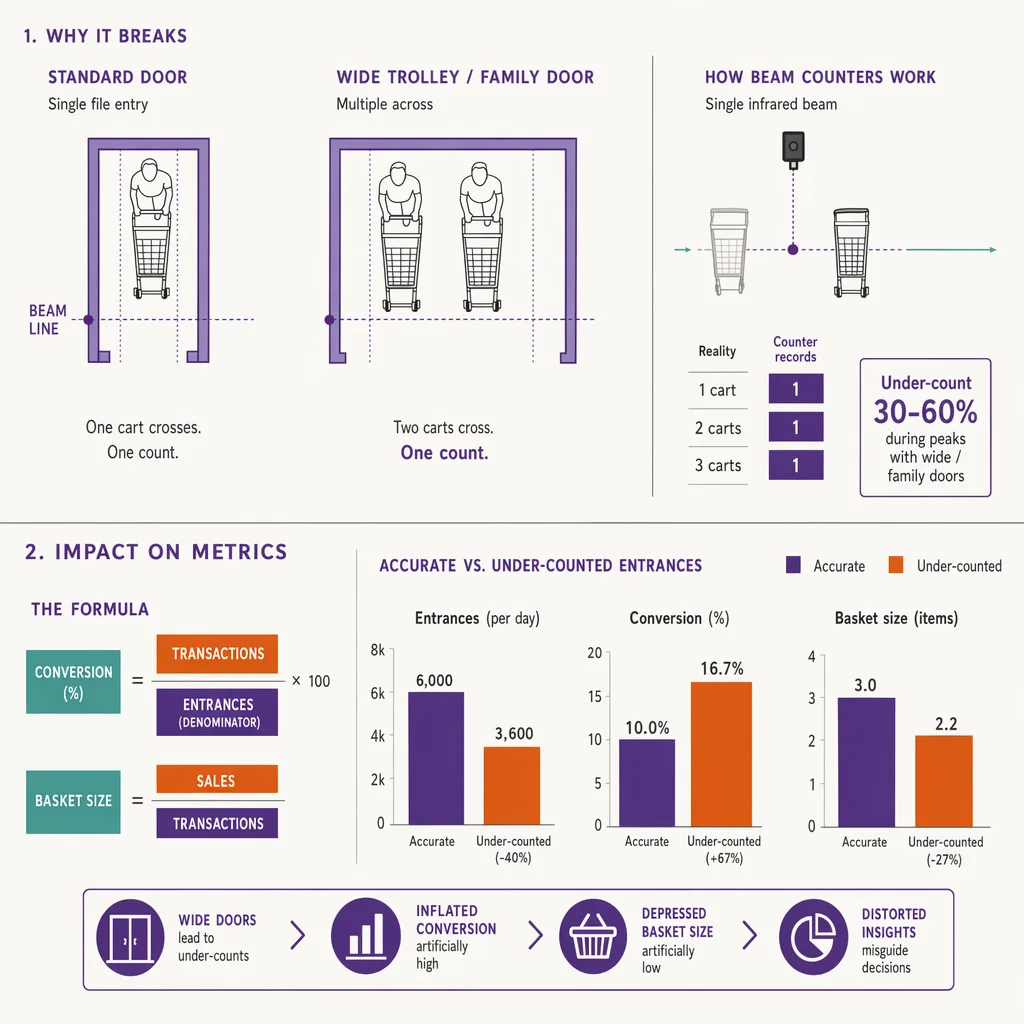
The supermarket pain point: wide automatic doors, trolleys, and families break a simple beam counter
The grocery entrance is the worst case for cheap counting hardware. It is wide, often several metres of automatic sliding door, so people do not file through single file; they spread out and pass side by side. They arrive in family groups. They push trolleys and pull bag-laden children. A break-the-beam sensor, which counts interruptions of a single line, was never built for this. Two adults and a child abreast can break the beam once. A trolley can break it as if it were a person. The result is a count that is wrong in both directions and wrong by a different amount at peak than off-peak, which is the worst kind of wrong because it is not even a consistent error you could correct for.
This matters because every downstream use, conversion, staffing, grading, inherits the door count's accuracy. A conversion rate built on an entry figure that undercounts groups will systematically overstate conversion at the busiest, most group-heavy times. So before any of the analysis is worth doing, the door count has to hold up at a wide, trolley-busy, family-heavy entrance. That is a real requirement, not a spec-sheet footnote, and it is why verifying counter accuracy on your own busiest door matters more than the headline percentage.
The grocery door has a few extra traps a buyer should test for specifically. Many large stores run a separate entrance and exit, or a single wide opening used in both directions, and a counter that cannot tell a returning trolley-pusher leaving from a new shopper arriving will inflate the count. Stores with a foyer, a coffee shop, or a concession inside the lobby see people loiter in the threshold zone, which a poorly placed sensor double-counts as they drift in and out. And the seasonal swing in a supermarket is brutal: the Saturday before a major holiday can run several times a quiet Tuesday, so a counter that holds accuracy at ordinary volume but degrades under crush is failing precisely on the days the numbers are used most. The accuracy claim that matters is the one measured at your own peak, on your own door layout, not the one on the brochure.
Conversion and basket: entries vs transactions vs spend
Conversion in a supermarket is a more interesting number than in a single-purpose store, because grocery shoppers nearly all intend to buy something. A low conversion rate at a supermarket is rarely a browser who never meant to buy; it is more often a shopper defeated by a queue, an out-of-stock, or a checkout experience that pushed them to abandon. That makes the entries-to-transactions ratio a live operational signal, not just a marketing metric. The calculation itself is the standard retail conversion rate: transactions over entries for the same window.
Layer basket value on top and the picture sharpens. Entries, transactions, and average spend together separate three different problems that look identical on a turnover report: fewer people came in, the same people came but more left without buying, or the people who bought spent less. Each has a different fix, and you cannot tell which one you have without the entry count underneath. Turnover alone blends all three into a single number that tells you something is off without telling you what.
Worked through, the three fixes really are different. If entries fell, the problem sits outside the store: a competitor opened, a roadworks scheme cut the catchment, a promotion ended. If entries held but conversion dropped, the problem is inside: stock gaps, a queue that turned people away, a layout change that confused shoppers. If conversion held but spend fell, the problem is the basket: range, pricing, or a shift in what the same shoppers are buying. A manager handed a "sales are down 6%" target with only the turnover number can do little but worry. The same manager with entries, conversion, and spend can say which of the three moved and point the response at it, which is the difference between a plan and a panic.
Hourly staffing: tills, deli, and self-checkout supervision against the traffic curve
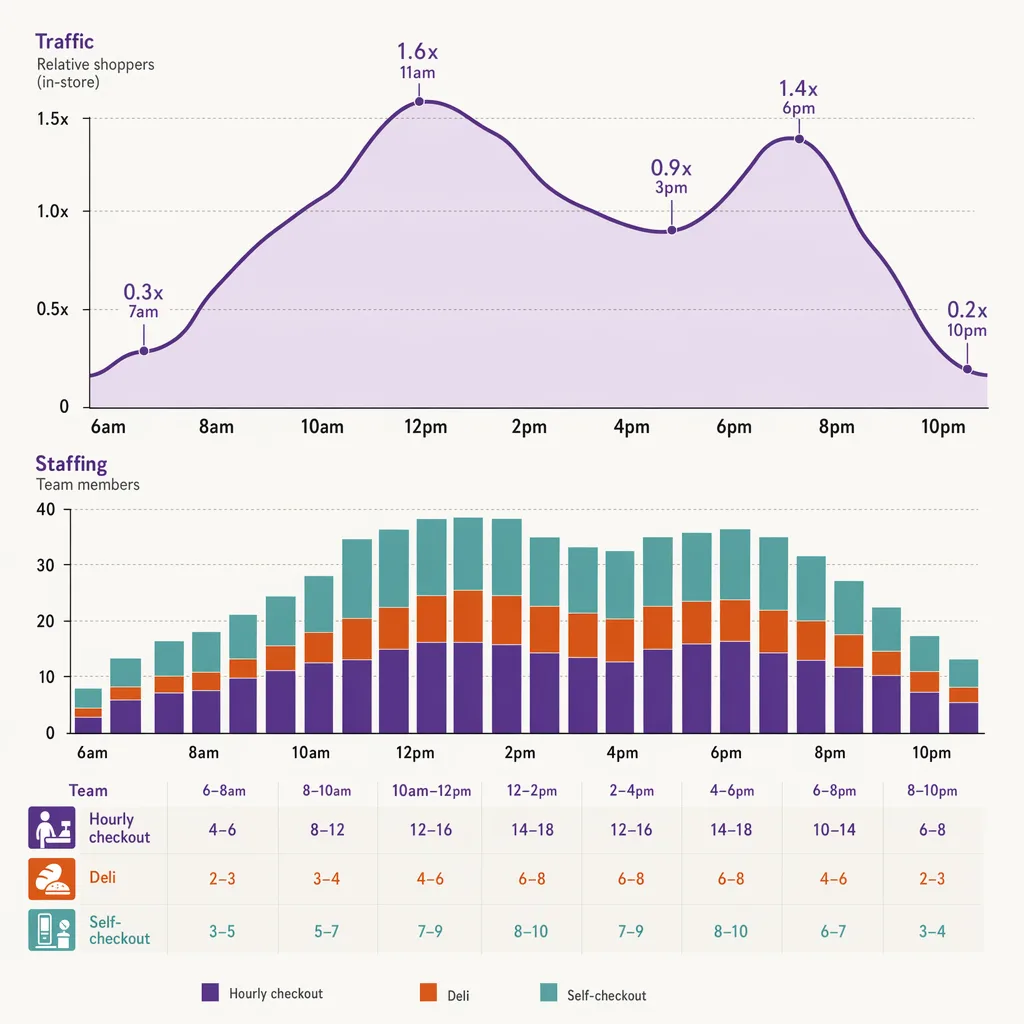
Supermarket labour is the controllable cost, and it is mostly spent at the front end: staffed tills, self-checkout supervision, the deli and counter services. All three should track the traffic curve, and all three are commonly scheduled against a curve that is a year out of date or a manager's intuition.
Counting gives the live and historical traffic shape by hour, which lets you put the till bank, the self-checkout supervisor, and the counter staff where the shoppers actually are. The classic failure is the checkout queue that builds at a predictable daily peak the rota never quite covers, while two tills sit idle mid-morning. This is the staff-to-customer ratio problem in its most visible form: the queue at the till is the single thing a grocery shopper complains about most, and it is the most directly fixable with an accurate hourly count. The point is not to add labour, it is to move the labour you already have onto the hours that need it.
The grocery front end is unusual in how many separate decisions ride on the same curve. There is a lag to manage: the till peak is not the door peak, because a shopper who enters at 17:15 reaches the checkout twenty or thirty minutes later, so the staffed-till curve should sit shifted to the right of the entry curve, and a counter that captures entries by hour lets a manager build that lag into the rota instead of being surprised by it every evening. There is the self-checkout supervision ratio, which is not about the till count but about how many shoppers are using the self-scan bank, since one supervisor can cover a quiet bank and not a swamped one. And there is the call to open or close tills live: a duty manager watching the entry count climb knows to call staff to the front before the queue forms rather than after a shopper has already abandoned a full trolley. Each of these is a different use of the same hourly number, and none of them is available from a stale or intuited curve.
Live alerts versus the weekly rota
It helps to separate the two clocks counting runs on. The weekly rota is built from the historical curve: the repeatable Saturday-morning peak, the Thursday late-evening top-up rush, the dead Tuesday afternoon. That is a planning use, done days ahead, and it is where most of the labour saving sits. The live count is a different tool for a different moment: it catches the day that breaks the pattern, the unexpected rush before a weather event or a local match, and lets the manager react in the moment by opening tills or pulling staff forward. A supermarket needs both, and they come from the same sensor reading the same door, used at two different time horizons.
Grading a store estate fairly by traffic, not turnover
A grocery chain that ranks its stores by turnover is rewarding location as much as management. A store on a busy high street will out-turn a store in a quiet suburb almost regardless of how well either is run. That makes turnover a poor tool for judging a manager, spotting a problem, or sharing what works.
Entry counting gives a fairer denominator. Conversion and spend per visitor, measured against the actual footfall each store receives, separate the stores that convert their traffic well from the stores that simply get more of it. A smaller store converting a high share of a modest footfall may be better run than a flagship coasting on location. This is the same insight behind tracking sales per visitor rather than raw takings: it sizes performance by the traffic a store actually had, which is the only fair way to compare a high-street branch with a retail-park one.
Used carefully, this reshapes a few estate-level conversations. A store that ranks middling on turnover but top on conversion is a candidate for a format the chain should copy, not a manager to leave alone because the headline number is unremarkable. A store with high footfall and weak conversion is leaking sales it already has the traffic for, which is a coaching and operations problem, not a marketing one, and pouring more promotional spend at it would be treating the wrong cause. Footfall also reframes a closure or relocation decision: a branch that converts well but simply sits in a low-traffic catchment is a different case from one that gets the traffic and fails to convert it, and the two should not share a fate just because their takings look alike. None of these reads is available from a turnover league table, which rewards the postcode as much as the team.
A caution belongs here. Footfall-based grading is fairer than turnover, but it is still a comparison between stores with different ranges, store sizes, and local demographics, so it works best as a way to surface questions rather than to rank managers mechanically. The right use is "why does this store convert ten points below its peer group," followed by a look at staffing, stock, and layout, not an automatic bonus formula. The number points to where to look; the explanation still comes from the store.
Counting accuracy at a busy grocery door: group and trolley handling
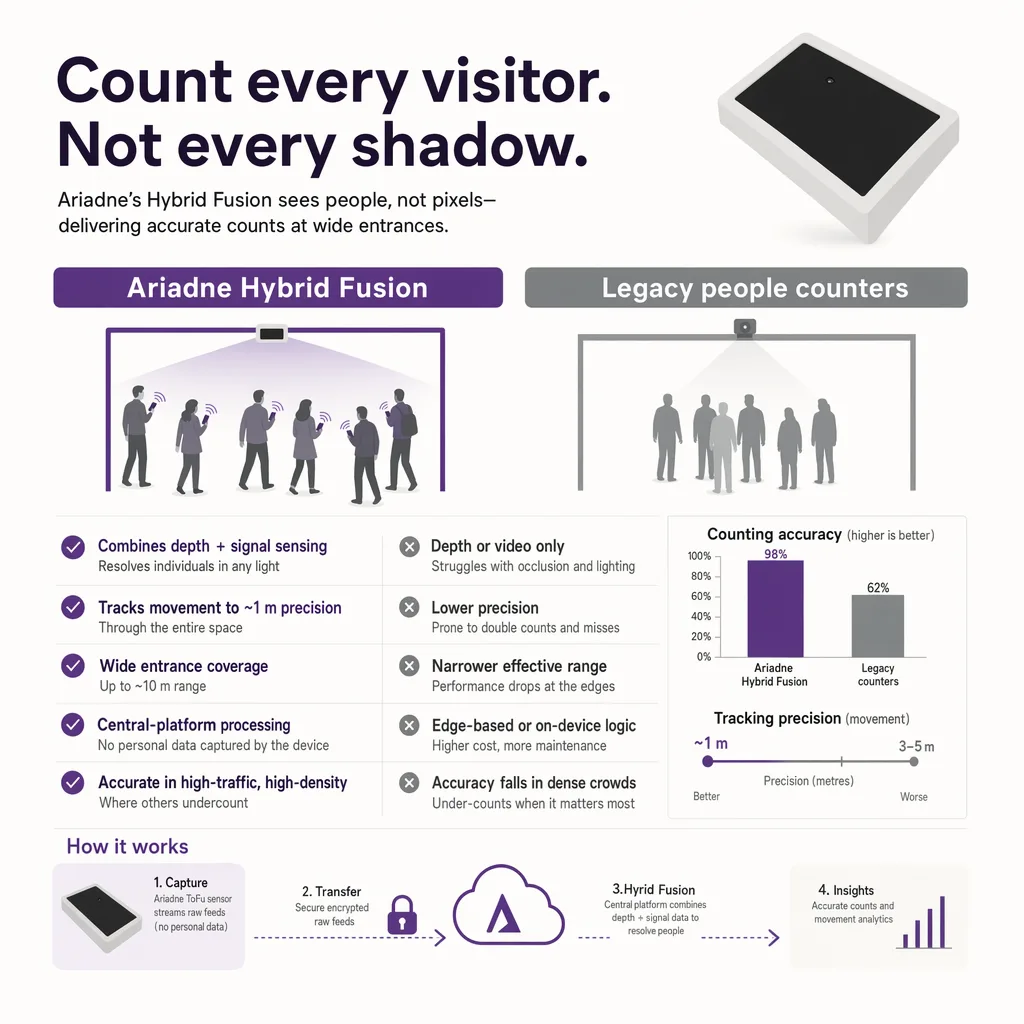
Everything above depends on getting the entrance count right, and the entrance is where the grocery format is hardest. The requirement is a method that resolves two people walking abreast as two, ignores trolleys and bags as not-people, and holds that accuracy as the door gets busier rather than degrading exactly when it matters most. A single beam cannot do this. It is a limitation of what the sensor captures, not something you tune away.
Ariadne measures this with Hybrid Fusion, its patented camera-free method. Time-of-Flight depth sensing counts every visitor at the entrances, capturing geometry rather than images, while patented phone signal sensing follows movement through the interior, detecting the signals a phone emits even in airplane mode, and tracks that movement to about one-metre precision. The sensor streams both feeds to Ariadne, where Hybrid Fusion combines them into one trajectory per visit and computes counts, dwell, and paths. The streams carry no identifier: no MAC address, no device ID, no biometric data, and no camera is involved. Identifiers are stored only when a visitor explicitly opts in, which keeps the method GDPR-friendly and outside biometric territory.
Depth at the door is the part that handles the grocery-specific mess: it sees the height and shape of each body, so a parent and child side by side are two shapes, not one broken line, and a trolley with no human profile is rejected. That is the same group-resolution challenge documented in counting families and groups, and it is the difference between a conversion rate you can trust at peak and one that quietly flatters you on your busiest Saturday.
FAQ
Why is a supermarket entrance hard to count accurately?
Grocery doors are wide automatic openings where people pass side by side, arrive in family groups, and push trolleys. A single-beam counter, which counts breaks in one line, miscounts all of this and miscounts it differently at peak than off-peak. Accurate grocery counting needs depth sensing that resolves separate bodies and rejects trolleys.
How is supermarket conversion different from other retail conversion?
Most grocery shoppers intend to buy, so a low conversion rate usually signals a problem, a queue, an out-of-stock, an abandoned checkout, rather than a casual browser. That makes the entries-to-transactions ratio an operational alarm, not just a marketing metric.
Can people counting help schedule checkout staff?
Yes. An accurate hourly traffic curve shows when the checkout, self-checkout supervision, and counter services actually peak, so you can move existing staff onto those hours instead of scheduling against intuition or a stale curve. The checkout queue is the most visible and most fixable staffing failure in a supermarket.
How does counting grade stores more fairly than turnover?
Turnover rewards location: a busy high-street store out-turns a quiet suburban one regardless of management. Measuring conversion and spend against each store's actual footfall sizes performance by the traffic it really had, separating well-run stores from well-located ones.
Does supermarket people counting use cameras?
No. A camera-free method counts the shapes of people at the door with depth sensing and reads phone signals for interior movement, capturing no image and no identifier. Nothing personal is recorded about any shopper.
Why does the till peak come after the door peak?
Because a grocery shop takes time. A shopper who enters at the evening rush reaches the checkout twenty or thirty minutes later, so the staffed-till demand curve sits shifted later than the entry curve. An accurate hourly entry count lets a manager build that lag into the rota and have tills open before the queue forms rather than after.
Does this apply to a convenience store or only a large supermarket?
This guide is about large-format grocery: wide automatic doors, trolleys, family groups, multiple front-end services. Small-format convenience counting is a different problem with its own quirks and is covered separately in people counting in small-format retail. The accuracy challenge described here is specific to the wide, group-heavy grocery entrance.
---


